The Federal Data Case That Should Be On Every Warehouse Manager's Wall
Start with a number that should reframe how every warehouse worker thinks about their off-shift recovery: musculoskeletal disorders account for approximately 30% of all nonfatal occupational injuries with days away from work across U.S. private industry, according to the Bureau of Labor Statistics Survey of Occupational Injuries and Illnesses. That is not a rounding error. That is the single largest injury category in American workplaces, and warehousing and storage consistently surfaces as one of the highest-rate industries within it.
The mechanics are not mysterious. A standard warehouse shift involves repetitive trunk flexion during picking operations, axial spinal loading while palletizing, sustained awkward postures during inventory tasks, and floor-level retrieval movements that place compressive and shear forces on the lumbar spine hundreds of times per day. Unlike a construction laborer whose injury risk is concentrated in acute high-force events — a sector the BLS Census of Fatal Occupational Injuries (CFOI) documented as recording 1,075 fatal work injuries in 2023, the highest absolute total of any private industry sector — the warehouse worker's injury profile is dominated by cumulative microtrauma. Soft tissue breaks down incrementally. The lumbar erector spinae, the thoracolumbar fascia, the SI joint ligamentous structures: these accumulate stress across a 10-hour shift and are still inflamed when the next shift begins.
That cumulative inflammatory load is exactly where cold-water immersion enters the evidence base — and where it earns its place not as a wellness luxury but as a legitimate occupational recovery tool.
What NIOSH-Cited Research Actually Says About Cold Immersion
The recovery science here is not fringe. NIOSH-cited recovery literature documents that cold-water immersion at 50–59°F (10–15°C) for 10–15 minutes post-exertion reduces delayed-onset muscle soreness and lowers serum creatine kinase markers — creatine kinase being one of the primary enzymatic indicators of muscle tissue breakdown and inflammation. For a warehouse worker whose lumbar extensors, gluteal complex, and hamstring chain are under sustained mechanical stress every working day, reducing that inflammatory marker between shifts is not a performance optimization. It is a damage-control strategy.
The mechanism operates through several pathways. Vasoconstriction during immersion reduces local edema in stressed musculoskeletal tissue. The hydrostatic pressure of full-torso immersion assists lymphatic drainage from lower extremity and lumbar regions — the exact anatomical zones where warehouse workers accumulate the highest inflammatory load. Upon exiting the cold water, the rebound vasodilation drives oxygenated blood back through tissue that has been under ischemic stress. Over time, consistent cold exposure has also been associated with improved parasympathetic tone — the nervous system state that governs tissue repair, sleep quality, and pain modulation.
The practical translation: a 10–15 minute cold plunge at the NIOSH-cited temperature range, performed after the final shift of the workday, interrupts the inflammatory cascade before it compounds into the chronic low-grade lumbar pain that precedes a recordable MSD event.
The Overlooked Heat Exposure Variable
Warehouse environments are not uniformly climate-controlled. Seasonal heat stress is a real occupational variable, particularly in distribution centers without adequate HVAC in loading dock zones. NOAA's workplace heat exposure data documents elevated injury and recovery demand during summer months even for occupations that are only partially outdoor-exposed — a category that directly includes distribution center workers cycling between climate-controlled interiors and loading dock environments.
When a worker is simultaneously managing heat-related physiological stress and cumulative MSD load, the recovery demand is compounded. Core body temperature elevation after an outdoor dock exposure segment impairs the CNS's ability to accurately assess musculoskeletal fatigue, which increases injury risk in subsequent picking operations. Cold plunge use in this context serves a dual function: accelerating thermoregulatory recovery alongside the inflammatory management described above. This is not an ancillary benefit — it is a mechanistically distinct second pathway through which cold immersion earns its place in a warehouse worker's recovery protocol.
What to Actually Look For in a Cold Plunge Built for Daily Use
Most cold plunge marketing is aimed at biohackers, athletes, and wellness consumers. The product language rarely maps onto the needs of a worker doing a physically demanding job six days a week. Here is what actually matters for that use case:
Temperature stability at the NIOSH-cited therapeutic range. The 50–59°F window is not wide. A product that drifts to 65°F on a warm afternoon has lost its therapeutic specificity. Either you invest in a chiller-equipped unit that holds temperature actively, or you commit to a consistent ice-management protocol with a well-insulated barrel.
Water hygiene for daily use. An athlete plunging twice a week can manage water quality manually with relative ease. A worker plunging six days a week in a home environment needs either a filtration and sanitation system or a low-maintenance protocol that does not add recovery overhead.
Ergonomic entry and exit. This sounds trivial until you consider that the target user has a compressed or inflamed lumbar spine after a 10-hour shift. A unit that requires awkward step-up entry or low-clearance positioning can itself be an injury vector. Barrel-style units with high side walls and stable bases are the relevant design consideration here.
Durability for year-round outdoor residential use. Distribution center workers are predominantly working-class households without dedicated wellness spaces. The unit will sit on a back patio or in a garage. UV-resistance, structural integrity in freeze-thaw cycles, and hardware corrosion resistance are non-negotiable durability variables.
The Ice Barrel 400: The Case for the No-Frills Daily Protocol
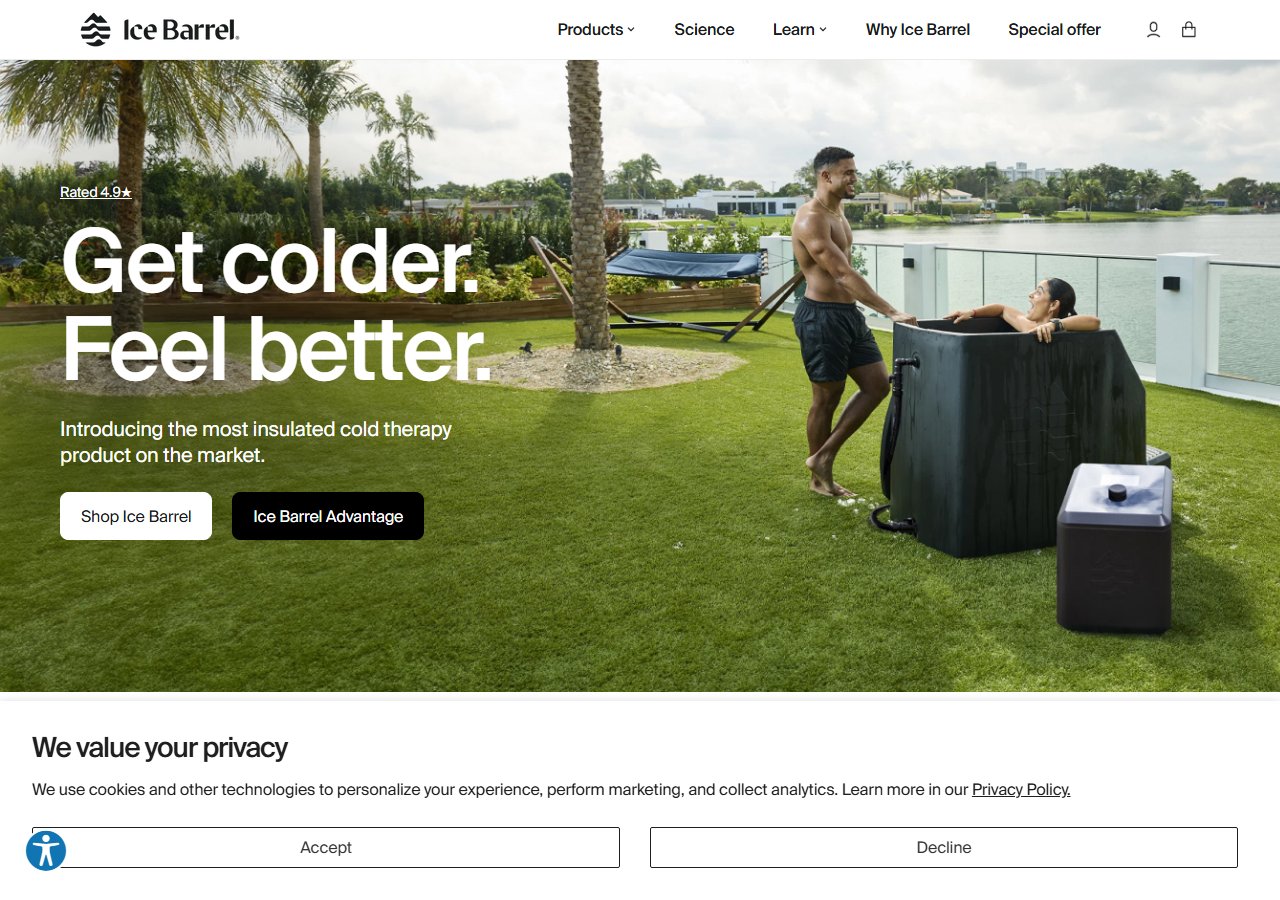
The Ice Barrel 400 is the entry point for warehouse workers who want to commit to the NIOSH-cited recovery protocol without a multi-thousand-dollar capital outlay. At $1,200, it is the most accessible purpose-built cold plunge on this list, and its design philosophy is directly compatible with daily working-class use.
The barrel format accomplishes several things that matter for this specific user. The upright seated immersion posture — torso submerged, knees bent, lumbar spine decompressed — is anatomically ideal for a worker whose primary injury zone is the lower back. Unlike flat-lay tub formats that require hip extension and low back loading to enter and exit, the barrel allows a controlled step-over with both hands available for stabilization. For someone with active lumbar inflammation, that distinction is meaningful.
The 400 model is constructed from UV-stabilized recycled materials and is rated for outdoor residential use year-round. There is no chiller — temperature is managed through ice addition — which means the user controls the protocol directly and the unit requires zero electrical infrastructure. For a worker running a consistent post-shift routine, the ice-management habit is easy to build; most users in moderate climates report reaching the therapeutic range with 20–40 pounds of ice depending on ambient temperature.
The Ice Barrel 400's limitation is obvious: without active chilling, it requires ongoing ice expenditure. In summer months, a daily protocol can cost $10–20/week in ice depending on local pricing. That is a real operational cost to factor against the $1,200 capital investment. But for workers who are evaluating this as a medical expense alternative — against co-pays, physical therapy, or prescription anti-inflammatory costs — the math frequently favors the barrel.
The Sun Home Cold Plunge Pro: When Consistency Demands Automation
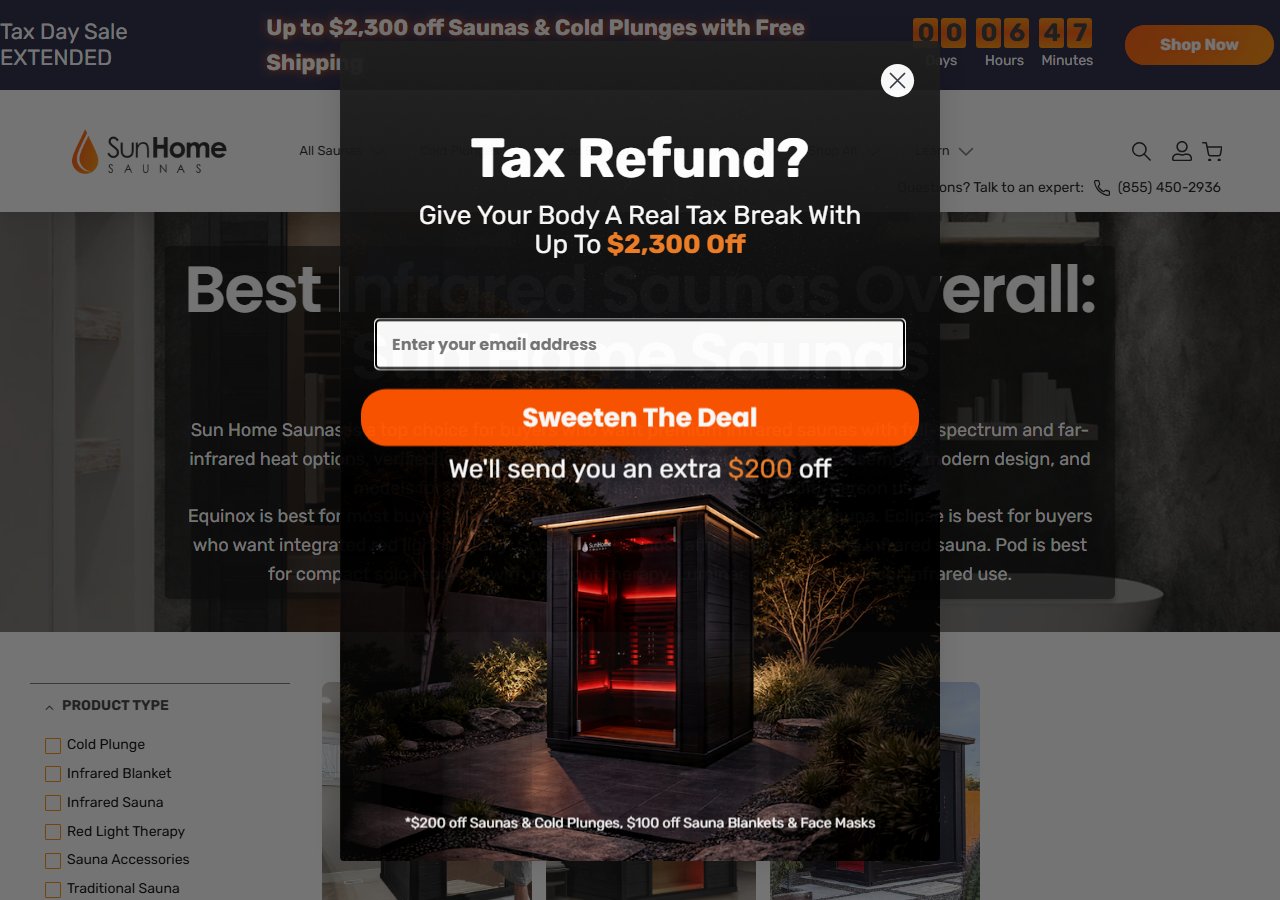
For warehouse workers who cannot afford to let their recovery protocol slip on the days when buying ice feels like too much friction, the Sun Home Cold Plunge Pro solves the consistency problem at a premium price point of $4,499.
This unit's defining feature is its integrated chiller and self-cleaning system — a combination that matters enormously for daily high-frequency use. The chiller maintains water temperature within the NIOSH-cited 50–59°F therapeutic window without any ice management. You set the temperature once. It is at protocol temperature when you arrive home from your shift. The self-cleaning filtration system manages water hygiene automatically, which means the unit supports daily use without the water-change labor that manually-managed tubs require.
The Sun Home Cold Plunge Pro is a serious piece of equipment built for serious recovery frequency. Its stainless steel construction handles year-round outdoor residential exposure, and the insulated cover retains temperature between sessions — reducing the chiller's energy load and extending equipment longevity. For a warehouse worker committed to a six-day-a-week protocol, the per-session cost calculation over a multi-year ownership period narrows the gap with the Ice Barrel 400 considerably when ice costs are factored out.
The genuine limitation is capital access. $4,499 is a significant upfront cost that many hourly workers cannot absorb without financing. That is a structural barrier the data cannot argue away. But for workers with a health savings account, a union benefit package, or household savings capacity, this is the unit that removes every friction point from the daily protocol — which is exactly what compliance with a therapeutic routine requires.
[[mini-list]]
Connecting the Data to the Decision
It is worth being direct about what the federal data is and is not saying. The BLS SOII's documentation of MSDs as approximately 30% of nonfatal occupational injuries with days away from work is a population-level finding. It does not guarantee that any individual warehouse worker will develop a recordable MSD, and no cold plunge will immunize a worker against cumulative musculoskeletal injury caused by poor ergonomic conditions, inadequate rest, or unsupported lifting demands.
What the data does establish is a risk landscape. Warehouse workers operate in a high-MSD-risk occupational category by federal surveillance measure. The NIOSH-cited recovery literature establishes that cold-water immersion at a specific temperature range, applied at a specific duration post-exertion, produces measurable reductions in the inflammatory markers associated with MSD onset. That is an evidence-supported intervention pathway.
The honest framing is this: cold plunge therapy is not a substitute for employer-side ergonomic controls, proper equipment, adequate staffing levels, or occupational health access. But for workers who have limited control over those upstream factors, daily cold immersion is one of the few off-shift interventions with documented physiological mechanism and federal research backing. It is not a miracle. It is a consistent, repeatable, evidence-anchored tool for managing the inflammatory consequences of physically demanding work.
The Investment Framing That Actually Makes Sense
Consider what a single recordable MSD event costs a warehouse worker: typically, lost wages during recovery, reduced earning capacity if the injury becomes chronic, co-pays and out-of-pocket physical therapy costs, and the long-term career risk of a documented musculoskeletal condition in a physically demanding occupation. The NOAA-documented compounding effect of heat exposure on injury risk during summer months adds an additional seasonal vulnerability window.
Against that cost structure, the Ice Barrel 400 at $1,200 or the Sun Home Cold Plunge Pro at $4,499 reads differently than a wellness purchase. This is occupational risk management with a capital equipment price tag. The workers most likely to benefit are those already experiencing the early warning signs — end-of-shift lumbar stiffness, morning soreness that takes more than an hour to resolve, reduced range of motion in trunk flexion — that precede recordable MSD events in federal surveillance data.
Start with the protocol. Commit to the temperature range and duration that the NIOSH literature supports. Pick the unit that matches your capital access and your willingness to manage ice logistics. And treat the investment with the seriousness that 30% of all occupational injuries demands.