One in Five American Adults Goes to Bed Tonight With a Back That Already Hurts
CDC NCHS Data Brief 390 puts a precise number on a condition that feels diffuse and personal: approximately 20% of U.S. adults experience chronic pain, and lower back pain is the single most common location. That is roughly 65 million people whose nights are shaped, disrupted, and in many cases defined by what happens when they lie down. And according to CDC sleep data, 35% of U.S. adults already sleep fewer than 7 hours per night — the threshold associated with elevated chronic disease risk — before you layer chronic pain on top of that deficit.
Those two statistics compound each other in a way that federal healthcare economists understand very well. AHRQ's Hospital Cost data (HCUP) identifies back pain as one of the most expensive conditions in the entire U.S. healthcare system by total inpatient and outpatient expenditure. AHRQ's Medical Expenditure Panel Survey (MEPS) confirms that adults with chronic back conditions carry substantially higher annual personal healthcare costs than adults without such conditions. And CMS drug spending data shows that opioid and non-opioid pain medication spending is among the most expensive Medicare drug categories in the country — a direct downstream consequence of undertreated or improperly managed chronic back pain.
This is not a niche problem. It is a population-level condition with significant economic, occupational, and quality-of-life consequences. The question this article answers is specific: what does the federal evidence base actually say about managing chronic lumbar pain during sleep, and where — precisely — does a sleep surface fit into that hierarchy?
Why Backs Break Down: The Biomechanical and Occupational Mechanism
Before any intervention makes sense, the mechanism needs to be understood. Chronic low back pain is not random. It follows predictable patterns rooted in spinal loading, soft tissue fatigue, and cumulative mechanical stress.
The lumbar spine — the five vertebrae between the thoracic cage and the sacrum — bears the majority of axial load during standing, sitting, lifting, and even lying down. The intervertebral discs that cushion those vertebrae are avascular: they rely on diffusion of nutrients and fluid during periods of unloaded rest (primarily sleep) to maintain hydration and structural integrity. When sleep is disrupted, shortened, or spent in a posture that maintains compressive loading on the lumbar discs, that recovery process is impaired. Over years and decades, disc dehydration, facet joint arthritis, and paraspinal muscle fatigue accumulate into what most patients call chronic back pain.
The BLS Musculoskeletal Disorder tracking data is unambiguous: the back is the most common body part injured across all U.S. occupations with days away from work. That injury pattern is not confined to physically demanding trades. It shows up in warehouse workers, healthcare aides, construction laborers, and office workers alike — anyone whose daily mechanical load on the lumbar spine exceeds what the tissue can repair overnight.
The NIOSH Lifting Equation documents that manual material-handling tasks across warehousing, construction, and healthcare routinely exceed safe spinal compressive force limits. Approximately 25% of U.S. adults report doctor-diagnosed arthritis, with prevalence concentrated in exactly those occupational categories. And SSA Disability Insurance data identifies musculoskeletal disorders — led by back conditions — as the largest single category of new disability claims annually. The pipeline from daily mechanical overload to chronic pain to disability is well-documented at the federal level.
Sleep is the one period in each 24-hour cycle when the spine is horizontal, gravitational compressive load is near zero, and the intervertebral discs can rehydrate. The position in which you sleep, and the surface on which you sleep, determine whether that recovery actually occurs — or whether you spend 7 hours in a posture that maintains stress on already-compromised lumbar structures.
The Free Interventions Come First
The cheapest intervention is the one that requires no purchase. Before any discussion of sleep surfaces, federal evidence supports several zero-cost interventions that address chronic back pain more directly than any mattress can. The goal of this section is not to dismiss sleep surface quality — it genuinely matters — but to establish the correct hierarchy. A new mattress on top of poor sleep position, sedentary days, or inadequate clinical evaluation is an expensive distraction.
Sleep position is the most immediate free variable. NIH's National Institute of Arthritis and Musculoskeletal and Skin Diseases back pain guidance is specific: side-sleeping with a pillow between the knees, or back-sleeping with a pillow under the knees, maintains lumbar neutral alignment. Stomach-sleeping torques the lumbar spine into extension and lateral rotation — a posture that directly compresses facet joints and stresses lumbar musculature throughout the night. For many chronic back pain sufferers, changing sleep position alone produces measurable improvement within days. It costs nothing.
Movement is the second lever. NIH's National Center for Complementary and Integrative Health (NCCIH) evidence review on low back pain is direct: walking 30 minutes most days reduces chronic low back pain as effectively as most non-drug clinical treatments. The mechanism is multifactorial — walking promotes disc nutrition through gentle cyclic loading, strengthens paraspinal musculature, reduces systemic inflammation, and improves sleep quality independently of pain. A new mattress does not generate any of these benefits. Movement does.
Lifting and bending mechanics deserve attention for anyone whose back pain has an occupational component. OSHA's ergonomics guidance is clear: hinge at the hips, not the lumbar spine; keep loads close to the body; avoid twisting under load. Most acute back episodes are mechanical in origin and mechanical in solution. Rehearsing correct movement patterns during waking hours reduces the cumulative load that the spine must recover from during sleep.
Finally, there is the question of whether a mattress replacement is actually warranted at all. CDC sleep hygiene guidance supports replacement when a mattress shows visible sag, when you consistently wake stiffer than you went to bed, or when the mattress is older than 7 to 10 years. These are legitimate clinical signals. In their absence, the issue is more likely sleep position, daytime movement, or clinical pathology — not the sleep surface itself.
For readers who have already addressed sleep position, are walking regularly, and are still waking with lumbar stiffness or pain — and whose mattress is sagging or aged — the sleep surface becomes a legitimate intervention. At that point, the construction characteristics of the mattress matter significantly, and federal data can help frame what to look for.
When to See a Clinician: Red Flags That No Mattress Addresses
A critical constraint before any product discussion: there is a category of back pain for which a mattress is not only irrelevant but potentially dangerous as a distraction. NIH's National Institute of Neurological Disorders and Stroke back pain guidance is explicit about the red flags that require prompt clinical evaluation rather than consumer product research.
Back pain that radiates below the knee — particularly with tingling, numbness, or weakness in the foot or leg — suggests nerve root compression that may require imaging and clinical intervention. Pain that follows trauma (a fall, a motor vehicle accident) needs structural evaluation before any other management. Back pain accompanied by bowel or bladder dysfunction, leg weakness, or fever is a medical emergency. These presentations do not belong in a mattress buying guide.
The AHRQ HCUP data on the total inpatient and outpatient cost of back pain reflects a healthcare system that frequently mismanages chronic lumbar conditions — overtreating some presentations with surgery and undertreating others with passive interventions. Getting the clinical classification right early matters enormously, both for outcomes and for costs.
Where Sleep Surfaces Actually Fit: Construction Characteristics That Match the Biomechanics
For the reader who has already addressed position, movement, and clinical clearance — and whose mattress is legitimately worn — the evidence base supports several specific construction characteristics over generic firmness claims.
The research on firmness for chronic lumbar pain is more nuanced than the retail narrative suggests. A widely cited randomized controlled trial (Kovacs et al., published in The Lancet) found that medium-firm mattresses, not firm mattresses, produced better outcomes for chronic low back pain. The mechanism is straightforward: a surface that is too firm maintains elevated contact pressure at the lumbar curve and the hips, while a surface that is too soft allows the spine to fall into flexion. Medium-firm surfaces distribute pressure evenly, allow the hips and shoulders to sink to the appropriate depth, and maintain lumbar neutral alignment without creating pressure points.
Memory foam surfaces address the pressure-distribution problem directly through viscoelastic contouring. For back pain sufferers with pronounced lumbar curves, significant hip-to-waist differential, or comorbid arthritis (recall: CDC data shows 25% of U.S. adults have doctor-diagnosed arthritis), a surface that conforms precisely to body geometry can meaningfully reduce nocturnal pain. The limitation of memory foam is heat retention — a clinically relevant issue because sleep fragmentation from thermal discomfort reduces the restorative sleep that disc rehydration depends on.
The Saatva Loom & Leaf Memory Foam Mattress addresses both sides of that tradeoff. It is a premium all-foam construction built with high-density memory foam and an organic cotton cover with cooling treatment — engineered specifically to deliver the pressure-conforming properties of memory foam without the heat-trapping that undermines sleep continuity. For the chronic back pain sufferer whose primary complaint is pressure-related pain at the hips and lumbar region, Loom & Leaf's contouring depth and dual-firmness options (Relaxed Firm and Firm) allow matching surface feel to individual body geometry and sleep position. At $1,695–$3,295 depending on size, it is a serious investment; it is also the kind of construction that sleep science supports for this specific presentation.
For readers whose back pain has an occupational component — particularly those whose jobs fall into the BLS high-MSD categories like warehousing, construction, or healthcare — body weight and frame size become biomechanically relevant. Standard mattress coil systems are engineered for a weight distribution assumption that does not apply to larger-framed individuals. When that mismatch occurs, the sleep surface sags unevenly, the lumbar spine loses neutral alignment, and the nocturnal recovery that the spine depends on is compromised. BLS workers' compensation cost data shows that high-MSD industries carry insurance rates 3–5x higher than low-MSD industries — a downstream signal of how much these occupational body demands accumulate over time.
The Saatva HD Mattress was built specifically for this population. Its heavy-duty coil system is engineered for bodies up to 500 pounds, with a support architecture that maintains lumbar alignment under weight distributions that standard mattresses cannot accommodate. For the warehouse worker or construction laborer — someone whose spine is already absorbing compressive forces at or beyond NIOSH-recommended limits during the workday — a sleep surface that genuinely supports rather than sags is not a luxury, it is a recovery tool. Saatva HD runs $2,395–$3,995 depending on size.
The third construction approach worth examining is polymer grid technology, which takes a different route to pressure relief than foam or coil systems. The Purple Hybrid Premier Mattress uses a Purple Grid™ layer — a hyper-elastic polymer structure that instantly adapts to pressure rather than slowly conforming like memory foam. The clinical relevance for back pain sufferers is its behavior at pressure points: the grid collapses where pressure is concentrated (hips, shoulders) while remaining supportive under lower-load areas (lumbar curve). This design avoids the "hammock effect" of soft foam while providing more pressure relief than firm innerspring surfaces. For side-sleeping back pain sufferers in particular — who experience concentrated pressure at the hip and shoulder — the grid's pressure-relief profile matches the biomechanical need. Purple Hybrid Premier ranges from $2,499–$4,799.
Sleep Surfaces Matched to Chronic Lumbar Conditions, by Construction Type
These three mattresses were selected because their construction characteristics directly address the biomechanical variables — pressure distribution, lumbar alignment, and structural support under load — that federal sleep and pain research identifies as most relevant to chronic back pain sufferers.

Saatva Loom & Leaf Memory Foam Mattress
$1,695-$3,295
See Price at Saatva →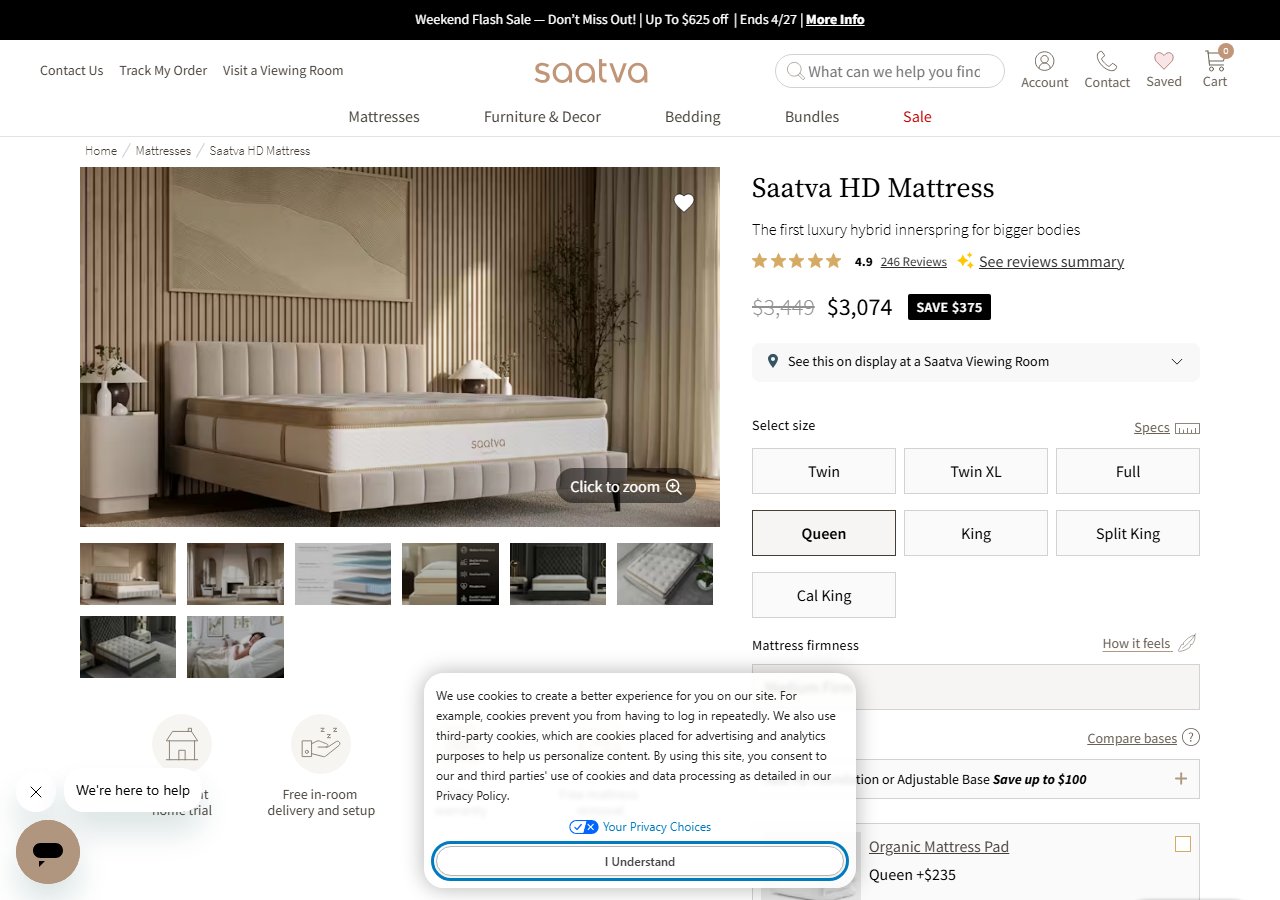
Saatva HD Mattress (Heavy-Duty)
$2,395-$3,995
See Price at Saatva →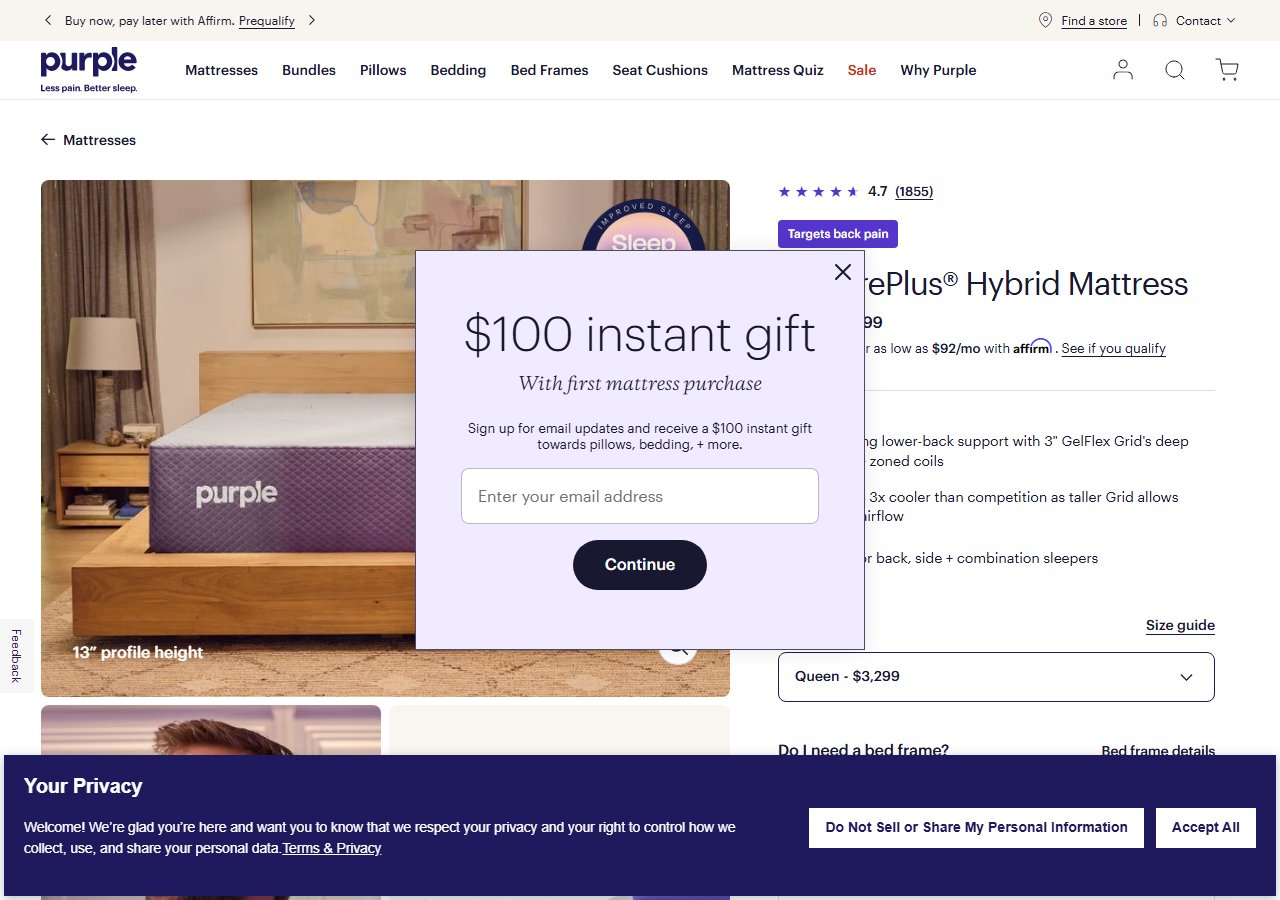
Purple Hybrid Premier Mattress
$2,499-$4,799
See Price at Purple →The Data-to-Intervention-to-Product Hierarchy, Summarized
The federal data on chronic back pain describes a condition that is expensive, prevalent, and systematically undertreated with the right interventions at the right time. CDC's chronic pain data puts 20% of U.S. adults in this category. SSA disability data shows where the trajectory leads when it is poorly managed. AHRQ expenditure data quantifies what the healthcare system spends on the downstream consequences.
The hierarchy that evidence supports is consistent: sleep position first (free, immediate, often highly effective), daily movement second (the intervention with the strongest non-drug evidence base per NIH NCCIH), clinical evaluation for any red-flag presentations, and then — for the reader whose mattress is genuinely worn and whose non-product interventions are already in place — a sleep surface whose construction characteristics match the specific biomechanical demands of their body, sleep position, and pain pattern.
The three surfaces profiled here — Saatva Loom & Leaf for pressure-conforming memory foam, Saatva HD for occupationally-stressed larger-framed sleepers, and Purple Hybrid Premier for polymer-grid pressure relief — were selected because their construction approaches map directly onto what the biomechanical and epidemiological evidence identifies as the relevant variables. They are not a replacement for movement, position, and clinical care. They are the best available hardware for the recovery window that those interventions open up.