One in Five Americans Wakes Up in Pain — and the Numbers Get Worse From There
According to CDC NCHS Data Brief 390, approximately 20% of U.S. adults experience chronic pain, and the lower back is the single most common location. That figure is not a rounding artifact or a statistical curiosity — it represents roughly 50 million people who navigate every workday, every commute, and every attempt at restorative sleep with a lumbar spine that is not cooperating. If you are reading this, you are almost certainly one of them, or you care for someone who is.
The economic footprint of that suffering is staggering. AHRQ HCUP data identifies back pain as one of the most expensive conditions in U.S. healthcare when you sum inpatient and outpatient costs. AHRQ's Medical Expenditure Panel Survey confirms that adults with chronic back conditions spend substantially more on personal healthcare annually than adults without such conditions — a gap that compounds year over year. And at the macro level, the Social Security Administration's Disability Insurance reports show that musculoskeletal disorders are the largest single category of new disability claims filed each year. Chronic back pain is not a lifestyle inconvenience. It is a public health burden with federal accounting to prove it.
What the federal data does not always make explicit — but what biomechanical research fills in — is that approximately one-third of every 24-hour day is spent lying on a sleep surface. That is roughly 2,900 hours per year during which your lumbar spine is either being supported in a neutral position or being torqued, compressed, or allowed to sag into misalignment. For someone managing a chronic lumbar condition, those hours matter enormously. The question this article answers: what does the evidence actually say about optimizing that time?
Why the Lumbar Spine Is So Vulnerable During Sleep
The lumbar spine — the five vertebrae between your ribcage and pelvis — bears the majority of axial load during upright activity and must decompress during recumbency to allow the intervertebral discs to rehydrate. Discs are avascular; they receive nutrition primarily through this nightly fluid exchange. When sleep surface geometry prevents proper spinal unloading, that exchange is impaired. This is not theoretical. It is the mechanical basis for why people with disc pathology report worse morning stiffness after poor sleep.
The problem is compounded by occupational exposure. NIOSH's Lifting Equation documentation shows that manual material-handling tasks across warehousing, construction, and healthcare routinely exceed safe spinal loading limits. Workers in these sectors arrive at bedtime having already stressed spinal structures beyond recommended thresholds. Their discs and facet joints are inflamed, their paraspinal muscles are fatigued, and their connective tissues are carrying accumulated mechanical insult. A sleep surface that cannot offload pressure points — particularly the iliac crests in side-sleepers and the sacrum in back-sleepers — adds to that cumulative burden rather than reversing it.
The occupational data reinforces this. BLS Musculoskeletal Disorder tracking shows the back is the most common body part injured across all U.S. occupations with days away from work. Industries with high MSD incidence carry workers' compensation costs 3–5 times higher than low-MSD industries — a direct financial signal of how widespread and severe the problem is. And CDC arthritis data shows that approximately 25% of U.S. adults report doctor-diagnosed arthritis, with prevalence concentrated in exactly those physically demanding occupations. Arthritis in the facet joints of the lumbar spine is a major driver of position-dependent pain during sleep.
Sleeping itself is not a neutral activity when you have chronic lumbar pathology. Stomach-sleeping places the lumbar spine in sustained extension and cervical rotation simultaneously — a position that compresses facet joints and strains the anterior longitudinal ligament over hours. Side-sleeping without adequate hip and shoulder support creates lateral spinal curvature. Even back-sleeping on an excessively firm or excessively soft surface leaves the lumbar curve unsupported, allowing the paraspinal muscles to fire defensively rather than rest. The mattress is not a cure. But it is a load-management variable that operates every single night.
There is a second, underappreciated mechanism: sleep deprivation and pain amplification. CDC sleep data shows that approximately 35% of U.S. adults report sleeping fewer than 7 hours per night, the threshold below which chronic disease risk — including pain sensitization — rises measurably. Poor sleep increases inflammatory cytokine production and lowers pain thresholds. This creates a bidirectional cycle: back pain disrupts sleep architecture, and sleep disruption lowers the neurological threshold at which pain signals are perceived. You wake more sensitive to the pain that kept you from sleeping well. The sleep surface is the physical environment in which that cycle either worsens or improves.
Try These First — The Cheapest Interventions Are the Free Ones
Before discussing any piece of equipment, a core principle: the cheapest intervention is the one that does not require buying anything. Federal clinical data supports several no-cost interventions that have evidence bases as strong as, or stronger than, any mattress technology on the market. These are not consolation prizes for people who cannot afford equipment. They are genuinely first-line approaches that even people with premium sleep setups should be practicing.
NIH NCCIH's evidence review of low-back pain treatments concludes that walking 30 minutes most days reduces chronic low back pain as effectively as most non-drug clinical treatments. That is a striking finding. The analgesic effect of regular walking comes from several mechanisms: it pumps synovial fluid through facet joints, promotes disc nutrition through spinal loading and unloading cycles, reduces inflammatory cytokines, and strengthens the deep stabilizer muscles (multifidus, transversus abdominis) that protect lumbar structures during dynamic activity. Walking is also the most accessible exercise for people across all fitness levels and most pain presentations.
NIH's guidance on back pain specifically addresses sleep position as the most immediately modifiable variable in nocturnal pain management. Side-sleeping with a pillow between the knees keeps the pelvis level, prevents femoral adduction that torques the sacroiliac joint, and maintains neutral lumbar alignment. Back-sleeping with a pillow under the knees reduces the hip flexor tension that pulls the lumbar spine into extension. Stomach-sleeping is not recommended for anyone with chronic lumbar pathology — the evidence against it is straightforward. These position corrections cost nothing and can be implemented tonight.
OSHA's ergonomics guidance addresses the mechanical origins of most acute back episodes — poor lifting mechanics. Hinging at the hips rather than rounding the lumbar spine, keeping loads close to the body, and eliminating twisting under load are the three pillars of spinal load management during material handling. For workers whose lumbar pathology began as an occupational injury, correcting mechanics during the day reduces the inflammatory load the spine arrives at bedtime carrying. A new mattress cannot undo a day of poor mechanics, but improved mechanics change what the mattress needs to manage overnight.
Finally, CDC sleep hygiene guidance provides a useful threshold for when a mattress replacement is actually warranted: visible sag, consistent morning stiffness worse than bedtime stiffness, or a mattress older than 7–10 years. These are the objective signals that the sleep surface has degraded to the point where it is actively contributing to pain rather than being neutral. Replacing a mattress before these thresholds is a preference decision, not a clinical one.
For readers who have already corrected their sleep position, improved their lifting mechanics, added daily walking, and replaced a clearly degraded mattress — and still wake with significant lumbar pain — equipment becomes a more meaningful variable. The right mattress construction can make a measurable difference in pressure distribution, spinal alignment maintenance, and heat dissipation (which matters because temperature fluctuations during the night alter sleep architecture and increase pain sensitivity). The question becomes which constructions the evidence supports and why.
When to See a Clinician First
A mattress selection guide is the wrong framework if your back pain has features that require medical evaluation. NIH's National Institute of Neurological Disorders and Stroke is explicit: seek prompt clinical evaluation for back pain that radiates below the knee, follows trauma, is accompanied by leg weakness, involves bowel or bladder changes, or occurs alongside fever or unexplained weight loss. These presentations can indicate nerve compression, spinal instability, infection, or malignancy — conditions for which a new sleep surface is not a treatment and for which delayed diagnosis carries real risk.
The cost of untreated serious spinal pathology is not abstract. CMS drug spending data identifies opioid and non-opioid pain medications among the most expensive Medicare drug categories — a downstream consequence of undertreated and mistreated chronic pain conditions. Early clinical evaluation and appropriate imaging, when indicated, can redirect treatment toward interventions with better long-term evidence and lower systemic cost. If you have any of the red flags listed below, the first call is to a physician or physical therapist, not a mattress retailer.
Where the Right Sleep Surface Actually Helps
For readers with mechanical chronic low back pain — the kind without neurological red flags, the kind that responds to position changes and is worse in the morning after poor sleep — mattress construction is a legitimate clinical variable. The evidence base here is more nuanced than most marketing suggests, but several principles hold up under scrutiny.
Firmness is not binary, and medium-firm is not universally correct. The clinical literature on spinal alignment during sleep indicates that the optimal firmness level is body-weight and sleep-position dependent. Heavier individuals and side-sleepers require more conforming surfaces to allow the hip and shoulder to sink adequately, keeping the lumbar spine from laterally deviating. Lighter individuals and back-sleepers can typically tolerate firmer surfaces that provide more active support. The often-repeated recommendation to buy a medium-firm mattress is a reasonable population-level average — not an individualized prescription.
Pressure relief at key contact points reduces nocturnal muscle guarding. The iliac crests, greater trochanters, and sacrum are the primary pressure points for side-sleepers. The sacrum and heels are the primary points for back-sleepers. When a surface cannot adequately distribute pressure at these locations, the paraspinal and gluteal muscles fire defensively to shift load — preventing the deep muscular relaxation that allows the spine to decompress properly. This is the mechanism by which pressure relief translates into pain reduction, not just comfort.
Motion transfer matters for co-sleeping chronic pain patients. If a bed partner's movement repeatedly disrupts sleep architecture, the pain amplification cycle described earlier operates regardless of how well the surface handles pressure distribution. Independently responsive materials — individually wrapped coils, zoned foam layers — reduce transmitted motion and help maintain the deep sleep stages during which pain threshold recovery occurs.
With those principles established, three mattress constructions stand out for chronic lumbar pain management.
The Saatva Loom & Leaf Memory Foam Mattress is the premium memory foam pick for serious back pain sufferers. Its construction uses a multi-layer gel memory foam system with a supportive base that provides the pressure-conforming behavior necessary for side-sleepers with hip and lumbar tenderness, while the base layer maintains enough resistance to prevent the excessive sinkage that misaligns the spine in back-sleepers. The Loom & Leaf comes in two firmness options — Relaxed Firm and Firm — which is a meaningful differentiation for readers who have already learned that their body weight and sleep position require something other than an arbitrary medium-firm. This is a white-glove delivered, domestic-production product built to a specification that reflects actual lumbar support engineering rather than marketing language.
For heavier individuals — specifically those over 230 pounds, a population for whom standard mattress firmness ratings are systematically miscalibrated — the Saatva HD Mattress is the appropriate pick. Standard consumer mattresses are designed and tested for occupants in the 130–200 pound range. For warehouse workers, construction tradespeople, or anyone outside that range who also carries chronic lumbar pathology, a standard mattress compresses to a support profile that was never intended for their body weight. The Saatva HD is engineered with a dual-coil system and high-density foam that maintains its support geometry under greater static and dynamic loads — which means the firmness rating you experience on day one does not degrade to a hammock profile by year two. For this reader, that durability is not a luxury feature. It is the functional requirement.
The Purple Hybrid Premier Mattress takes a fundamentally different engineering approach that is particularly relevant for back pain sufferers who run hot and have found that conventional foam's heat retention disrupts their sleep. Purple's proprietary GelFlex Grid distributes weight across a hyperelastic polymer grid that simultaneously conforms to pressure points (providing the relief mechanism described above) and allows airflow — solving the temperature regulation problem that undermines sleep architecture in many memory foam users. The Hybrid Premier adds pocketed coils beneath the grid for motion isolation and edge support. For readers who have tried traditional memory foam and found it either too hot or insufficiently responsive for position changes during the night, the Purple Hybrid Premier represents a genuinely different construction category worth evaluating.
Sleep Surfaces Engineered for Chronic Lumbar Back Pain
Each of these mattresses was selected for a specific construction reason relevant to chronic lower-back pain sufferers — not general comfort ratings — based on pressure relief geometry, support durability under load, and materials research.

Saatva Loom & Leaf Memory Foam Mattress
$1,695-$3,295
See Price at Saatva →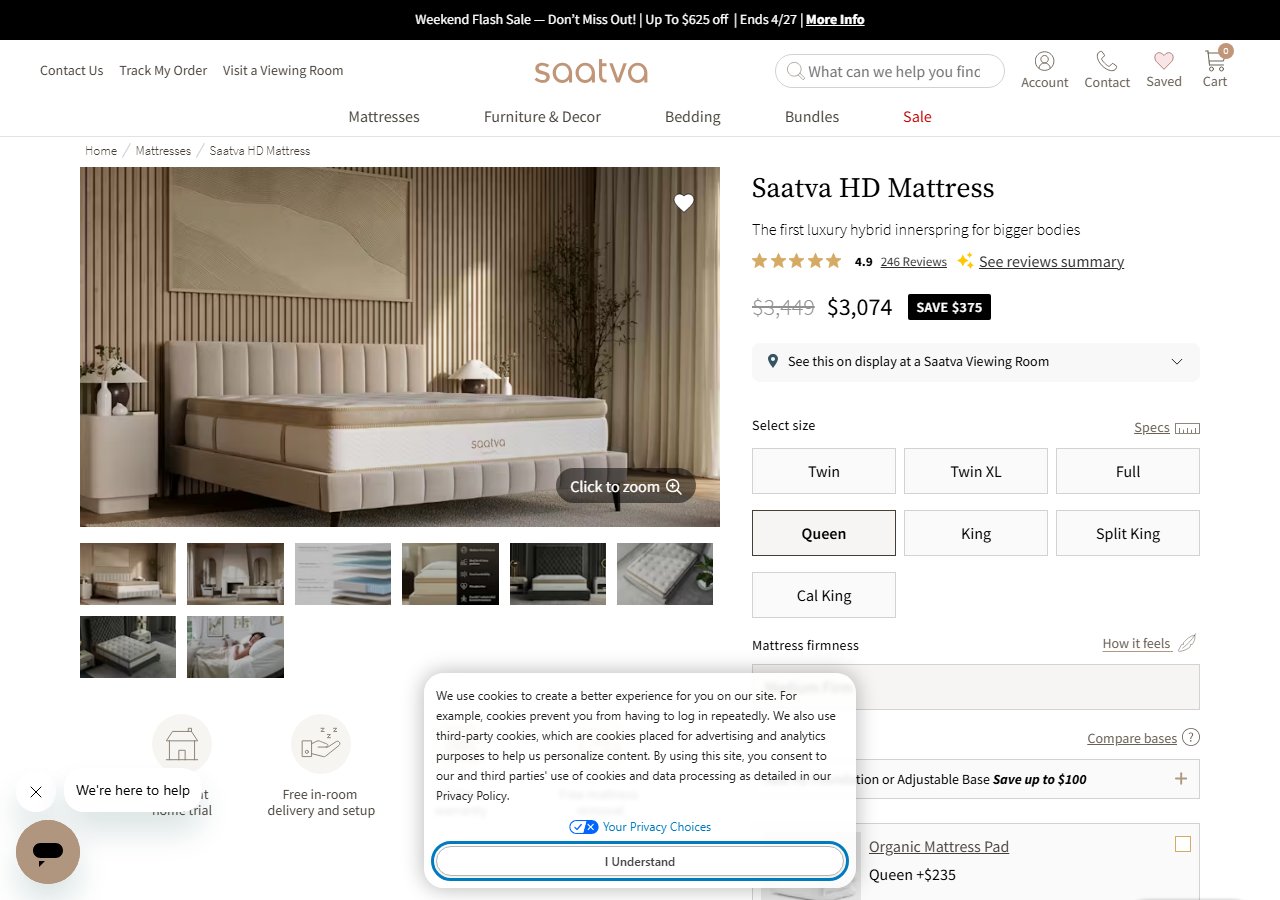
Saatva HD Mattress (Heavy-Duty)
$2,395-$3,995
See Price at Saatva →
Purple Hybrid Premier Mattress
$2,499-$4,799
See Price at Purple →The Data-to-Decision Hierarchy
Chronic back pain is expensive, disabling, and deeply common — federal data from the CDC, AHRQ, BLS, and SSA all confirm this at scale. The $2,000–$4,000 range for a quality sleep surface represents a fraction of the average annual healthcare expenditure differential that AHRQ MEPS documents for adults with chronic back conditions. Framed that way, the economics of a well-matched mattress are not difficult to justify.
But the economics only hold if the mattress is being deployed correctly — after sleep position has been corrected, after movement habits have been established, after lifting mechanics have been improved, and after clinical red flags have been ruled out. A premium sleep surface layered on top of stomach-sleeping, sedentary days, and a spine that has not been evaluated for neurological involvement will not deliver the ROI the data suggests.
The hierarchy is: mechanism first, free interventions second, clinical evaluation when indicated, and then equipment as an adjunct. Every element of that hierarchy is supported by federal data. Follow the data.