One in Five Americans Wakes Up Hurting — Federal Data on Why
CDC NCHS Data Brief 390 puts the number plainly: approximately 20% of U.S. adults experience chronic pain, and the lower back is the single most common location. That is roughly 50 million people who negotiate pain as a daily variable — choosing how to sit, how to stand, how long they can drive, and, critically, how they sleep. The night is not a passive recovery period for people with chronic lumbar conditions. It is eight hours of mechanical loading on a surface that either supports spinal alignment or compounds the dysfunction that began during the day.
The scale of this problem is not abstract. AHRQ HCUP data identifies back pain as one of the most expensive conditions in U.S. healthcare by total inpatient and outpatient cost. AHRQ's Medical Expenditure Panel Survey shows that adults with chronic back conditions spend substantially more on personal healthcare annually than adults without those conditions — a gap driven by imaging, specialist visits, physical therapy, and medication that accumulates over years of undertreated or mistreated pain. Meanwhile, CMS drug spending data identifies opioid and non-opioid pain medication among the most expensive Medicare drug categories, a signal of how systemically undertreated chronic back pain actually is when people do not have access to better interventions earlier in the disease course.
The burden does not stay in the clinic. SSA Disability Insurance reports identify musculoskeletal disorders as the largest single category of new disability claims annually. These are not rare or exotic conditions — they are the accumulated consequence of years of mechanical loading, inadequate recovery, and sleep that fails to offload the spine effectively.
Why Chronic Back Pain Is a Sleep Problem as Much as a Daytime Problem
Understanding why the sleep surface matters requires understanding how chronic lumbar pain works mechanically. The intervertebral discs that cushion your lumbar vertebrae absorb and redistribute compressive load throughout the day. During upright activity — walking, sitting, lifting — those discs are under continuous pressure. Horizontal sleep is theoretically the decompression window: the period during which disc hydration can recover and muscular tension around the lumbar erectors can diminish.
Theoretically. In practice, a sleep surface that allows the hips to sink too far forward (typically too-soft mattresses for heavier individuals) or holds the lumbar spine in lateral flexion (a surface too firm for side sleepers who lack contouring) does not decompress the spine — it loads it in a different plane for eight hours. The morning stiffness that chronic back pain sufferers know intimately is partly this: a night of unrelieved mechanical tension presenting as reduced range of motion and elevated pain sensitivity when upright loading resumes.
BLS Musculoskeletal Disorder tracking confirms that the back is the most common body part injured across all U.S. occupations with days away from work. For people in physically demanding roles — the warehouse associate, the construction laborer, the home health aide — the daytime spinal loading is severe enough that inadequate nighttime recovery compounds rather than resolves the cumulative microtrauma. NIOSH's Lifting Equation documentation establishes that manual material-handling tasks in warehousing, construction, and healthcare routinely exceed safe spinal loading limits — meaning the spine arrives at bedtime already stressed beyond safe parameters.
And the night is not long enough for most Americans. CDC sleep data shows approximately 35% of U.S. adults report sleeping fewer than 7 hours per night, the threshold associated with elevated chronic disease risk. Shorter sleep duration compresses the recovery window further. The interaction between inadequate sleep duration, poor sleep surface mechanics, and daytime spinal loading creates a compounding deficit that no single intervention fully addresses — which is why the approach here prioritizes layering interventions rather than leading with a product purchase.
The Biomechanics of Surface Firmness: What the Evidence Actually Shows
The intuition that firmer mattresses are better for back pain is approximately 40 years old and was never well-supported by controlled evidence. The research that has accumulated since suggests the relationship is more nuanced: medium-firm surfaces consistently outperform very firm surfaces for chronic lumbar pain, likely because medium-firm construction allows enough contouring to reduce pressure at the sacrum and greater trochanter (hip) in side-sleeping positions while maintaining enough resistance to prevent excessive lumbar flexion.
For back sleepers, the calculus differs slightly. A surface that allows mild lumbar contouring — rather than a flat-rigid surface that leaves the natural lumbar curve unsupported — maintains closer to neutral spinal alignment. The pillow-under-the-knees technique (discussed in the interventions section below) amplifies this by reducing hip flexor tension that would otherwise pull the pelvis into anterior tilt.
Body weight is a significant modifier. At higher body weights, a surface that would feel medium-firm to an average-weight sleeper will feel substantially softer — because firmness perception is a function of applied pressure, and heavier individuals compress the surface more deeply. This means firmness recommendations are not transferable across body types: a 130-pound side sleeper and a 280-pound back sleeper have different optimal surface stiffness requirements even if both have chronic lumbar pain.
BLS workers' compensation cost data shows industries with high MSD incidence carry workers' compensation insurance rates 3-5x higher than low-MSD industries. The workers in those industries — and the 50 million Americans with chronic pain broadly — are not well-served by one-size-fits-all product guidance.
Try These First — The Free and Low-Cost Interventions
The cheapest intervention is the one that does not require buying anything. Before evaluating any sleep surface, every chronic back pain sufferer should audit the modifiable variables that cost nothing to change. The evidence base for these is, in several cases, stronger than the evidence base for any specific mattress construction.
Sleep position is the largest free variable. NIH National Institute of Arthritis and Musculoskeletal and Skin Diseases guidance is explicit: side-sleeping with a pillow between the knees, or back-sleeping with a pillow under the knees, maintains closer to neutral spinal alignment than any other common position. Stomach-sleeping places the lumbar spine in sustained extension and rotates the cervical spine laterally — a combination that aggravates rather than relieves chronic lumbar conditions. If you currently sleep on your stomach and have chronic back pain, changing your sleep position is the highest-yield, zero-cost intervention available.
Daily walking is the movement intervention with the strongest evidence base. NIH NCCIH's evidence review on low-back pain concludes that walking 30 minutes most days reduces chronic low back pain as effectively as most non-drug clinical treatments. This is a finding worth sitting with: a free, accessible activity matches the efficacy of physical therapy, massage, and anti-inflammatory medications in head-to-head comparisons. A new mattress does not deliver that level of evidence-backed benefit in isolation.
Lifting and bending mechanics are relevant for the substantial fraction of chronic back pain sufferers whose pain originated in or is aggravated by occupational loading. OSHA's ergonomics guidance specifies hinging at the hips rather than the lumbar spine, keeping loads close to the body, and avoiding twisting under load. Most acute back episodes are mechanical and — critically — rehearsable. Correcting movement mechanics does not eliminate the need for recovery, but it reduces the daily loading that the sleep surface must offset.
When the mattress itself is the problem: CDC sleep hygiene guidance recommends replacing a mattress with visible sag, one that leaves you stiffer than you went to bed, or one older than 7 to 10 years. This is a real and valid trigger for a mattress purchase — but it is distinct from upgrading a functional mattress in hopes of resolving pain that has other causes.
For readers who have already audited their sleep position, replaced a worn mattress, addressed movement mechanics, and still wake with significant lumbar pain — or who carry enough body weight that standard mattresses compress inadequately — the sleep surface construction becomes a meaningful variable. The products below were selected based on how their construction maps to the biomechanical requirements described above.
When to See a Clinician Before Buying Anything
Back pain is the most common musculoskeletal complaint in primary care, and the majority of acute episodes resolve without intervention within six weeks. But a subset of back pain presentations are not mechanical in origin and are not addressable by sleep surface changes. NIH National Institute of Neurological Disorders and Stroke back pain guidance identifies several presentations that require prompt clinical evaluation rather than a mattress upgrade.
If your back pain radiates below the knee, arrives after trauma, accompanies leg weakness, is associated with bowel or bladder changes, or comes with fever, you need imaging and a clinician — not a new sleep surface. These are not presentations where firmness optimization will help. The SSA's disability data on musculoskeletal disorders as the leading driver of new disability claims is, in part, a story about delayed clinical evaluation — people managing symptoms with over-the-counter interventions long past the point where earlier clinical contact would have changed the trajectory.
Approximately 25% of U.S. adults have doctor-diagnosed arthritis, with prevalence concentrated in occupations involving sustained physical demand. Inflammatory arthritis — rheumatoid arthritis, ankylosing spondylitis, psoriatic arthritis — can present with back pain that is worse in the morning and improves with movement, a pattern sometimes mistaken for mattress-related sleep issues. If your morning stiffness lasts more than 45 minutes and improves during the day, discuss this pattern with a rheumatologist before attributing it to your sleep surface.
Where Sleep Surface Construction Actually Helps
For readers who have cleared the clinical threshold — mechanical chronic low back pain without neurological compromise, on a mattress that is worn or biomechanically mismatched — the surface construction matters. Here is how the three products in this article map to the evidence.
The Saatva Loom & Leaf Memory Foam Mattress is the first product to consider for standard-weight adults with chronic lumbar pain who are primarily back or side sleepers. Loom & Leaf is built on a dual-layer memory foam construction — a comfort layer above a high-density support core — with an organic cotton cover and a spinal zone support system that delivers differential firmness under the lumbar region. Available in Relaxed Firm and Firm, it targets the medium-to-firm range that the chronic low back pain evidence most consistently supports. The Relaxed Firm variant is the better choice for side sleepers and those under approximately 200 pounds; the Firm variant suits back sleepers and those who previously found medium mattresses to feel insufficiently supportive. Saatva delivers white-glove to your room and removes the old mattress, which matters for people with limited mobility.
For workers in physically demanding occupations — the warehouse associate whose spine has absorbed NIOSH-documented overloading all week, the construction laborer, the heavier-framed individual for whom standard mattresses compress to the point of bottoming out — the Saatva HD Mattress is the engineering-forward choice. The Saatva HD is built specifically for individuals up to 500 pounds, using a dual tempered steel coil system (a micro-coil comfort layer over an 884-count pocketed coil support core), with a layer of high-density memory foam for contouring. Standard mattresses are engineered for an assumed weight range of roughly 130–230 pounds. Outside that range, both foam and coil systems behave differently than their marketing describes — softer, less supportive, with compression that places the sleeper's lumbar spine in positions no firmness label accurately predicts. The Saatva HD eliminates that mismatch. For any back pain sufferer above 230 pounds, this is the most mechanically honest choice in this article.
The Purple Hybrid Premier Mattress occupies a different engineering niche. Purple's proprietary GelFlex Grid — a hyper-elastic polymer grid rather than conventional foam — redistributes pressure by buckling under direct point loads (bony prominences like the hip and shoulder) while remaining firm under distributed loads (the lumbar and thoracic spine). For chronic back pain sufferers who also experience hip or shoulder pain from their sleep surface, the Purple Hybrid Premier's pressure-relief profile is meaningfully different from memory foam or latex. The pocketed coil support layer beneath the grid maintains spinal alignment while the grid handles the pressure mapping. This is the premium pressure-relief pick for combination sleepers — those who move through back and side positions — where a single-firmness foam solution tends to compromise in one position to optimize for another.
Sleep Surfaces Matched to the Biomechanics of Chronic Back Pain
These three mattresses were selected because their construction — foam layering, coil engineering, or pressure-grid technology — maps directly to the spinal alignment and pressure-relief requirements documented in the chronic back pain evidence base, with options for standard-weight adults, heavier-framed individuals, and combination sleepers.

Saatva Loom & Leaf Memory Foam Mattress
$1,695-$3,295
See Price at Saatva →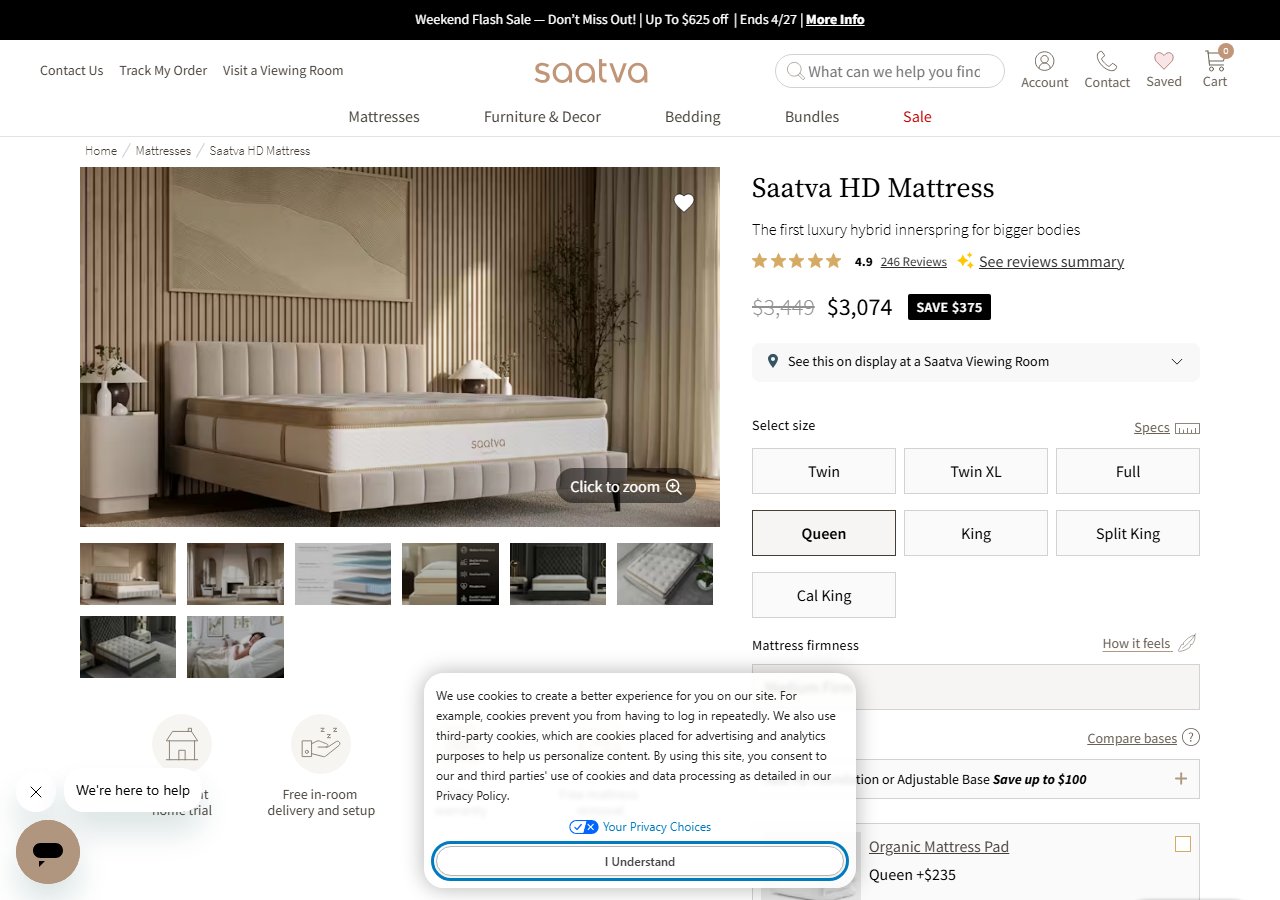
Saatva HD Mattress (Heavy-Duty)
$2,395-$3,995
See Price at Saatva →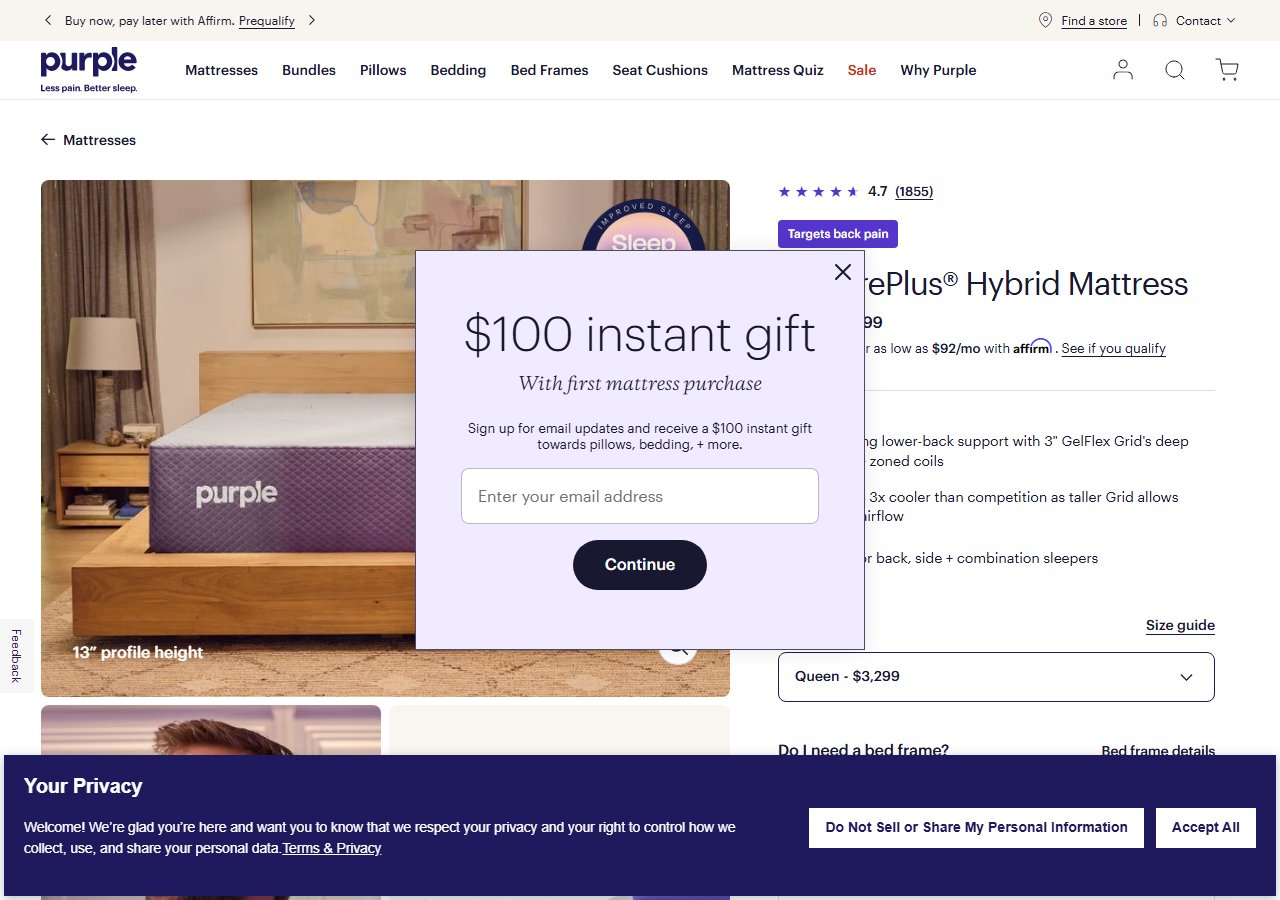
Purple Hybrid Premier Mattress
$2,499-$4,799
See Price at Purple →Pulling It Together: A Data-to-Decision Framework
The federal data assembled here tells a coherent story. Chronic back pain is a population-scale burden — 20% of U.S. adults, the leading musculoskeletal disability category, one of the most expensive conditions in the U.S. healthcare system. It is concentrated in occupations with the highest physical demand, compounded by inadequate sleep duration, and undertreated by a healthcare system that spends heavily on medication rather than prevention and recovery infrastructure.
The decision framework that follows from this evidence is not "buy a better mattress." It is: audit sleep position first (free, high-yield), add 30 minutes of daily walking (free, evidence-backed), address lifting mechanics if occupationally relevant (free, rehearsable), replace a worn or mismatched surface if the mattress itself is the problem (cost-justified), and see a clinician if any neurological red flags are present before spending money on anything else.
Within the subset of cases where a mattress replacement is genuinely indicated, the construction should match the biomechanical requirements: medium-firm for most adults with lumbar pain, body-weight-appropriate engineering for heavier individuals, and pressure-relief orientation for those with concurrent hip or shoulder pain. The Saatva Loom & Leaf, Saatva HD, and Purple Hybrid Premier were selected because their construction specifications map to those requirements — not because they are the most expensive options or the most heavily marketed.
The 50 million Americans managing chronic back pain deserve an evidence hierarchy, not a product catalog. This article has tried to deliver both, in the right order.