One in Five Americans Wakes Up Hurting — and Federal Data Explains Why
According to CDC NCHS Data Brief 390, approximately 20% of U.S. adults live with chronic pain, and the lower back is the single most common pain location in that cohort. That is roughly 65 million people who go to bed every night wondering whether they will wake up feeling worse than when they lay down. The question this article answers is not which mattress to buy. It is: what does the federal data actually say about how sleep surfaces, sleep positions, and daily movement habits interact with chronic lumbar conditions — and how should you sequence your interventions?
The answer, grounded in data from CDC, AHRQ, BLS, NIH, and SSA, is that most people are starting in the wrong place. They are shopping for a mattress before they have addressed sleep position, walking habit, or body mechanics. Those free interventions, documented in peer-reviewed NIH guidance, outperform most passive equipment solutions for the majority of chronic back pain sufferers. A well-chosen sleep surface is a real adjunct — but it is an adjunct.
The scale of the problem is worth dwelling on. AHRQ's Healthcare Cost and Utilization Project (HCUP) identifies back pain as one of the most expensive conditions in U.S. healthcare by total inpatient and outpatient spend — a burden that lands on individuals, employers, and federal programs simultaneously. AHRQ's Medical Expenditure Panel Survey (MEPS) shows that adults with chronic back conditions carry annual personal healthcare expenditures that substantially exceed those of adults without such conditions. Meanwhile, CMS drug spending data places opioid and non-opioid pain medication among the most expensive categories in Medicare drug spending — a proxy for how inadequately the current treatment ecosystem serves this population. When one in five adults is in chronic pain and the dominant treatment response is pharmaceutical, the system is revealing its own gaps. Sleep surface optimization is not a cure, but it sits in a category of non-pharmacological, modifiable environmental factors that federal health agencies consistently recommend exploring.
Why Chronic Back Pain and Sleep Form a Destructive Loop
Understanding the mechanism matters before you reach for a solution. Chronic lumbar pain disrupts sleep architecture. Pain signals interrupt slow-wave and REM sleep, which are the phases most associated with tissue repair and neurological restoration. When sleep quality degrades, pain sensitivity increases — a well-documented phenomenon in pain neuroscience sometimes called central sensitization. The result is a reinforcing cycle: pain impairs sleep, impaired sleep amplifies pain perception, and heightened pain perception makes the next night worse.
CDC sleep and sleep disorders data shows that approximately 35% of U.S. adults already report sleeping fewer than 7 hours per night — the threshold the CDC associates with elevated chronic disease risk. For chronic back pain sufferers, the baseline sleep deficit is frequently worse. They are starting from a compromised position before occupational stressors are even introduced.
For workers in physically demanding occupations, the compounding is severe. BLS Musculoskeletal Disorders by Occupation tracking identifies the back as the most commonly injured body part across all U.S. occupations with days away from work. The NIOSH Lifting Equation documents that manual material-handling tasks in warehousing, construction, and healthcare routinely exceed safe spinal loading limits — meaning millions of workers are accumulating vertebral microtrauma during the day and then asking damaged tissue to recover on whatever sleep surface they happen to own. BLS Employer Costs for Employee Compensation data shows industries with high MSD incidence carry workers' compensation insurance rates 3 to 5 times higher than low-MSD industries, which tells you what actuaries think about the risk these jobs pose to spinal health.
The picture is not limited to blue-collar workers. CDC Arthritis data shows approximately 25% of U.S. adults report doctor-diagnosed arthritis, with prevalence concentrated in occupations involving sustained physical demand. Arthritis in the facet joints of the lumbar spine is a direct contributor to sleep disruption — the joints stiffen overnight when held in one position too long, driving people to shift, wake, and lose restorative sleep. This is exactly the mechanism where sleep surface characteristics become relevant: a surface that distributes pressure unevenly forces more positional shifts and more micro-arousals.
SSA Disability Insurance data provides perhaps the starkest single data point: musculoskeletal disorders are the largest single category of new disability claims filed annually. Back pain is not a minor inconvenience. It is the condition most likely to end a working career prematurely in the United States. That context should inform how seriously people take every modifiable variable — including sleep environment.
The Biomechanics of a Bad Night's Sleep
To understand why mattress firmness and sleep position matter for lumbar health specifically, you have to understand what happens to the lumbar spine during recumbency. In an upright position, the lumbar spine maintains a natural inward curve (lordosis). When you lie down, gravity and muscle relaxation change the load profile. The goal of a sleep surface is to support that natural lordosis without either over-correcting (too firm, which creates pressure points at hips and shoulders that force the spine to sag) or under-correcting (too soft, which allows the spine to slump into flexion).
For side sleepers — the position that most orthopedic and pain specialists recommend — the mattress must accommodate the wider profile of the hips while keeping the shoulder from driving lateral spinal flexion. A mattress that is too firm creates a pressure canyon at the hip; one that is too soft lets the hip sink so far that the lumbar spine curves laterally. Neither is neutral.
For back sleepers, the lumbar spine is most vulnerable at the space between L4-L5 and L5-S1, the two discs most frequently implicated in chronic low back pain and radiculopathy. A mattress that is too firm leaves the lumbar spine unsupported across that gap; one that is too soft lets the pelvis sink and the lumbar spine flex into kyphosis. Medium-firm support with targeted lumbar fill — a construction detail present in better-designed mattresses — is the evidence-cited sweet spot for this sleep position.
Stomach sleeping is categorically problematic for lumbar health. It forces the lumbar spine into hyperextension, compresses facet joints, and torques the cervical spine. NIH National Institute of Arthritis and Musculoskeletal and Skin Diseases guidance specifically identifies stomach sleeping as a position that worsens chronic back pain — and no mattress engineering solves a fundamentally damaging position.
Try These First — Free Interventions That Federal Research Supports
The cheapest intervention is the one that does not require buying anything. Before you spend $1,700 to $4,800 on a new sleep surface, work through this sequence. These are not placebo recommendations — they are drawn directly from NIH, CDC, and OSHA guidance, the same agencies that back pain researchers cite in clinical literature.
Sleep position is the most impactful free variable most people have never deliberately managed. NIH National Institute of Arthritis and Musculoskeletal and Skin Diseases back pain guidance specifies: side-sleeping with a pillow between the knees, or back-sleeping with a pillow under the knees, keeps the spine in a neutral position through the night. These positions are not difficult to learn. A standard pillow positioned correctly costs nothing if you already own one. Eliminating stomach sleeping alone has been shown in NIH-cited research to reduce morning lumbar stiffness in patients with chronic lower back conditions.
Daily walking is the single most underrated intervention in this space. NIH NCCIH's evidence review on low back pain concludes that walking 30 minutes most days reduces chronic low back pain as effectively as most non-drug clinical treatments. The mechanism is partly biomechanical — walking rehydrates intervertebral discs through the pump-like loading cycle of gait — and partly neurological, engaging descending pain inhibition pathways. The evidence for a new mattress improving back pain is real but modest; the evidence for 30 minutes of daily walking is robust and free.
Lifting and bending mechanics matter acutely for the large portion of this readership that engages in manual material handling at work. OSHA ergonomics guidance is specific: hinge at the hips, not the lumbar spine; keep loads close to the body; avoid twisting under load. Most acute back episodes that become chronic are mechanical in origin — a pattern rehearsed over months or years before the disc or facet joint finally protests loudly. Correcting mechanics is not glamorous, but it is the intervention that prevents the injury that the sleep surface is later asked to help recover from.
Mattress replacement timing is a decision point that requires honest evaluation. CDC sleep hygiene guidance and occupational health consensus align on the indicators: visible sag, waking stiffer than you went to bed, or a mattress older than 7 to 10 years. If none of these conditions apply, a new mattress may not be the variable to change.
For readers who have genuinely worked through the above — corrected sleep position, added daily walking, addressed lifting mechanics, and confirmed their current mattress is past its functional life — the next question is what construction characteristics the research supports. That is where specific products enter the conversation.
When to See a Clinician Before Changing Anything Else
Not every presentation of back pain is a sleep surface problem. Some presentations require clinical evaluation before any environmental modification, and proceeding without evaluation can delay diagnosis of conditions that worsen without treatment. NIH National Institute of Neurological Disorders and Stroke back pain guidance identifies specific red flags that should prompt immediate clinical contact rather than a mattress purchase.
The critical distinction is between mechanical back pain — which is responsive to position, movement, and load management — and back pain that may have a neurological, infectious, neoplastic, or vascular origin. A new sleep surface is an appropriate adjunct for the former; it is irrelevant and potentially delay-inducing for the latter. If your back pain radiates below the knee, emerged after trauma, is accompanied by leg weakness, involves bowel or bladder changes, or comes with fever or unexplained weight loss, stop optimizing your sleep environment and see a clinician. These are not edge cases; they are the diagnostic criteria that separate modifiable back pain from conditions that require imaging and specialist evaluation.
Clinical red flags are listed in the section below. The investment in a premium sleep surface only makes sense when these flags have been ruled out.
What Federal Data Actually Supports in a Sleep Surface
For the reader who has addressed sleep position, maintains a walking habit, manages occupational load mechanics correctly, and is evaluating a sleep surface that is visibly sagging or older than a decade — here is what the evidence-informed construction criteria look like.
Medium-firm to firm support with targeted pressure relief is the consistent recommendation in the orthopedic and sleep research literature for chronic lumbar pain. The reasoning maps to the biomechanics described earlier: enough support to maintain lumbar lordosis, enough contouring to prevent pressure buildups at the hips and shoulders that trigger position shifts. Hybrid constructions — foam or latex comfort layers over pocketed coil support cores — generally perform well for back pain sufferers because the coils provide zoned support while the comfort layer handles pressure distribution.
For chronic back pain sufferers with standard body proportions, the Saatva Loom & Leaf Memory Foam Mattress is the premium memory foam option engineered specifically around lumbar support. Its gel-infused memory foam construction addresses the thermal complaints that keep many back pain sufferers from sleeping through the night on traditional memory foam, and the dual-layer spinal zone technology directly targets the L4-L5 support gap that is most critical for lumbar pain management. The Loom & Leaf comes in Relaxed Firm (5 out of 10) and Firm (8 out of 10) — both appropriate for back sleepers and side sleepers with chronic lumbar conditions; the Firm variant is better suited to heavier builds and strict back sleepers.
For workers in warehousing, construction, or any occupation involving sustained heavy physical demand — populations where the NIOSH Lifting Equation and BLS injury data converge on elevated spinal load risk — the Saatva HD Mattress is purpose-engineered for higher body weights and heavier recovery demands. Its dual tempered steel coil system and high-density foam perimeter deliver the support depth that standard mattress constructions cannot sustain for larger frames. The HD is not a marketing classification; it is a distinct structural specification designed for the load profiles that standard mattresses degrade under in 3 to 5 years.
For back pain sufferers whose primary complaint is pressure-point disruption — who wake repeatedly because hip or shoulder pain forces position changes — the Purple Hybrid Premier Mattress addresses that specific failure mode through its GelFlex Grid technology. Unlike foam, the Grid actively responds to pressure by collapsing under bony prominences while supporting surrounding tissue, which means less peak pressure at the hip trochanter and glenohumeral joint for side sleepers. The coil base layer provides the lumbar support depth that pure foam struggles to deliver. The Purple Hybrid Premier is the pressure-relief-prioritized pick in this group; it is particularly relevant for back pain sufferers who also have hip pain or shoulder pain that complicates their sleep position options.
Sleep Surfaces Built for Chronic Back Pain — Evidence-Informed Picks
Each mattress below was selected for construction characteristics that map to the specific biomechanical demands of chronic lumbar pain: zoned support, pressure distribution, and structural durability under sustained nightly load.

Saatva Loom & Leaf Memory Foam Mattress
$1,695-$3,295
See Price at Saatva →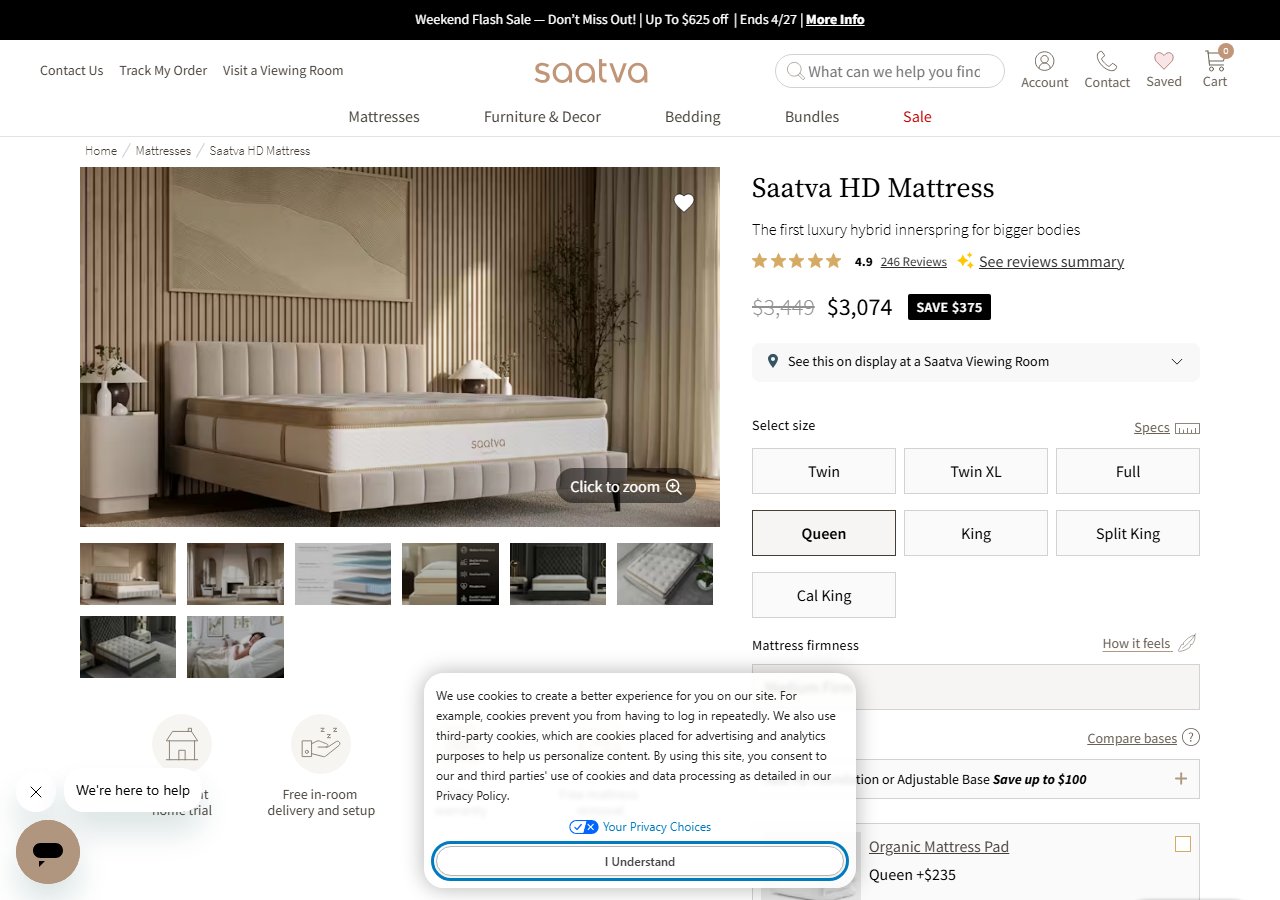
Saatva HD Mattress (Heavy-Duty)
$2,395-$3,995
See Price at Saatva →
Purple Hybrid Premier Mattress
$2,499-$4,799
See Price at Purple →The Hierarchy That Federal Data Supports
The through-line of every federal data source cited in this article is that chronic back pain is a systemic problem with systemic causes — occupational load exposure, inadequate physical activity, poor sleep hygiene, insufficient clinical management — and that no single product purchase interrupts that system meaningfully on its own. SSA disability data shows musculoskeletal disorders ending working careers. AHRQ MEPS data shows the personal financial drain on affected adults. CMS drug spending data shows billions spent on pain medication that manages symptoms without addressing causes.
A well-constructed sleep surface — one that maintains lumbar lordosis, distributes pressure at the hips and shoulders, and sustains those properties over years of use — is a real, non-pharmacological intervention that reduces the nightly accumulation of spinal stress for the 65 million Americans living with chronic lower back pain. It belongs in the toolkit. It does not replace the toolkit.
Start with sleep position. Add daily walking. Correct your lifting mechanics. Rule out clinical red flags with a provider. Then, if your current mattress is objectively degraded, evaluate the construction characteristics that the research supports. In that sequence, a sleep surface investment is defensible. Out of that sequence, it is a $2,000 hope.
The federal data is not ambiguous about what helps. The question is whether you apply it in the right order.