One in Five Americans Wakes Up in Pain — Federal Data Explains Why
The number is not anecdotal. CDC NHANES survey data documents that approximately 20% of U.S. adults experience chronic pain, and the lower back is the single most common location. That is roughly 65 million Americans managing lumbar pain across every waking hour — and across every sleeping hour too. The connection between nighttime sleep surface and daytime pain is not marketing copy; it is biomechanics with a federal data trail behind it.
The economic signal reinforces the scale of the problem. AHRQ's Hospital Cost and Utilization Project (HCUP) identifies back pain as one of the most expensive conditions in U.S. healthcare by total inpatient and outpatient cost. AHRQ's Medical Expenditure Panel Survey (MEPS) shows that annual personal healthcare expenditures for adults with chronic back conditions substantially exceed costs for adults without such conditions. And CMS drug spending data identifies opioid and non-opioid pain medication spending among the most expensive Medicare drug categories — a direct reflection of how chronically undertreated this condition remains despite enormous resource consumption.
The workforce dimension compounds the clinical one. BLS Musculoskeletal Disorders by Occupation tracking confirms that the back is the most common body part injured across all U.S. occupations with days away from work. The NIOSH Lifting Equation documents that manual material-handling tasks across warehousing, construction, and healthcare routinely exceed safe spinal loading limits — meaning millions of workers accumulate lumbar stress during work hours and then ask an inadequate sleep surface to undo it overnight. They cannot. The SSA Disability Insurance data is the downstream consequence: musculoskeletal disorders represent the largest single category of new disability claims filed annually. Back pain is not a lifestyle inconvenience. It is a disability pipeline.
Why Chronic Back Pain and Sleep Are Biomechanically Linked
Understanding why the sleep surface matters requires understanding what chronic lumbar pain actually is at the tissue level. The lumbar spine — the five vertebrae of the lower back — bears the cumulative compressive load of an upright human life. Intervertebral discs act as hydraulic shock absorbers, but they are avascular: they receive nutrition and hydration primarily through diffusion during recumbency. Sleep is not passive downtime for the spine. It is the primary recovery window during which discs rehydrate, inflammatory cytokines are partially cleared, and paraspinal muscles release sustained contraction.
When the sleep surface fails to maintain spinal neutrality, that recovery window is sabotaged. A surface that is too soft allows the pelvis to sink, creating an exaggerated lumbar lordosis that places sustained posterior disc pressure through the night. A surface that is too firm creates bridging at the natural lumbar curve, leaving unsupported paraspinal muscles in sustained contraction. Neither scenario allows the disc rehydration and inflammatory clearance that nocturnal recumbency is supposed to provide.
This is why CDC sleep data showing that 35% of U.S. adults sleep fewer than 7 hours per night is particularly alarming for back pain sufferers. Inadequate sleep duration compounds inadequate sleep quality — and for the population managing lumbar conditions, shortened recovery windows mean less disc rehydration per 24-hour cycle. The research literature on sleep and chronic pain is bidirectional: pain disrupts sleep, and poor sleep amplifies pain perception through central sensitization pathways. The relationship is a loop, not a line.
Among the 25% of U.S. adults with doctor-diagnosed arthritis — a condition concentrated in physically demanding occupations — this nocturnal biomechanical failure is particularly consequential. Inflammatory arthritis of the facet joints produces morning stiffness that is directly proportional to how poorly the spine was positioned during sleep. Waking stiffer than you went to bed is not random: it is a measurable signal that the recovery window was corrupted.
Try These First — Free Interventions With Federal Evidence Behind Them
Before we discuss sleep surfaces, a foundational point: the cheapest intervention is the one that does not require buying anything. Federal research documents several approaches that demonstrably reduce chronic low back pain and cost nothing beyond behavioral change. These are not consolation prizes for people who cannot afford good equipment. They are first-line interventions that the evidence supports regardless of budget.
Sleep position is the most immediately controllable variable for any back pain sufferer. NIH guidance from the National Institute of Arthritis and Musculoskeletal and Skin Diseases is specific: side-sleeping with a pillow between the knees keeps the pelvis level and maintains lumbar neutrality. Back-sleeping with a pillow under the knees reduces lumbar lordosis and disc pressure. Stomach-sleeping is the one position with consistent evidence of harm — it requires the lumbar spine to hyperextend and the cervical spine to rotate for hours at a time, compounding rather than relieving pain. If you currently sleep on your stomach and you have chronic lower back pain, position change alone may produce measurable morning improvement before you purchase anything.
Daily walking has a stronger evidence base for chronic low back pain than most people realize. NIH's National Center for Complementary and Integrative Health (NCCIH) evidence review concludes that walking 30 minutes most days reduces chronic low back pain as effectively as most non-drug clinical treatments. The mechanism involves both the biomechanical loading of the lumbar spine in a healthy, dynamic pattern (promoting disc nutrition) and the systemic anti-inflammatory effect of moderate aerobic activity. A new sleep surface helps. Movement is the primary lever.
Lifting and bending mechanics matter because most acute-on-chronic back episodes are mechanical and rehearsable. OSHA's ergonomic guidance specifies hinging at the hips rather than the lumbar spine, keeping loads close to the body, and avoiding spinal rotation under load. For workers in industries where the NIOSH Lifting Equation documents routine exceedance of safe spinal loading — warehousing, construction, healthcare — building this movement pattern reduces the cumulative daytime injury load that the sleep surface then has to help recover from overnight.
Mattress replacement timing is also a behavioral decision, not a product decision. CDC sleep hygiene guidance reinforces what sleep medicine clinicians observe: replace a mattress if it has visible sag, if you wake stiffer than you went to bed, or if it is older than 7 to 10 years. Even the most expensive mattress on the market does not compensate for poor sleep hygiene, insufficient sleep duration, or sedentary daytime patterns. The surface is a recovery tool. It cannot do the rest of the work for you.
For readers who have already adjusted sleep position, added daily walking, and addressed lifting mechanics — and still wake in significant lumbar pain — the sleep surface itself is a legitimate variable worth investing in. The biomechanics described above are real, and when the mattress is visibly sagging, structurally compromised, or simply not providing lumbar support at the correct firmness level, no behavioral intervention fully compensates. The rest of this article addresses what the evidence and engineering say about sleep surfaces for chronic lumbar conditions.
When to See a Clinician — Red Flags That Require Referral, Not a New Mattress
Chromic lower back pain is common and largely self-managed, but a subset of presentations require imaging and clinical evaluation before any sleep surface adjustment is relevant. Understanding where that line falls protects you from managing a serious condition as a comfort problem.
NIH guidance from the National Institute of Neurological Disorders and Stroke is specific about red flags: back pain that radiates below the knee suggests nerve root compression that a firmer mattress will not resolve. Pain following trauma, pain accompanied by leg weakness or numbness, and pain associated with bowel or bladder changes are neurological or structural emergencies. Fever with back pain suggests infection. Weight loss with back pain in older adults warrants malignancy workup. None of these conditions are sleep-surface problems. Treating them as comfort issues delays diagnosis and can result in permanent neurological injury.
For the much larger population with mechanical lower back pain — diffuse lumbar aching, morning stiffness that improves with movement, pain that worsens with prolonged sitting or specific positions — the sleep surface is a legitimate therapeutic variable. That is the population this article addresses.
medium-firm because it sounds right
leaves clinical value on the table. The research literature — and the federal biomechanical guidance — points toward a position-specific framework. **Back sleepers with chronic lumbar pain** generally do best on medium-firm to firm surfaces. The goal is preventing pelvic sinkage while allowing the natural lumbar curve to be supported rather than bridged. A pillow under the knees (per [NIH guidance](https://www.niams.nih.gov/health-topics/back-pain)) reduces lumbar disc pressure even on a properly firm surface. **Side sleepers with lumbar pain** need a surface that allows shoulder and hip to sink slightly while the waist zone remains supported. If the shoulder cannot sink, the spine laterally flexes toward the ceiling; if the hip sinks too far, it does the same in the opposite direction. Medium firmness with zonal pressure differentiation — or a grid-based material like Purple's — best serves this geometry. **Combination sleepers** managing chronic pain are the most challenging population. They need a surface that handles multiple positions without failing any of them. The Loom & Leaf's Relaxed Firm option and the Purple Hybrid Premier's grid construction both accommodate position transitions better than single-firmness foam slabs. For workers with [arthritis](https://www.cdc.gov/arthritis/data_statistics/) — particularly those in the 25% of U.S. adults with doctor-diagnosed arthritis whose occupations involve physical demand — morning stiffness is the primary outcome measure. The sleep surface should be evaluated by one metric above all others: do you wake stiffer than you went to bed? If yes after at least two weeks on a given surface, that firmness is likely wrong for your spinal geometry. ## The Data-to-Decision Hierarchy for Chronic Back Pain Sufferers [BLS data](https://www.bls.gov/news.release/ecec.toc.htm) showing that high-MSD industries carry workers' compensation rates 3–5x higher than low-MSD industries is a system-level signal about how common and costly back injury is across the U.S. workforce. [SSA Disability Insurance data](https://www.ssa.gov/policy/docs/statcomps/di_asr/) documents where that trajectory ends for many workers: musculoskeletal disorders are the single largest category of new disability claims filed each year. The clinical and economic stakes of chronic back pain management are not trivial. The intervention hierarchy that federal data supports is clear: **sleep position first** (free, high-impact, often underutilized), **daily movement second** (free, evidence-supported by NCCIH), **lifting mechanics third** (behavioral, OSHA-documented), **sleep surface evaluation fourth** (replace when sag or structural failure is evident), and **clinical referral for any red-flag symptoms** (non-negotiable before any product decision). Sleep surfaces with genuine lumbar engineering — the Loom & Leaf's spinal zone support system, the HD's heavy-duty coil construction for high-load occupational bodies, the Purple Hybrid Premier's pressure-differentiating grid — are legitimate tools in that hierarchy. They are not the first tool, and they are not a substitute for movement, sleep position, and clinical care. But for the 65 million Americans managing chronic lower back pain, they are a nightly variable that can be optimized. Federal data documents both the problem and the biomechanical pathway to address it. The rest is execution.

Saatva Loom & Leaf Memory Foam Mattress
$1,695-$3,295
See Price at Saatva →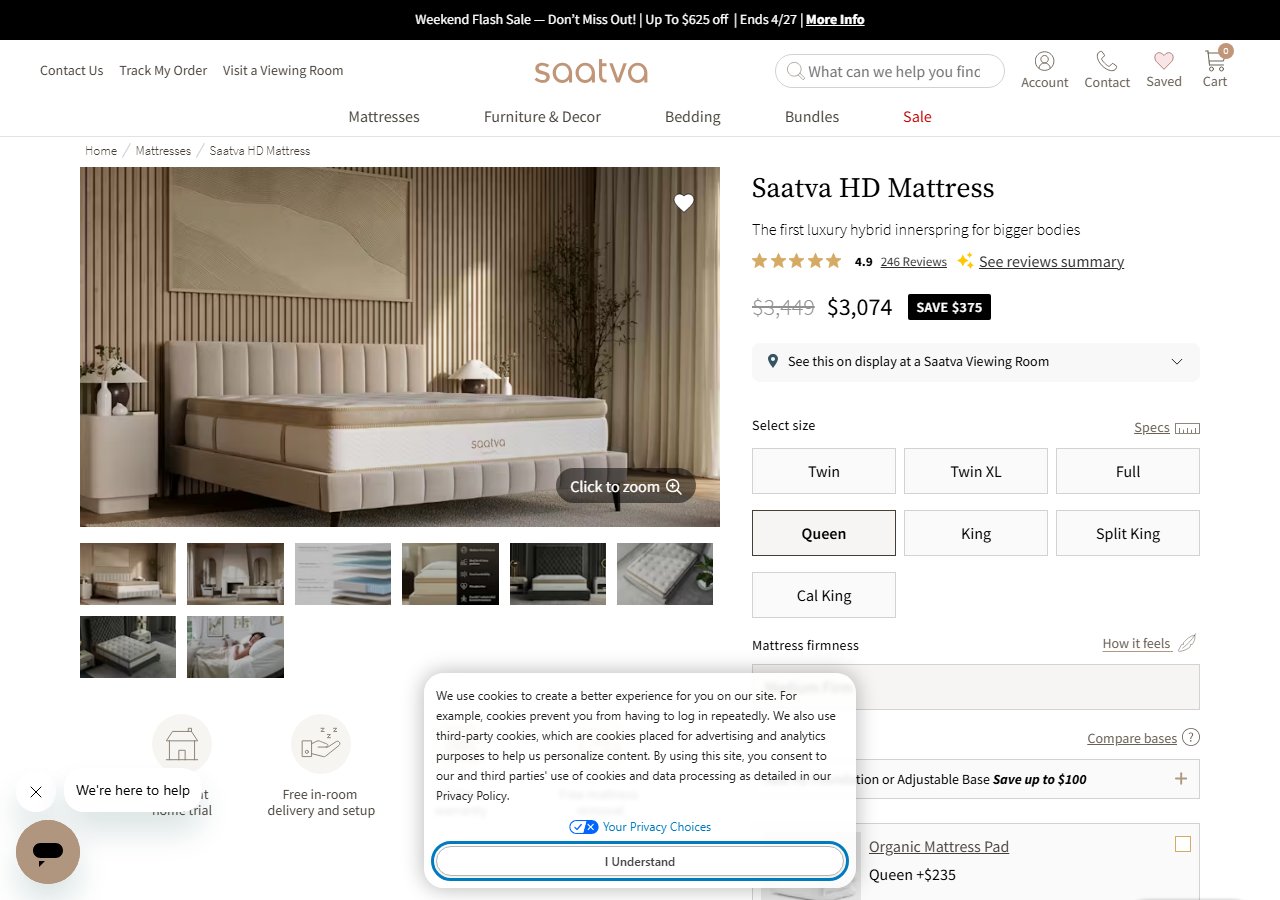
Saatva HD Mattress (Heavy-Duty)
$2,395-$3,995
See Price at Saatva →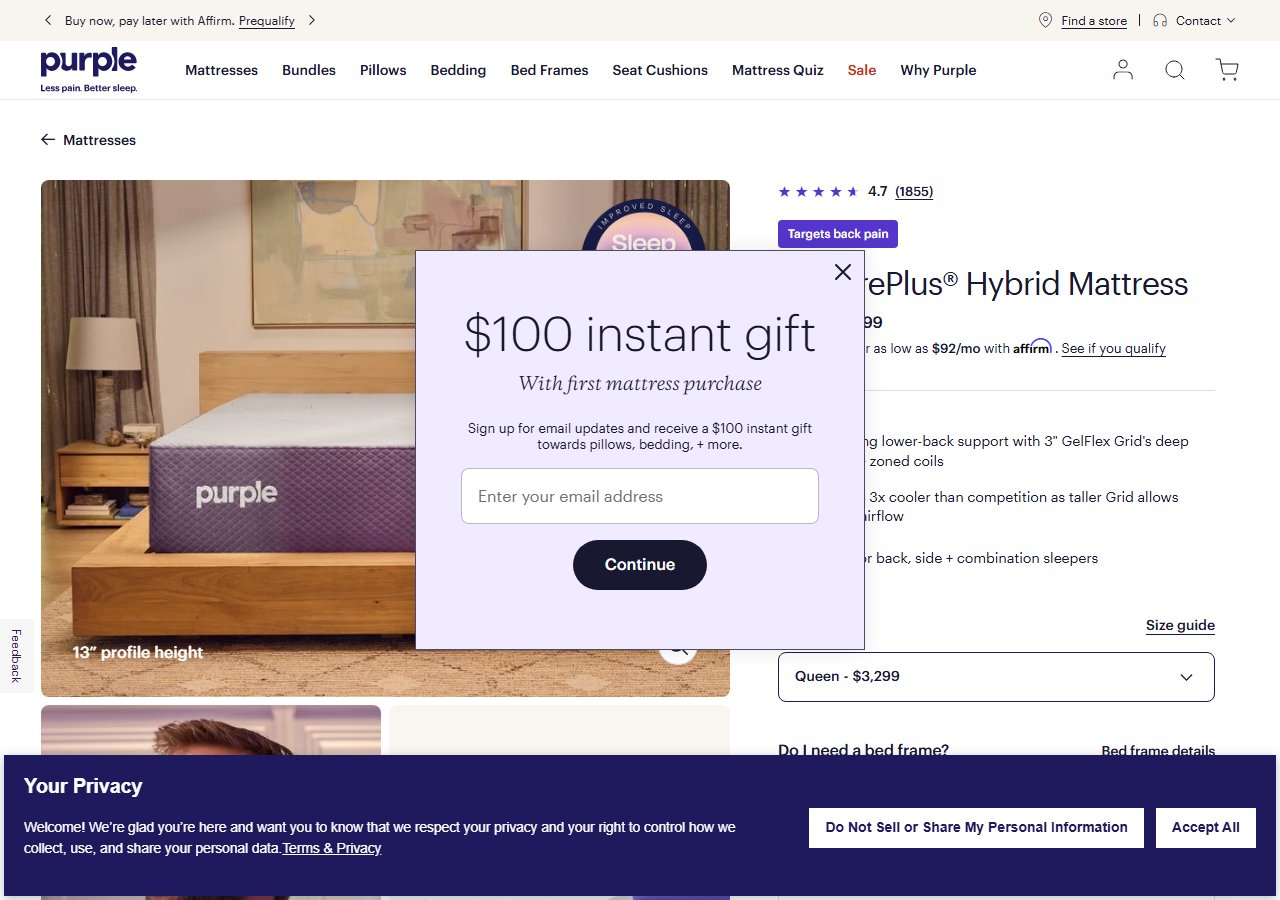
Purple Hybrid Premier Mattress
$2,499-$4,799
See Price at Purple →What Sleep Surface Engineering Actually Does for Chronic Lumbar Conditions
With non-product interventions established and clinical referral criteria clear, we can address what distinguishes sleep surfaces that help chronic back pain from those that worsen it. The central engineering challenge is zonal support: the lumbar spine needs more support than the shoulder zone to prevent the pelvis from sinking and creating deleterious lordosis. The shoulder zone needs enough give to keep the shoulder from bridging on side-sleeping. Getting both right requires either sophisticated foam layering, coil-zone variation, or a material that automatically differentiates pressure response.
The Saatva Loom & Leaf Memory Foam Mattress is the premium memory foam pick for readers with serious chronic lumbar conditions. Saatva engineers this mattress with a proprietary gel-infused memory foam layer that contours to the lumbar curve rather than allowing the pelvis to sink, paired with a spinal zone support system in the base layer that delivers enhanced firmness directly beneath the lumbar region. It is available in Relaxed Firm and Firm configurations — for most chronic back pain sufferers, Relaxed Firm provides the lumbar support without the rigid feel that aggravates pressure points. This is not a mattress for a general comfort upgrade; it is specifically constructed around the spinal neutrality mechanism described above. At $1,695–$3,295, it represents a meaningful capital expenditure, but in the context of AHRQ MEPS data showing that chronic back condition sufferers carry substantially higher annual healthcare costs, a properly engineered sleep surface is a plausible offset.
For workers in physically demanding occupations — particularly warehousing, construction, and healthcare — the load management problem is qualitatively different. The NIOSH Lifting Equation documents that these workers routinely accumulate spinal compressive forces that exceed safe limits during their shifts. By end of shift, the lumbar discs and paraspinal musculature have absorbed a loading pattern that requires a sleep surface engineered for higher body mass and sustained compressive recovery. The Saatva HD Mattress is purpose-built for this population: its dual steel coil system is engineered to support bodies up to 500 lbs without the progressive sag that standard innerspring or foam mattresses develop under sustained heavier-body loads. That sag is precisely the structural failure mode that translates into pelvic drop and lumbar lordosis during sleep. For BLS-documented high-MSD occupations where back injury is the norm rather than the exception, the HD's structural durability is not a luxury specification — it is functional engineering for a known spinal load pattern. At $2,395–$3,995, it reflects that engineering.
For side sleepers and readers whose primary complaint is pressure-point pain at the shoulder and hip — often secondary to lumbar guarding that causes them to shift position repeatedly through the night — the Purple Hybrid Premier Mattress addresses a different biomechanical problem. Purple's GelFlex Grid is a polymer structure that collapses under point pressure (at the hip and shoulder) while maintaining firmness under distributed load (at the lumbar zone). This automatic pressure differentiation is particularly useful for chronic pain sufferers who cannot tolerate conventional firm mattresses but need lumbar support. The hybrid construction pairs the Grid with pocketed coils for motion isolation and edge support. At $2,499–$4,799, it is the highest price point in this group, but for readers whose pain is as much about pressure as firmness, it addresses a need the foam-only options do not.
How to Calibrate Firmness to Your Sleep Position and Pain Pattern
Firmness preference is not arbitrary, and defaulting to