The Scale of the Problem: Federal Data on Chronic Back Pain
CDC NCHS Data Brief 390 delivers a number that should reframe the entire conversation about sleep and back pain: approximately 20% of U.S. adults — one in five — experience chronic pain, and the lower back is the single most common location. That is not occasional soreness after moving furniture. Chronic pain, by clinical definition, persists for three months or longer and significantly impairs daily functioning. For roughly 50 million Americans, the lower back is a daily adversary.
The consequences of ignoring this epidemic show up in federal financial data at every level. The Social Security Administration's Disability Insurance Reports identify musculoskeletal disorders — the category that includes chronic back conditions — as the single largest source of new disability claims filed each year. That means back pain is not just a quality-of-life problem. It is an economic catastrophe at population scale, removing workers from labor force participation and redirecting federal dollars into long-term income support.
The healthcare spending picture is equally grim. AHRQ's Medical Expenditure Panel Survey (MEPS) documents that adults carrying a chronic back diagnosis spend substantially more on personal healthcare annually than demographically similar adults without back conditions. The gap is not marginal. It reflects the cumulative cost of imaging, physical therapy, specialist visits, and — as CMS Drug Spending Dashboard data makes clear — opioid and non-opioid pain medication regimens that rank among Medicare's most expensive drug categories. Meanwhile, AHRQ's Healthcare Cost and Utilization Project (HCUP) places back pain among the most costly conditions in U.S. healthcare when inpatient and outpatient expenditures are combined.
For the person waking up stiff at 5 a.m., these aggregate numbers translate into a single lived experience: chronic back pain is expensive, exhausting, and often resistant to the interventions the healthcare system defaults to. Understanding why it happens — and why the night hours matter so much — is the first step toward doing something that actually works.
Why Chronic Back Pain Disrupts Sleep — and Why Sleep Disrupts Recovery
The relationship between sleep and back pain is bidirectional and vicious. Poor sleep elevates inflammatory cytokine levels, lowers pain thresholds, and reduces the muscle recovery that happens during slow-wave sleep. Back pain, in turn, disrupts sleep architecture — fragmenting deep sleep stages and triggering micro-arousals each time a sufferer shifts position to offload pressure. The result is a physiological loop in which pain worsens sleep and poor sleep worsens pain.
CDC sleep surveillance data shows that approximately 35% of U.S. adults already report sleeping fewer than seven hours per night — the threshold the CDC associates with elevated chronic disease risk. Among adults with chronic musculoskeletal pain, that figure is almost certainly higher. The interaction is clinically meaningful: sleep deprivation raises perceived pain intensity and lowers tolerance to mechanical stress, which means a lumbar disc that might be manageable after a well-rested night becomes acutely symptomatic after fragmented sleep.
The occupational dimension compounds everything. BLS Musculoskeletal Disorder tracking confirms that the back is the most frequently injured body part across all U.S. occupations with days away from work. The NIOSH Lifting Equation documents in rigorous biomechanical terms that manual material-handling tasks in warehousing, construction, and healthcare routinely impose spinal compression forces that exceed safe limits — often by wide margins during peak activity. Workers who spend their days at or above those spinal loading limits arrive at night with mechanically stressed lumbar tissue that is simultaneously in greatest need of restorative sleep and most likely to be disrupted by an inadequate sleep surface.
The arthritis dimension adds another layer. CDC arthritis surveillance data shows roughly 25% of U.S. adults have been diagnosed with arthritis, with prevalence concentrated in occupations involving sustained physical demand. Facet joint arthritis of the lumbar spine is a leading driver of positional night pain — specifically, the pain that worsens with sustained lying in one position and improves briefly with movement. This pattern is different from discogenic back pain, and it responds to sleep surface characteristics differently, favoring moderate contouring rather than firm flat support.
And industries with high musculoskeletal injury rates pay a measurable price: BLS Employer Costs for Employee Compensation data shows that high-MSD industries carry workers' compensation insurance rates 3 to 5 times higher than low-MSD counterparts. The worker who takes the injury home to a poor sleep environment isn't just suffering personally — the ripple effects price entire industry sectors out of competitive labor markets.
Try These First — Before Spending a Dollar on Equipment
Federal occupational health agencies and NIH clinical evidence converge on a consistent message: the cheapest intervention is the one that does not require buying anything. Before evaluating any sleep surface, every chronic back pain sufferer should work through the following free or low-cost interventions — not as a formality, but because evidence supports them as the highest-leverage tools available.
Know when a new mattress is the wrong answer. NIH National Institute of Neurological Disorders and Stroke guidance identifies a set of red flags that require clinical evaluation — not a sleep upgrade. Back pain that radiates below the knee, follows a traumatic event, accompanies leg weakness, or presents with bowel, bladder, or fever changes is not a sleep surface problem. It may indicate nerve compression, fracture, or systemic illness. Buying a mattress for these symptoms delays necessary care.
Move every day — more than you think you need to. NIH National Center for Complementary and Integrative Health's low-back pain evidence review concludes that walking 30 minutes on most days reduces chronic low back pain as effectively as most non-drug clinical treatments. That finding consistently surprises people who assume that rest is therapeutic. Passive rest beyond 48 hours for acute episodes and any rest-first approach to chronic pain is not supported by the evidence. The sleep surface matters far less than whether the person on it moves their body every day.
Optimize your sleep position before optimizing your mattress. NIH's National Institute of Arthritis and Musculoskeletal and Skin Diseases back pain guidance is specific: side-sleeping with a pillow between the knees maintains pelvic alignment and reduces lumbar rotation. Back-sleeping with a pillow under the knees unloads the lumbar spine. Stomach-sleeping — adopted by an estimated 16% of adults — applies sustained rotational torque to the lumbar spine all night. Changing sleep position costs nothing and produces immediate mechanical benefit. Many people who change position alone report meaningful morning stiffness reduction before ever considering a new mattress.
Assess whether your current mattress is actually the problem. CDC sleep hygiene guidance and clinical consensus establish a practical diagnostic: if your mattress has visible sag or permanent body impressions, if you wake stiffer than you went to bed consistently for weeks, or if the mattress is older than 7 to 10 years, it is a credible contributor to your symptoms. Importantly, even the most engineered sleep surface on the market does not compensate for poor movement habits, sedentary days, or inadequate sleep hygiene.
Fix your bending and lifting mechanics at work and at home. OSHA ergonomics guidance is unambiguous: hinge at the hips, not the lumbar spine; keep loads close to the body; avoid twisting under load. The majority of acute back episodes are mechanical and preventable with practiced movement patterns. A worker who lifts incorrectly during the day and then sleeps on a premium mattress at night is addressing roughly 20% of the problem.
For readers who have already implemented the above — who walk daily, sleep on their side with proper pillow support, have ruled out red flags with a clinician, and are still waking with lumbar pain on a sagging mattress older than a decade — a sleep surface upgrade is a legitimate and evidenced next step. The research on mattress firmness and back pain has matured considerably in the past 15 years, and the findings are specific enough to be actionable.
When to See a Clinician — Red Flags That Cannot Wait
A mattress article that does not clearly delineate clinical red flags is doing readers a disservice. NIH NINDS back pain guidance specifies that the following presentations require prompt clinical evaluation — not lifestyle or equipment changes:
If you experience pain that radiates below the knee (not just buttock or upper thigh discomfort, but true below-the-knee radiation), this may indicate nerve root compression from disc herniation or spinal stenosis. If the pain followed a fall, vehicle accident, or direct trauma, imaging is indicated to rule out fracture before any positional or equipment intervention. Leg weakness, numbness, or loss of reflexes accompanying back pain are neurological signs that require urgent evaluation. Bowel or bladder dysfunction in the context of back pain is a medical emergency — it may indicate cauda equina syndrome, which requires same-day neurosurgical assessment. Unexplained fever or significant unintentional weight loss with back pain raises the possibility of infectious, inflammatory, or neoplastic causes that are entirely outside the scope of sleep surface optimization.
For readers without these flags, whose back pain is positional, mechanical, and worse in the morning, the evidence supporting sleep surface modification is solid. Proceed.
What the Research Says About Mattress Firmness and Back Pain
The clinical literature on mattress firmness and chronic low back pain has shifted dramatically from the once-ubiquitous recommendation to sleep on the firmest possible surface. That recommendation was never strongly evidence-based, and subsequent randomized controlled trials have consistently shown it to be wrong for most back pain phenotypes.
The current evidence consensus — reflected across systematic reviews in orthopedic and sleep medicine literature — supports medium-firm support for the majority of chronic low back pain sufferers. A frequently cited Spanish RCT (Kovacs et al.) found that patients with chronic non-specific low back pain assigned to medium-firm mattresses reported significantly less morning pain and disability than those on firm mattresses. The mechanism is intuitive: a mattress that is too firm does not allow the hips and shoulders to sink sufficiently, creating a rigid bridge that suspends the lumbar spine in hyperextension. A mattress that is too soft allows the hips to sink excessively, creating a hammock-like lumbar flexion. Medium-firm surfaces thread the needle, supporting lumbar lordosis in its natural curve without forcing either extreme.
For side sleepers — the position NIH recommends for back pain sufferers — pressure distribution at the hip and shoulder becomes a co-equal variable alongside lumbar support. A mattress that is too firm for a side sleeper creates high-pressure points at the greater trochanter and acromion, which trigger micro-arousals and position-switching that fragments sleep. Memory foam and advanced polymer grid materials have specific advantages here: they conform to the body's geometry rather than resisting it, reducing peak interface pressure at bony prominences while maintaining enough support to prevent lumbar sag.
Body weight is a meaningful variable that most firmness discussions underweight. The same mattress that feels medium-firm to a 150-pound person may feel firm to a 120-pound person and soft to a 250-pound person, because perceived firmness is a function of how much the sleeper's weight deflects the surface. People in larger body categories — particularly those whose occupations already impose elevated spinal loading, per NIOSH data — require materially different support architectures than average-weight sleepers.
The Three Vetted Picks: What They're Actually Built For
With the evidence framework established, three specific mattresses stand out for different back-pain profiles. Each is described below with the biomechanical rationale — not marketing language.
For most chronic lumbar pain sufferers who want a premium memory foam option with medium-firm or firm support options, the Saatva Loom & Leaf Memory Foam Mattress is the most rigorously constructed option in this tier. Loom & Leaf uses a high-density memory foam construction that addresses a common failure mode in lower-quality memory foam: excessive heat retention and premature compression set. The mattress ships with two firmness options — Relaxed Firm and Firm — and the Relaxed Firm variant lands in the medium-firm range that the clinical evidence supports for most lumbar conditions. The gel-infused foam layer reduces the heat buildup that causes nocturnal restlessness, which matters specifically for back pain sufferers who already experience fragmented sleep. Saatva delivers and sets up this mattress in-home, which is clinically relevant: chronic back pain sufferers should not be maneuvering a compressed foam mattress up staircases.
For workers in physically demanding occupations — the population NIOSH lifting data consistently flags as exceeding safe spinal load limits — or for adults in larger body categories, the Saatva HD Mattress was engineered explicitly for this use case. The HD uses a dual-coil system with a lumbar zone enhancement and is rated for sleepers up to 500 pounds per side. Its support architecture does not compress into the soft range under higher loads, which is the failure mode that renders most consumer mattresses inadequate for this population. When a 280-pound warehouse worker who has already exceeded NIOSH safe spinal loading limits all day lies on a mattress that compresses unevenly, the overnight spinal environment can actively worsen the tissue stress accumulated during the day. The Saatva HD is designed to prevent that outcome.
For back pain sufferers who are specifically side sleepers, or whose primary complaint is pressure-point pain at the hips and shoulders in addition to lumbar aching, the Purple Hybrid Premier Mattress addresses a different biomechanical variable than the Saatva options. Purple's GelFlex Grid is a polymer grid that collapses under point loads (reducing peak pressure at bony prominences) while resisting distributed loads (maintaining lumbar support). The practical effect for a side-sleeping back pain sufferer is that the hip sinks into the grid, relieving greater trochanter pressure, while the lumbar zone remains supported. The Hybrid Premier uses pocketed coils beneath the grid layer to provide motion isolation and edge support. This is a pressure-map-first solution rather than a firmness-first solution, and it is best suited for sleepers whose primary problem is positional waking rather than global morning stiffness.
Mattresses Vetted for Chronic Lumbar Back Pain — Three Biomechanically Distinct Picks
Each pick below was selected for a specific back-pain profile — not for brand partnerships. They reflect different engineering approaches to the firmness, pressure distribution, and load-bearing variables that federal occupational health and clinical data identify as most relevant for chronic lumbar conditions.

Saatva Loom & Leaf Memory Foam Mattress
$1,695-$3,295
See Price at Saatva →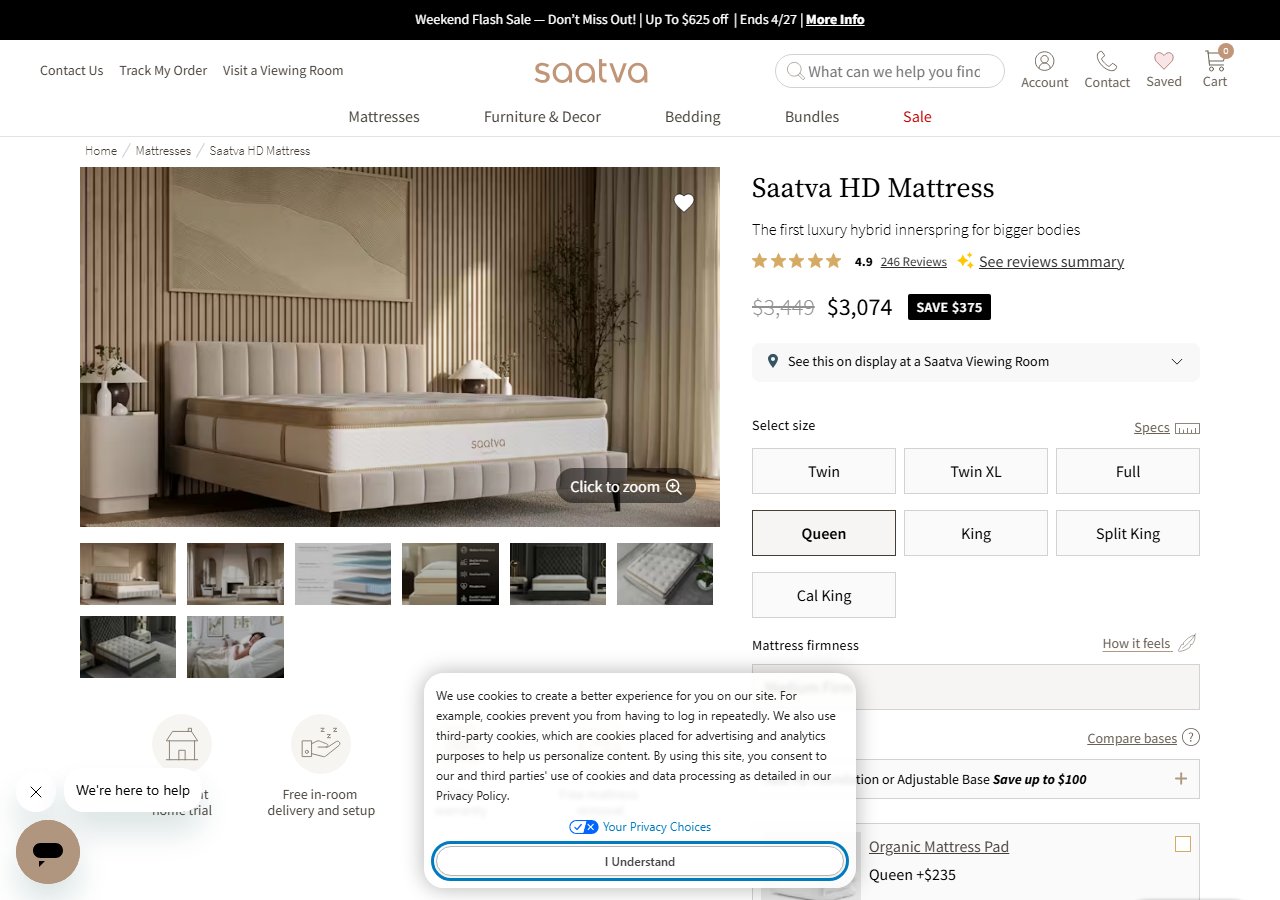
Saatva HD Mattress (Heavy-Duty)
$2,395-$3,995
See Price at Saatva →
Purple Hybrid Premier Mattress
$2,499-$4,799
See Price at Purple →Putting the Data Together: A Decision Framework
The federal data reviewed above — from CDC prevalence figures to SSA disability claims to AHRQ spending data — collectively make a case that chronic back pain is both extremely common and extremely costly, and that the healthcare system's default responses (imaging, opioids, specialist referral) are expensive and often insufficient. The intervention evidence, from NIH and NCCIH, makes an equally strong case that movement and positional optimization outperform most passive approaches, including sleep surface upgrades.
That said, the evidence also supports mattress firmness as a legitimate modifier of morning pain and sleep quality for people with chronic lumbar conditions — provided the mattress is genuinely inadequate (sagging, aged past 7 to 10 years, or demonstrably too firm or soft for the sleeper's weight and position). For that population, the three options above represent genuinely differentiated engineering approaches to a real biomechanical problem.
The decision framework is simple:
- Rule out red flags first. If pain radiates below the knee, accompanied trauma, or presents with neurological signs, see a clinician before anything else.
- Optimize sleep position and daily movement — both are free and evidence-supported as primary interventions.
- Assess your current mattress honestly. Visible sag, body impressions, or consistent morning stiffness that clears within an hour of rising are credible indicators.
- Match mattress type to your specific biomechanical profile: medium-firm memory foam for most lumbar conditions, heavy-duty dual-coil for higher body weight or demanding occupations, pressure-relieving grid for side-sleeper pressure pain.
- Revisit with a clinician if six to eight weeks of improved sleep hygiene and a new sleep surface do not produce meaningful change.
The $50 million Americans living with chronic back pain deserve better than a healthcare system that defaults to imaging and opioids and a consumer market that defaults to marketing language. Federal data tells the real story. The interventions and products above reflect what that data actually supports.