The Federal Data Picture No One Is Quoting at the Mattress Store
One in five American adults lives with chronic pain right now. According to CDC NCHS Data Brief 390, the lower back is the single most reported pain location in the country. That statistic is alarming on its own. But for adults who weigh 250 pounds or more — and who often work in physical occupations that involve repetitive lifting, sustained loading, and awkward postures — the number takes on a different character entirely. It is not background noise. It is a daily forecast.
Federal occupational health data makes the mechanism explicit. The NIOSH Lifting Equation is the engineering standard used to assess spinal load risk in workplaces. It documents that manual material-handling tasks across warehousing, construction, and healthcare routinely exceed safe spinal loading limits — even at average bodyweight. Add 50 to 150 additional pounds of body mass to those equations, and the compression forces transmitted through the lumbar discs during a standard warehouse lift can reach multiples of what spinal tissues were designed to sustain over a career. The BLS Musculoskeletal Disorders by Occupation data confirms the outcome: the back is the single most injured body part across all U.S. occupations that result in days away from work. Not the shoulder. Not the knee. The back.
The financial toll is staggering and underreported in popular coverage of back pain. AHRQ HCUP data ranks back pain among the most expensive conditions in U.S. healthcare by combined inpatient and outpatient cost. AHRQ MEPS data goes further: adults with chronic back conditions carry average annual personal healthcare expenditures that substantially exceed costs for adults without such conditions. And CMS Drug Spending Dashboard data identifies opioid and non-opioid pain medications among the most expensive Medicare drug categories — a direct reflection of how many Americans exhaust conservative options and arrive at pharmacological management of a mechanical problem. SSA Disability Insurance reports identify musculoskeletal disorders as the largest single category of new disability claims filed annually in the United States. The back pain crisis is not a niche health issue. It is a labor-force crisis with a federal paper trail.
Why High Bodyweight Changes the Biomechanics — and the Sleep Equation
The standard consumer conversation about mattresses for back pain tends to collapse into a single axis: firm versus soft. That framing is inadequate for most adults and almost entirely wrong for adults over 250 pounds. Here is why.
Spinal loading during sleep is not zero. The spine is never fully unloaded — even supine rest involves residual compressive and shear forces, particularly in the lumbar region. The magnitude of those forces scales with body mass. A mattress that provides adequate zoned support for a 170-pound sleeper may allow a 290-pound sleeper to sink past the comfort layer and into the transition or support core, which means the lumbar spine is no longer supported in a neutral position. The same mattress that earns five stars in a standard population benchmark becomes effectively a hammock for a high-bodyweight user — one that keeps the hips lower than the shoulders and exaggerates lumbar flexion for seven or eight hours.
For workers who spend their days exposing their lumbar spines to the kinds of loads the NIOSH Lifting Equation flags as unsafe — compressive forces during warehouse lifting that can exceed 770 pounds of spinal compression per lift — the nighttime recovery window is not optional. It is the biological mechanism through which intervertebral discs rehydrate. Discs are avascular; they absorb fluid and nutrients through diffusion during unloaded or lightly loaded rest. If the sleep surface fails to maintain neutral spinal alignment, that rehydration cycle is compromised, and the worker returns to the next shift with discs that are marginally more desiccated, more vulnerable, and less resilient than they should be. Over months and years, that deficit compounds.
CDC sleep data shows approximately 35% of U.S. adults already sleep fewer than seven hours per night — the threshold below which chronic disease risk rises measurably. High-bodyweight adults working physical jobs face a compounded deficit: they need more recovery time and often get less of it, and the recovery they do get may be mechanically ineffective if the sleep surface is under-engineered for their load. CDC Arthritis data adds another layer: approximately 25% of U.S. adults have doctor-diagnosed arthritis, with prevalence concentrated in occupations involving sustained physical demand. Arthritis in the facet joints of the lumbar spine is particularly sensitive to sleep position and surface support — and particularly common in the demographic this article is written for.
The workers' compensation angle is worth holding onto. BLS Employer Costs for Employee Compensation data shows that industries with high musculoskeletal disorder incidence carry workers' compensation insurance rates three to five times higher than low-MSD industries. That is not a coincidence. It is the actuarial expression of what happens when spinal loading at work is not offset by adequate recovery at home.
Try These First — Free and Low-Cost Interventions Before Equipment
The cheapest intervention is the one that does not require buying anything. Federal guidance and peer-reviewed evidence support several non-product interventions that work at the root cause level rather than around it. If you have not tried these systematically, start here — a new mattress on top of poor sleep mechanics and sedentary days is a partial solution at best.
Sleep position is the biggest free variable. NIH National Institute of Arthritis and Musculoskeletal and Skin Diseases guidance is specific: side-sleeping with a pillow between the knees, or back-sleeping with a pillow under the knees, keeps the spine in a mechanically neutral position throughout the night. Stomach-sleeping torques the lumbar spine and worsens chronic pain — and it is a particularly harmful position for high-bodyweight adults, whose abdominal mass further exaggerates lumbar extension in the prone position. A twenty-dollar pillow repositioned correctly costs nothing in ongoing effort and may reduce morning stiffness substantially.
Daily walking outperforms most passive interventions. The NIH National Center for Complementary and Integrative Health evidence review on low back pain concludes that walking thirty minutes most days reduces chronic low back pain as effectively as most non-drug clinical treatments. Physical deconditioning is both a cause and a consequence of chronic back pain, and walking interrupts that feedback loop. For high-bodyweight individuals in physical occupations, this is particularly important: occupational movement is not the same as therapeutic movement, and a body that lifts freight for eight hours but never walks for sustained aerobic benefit is not getting the anti-inflammatory, tissue-perfusion effects that moderate aerobic exercise provides.
Lifting and bending mechanics are rehearsable. OSHA's ergonomics guidance on safe lifting is not just for warehouse floors — it applies at home. Hinging at the hips rather than rounding the lumbar spine, keeping loads close to the body, and avoiding rotational twisting under load are the three primary mechanical interventions that reduce acute lumbar injury risk. Most acute back episodes are mechanical events that result from predictable movement errors. Learning and practicing correct hip-hinge mechanics — ideally with a physical therapist or certified strength coach — is one of the highest-return investments a high-bodyweight worker can make.
Evaluate your mattress before replacing it. CDC sleep hygiene guidance recommends replacing a mattress that shows visible sag, if you consistently wake stiffer than you went to bed, or if the mattress is older than seven to ten years. For high-bodyweight sleepers, that replacement window shortens — comfort layers compress more rapidly under greater sustained load. But the evaluation question matters: if your mattress is two years old and you still wake in pain, the mattress may not be the primary variable. Sleep hygiene, position, movement, and daytime loading all contribute.
For the subset of readers who have worked through sleep position correction, added consistent walking, and replaced a visibly sagging mattress — and are still waking in pain — the sleep surface engineering becomes the relevant variable. That is a real population. High-bodyweight adults who have optimized every free and low-cost lever and still experience morning stiffness, hip pain, or lumbar aching on waking are likely encountering a genuine equipment problem: a mattress that was not designed to maintain neutral spinal alignment under their load. That is when product selection becomes worth the investment.
When to See a Clinician First
Before discussing products at all, it is worth being direct: some back pain presentations in high-bodyweight adults require clinical evaluation — not a new mattress. A sleep surface can optimize mechanical alignment during recovery sleep. It cannot diagnose or treat nerve compression, spinal stenosis, disc herniation with radiculopathy, or serious pathology that may present as back pain.
NIH National Institute of Neurological Disorders and Stroke guidance identifies specific red flags that should prompt prompt clinical evaluation rather than self-management. These include back pain that radiates below the knee (suggesting nerve root involvement), pain that follows direct trauma, pain accompanied by leg weakness or numbness, any bowel or bladder changes associated with back pain, and pain accompanied by fever. High-bodyweight adults in physical occupations may be more likely to dismiss these symptoms as ordinary work soreness — which is a clinically significant error. Radicular symptoms in particular can worsen progressively if the underlying cause is not identified and addressed.
The clinical red flags section below this paragraph provides a formatted reference checklist. If any of those flags apply, the appropriate next step is a clinician visit, not a mattress upgrade.
Where the Sleep Surface Becomes the Lever
For readers who have cleared the clinical threshold, optimized sleep position, and confirmed that equipment is genuinely the limiting variable, here is what the engineering evidence supports for high-bodyweight sleepers with back pain.
The core requirement is not simply firmness — it is zoned progressive support calibrated for higher body mass. A standard firm mattress applies uniform resistance across the body surface. That uniform resistance works adequately for average-weight sleepers whose hips and shoulders need roughly similar support depth. For a 280-pound side-sleeper, however, the hip mass is substantially greater than the shoulder mass — meaning the hip needs to compress the comfort layer further to maintain a straight lateral spine. A mattress that does not allow adequate hip compression will push the hip upward relative to the shoulders, creating lateral lumbar flexion that stresses the facet joints and spinal ligaments over seven or eight hours.
The Saatva HD Mattress was specifically engineered for this load profile. It is rated for up to 500 pounds per side — a specification that most standard mattresses do not publish because most standard mattresses are not tested at those loads. The construction uses a dual-coil system: a pocketed-coil comfort layer sits above a tempered-steel Bonnell coil support core, creating a progressive resistance curve rather than a flat firmness plateau. That progressive curve means the mattress compresses appropriately under heavier body regions while maintaining adequate support under lighter ones. The lumbar zone includes additional coil density for targeted support — directly addressing the anatomical region where high-bodyweight workers accumulate the most occupational load. For warehouse workers, construction workers, and healthcare workers whose spines absorb the loads the NIOSH Lifting Equation flags as unsafe, the Saatva HD is the first recommendation in this list because it was designed for exactly this use case.
For high-bodyweight back-pain sufferers who prioritize memory foam's pressure-point relief over innerspring response, the Saatva Loom & Leaf Memory Foam Mattress represents the premium memory foam option. The Loom & Leaf uses high-density memory foam (5 lb per cubic foot in the top layer) — a density specification that resists the accelerated breakdown that standard 3 lb foam experiences under higher bodyweight loads. Standard memory foam mattresses in the 2–3 lb density range may sag within 18 to 24 months under a 280-pound sleeper; 5 lb density foam maintains its structural geometry substantially longer. The Loom & Leaf also uses a spinal zone gel layer — a targeted cooling and support intervention in the lumbar region — which is directly relevant for adults with diagnosed lumbar pathology. The pressure-relief properties of memory foam are particularly valuable for adults with hip or shoulder arthritis layered onto their back pain.
The Purple Hybrid Premier Mattress takes a different engineering approach worth understanding. Purple's GelFlex Grid is a hyper-elastic polymer grid that collapses under direct point load (like a hip bone or shoulder) while maintaining column strength under broader distributed loads (like the lumbar region). The result is simultaneous pressure relief and lumbar support — a combination that traditional foam and innerspring mattresses approximate but rarely achieve as cleanly. The Hybrid Premier pairs the grid with a pocketed-coil support core, which provides the motion isolation and edge support that high-bodyweight sleepers need. It is a premium pressure-relief pick for adults whose back pain is substantially driven by soft-tissue pressure sensitivity — hip bursitis, trochanteric pain, and thoracic tenderness alongside lumbar pain. The grid also runs cooler than memory foam, which matters for larger body-surface-area sleepers who tend to sleep warm.
Sleep Surfaces Engineered for High-Bodyweight Spinal Support
These three mattresses were selected for high-bodyweight adults (250+ lbs) with occupationally-driven back pain — each evaluated on weight rating, foam density or coil engineering, and zoned lumbar support rather than general comfort claims.

Saatva Loom & Leaf Memory Foam Mattress
$1,695-$3,295
See Price at Saatva →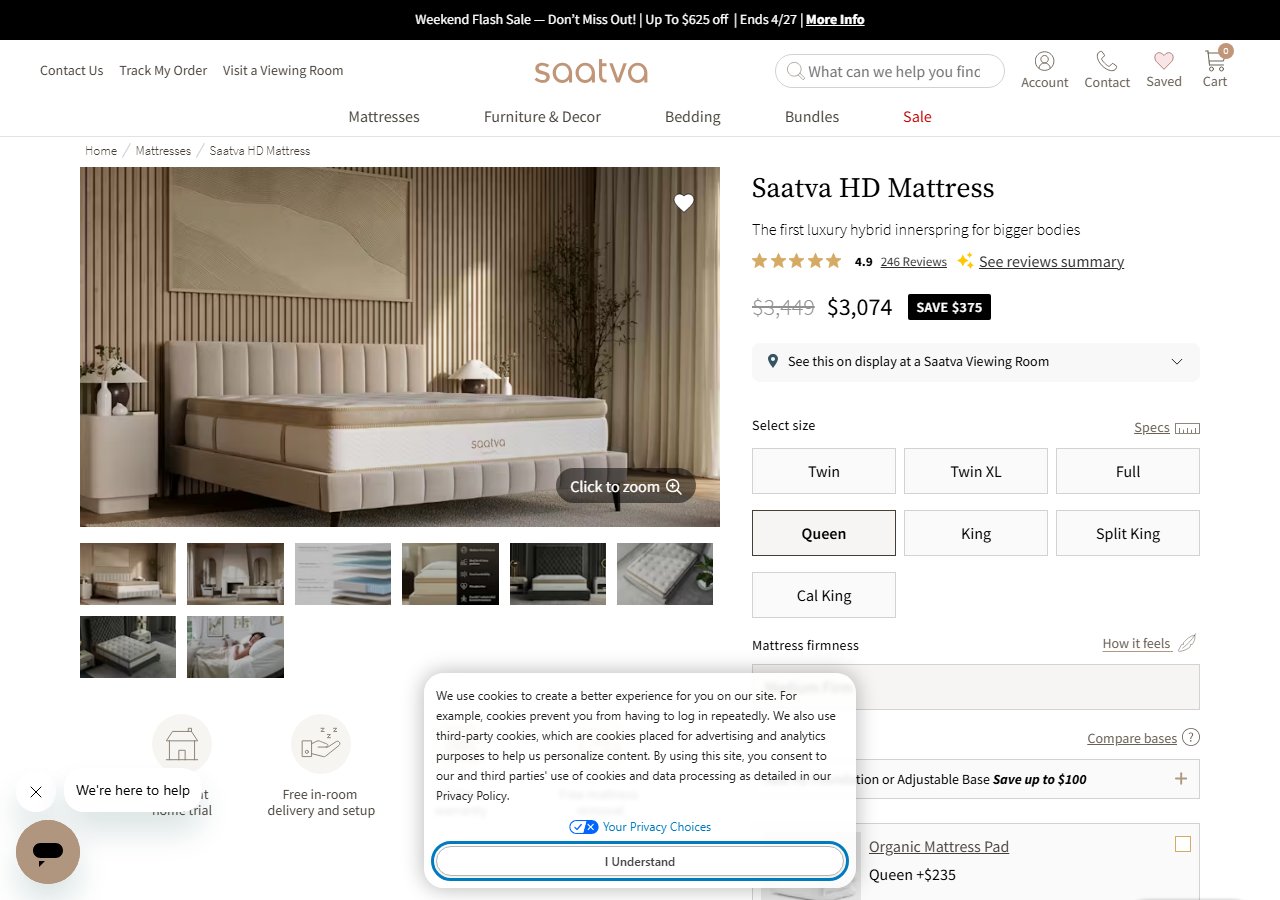
Saatva HD Mattress (Heavy-Duty)
$2,395-$3,995
See Price at Saatva →
Purple Hybrid Premier Mattress
$2,499-$4,799
See Price at Purple →The Data-to-Decision Summary
The federal data on back pain, occupational spinal loading, and sleep quality converges on a clear hierarchy for high-bodyweight adults in physically demanding work.
First, the scope of the problem is federally documented and larger than most people appreciate. CDC NCHS data puts chronic pain prevalence at one in five adults. BLS MSD data confirms the back as the top injury site across occupations. NIOSH documents that the physical tasks many of these workers perform routinely exceed safe spinal loading limits. The combination of occupational spinal loading and high body mass creates a compounding risk that standard mattress marketing does not address.
Second, free interventions come first. Sleep position correction, daily walking, and lifting mechanics training are each supported by federal or NIH evidence and cost nothing beyond commitment. They address root-cause mechanical issues that a new mattress cannot fix.
Third, clinical red flags preempt product decisions. Radicular symptoms, leg weakness, bowel or bladder changes, post-trauma pain, and fever-associated back pain all require clinician evaluation before self-management.
Fourth, when equipment selection becomes appropriate, the engineering specifications that matter for high-bodyweight sleepers are specific: weight ratings, foam density, coil gauge and count, and zoned lumbar support. The Saatva HD was designed explicitly for this population. The Loom & Leaf provides a high-density memory foam alternative. The Purple Hybrid Premier addresses the pressure-relief dimension. These are tools — one tool in a system that also includes movement, position, and clinical oversight.
The AHRQ HCUP data tells us back pain is already among the most expensive conditions in the healthcare system. The workers who carry that cost in their bodies deserve analysis that takes the engineering as seriously as they take the work.