The Federal Data Case for Taking This Seriously
If you weigh 250 pounds or more and you work a physically demanding job, the federal injury record is not abstract — it is your biography. BLS Musculoskeletal Disorders by Occupation tracking establishes that the back is the single most commonly injured body part across all U.S. occupations resulting in days away from work. That is not a statistical tie. It is a runaway leader. And the workers driving that statistic are overwhelmingly found in the same industries — warehousing, construction, healthcare support, long-haul trucking — where high-bodyweight individuals are also disproportionately represented.
The NIOSH Lifting Equation provides the biomechanical scaffolding for why this happens. NIOSH's Recommended Weight Limit (RWL) methodology calculates that routine manual material-handling tasks in warehousing, construction, and healthcare routinely push spinal compression forces past the 3,400 Newton threshold the agency identifies as the upper boundary of acceptable lumbar loading. For a worker at 185 lbs, a 50-lb lift executed with poor mechanics already flirts with that limit. For a worker at 280 lbs, the same lift — with the same mechanics — produces meaningfully higher spinal compressive forces because the spine is simultaneously managing the mass of the torso itself. Body weight is not a neutral variable in spinal loading. It is a multiplier.
The economic consequences follow the injury data precisely. AHRQ HCUP data places back pain among the most expensive conditions in U.S. healthcare measured by combined inpatient and outpatient cost. Separately, AHRQ MEPS data shows that adults with chronic back conditions carry substantially higher annual personal healthcare expenditures than adults without such conditions. The SSA Disability Insurance program records musculoskeletal disorders as the single largest category of new disability claims filed each year — and most musculoskeletal disability originates in the lower back. CMS drug spending data identifies opioid and non-opioid pain medications among the most expensive Medicare drug categories, a direct reflection of how many Americans are managing chronic back pain pharmacologically rather than structurally. The system is expensive. The individual pays most of it.
Why Bodyweight Amplifies the Problem — The Biomechanics
Understanding why 250+ lb adults experience disproportionate back injury risk requires a brief detour into spinal mechanics. The lumbar spine — the five vertebrae between the pelvis and the thoracic cage — handles the cumulative compressive and shear load of the entire upper body plus any external loads being moved. In a standing posture, lumbar compressive forces approximate 1.0 to 1.5 times body weight at rest. In forward flexion — bending to pick something up off the floor — compressive forces can reach 6 to 8 times body weight due to the mechanical disadvantage of the paraspinal muscles.
For a 270-lb adult, a simple forward bend produces an estimated 1,600 to 2,160 lbs of compressive force on the L4-L5 disc. That disc, designed to handle cyclic loading across a lifetime, is also the disc most commonly implicated in herniation and degeneration. The problem is not a single catastrophic event — it is the accumulated fatigue loading of thousands of sub-threshold mechanical insults that degrade disc integrity over years.
This is the context in which sleep surface quality becomes clinically relevant. The lumbar spine never fully offloads while a person is awake and upright. Sleep — specifically the 7+ hours of horizontal rest that CDC sleep research identifies as necessary to avoid elevated chronic disease risk — is the primary window in which spinal compression is reduced to near-zero and disc rehydration can occur. Intervertebral discs are avascular; they exchange nutrients and fluid through the mechanical pressure changes of the sleep cycle. A surface that allows the heavier lumbar region to sag into a hammock position eliminates this mechanical benefit and maintains the spine in a compressed, malaligned position throughout the night.
Yet CDC sleep data shows that approximately 35% of U.S. adults sleep fewer than 7 hours per night. For high-bodyweight adults with chronic back conditions, insufficient sleep is not merely a fatigue issue — it is a tissue recovery deficit. The spine never gets its maintenance window. Pain sensitization increases. The cycle compounds.
CDC NHANES data reports that roughly 20% of U.S. adults live with chronic pain, and the lower back is the most commonly reported pain site. That same dataset shows pain prevalence increases with BMI. CDC arthritis surveillance data documents that approximately 25% of U.S. adults have doctor-diagnosed arthritis, with prevalence concentrated in physically demanding occupations — the exact occupational profile of the high-bodyweight adult this article addresses. And BLS workers' compensation cost data confirms the structural reality: industries with high musculoskeletal disorder incidence carry workers' compensation insurance rates 3 to 5 times higher than low-MSD industries. These are not abstract risk statistics. They are priced into the labor market.
The Cheapest Intervention Is the One That Requires No Purchase
Before any product enters this conversation, it is worth being direct: the most effective back pain interventions in the federal evidence base are behavioral and postural, not commercial. A new sleep surface does not fix a lifting technique problem. It does not substitute for movement. And it cannot outperform the fundamental physics of how you load and unload your spine across a 16-hour waking day.
Federal guidance from OSHA's Ergonomics Solutions program is explicit: hinge at the hips rather than rounding the lumbar spine, keep loads close to the body's center of mass, and never combine forward flexion with axial rotation under load. This last point matters enormously for high-bodyweight workers — the combination of bending and twisting generates asymmetric disc loading that disc tissue is poorly designed to resist. These mechanics are learnable and rehearsable. Most acute back episodes in physically demanding workers are not structural failures — they are mechanical errors executed under fatigue.
For readers who have already addressed mechanics, position, and movement habits — and who are still waking with stiffness or pain that correlates clearly with their sleep surface — the research supports a targeted equipment upgrade. But the logic has to run in that order. A $3,000 mattress purchased before correcting a forward-bend habit is a poor investment. The same mattress purchased after optimizing the behavioral variables is a legitimate tool for spinal recovery during the only hours the spine can actually decompress.
When to See a Clinician First
A critical distinction: not all back pain in high-bodyweight adults is mechanical. Some presentations require clinical evaluation before any self-management strategy — behavioral or equipment-based — is appropriate. Purchasing a new mattress for a radiculopathy, a compression fracture, or an undiagnosed tumor is not merely unhelpful; it delays care that matters.
NIH NINDS back pain guidance identifies several presentations that require prompt clinical attention rather than self-management. High-bodyweight adults should be especially alert to these signals, because their pain may be attributed to body composition before structural pathology is ruled out. If your back pain is accompanied by any of the red flags below, pause on any purchasing decision and contact a physician or physical therapist first.
Where a Reinforced Sleep Surface Actually Helps
For the reader who has passed through the behavioral interventions and the clinical screening — whose back pain is mechanical, chronic, and clearly worse on a sagging or aging sleep surface — the engineering specifications of a mattress matter in ways that most mattress marketing obscures.
High-bodyweight adults compress a sleep surface 30 to 60 percent more than the median-weight adult for whom most consumer mattresses are designed. Standard innerspring coils are typically rated for a combined sleeping weight of 250 to 300 lbs. A single sleeper at 280 lbs is at or above that limit before a partner is considered. Standard memory foam — the 3 to 4 lb density foam found in most mass-market mattresses — bottoms out under sustained load, creating exactly the hammock effect that eliminates disc rehydration benefit. The result is a surface that feels supportive on first contact but delivers progressive sagging over months as the foam fatigues.
The engineering solutions that address this are specific: higher-density foam cores (5 lb density or greater), reinforced perimeter and center-zone coil systems, tempered steel coils with higher gauge ratings, and zoned support configurations that provide firmer lumbar resistance without transferring that firmness to shoulder or hip pressure points. These are not marketing terms — they are material specifications that can be verified and compared.
The Saatva HD Mattress is the product in this list most explicitly engineered around the physics described above. Saatva designed the HD specifically for sleepers up to 500 lbs, using a dual-coil system — a pocketed micro-coil comfort layer over a high-tempered steel innerspring — combined with a high-density foam foundation. The construction approach directly addresses the coil fatigue and foam bottoming-out failure modes that plague standard mattresses under sustained higher loads. For warehouse workers, construction tradespeople, or healthcare workers at 250+ lbs who spend their working days loading their lumbar spine above NIOSH-recommended limits and need their sleep hours to actually produce spinal decompression, the HD's weight-specific engineering is the most directly relevant specification in this comparison.
For high-bodyweight adults whose primary complaint is pressure-point pain rather than structural sag — hip pain, shoulder pain, or pain that shifts rather than generalizes — the Purple Hybrid Premier Mattress addresses a different failure mode. Standard foam collapses under high-pressure contact points, concentrating load rather than distributing it. Purple's GelFlex Grid is a polymer grid structure that deforms locally at high-pressure zones while remaining firm across lower-pressure areas, producing a pressure map that more closely resembles clinical offloading than standard foam compression. The Hybrid Premier pairs this grid with pocketed coils, which prevents the total-surface sag risk while maintaining the pressure-distribution benefit. For the 250+ lb adult who wakes with hip or shoulder pain, this is the mechanism most likely to be relevant.
The Saatva Loom & Leaf Memory Foam Mattress occupies a different position in this comparison. Built from 5 lb high-density memory foam rather than the 3 to 4 lb density foam standard in mass-market options, the Loom & Leaf is engineered for the full-body contouring and pressure relief that chronic back pain patients often find therapeutic — the foam conforms to lumbar curvature rather than forcing a flat-surface compromise. The density specification matters for durability under higher loads: 5 lb foam resists the progressive compression fatigue that causes cheaper foam to sag prematurely. For a 250 to 300 lb adult who sleeps alone, runs warm (a common complaint with memory foam, addressed in the Loom & Leaf through a cooling gel layer), and whose primary symptom is morning stiffness and lumbar aching rather than pressure-point pain, this is the memory-foam option with the material specifications to hold up over time.
Mattresses Engineered for 250+ lb Spinal Recovery — Curated from Federal Injury Data
Each product below was selected for engineering specifications — coil systems, foam density, and load ratings — that directly address the spinal decompression failure modes documented in NIOSH and BLS injury research for high-bodyweight adults.

Saatva Loom & Leaf Memory Foam Mattress
$1,695-$3,295
See Price at Saatva →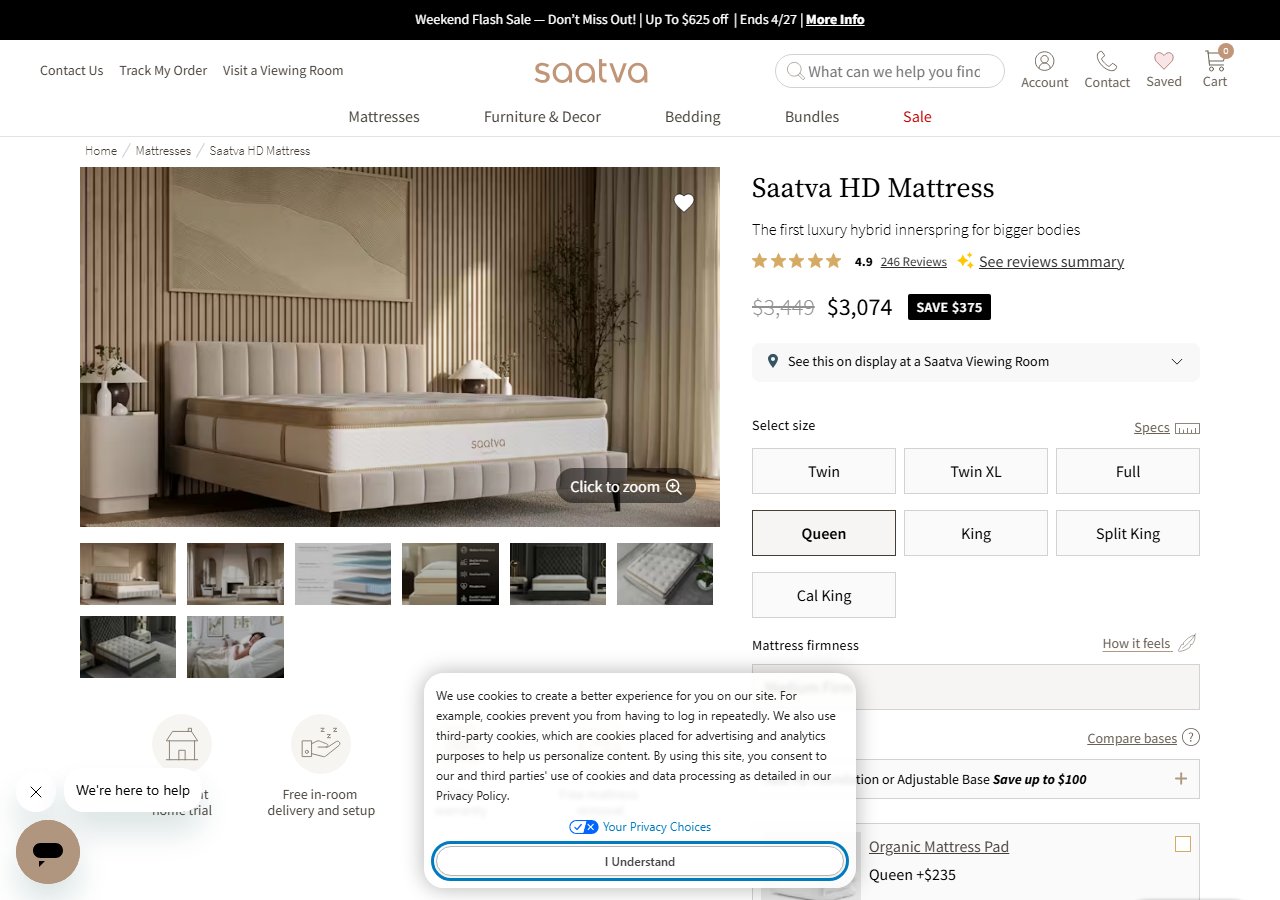
Saatva HD Mattress (Heavy-Duty)
$2,395-$3,995
See Price at Saatva →
Purple Hybrid Premier Mattress
$2,499-$4,799
See Price at Purple →Putting the Data Hierarchy Together
The federal evidence assembled here describes a compounding injury cycle that is well-documented, expensive, and disproportionately concentrated in high-bodyweight adults in physically demanding occupations. BLS injury data establishes that the back leads all body parts in occupational injury. NIOSH explains the mechanical mechanism. CDC chronic pain data confirms how many Americans are living inside that cycle. And CDC sleep research identifies the recovery window — sleep — that bodyweight and poor surface support can eliminate.
The intervention hierarchy that follows from this data is: mechanics first, movement second, clinical screening third, and equipment optimization fourth. A sleep surface engineered for higher weight loads is a legitimate fourth step — not a first one. For the reader who has worked through the first three steps and is still waking in pain on a mattress that sags visibly or was never rated for their weight, the engineering specifications reviewed above represent a real recovery tool, backed by the same physics that federal agencies use to understand spinal injury in the first place. Start with the free interventions. Screen the red flags. Then, and only then, let the material science do the work the behavioral changes set up.