The federal data portrait of back pain at higher body weight
BLS Musculoskeletal Disorder tracking is unambiguous on one point: the back is the single most injured body part across every U.S. occupation category that generates lost-workday cases. That is not a rounding error or a quirk of one industry — it holds in warehousing, construction, healthcare, transportation, and retail simultaneously. For the roughly 74 million American adults whose body weight exceeds 250 lbs, that occupational injury burden does not stop at the end of a shift. It follows them home, into the bedroom, and onto a sleep surface that may or may not be engineered to handle the structural demands their body places on it across seven or eight hours every night.
The scale of the downstream problem is visible throughout federal healthcare spending data. AHRQ's Hospital Cost and Utilization Project identifies back pain as one of the most expensive conditions in U.S. healthcare by combined inpatient and outpatient cost. AHRQ's Medical Expenditure Panel Survey documents that adults carrying a chronic back diagnosis spend substantially more on personal healthcare annually than adults without one — a gap that compounds over decades of working life. The SSA Disability Insurance program reports that musculoskeletal disorders remain the largest single category of new disability claims filed each year, meaning the trajectory from occupational back strain to long-term work disability is well-worn and federally documented. CMS Drug Spending Dashboard data shows opioid and non-opioid pain medications rank among the most expensive Medicare drug categories — a downstream cost signal that maps directly back to the chronic-pain population these spinal injuries create.
This is not a niche problem. CDC NCHS Data Brief 390 puts the prevalence of chronic pain among U.S. adults at approximately 20%, with lower back identified as the most common pain location. CDC Arthritis surveillance data shows a quarter of U.S. adults report doctor-diagnosed arthritis, with rates elevated among workers in physically demanding occupations. These two populations — chronic back pain sufferers and arthritis patients — overlap substantially with the high-bodyweight, physically demanding-occupation population this article addresses.
Why higher body weight and occupational loading create a compounding spinal risk
Understanding why this population experiences worse outcomes requires a brief detour into biomechanics, because the mechanism is not simply "more weight equals more pain." It is more specific than that, and the federal data traces the causal chain clearly.
The NIOSH Lifting Equation — the federal government's primary engineering tool for assessing manual material-handling risk — establishes recommended weight limits based on spinal compression force at the L4/L5 vertebral junction. Loads that exceed the recommended limit place compressive forces on spinal discs above the threshold associated with tissue damage over repeated exposure. NIOSH's own documentation confirms that warehousing, construction, and healthcare tasks routinely produce Lifting Index values above 1.0, meaning the task as performed regularly exceeds the safe recommended limit. For a 180-lb worker, this creates elevated disc loading. For a 280-lb worker performing the same lift, the axial compressive force at the lumbar spine is meaningfully higher because the worker's own body mass contributes to the spinal load equation — not just the weight being lifted.
This compounding dynamic extends into sleep. The intervertebral discs undergo a diurnal hydration cycle: they lose fluid (and height) under compressive load during waking hours and reabsorb fluid during the relative decompression of sleep. This is why humans are measurably taller in the morning than in the evening. For a high-bodyweight individual sleeping on a mattress that sags or lacks sufficient support, the lumbar spine does not actually achieve decompressive neutral alignment during sleep — it flexes into the sag, maintaining compressive load on the posterior disc margins and facet joints across the entire sleep period. The result is the clinical pattern many in this population know well: waking stiffer than they went to bed, with morning pain that takes an hour or more to "walk off."
CDC sleep data shows approximately 35% of U.S. adults already sleep fewer than 7 hours per night — the threshold below which chronic disease risk rises measurably. For high-bodyweight workers in physically demanding jobs, sleep disruption from pain is one of the primary drivers of that shortfall. Poor sleep impairs muscle repair, elevates inflammatory markers, and reduces pain tolerance the following day — creating a reinforcing cycle that worsens both the occupational injury risk and the recovery capacity.
The BLS Employer Costs data captures one more dimension of this problem: industries with high MSD incidence carry workers' compensation insurance rates 3 to 5 times higher than low-MSD industries. That premium is a market price signal for the documented injury frequency — and it is borne by employers and workers together through wage suppression and benefit structures. The worker living with the chronic back condition from the job pays for it twice: in lost productivity and in the healthcare costs that AHRQ data shows are substantially elevated compared to their non-injured peers.
Try these interventions before you spend anything
The cheapest intervention is the one that does not require buying anything. For high-bodyweight adults with occupational back strain, several behavioral and mechanical changes have stronger evidence bases than any mattress on the market. The interventions below are drawn from federal clinical guidance, not manufacturer claims. Work through as many as you can before committing to a new sleep surface.
Daily walking is the place to start. The NIH National Center for Complementary and Integrative Health's evidence review on low back pain finds that walking 30 minutes most days reduces chronic low back pain as effectively as most non-drug clinical treatments. This is not a consolation prize — it is first-line evidence-based treatment. The mechanism involves disc hydration (walking produces the pumping action that re-circulates fluid into the nucleus pulposus), paraspinal muscle conditioning, and reduction in central sensitization. For a worker who spends 8 to 10 hours on their feet lifting and then drives home and sits in the evening, a structured 30-minute walk is the highest-leverage free intervention available.
Sleep position is the biggest zero-cost variable most people ignore. NIH guidance from the National Institute of Arthritis and Musculoskeletal and Skin Diseases is specific: side-sleeping with a pillow between the knees maintains lumbopelvic neutral alignment; back-sleeping with a pillow under the knees reduces lordotic load on the posterior disc margins. Stomach-sleeping hyperextends the lumbar spine and twists the cervical spine simultaneously — it is the mechanically worst position for anyone with lumbar disc disease or facet arthritis, and high-bodyweight individuals on a soft mattress who stomach-sleep are adding hours of sustained lumbar hyperextension to a spine that already absorbed heavy occupational loading that day.
Lifting and bending mechanics matter even outside the workplace. OSHA's Ergonomics guidance teaches hip hinging — loading through the hip extensors rather than the lumbar spine — as the primary safe-lifting pattern. Most acute low back episodes in this population are mechanical and rehearsable: they occur when a fatigued worker loads their lumbar spine in flexion under load, often doing something mundane like picking up a bag of groceries after a heavy work shift. Practicing hip-hinge mechanics and keeping loads close to the body reduces peak spinal compressive force on the same disc structures that are taking occupational load all day.
Mattress replacement timing is worth addressing directly, because many readers in this population are sleeping on a mattress that has already failed them. CDC Sleep Hygiene guidance and occupational health consensus suggest replacing a mattress when it shows visible sag, when morning stiffness is consistently worse than bedtime stiffness, or when the mattress is older than 7 to 10 years — whichever comes first. High-bodyweight sleepers accelerate foam compression and coil fatigue; a mattress that a lighter sleeper could use for 10 years may be effectively dead at year 5 or 6 for a 270-lb person sleeping on it nightly. If any of these criteria apply, a new mattress is not a luxury — it is maintenance.
For readers who have already addressed sleep position, walking, and lifting mechanics — and who are sleeping on a mattress less than 7 years old that still shows sag or inadequate support at their body weight — a more capable sleep surface is the logical next step. The products below were selected specifically for high-bodyweight adults with documented or suspected occupational back strain. They are adjuncts to the interventions above, not substitutes for them.
When to see a clinician: red flags that a mattress cannot address
Some back pain presentations in this population require imaging, referral, or specialist evaluation before any sleep surface decision is relevant. The following red flags are drawn directly from NIH National Institute of Neurological Disorders and Stroke back pain guidance and should prompt a clinician visit, not a mattress purchase.
Pain that radiates below the knee — particularly into the calf, foot, or toes — may indicate nerve root compression (radiculopathy) or spinal stenosis, both of which require imaging to characterize. A better mattress will not decompress a compromised nerve root. Back pain following trauma (a fall, a vehicle accident, a heavy lift that produced immediate severe pain) may indicate fracture, particularly in older adults or those with bone-density risk factors. Back pain accompanied by leg weakness, foot drop, or difficulty walking requires urgent evaluation. Any back pain accompanied by bowel or bladder dysfunction — incontinence or new retention — is a surgical emergency that must be evaluated immediately regardless of time of day. Back pain with fever or unexplained weight loss requires workup to rule out infection or malignancy.
For chronic occupational back pain without these features — the grinding morning stiffness, the end-of-shift ache, the fatigue-related flares — the interventions above and the products below are appropriate to work through. But if any of the red flags above apply, start with a clinician, not a sleep retailer.
Where a reinforced sleep surface fits into the evidence hierarchy
For high-bodyweight adults who have cleared the red-flag screen, optimized sleep position, and addressed lifting mechanics, the sleep surface itself becomes a meaningful modifiable variable. The specific engineering features that matter for this population are different from general mattress marketing — firmness rating alone is insufficient. What matters is the ability to maintain spinal neutral alignment under the sustained compressive load of a 250-plus-pound body across a full sleep period, without the mattress deflecting so much that the sleeper sinks into flexion, or so little that pressure concentrates at the hip and shoulder.
For the reader dealing with serious lumbar disc pain and heat sensitivity in foam, the Saatva Loom & Leaf Memory Foam Mattress is the premium memory foam option engineered specifically for this use case. Saatva builds the Loom & Leaf with an 8-lb high-density memory foam core — denser than the 4- to 5-lb foam used in most consumer mattresses — which resists the progressive compression that causes cheaper memory foam to create the hammock effect. The lumbar zone support insert and the 3-inch gel-infused top layer address both the thermal dissipation issue common in memory foam (relevant for high-bodyweight sleepers who sleep hot) and the pressure mapping concern at the hip and sacral regions where occupational back patients typically concentrate their pain. At $1,695 to $3,295 depending on size, it is a serious purchase — but for a 280-lb warehouse worker waking up stiff every morning on a 6-year-old foam mattress, the engineering gap between a quality reinforced surface and an expired consumer mattress is clinically meaningful.
For the reader whose primary concern is raw structural support — the warehouse worker, the construction laborer, or the long-haul driver who comes home carrying a full shift's worth of spinal loading — the Saatva HD Mattress is purpose-built for bodies above 250 lbs in a way that most "firm" mattresses simply are not. The HD is constructed with a proprietary dual-tempered steel coil system rated specifically for the high-bodyweight load profile, a Talalay latex comfort layer that provides pressure relief without the heat retention of dense foam, and a high-density foam perimeter that prevents the edge-sitting collapse that causes many high-bodyweight sleepers to roll toward the edge in the night. The price range of $2,395 to $3,995 reflects genuine engineering differences — this is not a standard mattress with a different label. For someone in the 280-to-400-lb range who has burned through two mattresses in four years and is genuinely frustrated, the HD is the only option in this list designed specifically around their load parameters.
For readers whose primary complaint is pressure pain — the hip bursitis, the sacral pressure point, the shoulder impingement from side sleeping — rather than pure lumbar instability, the Purple Hybrid Premier Mattress takes a fundamentally different engineering approach. Purple's GelFlex Grid is a hyper-elastic polymer grid that collapses under point pressure (at the hip and shoulder) while supporting broader body regions (at the lumbar spine) — a pressure-mapping behavior that neither memory foam nor innerspring achieves cleanly. For high-bodyweight side sleepers specifically, this means the hip and greater trochanter can sink into pressure relief while the lumbar spine remains supported, reducing the lateral flexion that promotes disc loading through the night. At $2,499 to $4,799, the Purple Hybrid Premier is the premium pressure-relief pick in this group.
Sleep Surfaces Built for the 250+ lb Occupational Back Pain Load Profile
These three mattresses were selected specifically for high-bodyweight adults with occupational back strain — each addresses a different primary mechanism (structural support, pressure distribution, or memory foam density) documented in NIOSH and CDC spinal load research.

Saatva Loom & Leaf Memory Foam Mattress
$1,695-$3,295
See Price at Saatva →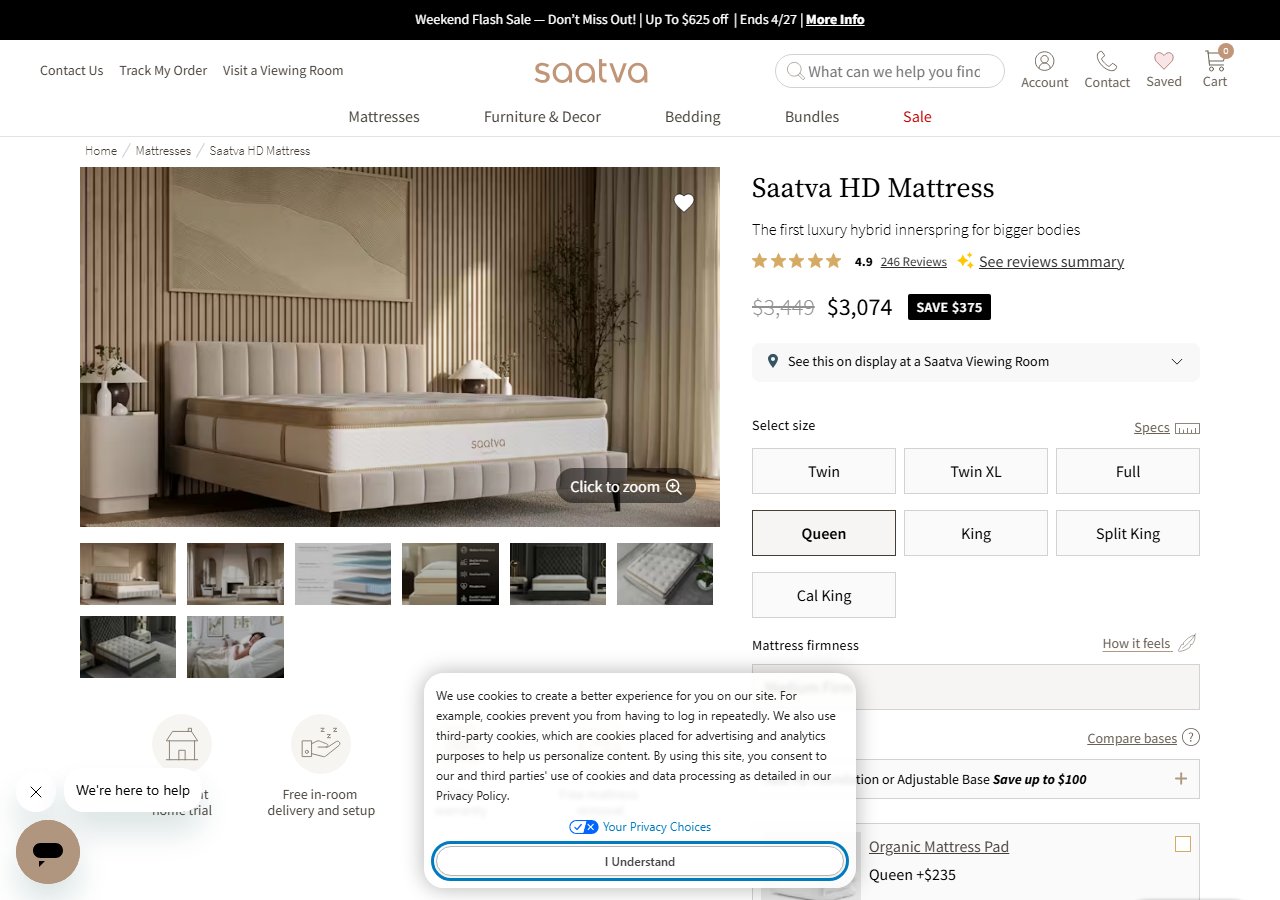
Saatva HD Mattress (Heavy-Duty)
$2,395-$3,995
See Price at Saatva →
Purple Hybrid Premier Mattress
$2,499-$4,799
See Price at Purple →The data-to-intervention-to-product hierarchy: a summary
The federal data tells a coherent story for this population. BLS tracks the occupational back injury burden. NIOSH documents the mechanical mechanism — spinal loading in manual handling jobs that systematically exceeds safe limits, with higher body mass adding to that load. CDC shows 20% of U.S. adults living with chronic pain, lower back dominant. AHRQ quantifies the healthcare cost that follows. SSA records the disability trajectory for those who reach that endpoint.
For adults over 250 lbs in physically demanding occupations, the sleep surface is one modifiable variable in a system of overlapping stressors. It is not the most important variable — movement is. Lifting mechanics are. Sleep position is. Clinical evaluation is, if any red flags apply. But for someone who has addressed those levers and is still waking up stiff because they are sleeping on a mattress designed for a 160-lb average-weight consumer, the engineering gap is real and addressable. The products above represent three distinct approaches — dense memory foam with lumbar zoning, purpose-built heavy-duty coil construction, and polymer grid pressure mapping — that match the specific load and pressure profiles the federal research describes. Use the interventions first. Use the products as the reinforcement they are. And if the red flags apply, start with a clinician before either.