The Back Injury Problem Isn't Just at Work — It Follows You to Bed
If you weigh 250 pounds or more and work a physically demanding job, the federal data on your back health is sobering. According to BLS Musculoskeletal Disorder tracking, the back is the single most commonly injured body part across all U.S. occupations requiring days away from work — every industry, every sector, year after year. That's not a coincidence. It's the predictable outcome of a workforce that lifts, bends, carries, and stands for 8 to 12 hours, then tries to recover on sleep surfaces that were engineered for the median American body — not for the 60 to 70 million Americans who weigh substantially more.
The CDC's NCHS Data Brief 390 puts a sharper point on the scale of the problem: approximately 20% of U.S. adults live with chronic pain, and the lower back is the most common pain location. Among heavier adults in physically demanding jobs, that percentage almost certainly skews higher — but even taking the national average at face value, one in five adults is dealing with ongoing lower-back dysfunction. When you factor in that CDC sleep data shows roughly 35% of U.S. adults sleep under the recommended 7 hours per night, you start to see the compounding picture: bodies that are beaten up at work are also failing to get the restorative sleep that would help them recover.
This article is about what the data actually shows — the biomechanics, the federal injury surveillance, the non-product interventions that should come first, the clinical red flags that require a physician, and the specific mattress engineering features that research supports for higher-bodyweight sleepers. If you're looking for a quick product recommendation, skip to the mini-list. But if you want to understand why your back hurts and what actually moves the needle, read the mechanism section first.
Why This Happens: The Biomechanics of Bodyweight, Work, and Spinal Loading
The spine tolerates compressive load during the day — that's its job. Intervertebral discs act as hydraulic cushions, absorbing force during lifting, walking, and carrying. But discs are hydrophilic: they rehydrate and decompress during sleep, particularly during the first few hours of horizontal rest. For that process to work, the spine needs to stay in a roughly neutral alignment while you sleep. If your sleep surface doesn't distribute your bodyweight adequately, the lumbar spine sags into extension or the hips sink so far that the spine curves laterally — and the discs don't get the decompression window they need.
For heavier adults, this physics problem is more acute. A 280-pound person exerts nearly twice the pressure on a mattress surface compared to a 150-pound person. Most mainstream mattresses are engineered and tested around a 150-to-180-pound adult — the statistical median. The comfort layers compress faster, the support core deflects more, and the result is a sleep surface that functionally sags even when it looks fine from the side. That's the mechanism. And it matters because the body arrives at the mattress already stressed.
The NIOSH Lifting Equation — the federal standard for evaluating manual material handling — documents that warehouse, construction, and healthcare jobs routinely expose workers to loads that exceed safe spinal compression limits. NIOSH defines a maximum recommended weight limit based on posture, frequency, and load distance; data from real-world lifting task analyses consistently show that workers in these industries exceed that limit multiple times per shift. The result is cumulative disc loading that compounds across years of work. By the time a warehouse worker or construction laborer reaches their 40s or 50s, they're not just dealing with tonight's fatigue — they're dealing with years of microdamage to lumbar discs and facet joints.
That cumulative damage shows up in the economics, too. AHRQ HCUP data identifies back pain as one of the most expensive conditions in all of U.S. healthcare when you add inpatient and outpatient spending together. AHRQ's Medical Expenditure Panel Survey shows that adults with chronic back conditions carry annual personal healthcare costs substantially above adults without them. And BLS employer compensation data shows that industries with high musculoskeletal disorder incidence pay workers' compensation insurance rates 3 to 5 times higher than low-MSD industries — the cost of back injury is so predictable that actuaries have already priced it into the system.
The endpoint of chronic, unmanaged back pain is not just discomfort. SSA Disability Insurance data identifies musculoskeletal disorders — the category that includes back conditions — as the largest single source of new disability claims each year. That's the policy signal that should orient every conversation about back health: we are not talking about a nuisance. We are talking about the condition most likely to end a working adult's career prematurely.
For the roughly 25% of U.S. adults who already have doctor-diagnosed arthritis — a condition disproportionately concentrated in physically demanding occupations — the sleep surface problem is even more immediate. Inflamed spinal joints that spend 7 hours compressed into a sagging mattress wake up stiff and reactive. The morning stiffness is not separate from the sleep surface. It is downstream of it.
Try These First: Free and Low-Cost Interventions That Actually Work
Before any product recommendation, the evidence base needs to be stated plainly: the cheapest intervention is the one that does not require buying anything. Federal health agencies have spent decades studying what actually moves the needle on chronic lower-back pain, and the answer is not a new mattress — or at least, not only a new mattress. Here are the interventions the data supports, starting with the ones that cost nothing.
Fix your sleep position first. NIH guidance on back pain is explicit: side-sleeping with a pillow between the knees keeps the pelvis and lumbar spine in neutral alignment. Back-sleeping with a pillow under the knees takes pressure off the lumbar discs. Stomach-sleeping twists the cervical and lumbar spine simultaneously and is the worst position for anyone with chronic back pain — and yet it is common among heavier adults because the prone position can relieve abdominal pressure. Changing your sleep position is free and can produce measurable improvement in morning stiffness within days.
Move more, specifically walking. The NIH National Center for Complementary and Integrative Health's evidence review on low-back pain found that 30 minutes of walking most days reduces chronic low-back pain as effectively as most non-drug clinical treatments. That is a remarkable finding. Walking decompresses lumbar discs through rhythmic motion, strengthens stabilizing muscles, and reduces the inflammatory signaling associated with chronic pain. For heavier adults who may have joint pain that limits other forms of exercise, walking is typically low enough impact to be accessible.
Learn to lift with your hips, not your lumbar spine. OSHA's ergonomics guidance recommends hinging at the hips, keeping loads close to the body, and eliminating torso rotation under load. Most acute back episodes in physically active adults are mechanical injuries — the disc or muscle was loaded in a position it wasn't designed to tolerate. These patterns are rehearsable. You can re-learn them. A physical therapist can formalize the training; OSHA's published guidance gives you the conceptual framework for free.
Audit your mattress honestly. CDC sleep hygiene guidance supports replacing a mattress if it has visible sag, if you wake consistently stiffer than you went to bed, or if it's more than 7 to 10 years old. This isn't a sales argument — it's a maintenance argument. A mattress that has exceeded its functional lifespan is no longer providing the support it was designed to provide. The flip side is equally important: even the most expensive mattress in the world does not compensate for poor sleep hygiene, sedentary days, or inadequate physical therapy.
For readers who have already worked through those interventions — or who are dealing with a mattress that has visibly failed under sustained higher-bodyweight use — the next question is what the engineering differences between mattresses actually mean for your spine. Some readers will have tried repositioning, tried walking programs, tried PT, and still find themselves waking with significant pain. For them, the sleep surface is a legitimate variable worth optimizing. The following section covers when to loop in a clinician, and then gets into the product specifics.
When to See a Clinician First
No mattress recommendation is appropriate before ruling out structural or systemic causes of back pain. NIH's National Institute of Neurological Disorders and Stroke provides explicit red flags that require prompt clinical evaluation: back pain that radiates below the knee, back pain that follows a traumatic event, leg weakness or numbness, bowel or bladder changes accompanying back pain, fever with back pain, and back pain that is progressively worsening rather than fluctuating. These are not mattress problems. These are clinical problems that require imaging, diagnosis, and treatment by a licensed provider.
For higher-bodyweight adults specifically, the risk of misattributing a structural or vascular condition to "just a bad mattress" is real. Lumbar spinal stenosis, herniated discs with nerve root compression, and sacroiliac joint dysfunction all produce symptoms that overlap with the morning stiffness and sleep disruption that a poor sleep surface causes. A primary care physician or physiatrist can distinguish between mechanical back pain (where sleep surface optimization is genuinely useful) and structural or inflammatory pain (where surgery, injection, or pharmacological treatment may be necessary). The CMS drug spending data showing opioid and non-opioid pain medications among the most expensive Medicare drug categories is a downstream measure of how often back pain reaches a pharmacological endpoint — and that's the outcome a timely clinical referral can help avoid.
What Mattress Engineering Actually Matters at 250+ lbs
For readers who have cleared the clinical threshold and confirmed that their pain is mechanical and sleep-position-related, the engineering differences between mattresses matter more at higher bodyweights than they do for median-weight sleepers. Here is what to look for, and where specific mattresses address these needs.
Coil count and gauge matter more than brand name. At higher bodyweights, the support core is doing more work. Pocketed coils allow independent deflection, which means the mattress can contour around hip and shoulder mass without the entire core collapsing. Coil gauge (wire thickness) determines how much the coil compresses under load: a heavier gauge coil resists compression more than a lighter one. Mattresses designed for higher-bodyweight sleepers often use a thicker gauge coil count in the lumbar zone — a feature that is explicitly described as "zoned support."
Foam density is the spec that separates supportive memory foam from foam that fails in two years. Standard mattress foam runs 3 to 3.5 pounds per cubic foot. High-density foam — the kind that maintains its profile under sustained higher-bodyweight use — starts at 4 to 5 pounds per cubic foot. If a mattress doesn't disclose foam density, that is itself a red flag. For a 270-pound side sleeper with chronic lumbar pain, a 3-pound-density foam comfort layer will bottom out within 12 to 18 months, recreating the same sag problem as an old mattress.
The Saatva Loom & Leaf Memory Foam Mattress is the premium memory foam pick for serious back pain. Saatva uses 5-pound high-density memory foam and a lumbar zone enhancement — a targeted support layer in the center third of the mattress that resists the hip-sinking failure mode that most memory foam mattresses exhibit under higher bodyweights. The Loom & Leaf is available in two firmness options; for adults over 250 lbs with back pain, the Relaxed Firm option provides the combination of pressure relief at the hips and shoulders and lumbar resistance that this profile needs. At $1,695 to $3,295 depending on size, this is a serious investment — but the foam density and construction specs are disclosed, which is the baseline of transparency that a back-pain-focused purchase requires.
For warehouse workers, construction laborers, and big-and-tall adults, the Saatva HD Mattress is the most directly engineered solution in this roundup. Saatva designed the HD explicitly for sleepers up to 500 pounds, with a reinforced lumbar crown, 3-inch Euro pillow top with 5-pound density foam, and a high-profile coil-on-coil support system using 13-gauge Quantum Edge coils along the perimeter — the hardest-working part of the mattress for heavier adults who sit on the edge to put on shoes or get in and out of bed. The edge support on most mattresses fails first at higher bodyweights, creating a roll-out effect that disrupts sleep architecture. The HD's perimeter reinforcement addresses that specific failure mode. At $2,395 to $3,995, the HD is the most expensive option here — and also the one most explicitly calibrated to the spinal loading patterns that the NIOSH lifting equation identifies as the norm for physically demanding occupations.
For side sleepers and pressure-point sensitivity, the Purple Hybrid Premier Mattress takes a different engineering approach. Purple's proprietary GelFlex Grid is a hyper-elastic polymer grid that collapses under concentrated pressure points (shoulders, hips) while remaining firm under distributed weight (lumbar spine, legs). The practical result for a heavier side sleeper is that the shoulder sinks into neutral alignment while the lumbar spine stays supported — the same mechanical goal that a pillow-between-the-knees position is trying to achieve, but accomplished by the surface itself. The Hybrid Premier adds a pocketed coil support core under the Grid, which gives it the edge support and lumbar resistance that pure foam mattresses lack at higher bodyweights. At $2,499 to $4,799, the Hybrid Premier is the pressure-relief specialist in this group.
Mattresses Built for Higher-Bodyweight Spinal Support and Back-Pain Recovery
These three mattresses were selected specifically for adults over 250 lbs managing occupational back stress — evaluated on foam density, coil gauge, lumbar zone engineering, and edge support performance under sustained higher-bodyweight use.

Saatva Loom & Leaf Memory Foam Mattress
$1,695-$3,295
See Price at Saatva →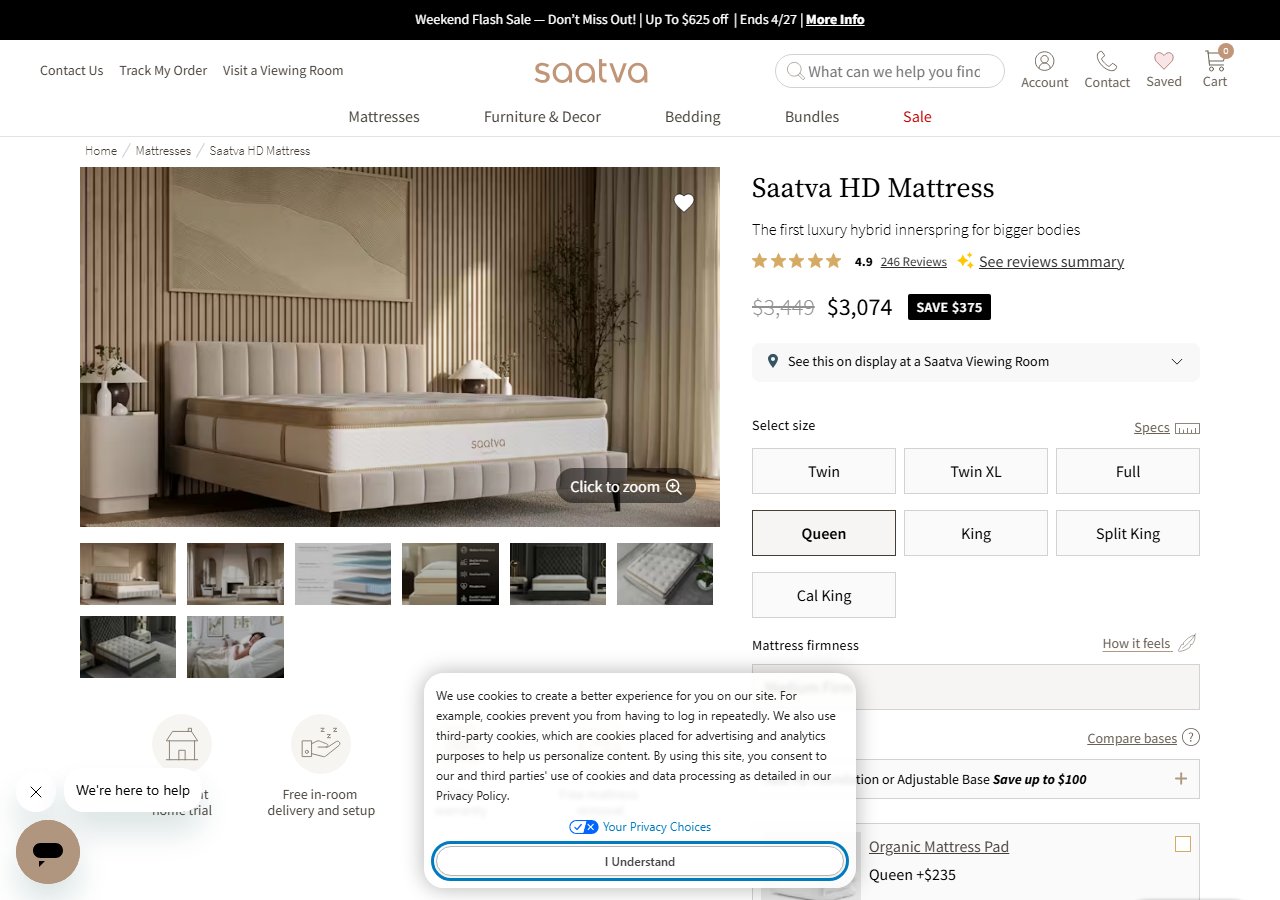
Saatva HD Mattress (Heavy-Duty)
$2,395-$3,995
See Price at Saatva →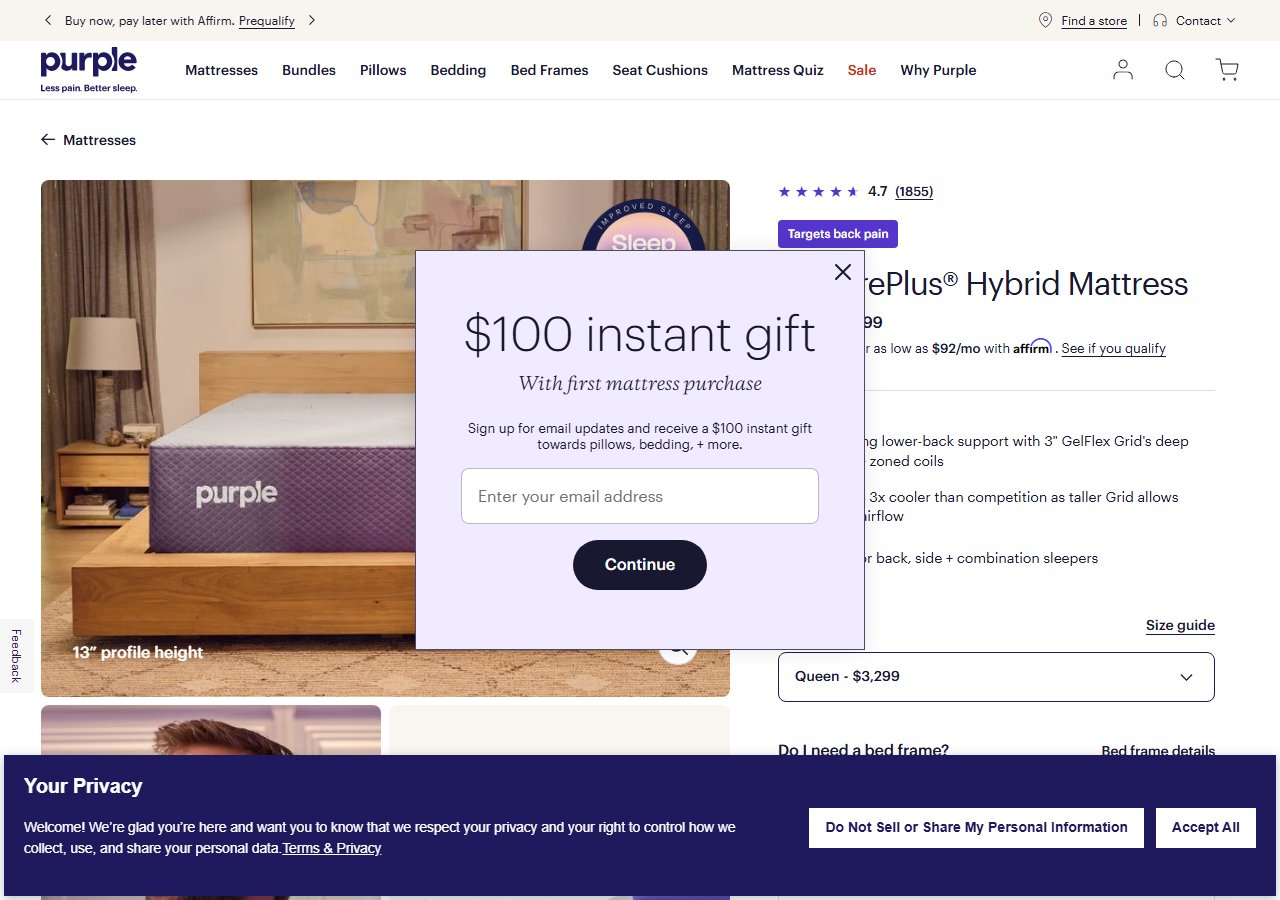
Purple Hybrid Premier Mattress
$2,499-$4,799
See Price at Purple →Putting It Together: The Right Sequence
The federal data tells a clear story. Back injury is the leading occupational injury by body part. Manual material handling in physically demanding jobs routinely exceeds safe spinal loading limits. Heavier adults carry that cumulative spinal load to a sleep surface that was usually not engineered for them. And chronic back pain, left unmanaged, is the leading pathway to disability claims in the United States.
The right sequence is not "buy a new mattress and see if it helps." The right sequence is: fix your sleep position tonight (free), add daily walking this week (free), learn proper lifting mechanics (free via OSHA guidance), audit your mattress honestly at the 7-to-10-year mark (maintenance), rule out structural causes with a clinician if any red flags are present, and then — if the sleep surface is genuinely the variable — match the mattress engineering to your specific biomechanical profile.
For adults over 250 lbs with occupational back stress, the Saatva HD's reinforced support system and the Loom & Leaf's high-density foam are the most directly aligned with what the spinal loading research suggests. The Purple Hybrid Premier is the right answer for those whose primary symptom is pressure-point pain in side sleeping. None of these is a substitute for movement, mechanics, and clinical oversight. All of them are meaningfully better than a sagging mattress that's adding 7 hours of spinal compression to a body that's already been working hard all day.