One in Five Americans Wakes Up in Pain — Federal Data Finally Explains Why
According to CDC NCHS Data Brief 390, approximately 20% of U.S. adults experience chronic pain, and when researchers ask where it hurts most, the answer is almost always the lower back. That is roughly 50 million people who begin each day — and often each night — negotiating with a spine that refuses to cooperate. The number is not an abstraction: it represents early morning stiffness that makes the first trip to the bathroom feel like a negotiation, the 3 a.m. repositioning ritual that ruins sleep architecture, and the workday fatigue that accumulates when restorative sleep never quite arrives.
The federal occupational data reinforces what the pain data suggests. BLS tracking of musculoskeletal disorders by occupation confirms that the back is the most common body part injured across all U.S. occupations with days away from work — every sector, every income bracket, every shift pattern. And the Social Security Administration's Disability Insurance reports show that musculoskeletal disorders are the single largest category of new disability claims filed each year. We are not talking about a niche health concern. We are talking about the dominant occupational and chronic-disease burden in the country.
What federal data does not always say loudly enough is how much of that burden is shaped by the eight hours a night most people spend horizontal — and by the surface they are horizontal on. This article unpacks the biomechanics, the free interventions federal agencies recommend, the red flags that require a clinician rather than a new mattress, and the specific mattress construction features that address the spinal loading patterns chronic back-pain sufferers actually experience.
Why Chronic Back Pain and Poor Sleep Reinforce Each Other
The relationship between chronic back pain and sleep is bidirectional and vicious. Pain disrupts sleep. Disrupted sleep amplifies pain sensitivity through central sensitization — a neurological process in which the spinal cord and brain downregulate their pain-inhibition pathways when sleep is chronically insufficient. CDC sleep data shows that approximately 35% of U.S. adults already report sleeping fewer than 7 hours per night, the threshold below which chronic disease risk escalates across multiple systems. For back-pain sufferers, that percentage is almost certainly higher.
The biomechanical mechanism starts with spinal loading. During waking hours, intervertebral discs absorb compressive forces from posture, movement, and especially occupational tasks. NIOSH's Lifting Equation documents that manual material-handling tasks across warehousing, construction, and healthcare routinely exceed safe spinal loading limits — meaning millions of workers finish every shift with discs and facet joints that have been loaded beyond their design tolerance. Sleep is supposed to be the decompression window: horizontal positioning reduces axial loading on the lumbar spine, intervertebral discs rehydrate through osmotic diffusion, and paraspinal muscles relax.
But that recovery only happens when the sleep surface allows the spine to remain neutral. A mattress that is too soft lets the heaviest body segment — the pelvis and lumbar region — sink into a V-shaped curve, hyperflexing the lumbar spine and keeping the posterior disc margin under tension for hours. A mattress that is too firm does the opposite: it holds the pelvis high and flattens the natural lordosis, loading the facet joints and creating pressure point pain at the sacrum and greater trochanters that forces constant repositioning. Neither scenario allows the decompression that the spine needs after a day of work.
The problem is compounded by sleep position. As NIH guidance on back pain explains, stomach-sleeping torques the lumbar spine and cervical spine simultaneously, creating sustained rotation across segments that are already inflamed. Side-sleeping or back-sleeping with appropriate support keeps the spine in a biomechanically neutral zone — but only if the mattress firmness is matched to body weight and preferred position.
CDC arthritis data adds another layer: approximately 25% of U.S. adults report doctor-diagnosed arthritis, concentrated in physically demanding occupations. For people with facet joint arthritis or sacroiliac joint involvement — both common in chronic low back pain presentations — the firmness and pressure-relief characteristics of the sleep surface can determine whether they wake able to move through their morning routine or not.
The financial consequences of undertreating this pain are stark. AHRQ's Medical Expenditure Panel Survey shows that average annual personal healthcare expenditures for adults with chronic back conditions substantially exceed costs for adults without them, and AHRQ HCUP data ranks back pain among the most expensive conditions in U.S. healthcare by total inpatient and outpatient cost. Meanwhile, CMS drug spending data identifies opioid and non-opioid pain medication spending among the most expensive Medicare drug categories, reflecting a chronic-pain treatment system that is long on pharmaceutical spend and short on behavioral and environmental intervention.
That last point matters here: a sleep surface optimization is an environmental intervention. It is not a cure, and it is not always the right starting point. But for someone already doing the right things clinically and behaviorally, a sleep surface that works against spinal recovery is a daily insult to whatever progress they are making.
Try These First — Free Interventions That Federal Data Supports
The cheapest intervention is the one that does not require buying anything. Before evaluating mattresses, chronic back-pain sufferers should audit the following evidence-based behaviors, each of which carries stronger federal-evidence support than any sleep product on the market.
Sleep position correction is the highest-leverage free variable. NIH's National Institute of Arthritis and Musculoskeletal and Skin Diseases specifically recommends side-sleeping with a pillow between the knees, or back-sleeping with a pillow under the knees — both of which keep the lumbar spine in neutral and reduce facet joint loading. Stomach-sleeping should be eliminated if possible; it sustains lumbar rotation and cervical extension for hours at a stretch.
Daily walking has a stronger evidence base than most people assume. NIH's National Center for Complementary and Integrative Health finds that walking 30 minutes on most days reduces chronic low back pain as effectively as most non-drug clinical treatments. Walking recruits the paraspinal musculature, promotes disc nutrition through loading-unloading cycles, and — critically — is free, repeatable, and scalable. A new mattress does not substitute for daily movement.
Lifting and bending mechanics are responsible for a significant share of acute-on-chronic back episodes. OSHA's ergonomics guidance recommends hinging at the hips rather than the lumbar spine, keeping loads close to the body, and avoiding spinal rotation under load. Most acute exacerbations in people with chronic low back pain are mechanical and rehearsable — meaning pattern correction can prevent them.
Mattress replacement criteria deserve an honest audit. CDC sleep hygiene guidance and clinical consensus suggest replacing a mattress when it shows visible sag, when you consistently wake stiffer than you went to bed, or when it is older than 7 to 10 years. Even the most expensive mattress does not undo poor sleep hygiene, chronic stress, sedentary daytime behavior, or an occupational exposure that remains unchanged.
For readers who have already addressed sleep position, implemented a walking routine, corrected their lifting mechanics, and confirmed their mattress genuinely needs replacement — the conversation about sleep surface construction becomes clinically relevant. A mattress that cannot maintain spinal neutrality across a full night is not a passive background variable. It is an active contributor to the pain cycle.
When to See a Clinician — Red Flags That No Mattress Addresses
Back pain that is mechanical and positional — the kind that improves with movement, changes with position, and has no systemic features — is the type most likely to respond to the interventions described above, including sleep surface optimization. Back pain with any of the following features is a different clinical picture entirely, and a mattress purchase is not the appropriate next step.
NIH's National Institute of Neurological Disorders and Stroke advises seeking prompt evaluation for back pain that radiates below the knee (which may indicate nerve root compression or stenosis), pain that follows trauma, pain accompanied by leg weakness, any changes in bowel or bladder function, or back pain that presents alongside fever. These symptoms can indicate serious structural, infectious, or neurological pathology that requires imaging and specialist referral — not a firmer mattress.
The BLS workers' compensation cost data is a useful frame here as well: BLS employer compensation data shows that industries with high musculoskeletal disorder incidence carry workers' compensation insurance rates 3 to 5 times higher than low-MSD industries. That cost structure exists because undertreated occupational back injuries escalate into long-term disability claims — exactly the pattern the SSA disability data documents. Early clinical intervention for red-flag presentations is far less expensive than delayed diagnosis. If you are unsure whether your symptoms meet the threshold for evaluation, the conservative answer is to call your provider.
Where Sleep Surface Construction Actually Matters
For the majority of chronic low back pain sufferers whose symptoms are positional, mechanical, and non-radicular, the mattress is a meaningful variable in their recovery environment. Three construction factors dominate the research literature: firmness level matched to body weight and sleep position, pressure relief at the iliac crest and greater trochanter (the hip prominences that bear disproportionate load in side-sleeping), and zoned support that allows the lumbar region to receive more resistance than the shoulder or hip zone.
Medium-firm mattresses consistently outperform both soft and firm options in the peer-reviewed literature on chronic low back pain — but "medium-firm" is not a standardized industry term. A medium-firm rating from one brand may test significantly differently on indentation load deflection (ILD) measurements than the same label from another. What matters more than the label is the construction: a mattress with individually pocketed coils at the base, targeted lumbar reinforcement, and a comfort layer calibrated for pressure relief — rather than maximum sink — will outperform a label-matched competitor built with inferior materials.
The Saatva Loom & Leaf Memory Foam Mattress is the premium memory foam pick for serious back-pain sufferers. Its multi-layer memory foam construction is available in Relaxed Firm and Firm configurations, giving back-pain sufferers who need lumbar support without pressure-point sacrifice a genuine choice rather than a single compromise. The organic cotton cover, dual tempered steel coil base, and targeted lumbar zone make this a mattress engineered around the spinal neutrality problem — not a generic comfort product.
For warehouse workers, construction laborers, healthcare workers, and others in the high-MSD occupational categories the BLS tracks, body weight and accumulated spinal loading create a different performance requirement. The standard consumer mattress is not built for bodies above 250 lbs or for the compressive load patterns that come with high-demand physical work. The Saatva HD Mattress addresses this directly: it is engineered for individuals up to 500 lbs, with a reinforced coil system, high-density foam core, and a lumbar crown support layer that specifically targets the region most stressed by manual labor. For the reader whose occupation is documented by NIOSH's Lifting Equation as routinely exceeding safe spinal loading — this is the tier of product that matches the load pattern.
For back-pain sufferers whose primary complaint is pressure-point pain rather than lumbar instability — particularly side-sleepers who wake with hip or shoulder pain that then triggers compensatory back pain — the pressure-relief architecture of the mattress becomes the dominant variable. The Purple Hybrid Premier Mattress uses a proprietary GelFlex Grid comfort system that distributes pressure differently from both memory foam and traditional latex: open channels in the grid collapse under pressure points while remaining firm under the lumbar and neutral zones. For side-sleeping back-pain sufferers who have tried firm mattresses and found them punishing at the hip, this construction approach offers a genuinely different pressure map.
All three mattresses represent different answers to the same underlying engineering problem: how to keep the lumbar spine in a neutral position for 7 to 9 hours while accommodating a body that arrives carrying the load history of an entire waking day.
Mattresses Engineered for Chronic Lumbar Pain — Three Federal-Data-Informed Picks
These three mattresses were selected for their specific construction features — firmness zoning, pressure relief, and load-bearing capacity — that directly address the spinal neutrality and pressure-point problems federal health data identifies in chronic back-pain sufferers.

Saatva Loom & Leaf Memory Foam Mattress
$1,695-$3,295
See Price at Saatva →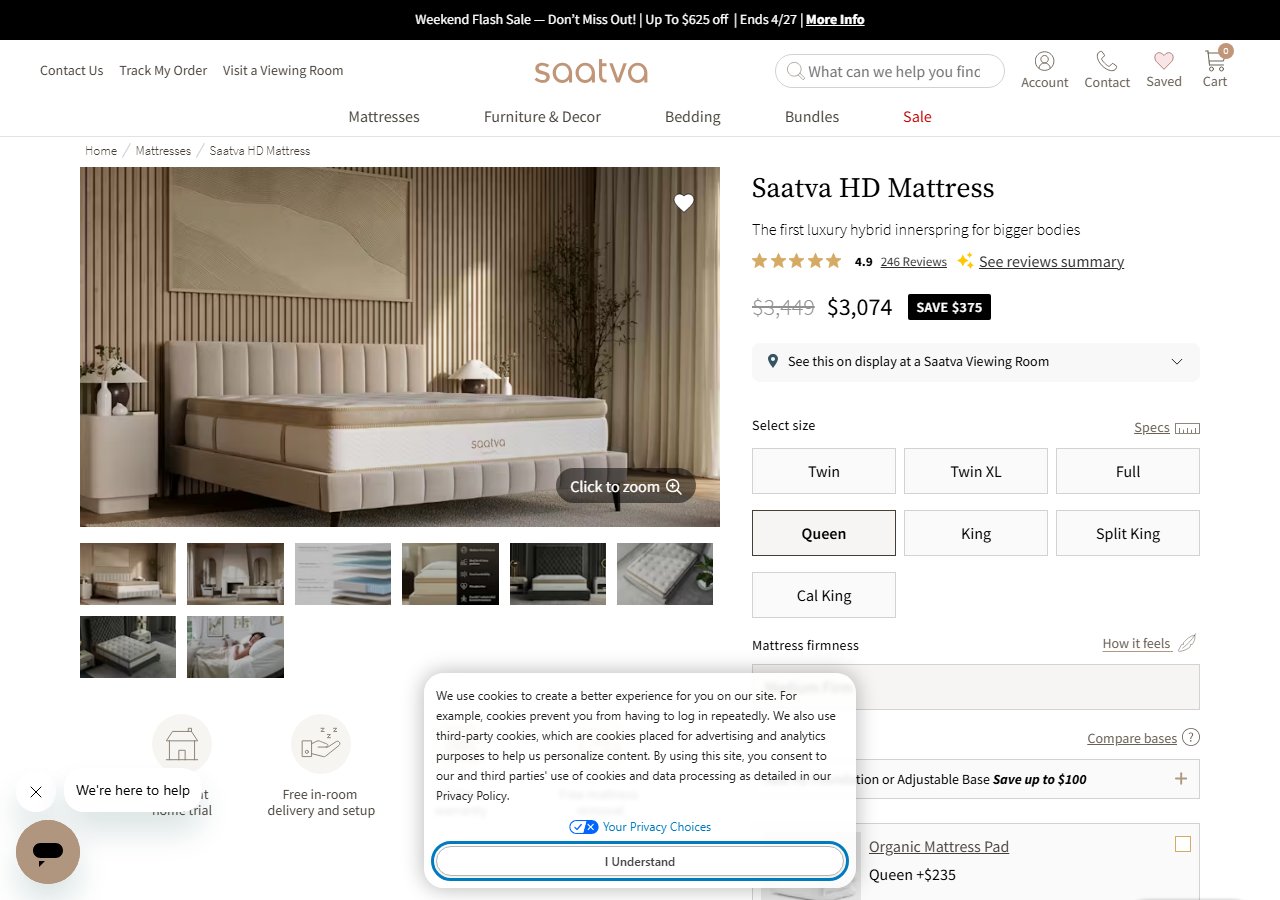
Saatva HD Mattress (Heavy-Duty)
$2,395-$3,995
See Price at Saatva →
Purple Hybrid Premier Mattress
$2,499-$4,799
See Price at Purple →The Data-to-Intervention-to-Product Hierarchy
The federal data on chronic back pain tells a consistent story: this is a condition that affects one in five Americans, drives the largest category of new disability claims, generates some of the highest per-patient healthcare costs in the system, and is concentrated in the occupational groups most exposed to spinal overloading. It is undertreated, often managed pharmaceutically rather than behaviorally and environmentally, and profoundly disrupted by — and disruptive of — sleep.
The appropriate response to that data is not to lead with a product recommendation. It is to lead with movement, sleep position correction, lifting mechanics, and an honest assessment of whether the current sleep surface is genuinely part of the problem. For those readers who have done that audit and confirmed the mattress is a contributing variable, the construction principles documented here — firmness matched to body weight and position, pressure relief at bony prominences, zoned lumbar support — are the features worth paying for.
The Saatva Loom & Leaf addresses serious lumbar support needs in a premium memory foam platform. The Saatva HD addresses the specific load patterns of physically demanding occupations and larger bodies. The Purple Hybrid Premier addresses pressure-point-driven pain in side-sleepers. None of them replace a walking routine, a clinician's evaluation for red-flag symptoms, or the zero-cost intervention of sleeping with a pillow between your knees tonight. But for a condition that costs the healthcare system billions annually and keeps 50 million Americans from sleeping well, optimizing the sleep environment is not an indulgence. It is part of the recovery protocol.