One in five Americans wakes up in pain — federal data explains why
CDC NCHS Data Brief 390 puts the number plainly: approximately 20% of U.S. adults experience chronic pain, and the lower back is the most common single pain location in that population. That is not a rounding error — it is roughly 50 million people navigating daily life around a spine that will not give them a break. For millions of them, the worst moment of the day is not the commute or the desk shift or the warehouse floor. It is the first thirty seconds after the alarm goes off, when the body stiffens into the position it held all night and the lumbar spine sends its morning report.
The economic signal matches the clinical one. AHRQ's Medical Expenditure Panel Survey (MEPS) documents that adults with chronic back conditions spend substantially more on personal healthcare annually than adults without those conditions. AHRQ's HCUP database identifies back pain as one of the most expensive conditions in U.S. healthcare measured by combined inpatient and outpatient cost. And SSA Disability Insurance reports show that musculoskeletal disorders — the category that includes chronic low back conditions — represent the single largest source of new disability claims every year. This is not a niche wellness topic. It is a public health and economic emergency wearing comfortable clothes.
The workplace dimension is equally stark. BLS Musculoskeletal Disorders by Occupation data identifies the back as the most common injured body part across all U.S. occupations with days away from work. Workers in warehousing, construction, nursing, and long-haul trucking carry disproportionate lumbar load throughout their working years. BLS Employer Costs data shows industries with high musculoskeletal disorder incidence pay workers' compensation insurance rates 3 to 5 times higher than low-MSD sectors — a figure that reflects the downstream cost of years of cumulative spinal loading. And the NIOSH Lifting Equation documents that manual material-handling tasks in warehousing, construction, and healthcare routinely exceed safe spinal loading limits, meaning millions of workers arrive home each night with spines that have already been pushed past their design tolerance before they ever lie down.
The problem compounds at night. CDC sleep data shows approximately 35% of U.S. adults report sleeping fewer than 7 hours per night, the threshold associated with elevated chronic disease risk. Sleep deprivation is not a side issue for back pain sufferers — it is a direct pain amplifier. Animal and human studies consistently show that sleep restriction lowers pain thresholds. A body that cannot get restorative sleep because its sleep surface is aggravating lumbar pain is caught in a closed loop: pain disrupts sleep, poor sleep intensifies pain sensitivity, and the cycle continues.
Why the spine degrades overnight — the biomechanical mechanism
Understanding why sleep surfaces matter for chronic lumbar pain requires a brief detour into spinal mechanics. The lumbar spine is a load-bearing column of five vertebrae separated by intervertebral discs — cartilaginous shock absorbers that rely on cyclical compression and decompression to maintain hydration and structural integrity. During upright hours, gravity compresses the discs. During sleep, horizontal unloading theoretically allows the discs to rehydrate. But that rehydration only occurs if the spine maintains a neutral lordotic curve throughout the night.
A sleep surface that is too soft allows the heavier pelvis to sink disproportionately, placing the lumbar spine into chronic flexion for six to eight hours. A sleep surface that is too firm does not conform to the natural lumbar curve, leaving the lumbar spine unsupported in a slightly extended, suspended position. Either deviation — excessive flexion or excessive extension held for hours — creates sustained tension on the posterior spinal ligaments, facet joints, and paraspinal musculature. People with degenerative disc disease, lumbar spondylosis, spinal stenosis, or sacroiliac joint dysfunction are particularly vulnerable to both failure modes.
CDC Arthritis data shows approximately 25% of U.S. adults have doctor-diagnosed arthritis, and spinal arthritis is a major subset. For this population, morning stiffness is a nearly universal complaint — and in many cases, the sleep surface is a direct contributor. The clinical literature on firmness consistently points toward medium-firm surfaces as optimal for non-specific chronic low back pain, though individuals with specific pathologies (spinal stenosis, for example, where flexion is often relieving) may require surface adjustments.
Sleep position compounds the surface question. The NIH National Institute of Arthritis and Musculoskeletal and Skin Diseases recommends side-sleeping with a pillow between the knees, or back-sleeping with a pillow under the knees, as the two positions best suited to maintaining lumbar neutrality. Stomach-sleeping — which rotates the cervical spine and pushes the lumbar spine into extension — is consistently flagged as the worst position for chronic lower back pain. A medium-firm mattress that supports neutral alignment interacts with sleep position; neither variable works in isolation.
Try these first — the interventions that cost nothing
The cheapest intervention is the one that does not require buying anything. Before evaluating any sleep surface, back pain sufferers should audit the free variables available to them. The federal evidence base supports several non-product interventions with evidence quality comparable to or exceeding that of many clinical treatments. The following five interventions are grounded in NIH, NIOSH, and OSHA guidance — and each one can be started this week at zero cost.
Daily walking is the one that surprises most people. NIH NCCIH's evidence review on low back pain finds that walking 30 minutes most days reduces chronic low back pain as effectively as most non-drug clinical treatments. This is not a soft recommendation. The evidence quality for walking rivals that for physical therapy for non-specific chronic low back pain. A new mattress is a static intervention — it changes one variable in a sedentary system. Walking is dynamic load management.
Sleep position correction is the most direct free variable for nocturnal pain. NIH NIAMS back pain guidance recommends side-sleeping with a pillow between the knees or back-sleeping with a pillow under the knees. A $12 pillow repositioned tonight costs nothing meaningful and directly addresses the lumbar flexion or extension problem described in the mechanism section above.
Lifting and bending mechanics matter enormously for the 60% of chronic back pain sufferers whose condition was triggered or is maintained by occupational load. OSHA ergonomics guidance recommends hinging at the hips rather than the lumbar spine, keeping loads close to the body, and avoiding twisting under load. Most acute back episodes are mechanical and therefore rehearsable — the movement pattern can be reprogrammed.
Mattress replacement criteria deserve clear framing. CDC sleep hygiene guidance and general clinical consensus support replacing a mattress when it shows visible sag, when you consistently wake stiffer than you went to bed, or when it is older than 7 to 10 years. This is not a reason to buy a new mattress speculatively — it is a diagnostic checklist. If none of these apply, a new mattress may not be the variable.
Red flags requiring a clinician rather than a mattress are addressed by NIH NINDS back pain guidance: pain that radiates below the knee, follows trauma, comes with leg weakness, or involves bowel or bladder changes requires imaging and clinical evaluation, not a softer sleep surface.
For readers who have already addressed sleep position, replaced a visibly sagging mattress, and are walking daily — and whose pain still reliably worsens with sleep — the sleep surface itself becomes a legitimate intervention target. The evidence for medium-firm mattresses in chronic low back pain is consistent enough that this is a reasonable clinical recommendation, not merely a consumer preference. The question then becomes: which construction approach best delivers neutral lumbar support for the specific load pattern of a chronic back pain sufferer?
When to see a clinician — the red flags that change the equation
A mattress is appropriate for managing the sleep-surface contribution to mechanical chronic low back pain. It is not appropriate for any of the following presentations, and purchasing a new mattress while delaying care for these conditions carries real clinical risk.
The NIH National Institute of Neurological Disorders and Stroke identifies these as priority referral criteria: back pain that radiates below the knee (possible nerve root compression or disc herniation requiring imaging), back pain following any trauma regardless of severity in adults over 50 (possible vertebral fracture), back pain accompanied by new leg weakness or numbness (possible cauda equina syndrome, a surgical emergency), and back pain with fever or unexplained weight loss (possible infection or malignancy). The NIH NIAMS adds bowel or bladder dysfunction to this list — loss of control or retention paired with back pain requires same-day emergency evaluation.
CMS drug spending data identifies opioid and non-opioid pain medication spending among the most expensive Medicare drug categories — a signal of how aggressively the healthcare system manages undertreated back pain with pharmacological tools once it becomes severe. Early clinical engagement before pain escalates to that level is consistently better for the patient and dramatically cheaper for the system. If your back pain is already managed with prescription medication and you have not had a recent imaging workup or physical therapy evaluation, a clinician visit is more valuable than any mattress purchase.
Where sleep surfaces actually help — and which construction approaches are supported
For readers who have cleared the clinical red flags, are managing the behavioral variables, and have confirmed their current surface is contributing to their pain pattern, the sleep surface decision becomes concrete. The evidence for medium-firm mattresses in chronic non-specific low back pain is the most consistent finding in the clinical literature. A 2003 randomized controlled trial in The Lancet — still among the most-cited studies in this space — found medium-firm mattresses produced significantly better outcomes than firm mattresses for chronic low back pain. More recent systematic reviews have held up this finding.
Beyond firmness, two construction variables matter for back pain sufferers: zoned support (differential firmness under the heavier pelvis relative to the lumbar spine and shoulders) and pressure relief (the ability of the surface layer to distribute contact pressure across the entire body rather than concentrating it at bony prominences). For side sleepers with back pain, pressure relief at the shoulder and hip prevents the compensatory lumbar rotation that happens when those areas are uncomfortable. For back sleepers, zoned lumbar support — firmer under the lumbar spine and sacrum — maintains the lordotic curve during sleep.
With those construction criteria in mind, three options stand out for chronic back pain sufferers at different price points and body types.
The Saatva Loom & Leaf Memory Foam Mattress is the premium memory foam pick for serious back pain. It uses a multi-layer American-made memory foam construction with a dual-layer lumbar zone support enhancement that specifically targets the L2-to-sacrum region where the majority of chronic low back pain originates. The Relaxed Firm option (5.5 on a firmness scale) hits the medium-firm sweet spot that the clinical literature supports, while the Firm option (7-8) suits back sleepers who need more aggressive lumbar support. Saatva's white-glove delivery and old-mattress removal service is worth noting for people whose pain makes moving heavy objects difficult.
For physically larger adults — specifically those in trades, warehousing, or any occupation involving sustained physical demand — the Saatva HD Mattress addresses a biomechanical failure mode that standard mattresses cannot. Standard mattresses are typically engineered for body weights up to 250 to 300 pounds. Above that threshold, even a nominally medium-firm mattress will deflect at the pelvis, placing the lumbar spine into the chronic flexion posture described in the mechanism section. The Saatva HD uses a custom-tempered dual coil system and high-density foam perimeter that maintains consistent support geometry for individuals up to 500 pounds, which is the engineering specification that matters for this population.
The Purple Hybrid Premier Mattress takes a different engineering approach: a grid-based pressure-relief system layered over a pocketed coil support core. The Purple Grid uses a hyperelastic polymer that collapses under localized pressure (bony prominences like hips and shoulders) while remaining supportive under distributed load (the lumbar spine). For side sleepers with back pain — where hip and shoulder pressure relief is the primary driver of lumbar comfort — this construction approach directly addresses the mechanism. The 3-inch grid variant provides more pronounced pressure relief than the 2-inch version, relevant for individuals with significant lateral hip loading from long work shifts.
Sleep Surfaces Matched to Chronic Lumbar Biomechanics
Each of these three options was selected based on construction characteristics — firmness calibration, zoned lumbar support, and pressure-relief engineering — that directly address the biomechanical failure modes driving nocturnal back pain, as documented by federal health data.

Saatva Loom & Leaf Memory Foam Mattress
$1,695-$3,295
See Price at Saatva →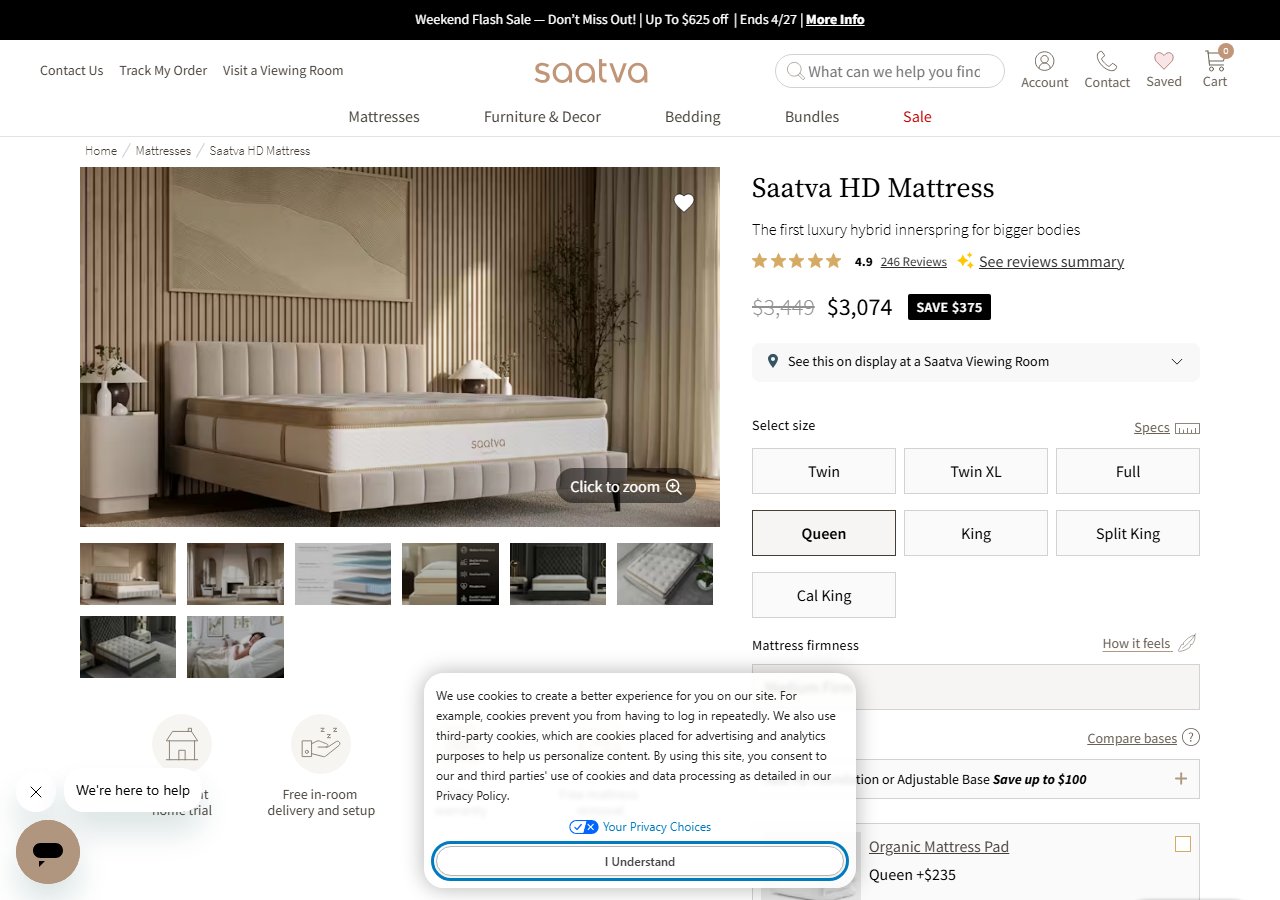
Saatva HD Mattress (Heavy-Duty)
$2,395-$3,995
See Price at Saatva →
Purple Hybrid Premier Mattress
$2,499-$4,799
See Price at Purple →The data-to-intervention-to-product hierarchy — a summary
The federal data on chronic back pain is unambiguous about scale: 20% of adults, the leading injury site across all U.S. occupations, the largest single driver of new disability claims, and one of the most expensive conditions in U.S. healthcare. What the data also shows — if you read NIOSH lifting guidance, NIH walking evidence reviews, and AHRQ cost data together — is that the treatment burden is largely downstream of preventable mechanical load management failures.
The sleep surface is one variable in that system. It is a real variable — the biomechanical case for medium-firm, zoned, pressure-relieving surfaces in chronic lumbar pain is supported by clinical evidence — but it is downstream of sleep position, daily movement, and lifting mechanics. Address those first. If pain persists and the mattress is old, visibly degraded, or clearly mismatched to your body weight, then the surface investment is justified. The three options described above — the Loom & Leaf for the memory foam buyer, the Saatva HD for heavier-framed individuals in physically demanding occupations, and the Purple Hybrid Premier for side sleepers prioritizing pressure relief — each represent construction approaches that are specifically matched to the lumbar biomechanics described by the federal evidence base. None of them are magic. All of them are better than sleeping on a sagging ten-year-old mattress and wondering why your back does not recover.