One in Five U.S. Adults Wakes Up in Pain — Federal Data Explains Why
If your lower back aches before you've had your first cup of coffee, you are not alone — and you are not imagining it. CDC NCHS Data Brief 390 documents that approximately 20% of U.S. adults experience chronic pain, with the lower back as the single most reported pain location. That is roughly 65 million Americans navigating daily life — and nightly sleep — around a spine that won't cooperate.
The economic weight behind that statistic is staggering. AHRQ's Healthcare Cost and Utilization Project (HCUP) identifies back pain as one of the most expensive conditions in the entire U.S. healthcare system by combined inpatient and outpatient cost. AHRQ's Medical Expenditure Panel Survey (MEPS) adds the granular picture: adults with chronic back conditions spend substantially more on personal healthcare every single year than adults without those conditions. And SSA Disability Insurance data confirms the endpoint nobody wants to reach — musculoskeletal disorders are the largest single category of new disability claims filed annually in the United States.
Those numbers frame the stakes. But they don't yet explain why chronic lumbar pain is so persistent, why sleep tends to make it worse rather than better, or what the evidence actually says about fixing it. That's where we're going.
Why Chronic Lower Back Pain Is a Nocturnal Problem
The back doesn't get a break during sleep — it gets loaded differently. During waking hours, the erector spinae muscles, deep spinal stabilizers, and surrounding soft tissue share the compression load from gravity and movement. Lie down, and the muscular bracing drops out. What remains is the passive load distributed across vertebral discs, facet joints, and the ligament system.
For a healthy spine, that passive unloading at night is restorative. For a spine dealing with disc degeneration, facet arthritis, spinal stenosis, or chronic soft-tissue dysfunction, the wrong sleep position or the wrong surface can mean six to eight hours of sustained mechanical stress on already sensitized structures — producing the classic symptom pattern of waking stiffness that eases slowly over 30 to 60 minutes.
The occupational data reinforces this picture. BLS Musculoskeletal Disorders by Occupation tracking consistently shows the back as the most common body part injured across all U.S. occupations involving days away from work. The NIOSH Lifting Equation documents that manual material-handling tasks across warehousing, construction, and healthcare routinely exceed safe spinal loading limits — meaning millions of workers arrive home each night with spines that have already absorbed compressive and shear forces beyond recommended thresholds. Those workers then sleep on whatever surface they happen to own, in whatever position habit has established, compounding the daytime insult.
CDC sleep data shows approximately 35% of U.S. adults report sleeping less than 7 hours per night — the threshold associated with elevated chronic disease risk. Sleep deprivation independently amplifies pain sensitivity through central sensitization pathways. The relationship runs in both directions: chronic back pain fragments sleep, and fragmented sleep lowers the pain threshold, creating a feedback loop that is difficult to interrupt with any single intervention.
CDC Arthritis Data notes that approximately 25% of U.S. adults report doctor-diagnosed arthritis, with highest prevalence in occupations involving sustained physical demand. Lumbar facet arthritis is a common contributor to chronic low back pain and creates a specific mechanical pattern: stiffness that worsens with extension (lying flat on a firm surface with the lumbar spine unsupported) and improves with mild flexion (side-lying with knees slightly bent).
Understanding the mechanism matters because it tells you which variables are actually modifiable — and it tells you that a new mattress addresses only a subset of them.
The Cheapest Intervention Is the One That Costs Nothing
Before discussing any product, it's worth sitting with what the federal evidence base actually says works for chronic low back pain. The short answer: movement, position correction, and lifting mechanics have stronger and more consistent evidence than passive interventions including, yes, mattress upgrades.
NIH NCCIH's evidence review on low-back pain documents that walking 30 minutes most days reduces chronic low back pain as effectively as most non-drug clinical treatments. Not physical therapy equipment, not expensive devices — walking. Daily locomotion addresses the muscle deconditioning, the fascial stiffness, and the central sensitization that accumulate when a painful back causes a person to move less, causing more pain, causing still less movement.
Sleep position is the other high-leverage free variable. NIH National Institute of Arthritis and Musculoskeletal and Skin Diseases back pain guidance is specific: side-sleeping with a pillow between the knees, or back-sleeping with a pillow under the knees, keeps the lumbar spine in a neutral position. Stomach-sleeping places the lumbar spine in sustained extension and rotation — a posture that loads facet joints and compresses intervertebral foramina for hours at a time. Changing sleep position costs nothing and, for many people, produces immediate results.
For the large subset of back pain sufferers whose conditions are occupationally driven, OSHA's lifting guidance provides the mechanical framework: hinge at the hips not the lumbar spine, keep loads close to the body, avoid twisting under load. Most acute back episodes are mechanical and therefore trainable. Correcting the daytime biomechanics reduces the cumulative load that arrives at the sleep surface each night.
Finally, a word about knowing when the mattress itself is the problem versus when it's contributing: replace a mattress if it has visible sag, if you wake stiffer than you went to bed, or if it is older than 7 to 10 years. But even the most expensive mattress on the market does not undo poor sleep hygiene or sedentary days. CDC Sleep Hygiene guidance is clear that consistent sleep schedules, dark and cool sleeping environments, and limited pre-bed screen exposure are foundational — and they cost nothing.
For readers who have already addressed position, movement habits, and mattress age — and who are still waking with significant lumbar stiffness or pain — a purpose-built sleep surface becomes a legitimate next step. The evidence for mattress firmness in chronic back pain is real, if more nuanced than marketing language suggests. We'll get to that. But first, a section you should not skip.
When to See a Clinician Before You See a Product Page
Not all back pain is mechanical. Some presentations require imaging, specialist evaluation, or urgent care — and no mattress addresses those. NIH National Institute of Neurological Disorders and Stroke back pain guidance identifies specific red flags that warrant prompt clinical evaluation rather than passive management.
The CMS Drug Spending Dashboard identifies opioid and non-opioid pain medication spending among the most expensive Medicare drug categories — a direct reflection of how often chronic back pain becomes a managed pharmaceutical condition rather than a treated structural one. Early clinical evaluation, when red flags are present, is the intervention most likely to prevent that outcome. BLS workers' compensation data also shows industries with high MSD incidence carry workers' compensation insurance rates 3 to 5 times higher than low-MSD industries — meaning occupational back injuries have systemic financial consequences that go far beyond the individual's pain experience.
If any of the following apply to you, the right next step is a clinician visit, not a new mattress:
- Back pain that radiates below the knee, particularly with numbness or tingling in the foot
- Back pain following trauma (a fall, motor vehicle collision, or work injury)
- Back pain accompanied by leg weakness or foot drop
- Back pain with bowel or bladder changes — urgency, incontinence, or retention
- Back pain with unexplained fever, night sweats, or unintentional weight loss
- Back pain in adults over 50 with osteoporosis risk factors (postmenopausal women, long-term steroid users)
These presentations require evaluation that no consumer product can substitute for.
What Sleep Surface Research Actually Shows for Lumbar Conditions
For the large majority of chronic back pain sufferers who have mechanical, positional, or degenerative lumbar conditions without red flags, sleep surface does matter — but the evidence is more specific than "firmer is better" or "softer is better."
The research literature on mattress firmness and back pain has evolved substantially over the past 20 years. The older clinical dogma that firm mattresses were universally better has not survived randomized controlled trials. Medium-firm surfaces consistently outperform both very firm and very soft in studies of chronic low back pain, because medium-firm allows enough contouring to reduce pressure at the shoulders and hips (keeping the spine horizontal rather than bowed) while providing enough pushback to prevent the lumbar spine from sinking into excessive flexion.
For side sleepers — the position NIH recommends for lumbar pain — pressure relief at the shoulder and hip is the critical mechanical variable. If a surface is too firm, the shoulder and hip absorb all the load and the spine hangs unsupported between them. If it's too soft, the shoulder and hip sink until the spine follows in a lateral curve. The correct surface holds the shoulder and hip while supporting the spine through the dip.
For back sleepers with chronic lumbar conditions, particularly facet arthritis, mild lumbar lordosis support matters. The lumbar spine has a natural inward curve; a surface that bridges across that curve leaves it unsupported. A surface that conforms to it (or a pillow under the knees to flatten the lumbar curve) distributes load more evenly.
Memory foam and pressure-relieving hybrid designs are the categories that mechanical research most consistently supports for these goals — not because they carry a particular brand's marketing, but because their conforming properties address the specific failure modes of too-firm and too-soft surfaces described above.
With that mechanical framework established, here are the specific products that best match the evidence:
For readers whose primary complaint is pressure-point sensitivity combined with lumbar aching — the waking-stiff-at-shoulders-and-hips pattern common in side sleepers with disc degeneration — the Saatva Loom & Leaf Memory Foam Mattress is the premium memory foam pick in this category. Loom & Leaf uses a 5-lb high-density memory foam layer over tempered steel coils, producing the conforming pressure relief that mechanical research supports for lateral sleeping, while the coil layer provides enough pushback to prevent lumbar sag. It's available in a Relaxed Firm option (medium-firm, the firmness level most consistently supported by the trial literature) and a Firm option for back sleepers who want more support underneath the lumbar curve.
For readers in physically demanding occupations — warehouse workers, construction laborers, agricultural workers — whose spines have absorbed compressive loading significantly above NIOSH's recommended limits during the workday, the Saatva HD Mattress is engineered specifically for higher body weights and load patterns. Its individually wrapped coil system uses a wider gauge and higher coil count than standard mattresses, maintaining its support profile under loads that cause standard consumer mattresses to sag prematurely. Sagging is the single most common mechanism by which mattresses contribute to back pain — the surface conforms to the sleeper's worst habitual position rather than supporting a neutral one. For the warehouse worker or construction laborer who ends each shift having already tested the limits of spinal loading, a mattress that maintains structural integrity over time is a meaningful ergonomic investment.
For readers whose primary complaint is pressure sensitivity — the burning or aching at pressure points that wakes them or prevents them from finding a comfortable position — the Purple Hybrid Premier Mattress uses Purple's GelFlex Grid technology, a polymer grid that collapses under bony prominences (shoulder, hip, knee) and remains firm under supported areas (lumbar spine, legs). This differentiated response — softer where pressure is highest, firmer where support is needed — is mechanically well-suited to the side-sleeping pattern recommended by NIH for lumbar pain. The Hybrid Premier adds a pocketed coil base for motion isolation and edge support, addressing the practical sleep needs of people who share a bed.
Mattresses Engineered for Chronic Lumbar Conditions
Each pick below was selected for its mechanical fit with the sleep position and spinal loading research described above — not for marketing claims. These are surface choices for readers who have already addressed position, movement, and clinical red flags.

Saatva Loom & Leaf Memory Foam Mattress
$1,695-$3,295
See Price at Saatva →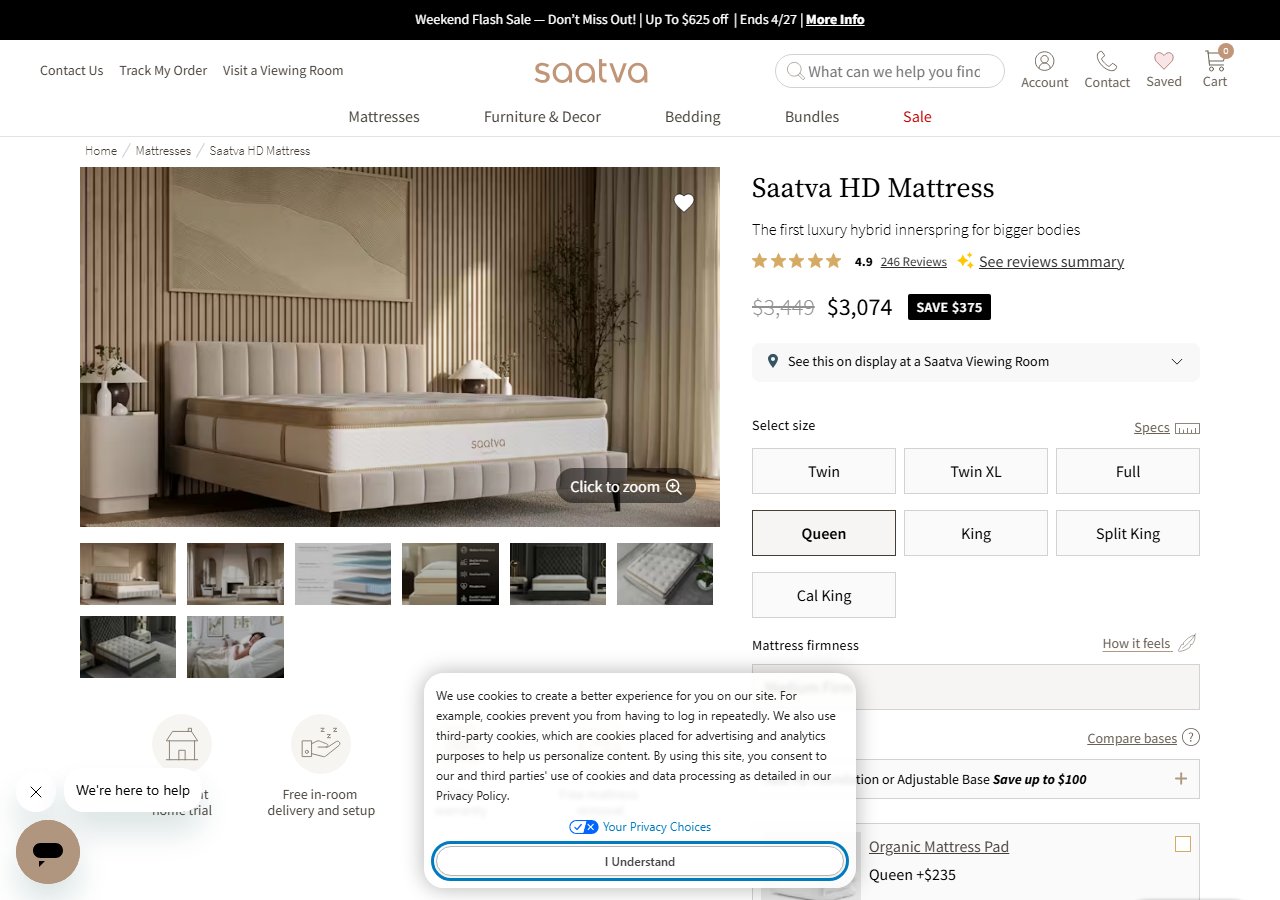
Saatva HD Mattress (Heavy-Duty)
$2,395-$3,995
See Price at Saatva →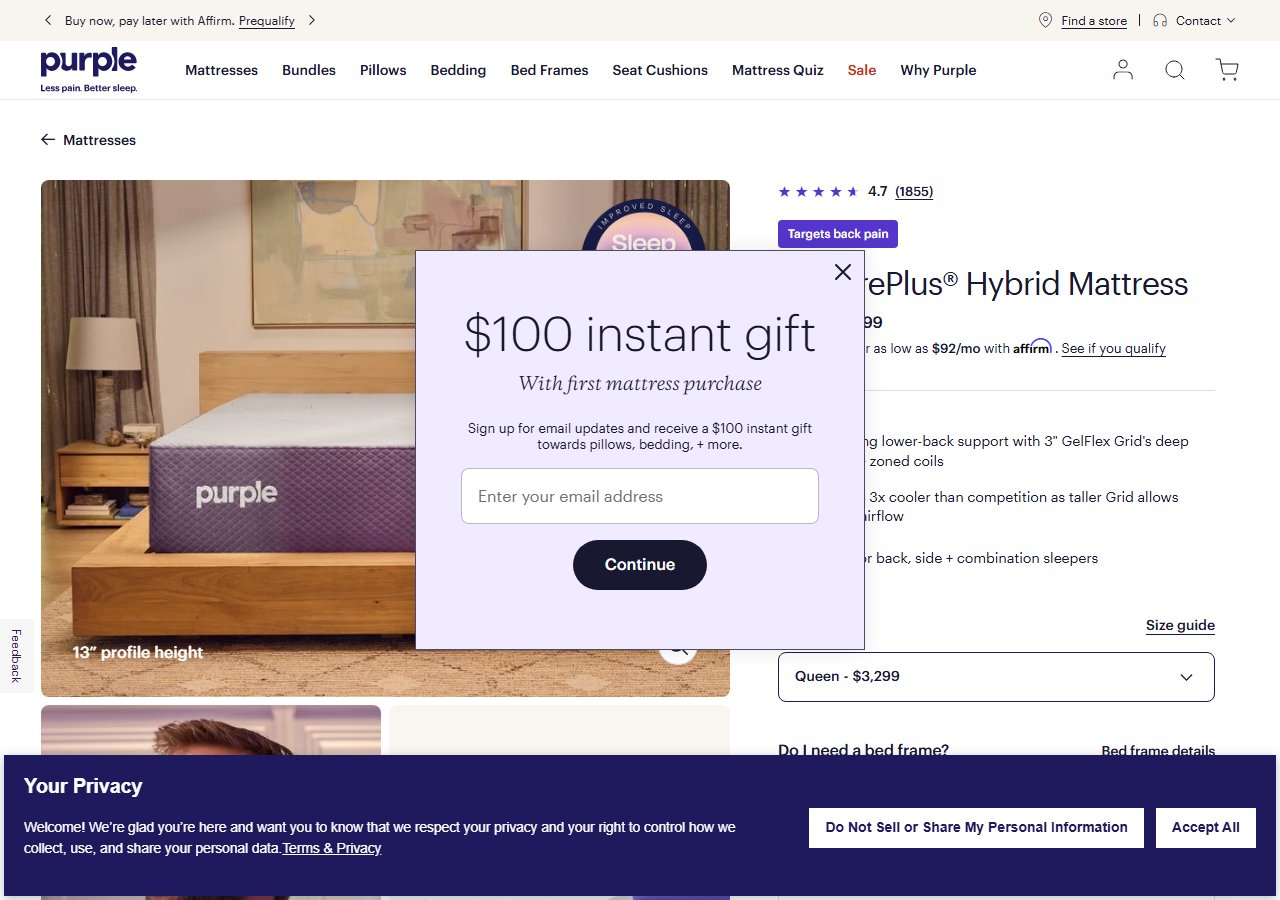
Purple Hybrid Premier Mattress
$2,499-$4,799
See Price at Purple →Putting the Evidence Together: A Hierarchy That Actually Works
The federal data tells a coherent story if you read it as a hierarchy rather than a product guide. At the top: movement is medicine. NIH NCCIH's evidence is unambiguous — 30 minutes of daily walking reduces chronic low back pain as effectively as most clinical non-drug treatments. Below that: position is free. The NIH NIAMS recommendation to sleep with a pillow between the knees (side) or under the knees (back) costs nothing and addresses the spinal mechanics directly. Below that: occupational load management — NIOSH and OSHA have documented the mechanisms of spinal overload and the mechanics of preventing it. Below that: clinical evaluation when red flags are present, before any passive intervention is pursued.
Sleep surfaces enter the hierarchy as adjuncts — meaningful ones for people who have addressed the layers above and still find that their surface is contributing to pain through sag, insufficient pressure relief, or mismatch with their sleep position. For those readers, the evidence supports medium-firm, pressure-relieving designs, specifically memory foam and hybrid options that combine contouring with adequate lumbar support.
The economic stakes described by AHRQ MEPS, AHRQ HCUP, and the SSA disability data are real: untreated or inadequately managed chronic back pain has a compounding cost trajectory — more medications, more procedures, more lost workdays, and in the worst cases, disability claims. A sleep surface that genuinely reduces nocturnal loading on an already stressed spine is a legitimate tool in that prevention calculus. But it works as a tool, not a cure — and it works best when it's the last piece added to a foundation of movement, position awareness, and appropriate clinical oversight.
The one in five Americans with chronic back pain deserves a complete picture of what the evidence actually supports. That picture starts with walking, continues through sleep position, passes through clinical red flag screening, and — for those who still need it — arrives at a purpose-built surface. In that order.
This article is an analysis of publicly available federal data and published research. It is not medical advice. Consult a licensed clinician for diagnosis and treatment of any back pain condition.