One in Five Americans Wakes Up in Pain Every Day
CDC NHANES survey data puts the chronic pain prevalence figure at approximately 20% of U.S. adults — roughly 51 million people — and the lower back is the single most common pain site in that population. That is not a rounding error. It means that in every office, on every job site, and in every household, one in five people is managing a condition that follows them from their waking hours into their sleep and back again. And sleep, it turns out, is one of the places where chronic lumbar pain is either quietly made worse or modestly improved — every single night.
This article does not argue that a mattress will cure chronic back pain. Federal data does not support that claim, and anyone making it is not your ally. What the evidence does support is that sleep surface firmness, sleep position, and spinal alignment during the 6–9 hours you spend horizontal are modifiable variables — ones that interact directly with the biomechanics responsible for your pain. Understanding those mechanics is where this analysis begins.
Why Chronic Lumbar Pain Gets Worse at Night
The lumbar spine — the five vertebrae between the thoracic cage and the sacrum — bears the largest compressive loads of any spinal segment during upright activity. The intervertebral discs in this region are subjected to forces that NIOSH's Lifting Equation documentation confirms routinely exceed safe spinal loading limits in manual-handling occupations including warehousing, construction, and healthcare. Compression forces during lifting can reach 3,400 Newtons or higher, which is the NIOSH action limit for disc injury risk.
But sleep is supposed to be decompression time. The problem is that decompression only happens when the spine is actually in a neutral position — when the natural lumbar curve is supported, not flattened against a too-firm surface or allowed to sag into a too-soft one. When the sleep surface fails to maintain that curve, two things happen:
- Paraspinal muscles do not fully relax. They remain in low-grade isometric contraction trying to protect lumbar alignment. Over 7–8 hours, this is the equivalent of a very slow, sustained workout — you wake stiff and fatigued rather than recovered.
- Disc rehydration is impaired. Intervertebral discs absorb fluid during unloaded rest. If loading is never truly removed — because the spine is twisted or compressed against an unsupportive surface — disc rehydration is incomplete. Over months, this contributes to the degenerative cascade that spinal imaging eventually documents.
BLS tracking of musculoskeletal disorders by occupation confirms that the back is the most frequently injured body part across all U.S. occupations resulting in days away from work. That injury pattern does not begin and end at the job site. Workers who accumulate spinal load during the day and then sleep on poorly matched surfaces are loading a disc that never fully recovers. The cumulative effect is what eventually shows up in an MRI.
The financial weight of this is staggering. AHRQ HCUP data identifies back pain as one of the most expensive conditions in the U.S. healthcare system by total inpatient and outpatient cost. AHRQ MEPS data shows that average annual personal healthcare expenditures for adults with chronic back conditions substantially exceed those for adults without such conditions. And CMS drug spending data places opioid and non-opioid pain medication among the most expensive Medicare drug categories — a direct reflection of how undertreated and undertooled this population is. SSA Disability Insurance data identifies musculoskeletal disorders as the largest single category of new disability claims every year. The system is paying an enormous price for a condition that, in many cases, has sleep as a modifiable input.
Sleep itself is already compromised in this population. CDC sleep data shows approximately 35% of U.S. adults report sleeping fewer than 7 hours per night — the threshold below which chronic disease risk rises measurably. For chronic back pain sufferers, pain-interrupted sleep is a well-documented contributor to that deficit. The pain-sleep relationship is bidirectional: poor sleep lowers pain thresholds, and elevated pain disrupts sleep architecture. Breaking that cycle requires addressing both sides.
The Biomechanics of Firmness: What the Research Actually Shows
The popular advice to "sleep on a firm mattress" for back pain is an oversimplification that clinical researchers have largely walked back. The mechanism is nuanced:
Too soft: A mattress with insufficient support allows the heaviest body segment — the pelvis in side sleepers, the lumbar arch in back sleepers — to sink disproportionately. This creates lateral spinal flexion (side sleeping) or lumbar hyperextension (back sleeping), either of which sustains paraspinal muscle activation throughout the night.
Too firm: A surface that does not conform to the body's contours creates pressure concentration at bony prominences — the greater trochanter and shoulder in side sleepers, the sacrum in back sleepers. This triggers frequent micro-arousals as the nervous system responds to sustained ischemic pressure, fragmenting sleep architecture without the sleeper fully waking.
The sweet spot: Medium to medium-firm surfaces — roughly in the 5–7 range on a 1–10 firmness scale, depending on body weight and sleep position — allow the lumbar curve to be supported while distributing pressure across a larger surface area. Body weight matters significantly here: a 140-pound side sleeper and a 280-pound back sleeper have fundamentally different optimal firmness levels. Heavier individuals compress foam layers more deeply, effectively experiencing a softer feel and requiring denser or more reinforced core construction to achieve the same spinal alignment.
CDC arthritis data shows approximately 25% of U.S. adults carry a doctor-diagnosed arthritis diagnosis, with prevalence concentrated in physically demanding occupations. For this subgroup, pressure relief is not a luxury feature — it is a functional requirement. Arthritic facet joints and hip bursae that are compressed against an inadequately conforming surface produce pain that is distinct from disc-mediated back pain but equally disruptive to sleep quality.
The Cheapest Interventions Come First
Before this analysis reaches mattresses, it is worth being direct: the most powerful intervention available to most chronic back pain sufferers does not cost anything. Federal health agencies are consistent on this point. The evidence for passive interventions — including mattresses — is meaningful but secondary to what active, behavioral, and positional changes can accomplish.
The evidence hierarchy matters because it protects you from spending $2,000 on a mattress while continuing habits that guarantee the mattress cannot perform. A new sleep surface placed under a body that stomach-sleeps, never moves during the day, and lifts improperly at work is a poorly allocated investment. The interventions below — drawn from NIH, NIOSH, OSHA, and CDC guidance — should be attempted, assessed, and ideally sustained before a product purchase enters the picture.
For readers who have already addressed sleep position, walking habits, and lifting mechanics — or whose mattress is visibly sagged, older than 7–10 years, or producing morning stiffness that was absent when the mattress was new — the case for a surface upgrade is real and supported by the biomechanical logic described above. The sections that follow address which constructions are best matched to the specific load patterns chronic lumbar sufferers present.
When to See a Clinician Before Buying Anything
Chronic back pain is a broad category that encompasses disc herniation, facet arthropathy, spinal stenosis, sacroiliac joint dysfunction, and musculoligamentous strain — among many others. Most of these are amenable to conservative management that includes sleep surface optimization. Some are not, and buying a new mattress for the wrong category of back pain is at best a waste of money and at worst a delay in care.
NIH National Institute of Neurological Disorders and Stroke guidance is specific about red flags that require prompt clinical evaluation. Back pain that radiates below the knee, pain that follows trauma, pain accompanied by leg weakness, bowel or bladder changes, or fever are all signals that the etiology may be compressive, infectious, or structural in a way that imaging or specialist referral — not a new mattress — is the appropriate first step. BLS workers' compensation data shows that industries with high musculoskeletal disorder incidence carry workers' compensation insurance rates 3–5x higher than low-MSD industries — which means if your pain is occupational in origin, your employer's WC program may cover diagnostic evaluation that a mattress cannot substitute for.
The red flags listed below are the clinical threshold. If any of these apply, the mattress research can wait.
Red Flags That Require a Clinician, Not a New Mattress
- Pain radiating below the knee — particularly with numbness, tingling, or weakness in the foot or lower leg — may indicate nerve root compression (radiculopathy) requiring imaging. See NIH NINDS Back Pain guidance.
- Back pain following trauma — a fall, vehicle collision, or direct impact — warrants fracture exclusion before any positional interventions. Same NIH NINDS source.
- Bowel or bladder dysfunction concurrent with back pain — urinary retention, incontinence, or altered rectal sensation — are hallmarks of cauda equina syndrome, a surgical emergency. Do not delay care. See NIH NINDS.
- Fever with back pain — particularly in immunocompromised individuals or IV drug users — raises concern for spinal epidural abscess or discitis, which require urgent infectious workup. See NIH NCCIH Low-Back Pain In Depth.
- Pain that is unrelenting at night and not relieved by any position — particularly in adults over 50 with a history of cancer — warrants evaluation for metastatic spinal disease. See NIH NINDS.
If none of these apply — if your back pain is chronic, positional, worse in the morning, and linked to activity level — then you are the reader for whom sleep surface optimization has genuine evidence-based rationale.
Where Products Enter the Picture
The mattress market's marketing language — "orthopedic," "chiropractic-approved," "back pain relief" — is largely unregulated and clinically meaningless. What is not meaningless is construction engineering. The three constructions most relevant to chronic lumbar pain are:
High-density memory foam: Viscoelastic foam conforms to the lumbar curve rather than resisting it, distributing pressure over a larger surface area and reducing the pressure-point loading that triggers micro-arousals. The trade-off is heat retention (addressed in newer open-cell and gel-infused formulations) and motion transfer. For back pain sufferers who are primarily back or side sleepers, this is the best-evidenced construction category.
Reinforced innerspring with zoned support: Coil systems with variable gauge or zoned tension — heavier gauge under the lumbar region, lighter gauge under the shoulders — approximate the biomechanical ideal of firmer support where the spine needs it and softer contouring where the body is narrower. This matters significantly for higher body weight individuals, whose compressive force on foam layers can effectively render a medium-firm surface soft.
Pressure-mapping polymer grid: A newer construction category — most prominently represented by Purple's Hyper-Elastic Polymer grid — uses a buckling-column architecture that collapses under bony prominences (redistributing pressure) while remaining firm under broader flat surfaces (maintaining lumbar support). The engineering rationale is distinct from both foam and coil approaches and is particularly relevant for sleepers who find traditional memory foam either too conforming or too heat-retentive.
For chronic back pain sufferers whose primary issue is disc-mediated lumbar pain, the Saatva Loom & Leaf Memory Foam Mattress represents the premium memory foam option in this analysis. It uses a multi-layer construction — 5 lb. high-density memory foam over a lumbar zone enhancement layer over a base foam — that is specifically engineered to address the lumbar support-versus-pressure-relief tension. The Loom & Leaf is available in Relaxed Firm and Firm options, making it suitable for back sleepers who need genuine lumbar support rather than the soft-sink that worsens lordotic strain.
For readers who are heavier (roughly 230 lbs. and above) or whose occupational loading pattern — warehouse work, construction, healthcare — produces the cumulative spinal compression that NIOSH documents as routinely exceeding safe limits, the Saatva HD Mattress addresses a specific engineering gap that standard consumer mattresses do not. Its individually wrapped coil system uses heavier gauge steel and a lumbar crown — a raised center section — that compensates for the deeper compression heavier individuals produce in standard foam layers. For warehouse workers and others whose BLS-documented injury rates in the lumbar region are among the highest of any occupation, this construction distinction is not a marketing claim — it is a load-bearing specification.
For side sleepers, combination sleepers, or anyone whose primary complaint involves hip and shoulder pressure points as much as lumbar pain — including the approximately 25% of U.S. adults with doctor-diagnosed arthritis documented in CDC arthritis data — the Purple Hybrid Premier Mattress offers the pressure-mapping grid construction described above, combined with a pocketed coil base for motion isolation and edge support. Purple's grid is available in multiple thicknesses (2-inch, 3-inch, 4-inch); for chronic pain sufferers, the 3-inch or 4-inch grid provides more pronounced pressure redistribution at the hip and shoulder without sacrificing lumbar support.
Each of these products occupies a different part of the back-pain-sufferer design space. They are not interchangeable, and the right choice depends on body weight, primary sleep position, and whether the dominant complaint is lumbar support failure or pressure-point pain.
Sleep Surfaces Engineered for Chronic Lumbar Pain and Pressure Relief
These three mattresses were selected for readers with chronic back conditions based on construction engineering that maps to the specific load patterns — disc compression, pressure-point pain, and high body weight — that federal data identifies as driving lumbar injury and sleep disruption.

Saatva Loom & Leaf Memory Foam Mattress
$1,695-$3,295
See Price at Saatva →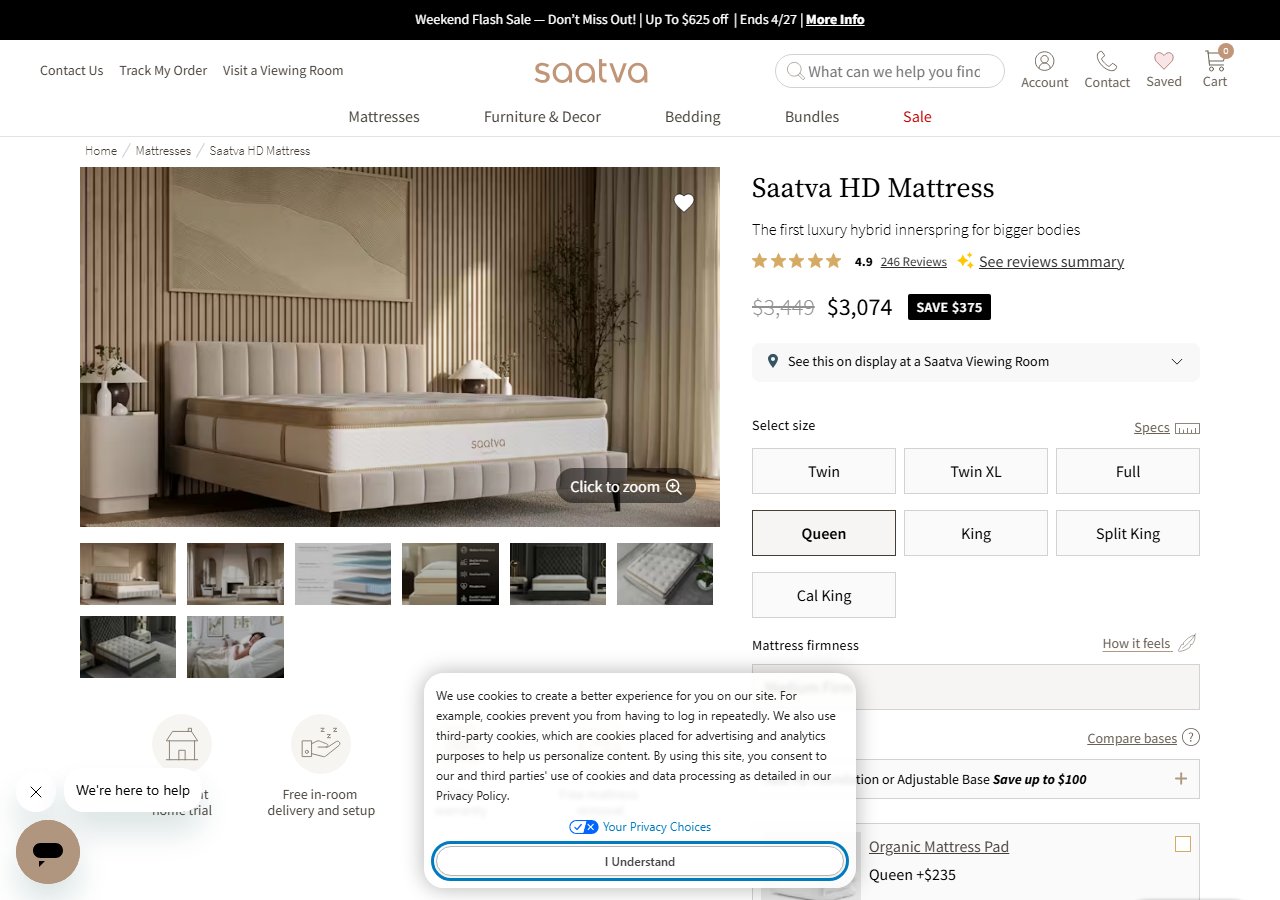
Saatva HD Mattress (Heavy-Duty)
$2,395-$3,995
See Price at Saatva →
Purple Hybrid Premier Mattress
$2,499-$4,799
See Price at Purple →Putting It Together: The Data-to-Decision Framework
Chronic back pain at the 20% population prevalence CDC documents is a systemic problem with systemic costs — costs that AHRQ, SSA, and CMS all quantify in the hundreds of billions annually. The individual decision about sleep surface sits inside that larger context: you are one of 51 million people making nightly contact with a surface that either supports spinal recovery or undermines it.
The decision framework this data points to is sequential:
- Rule out red flags. If you have any of the clinical signs listed above, imaging or referral comes before mattress shopping.
- Address the free variables first. Sleep position correction, daily walking, and lifting mechanics are each supported by federal health agency evidence as interventions for chronic lumbar pain. They cost nothing and interact favorably with whatever sleep surface you eventually choose.
- Assess your current mattress honestly. If it is visibly sagged, older than 7–10 years, or you reliably wake stiffer than you went to bed, replacement is justified. If it is 2 years old and your pain is new, the mattress is probably not the primary variable.
- Match construction to your specific load pattern. Memory foam for disc-mediated lumbar pain in normal-weight individuals. Reinforced coil systems for heavier individuals or high-occupational-load workers. Pressure-mapping grids for side sleepers and those with arthritis-related pressure sensitivity.
The mattress industry would prefer you skip steps 1 through 3. This publication's job is to make sure you do not. The federal data is clear: chronic back pain is expensive, disabling, and pervasive — and sleep is one of the places where it is either managed or compounded, every night.
Choose accordingly.