One in Five Americans Is Living With This Every Night
According to CDC NHANES survey data published in NCHS Data Brief 390, approximately 20% of U.S. adults experience chronic pain, and the lower back is the most commonly reported pain location in that population. That is not a rounding error — it is roughly 50 million people waking up stiff, reaching for ibuprofen before their first cup of coffee, and dreading the commute before the day has even started.
For those 50 million, the night is not passive recovery. It is eight hours of compressive or decompressive force applied to an already-stressed lumbar spine, shaped by whatever surface you happen to be lying on and whatever position gravity and habit put you in. AHRQ's Medical Expenditure Panel Survey documents that adults with chronic back conditions spend substantially more on healthcare annually than those without — a gap that reflects the relentless downstream costs of a condition that never fully turns off.
The stakes are higher than most people appreciate. SSA Disability Insurance reports identify musculoskeletal disorders as the single largest category of new disability claims filed each year in the United States. AHRQ's Healthcare Cost and Utilization Project ranks back pain among the most expensive conditions in the entire U.S. healthcare system by total inpatient and outpatient cost. And CMS drug spending data shows opioid and non-opioid pain medications ranking among the costliest Medicare drug categories — a figure that traces directly back to undertreated and poorly managed chronic pain.
This article is not going to sell you a mattress as a cure. What it will do is walk through the actual biomechanical mechanism driving nighttime back pain, surface the free interventions that federal research supports, flag the clinical red flags that need a physician rather than a new sleep surface, and then give you a clear-eyed look at the sleep surfaces that the evidence supports for chronic lumbar conditions.
Why Chronic Back Pain Gets Worse at Night: The Mechanism
Understanding why your back hurts more in certain sleep positions — or why you wake stiff regardless of how long you slept — requires a brief anatomy detour. Your intervertebral discs, the cartilaginous pads between each lumbar vertebra, are largely avascular. They receive nutrients and hydration through a process called imbibition: cyclic loading and unloading during the day drives fluid out, and horizontal rest at night allows fluid to re-enter. When this process is disrupted — by a sleep surface that keeps the spine in a loaded or misaligned position — the discs do not fully rehydrate, and you wake with the compressive stiffness that is the hallmark of chronic lumbar conditions.
The occupational dimension of this is significant and federally documented. BLS Musculoskeletal Disorder tracking confirms that the back is the most common body part injured across all U.S. occupations with days away from work. The NIOSH Lifting Equation documents that manual material-handling tasks in warehousing, construction, and healthcare routinely exceed safe spinal loading limits — meaning millions of workers are going to bed each night with spines that have already exceeded their biomechanical load budget for the day. For these workers, sleep surface quality is not a luxury preference. It is the only recovery window available.
CDC data on sleep duration adds another layer: approximately 35% of U.S. adults sleep fewer than 7 hours per night, the threshold the CDC associates with elevated chronic disease risk. Shortened sleep compresses the rehydration window further, and research consistently links poor sleep quality with heightened pain sensitivity — a feedback loop where pain disrupts sleep and abbreviated sleep amplifies pain.
The sleep surface sits at the intersection of all of this. A mattress that is too soft allows the lumbar spine to sag into flexion, placing the posterior elements of the vertebral column under sustained tension. A mattress that is too firm creates pressure concentration at the hips and shoulders in side-sleepers, which causes the sleeper to shift position repeatedly through the night — each micro-arousal interrupting slow-wave sleep, the phase most associated with tissue repair. The biomechanically optimal mattress keeps the spine in the same neutral alignment that a well-positioned standing posture would achieve: lordotic curve preserved, pelvis level, no lateral scoliosis introduced by mattress give.
Approximately 25% of U.S. adults also report doctor-diagnosed arthritis, with prevalence concentrated in occupations involving sustained physical demand — the same population most exposed to daily spinal overload. Arthritis at the facet joints of the lumbar spine is particularly position-sensitive: extension-loaded positions (stomach sleeping, inadequately supported back sleeping) tend to compress facet joints, while neutral spine positioning takes that load off. Sleep surface firmness is a direct input into which position the sleeper can actually maintain.
Try These First — Free Interventions Before Any Purchase
The cheapest intervention is the one that does not require buying anything. Federal research consistently shows that behavioral and positional changes produce clinically meaningful pain reduction for the majority of chronic low back pain sufferers — often matching or exceeding the effect sizes of passive interventions including new sleep surfaces. Before evaluating any product, every chronic back pain sufferer should work through the following evidence-based, zero-cost steps.
Sleep position is the single highest-leverage free variable in nocturnal spinal loading. NIH guidance from the National Institute of Arthritis and Musculoskeletal and Skin Diseases recommends side-sleeping with a pillow between the knees, or back-sleeping with a pillow under the knees. Both positions preserve lumbar lordosis and reduce facet joint compression. Stomach sleeping, by contrast, forces the lumbar spine into extension and rotates the cervical spine to one side — a sustained positional insult that chronically worsens lumbar and cervical symptoms. This costs nothing to change tonight.
Daily walking outperforms most passive interventions in federal evidence reviews. NIH NCCIH's low-back pain evidence synthesis finds that walking 30 minutes most days reduces chronic low back pain as effectively as most non-drug clinical treatments. Walking promotes lumbar disc imbibition, strengthens the paraspinal musculature, and reduces the central sensitization that makes chronic pain self-reinforcing. No mattress substitutes for this.
Lifting and bending mechanics are responsible for a significant share of acute-on-chronic back episodes. OSHA's ergonomics guidance specifies hinging at the hips rather than the lumbar spine, keeping loads close to the body, and avoiding twisting under load. These are rehearsable skills. Most acute flare-ups in chronic back pain sufferers are mechanical — triggered by a single poor-mechanics event — and are therefore preventable.
Mattress condition and replacement timing matters more than mattress brand. CDC sleep hygiene guidance and clinical consensus support replacing a mattress if it shows visible sag, if you consistently wake stiffer than you went to bed, or if it is older than 7 to 10 years. An expensive new mattress on top of poor sleep hygiene or a sedentary lifestyle does not close the gap.
If you have worked through those interventions consistently for 4 to 8 weeks and are still waking with pain, or if your current mattress is visibly degraded, that is the appropriate moment to evaluate sleep surface upgrades. For a meaningful subset of chronic back pain sufferers — particularly those with diagnosed disc pathology, facet arthritis, or occupational spinal loading — a properly matched sleep surface does provide measurable, sustained symptom relief. The products below were selected with that subset in mind.
When to See a Clinician Before Buying Anything
A new mattress is appropriate for mechanical, positional, and surface-quality-driven back pain. It is not appropriate as a first response to back pain that carries neurological or systemic warning signs. NIH's National Institute of Neurological Disorders and Stroke is explicit about the red flags that require prompt clinical evaluation rather than conservative management. These include pain that radiates below the knee (suggesting nerve root impingement or disc herniation at a level that may require imaging), pain following acute trauma, progressive leg weakness, and changes in bowel or bladder function — the last of which can signal cauda equina syndrome, a surgical emergency.
Back pain accompanied by fever, unexplained weight loss, or onset in a patient with a history of cancer requires urgent evaluation to rule out infectious or metastatic etiology. None of these scenarios are amenable to mattress selection. For everyone else — the vast majority of chronic back pain sufferers with mechanical, degenerative, or postural etiologies — conservative management including optimized sleep surface is appropriate, supported by federal clinical guidance and consistent with AHRQ's evidence-based treatment recommendations.
Where Sleep Surfaces Actually Help — and Which Ones
For chronic lumbar conditions, the research-supported sweet spot in mattress firmness is medium-firm: firm enough to prevent lumbar sag and maintain lordotic curvature, compliant enough to accommodate the pressure points at hips and shoulders in side-sleepers. A 2015 randomized controlled trial published in Sleep Health — one of the most-cited mattress-and-back-pain studies — found that medium-firm mattresses produced significantly lower pain and disability scores at 90 days compared to either firm or soft surfaces. The mechanism matches what disc biology predicts: neutral spine alignment maximizes overnight rehydration and minimizes facet joint compression.
For back pain sufferers with higher body weight — including the significant portion of the warehouse and construction workforce that BLS MSD data documents as experiencing disproportionately high spinal injury rates — standard mattresses often deflect excessively, losing the neutral spine position that medium-firm construction is supposed to provide. These sleepers need higher-density foam cores or reinforced coil systems to maintain the same functional firmness at higher loads.
Three sleep surfaces stand out for chronic back pain sufferers across different presentations:
The Saatva Loom & Leaf Memory Foam Mattress is the premium memory foam pick for serious back pain. It is constructed with a multi-layer system: a cooling gel-infused memory foam layer over high-density support foam, available in Relaxed Firm and Firm configurations. The Relaxed Firm option sits in the medium-firm zone that the clinical literature favors, while the gel layer addresses one of the most consistent complaints about memory foam among chronic pain sufferers — heat retention that disrupts slow-wave sleep. Saatva delivers with white-glove setup and old mattress removal, which matters for back pain sufferers who should not be lifting and maneuvering a new mattress themselves.
For sleepers with higher body weight or occupational spinal loading — the warehouse worker, the construction tradesperson, the nurse who spent 12 hours on their feet — the Saatva HD Mattress is purpose-built. Its dual tempered steel coil system and high-density foam layers are engineered to maintain medium-firm support at body weights where standard mattresses begin to sag. This is the sleep surface equivalent of the NIOSH Lifting Equation's logic: match the intervention to the actual load, not to an average that excludes most of the people who need it most.
For chronic back pain sufferers whose primary complaint is pressure-point pain — hip pain in side-sleepers, shoulder pain that disrupts sleep continuity — the Purple Hybrid Premier Mattress addresses the firmness-versus-pressure-relief tradeoff differently than foam or coil-only systems. Purple's proprietary GelFlex Grid redistributes pressure horizontally rather than compressing vertically, which means it can maintain spinal support while simultaneously eliminating the concentrated pressure that drives position-switching and sleep fragmentation. The coil layer underneath provides the motion isolation and edge support that foam-only grids lack.
Sleep Surfaces Built for Chronic Lumbar Conditions
Each of these mattresses was selected based on construction characteristics matched to the biomechanical needs of chronic low back pain sufferers — not brand recognition or price tier alone.

Saatva Loom & Leaf Memory Foam Mattress
$1,695-$3,295
See Price at Saatva →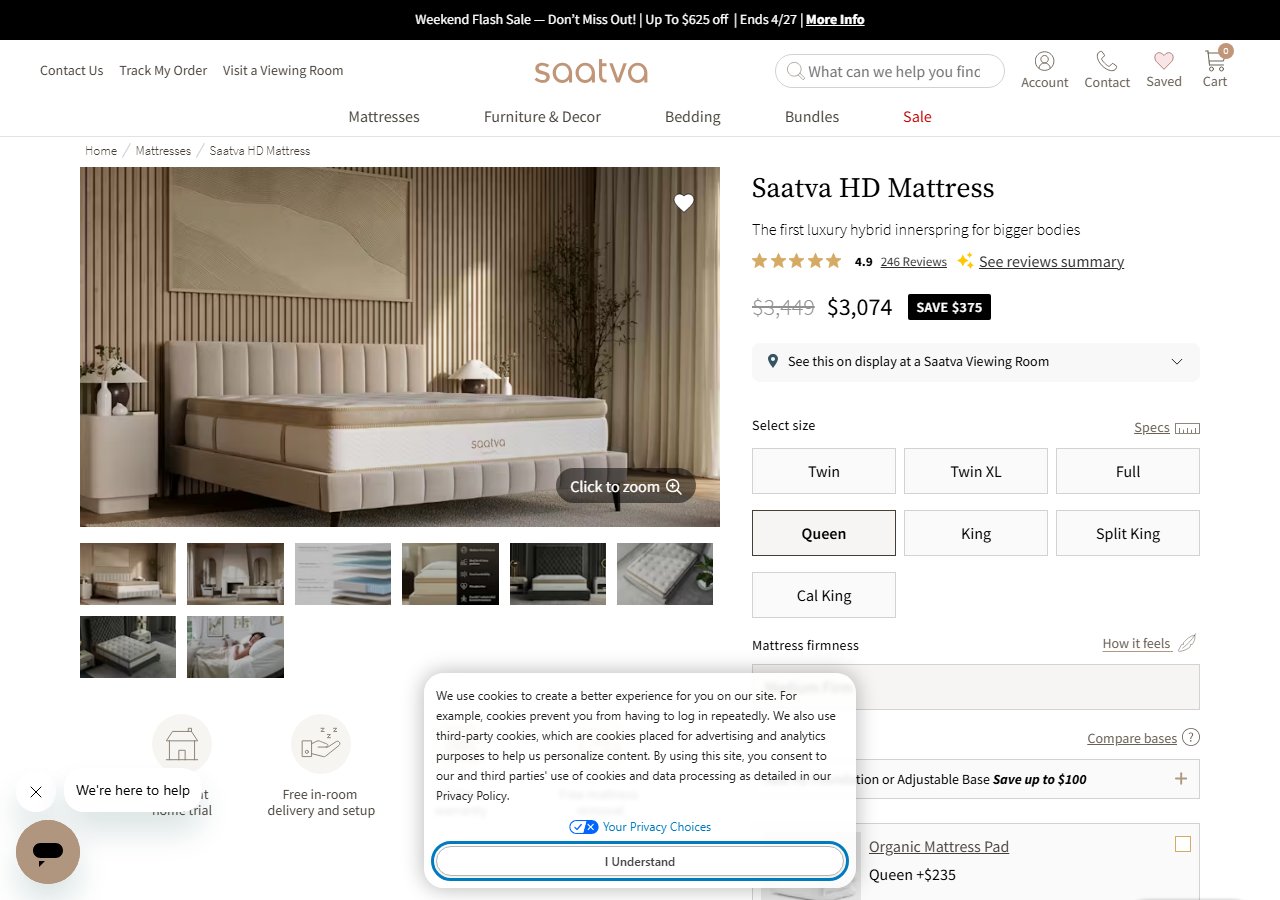
Saatva HD Mattress (Heavy-Duty)
$2,395-$3,995
See Price at Saatva →
Purple Hybrid Premier Mattress
$2,499-$4,799
See Price at Purple →The Data-to-Decision Summary
The federal picture on chronic back pain is unambiguous about scale and cost. CDC NCHS Data Brief 390 documents 20% adult chronic pain prevalence. AHRQ HCUP puts back pain at the top of the national healthcare cost table. SSA tracks musculoskeletal disorders as the dominant driver of new disability claims. CMS documents the pharmaceutical spending that follows undertreated chronic pain. The aggregate message is that chronic back pain is an enormous, expensive, and poorly managed public health burden — and that most of the people carrying it are sleeping on surfaces and in positions that make it worse rather than better.
The hierarchy that evidence supports is clear: fix your sleep position tonight (free), walk 30 minutes most days (free), audit your lifting mechanics (free), then evaluate your mattress condition and firmness match. If a new surface is warranted, match it to your body weight and dominant sleep position. See a clinician before purchasing anything if your pain carries neurological flags.
Products are one tool in a stack that also includes movement, mechanics, and position. The sleepers who get the most out of a better mattress are the ones who have already done the free work.