One in Five U.S. Adults Wakes Up in Pain — and the Back Is Almost Always the Culprit
CDC NCHS Data Brief 390 puts the number plainly: approximately 20% of U.S. adults live with chronic pain, and when researchers drill down to the most common location, the lower back dominates. That is roughly 50 million people whose daily routine — getting out of bed, driving, sitting at a desk, lifting anything — is shaped by lumbar discomfort. If you are reading this article, you are almost certainly one of them, and you have probably already tried ibuprofen, a heating pad, and at least one appointment with a provider who told you to "strengthen your core." This article is not going to tell you to strengthen your core. It is going to tell you what the federal data actually shows about why chronic back pain persists, what interventions have the strongest evidence base, what red flags require clinical attention, and where a sleep surface upgrade fits into the hierarchy — which is further down the list than most mattress marketing would have you believe.
The economic picture around chronic back pain is staggering and worth anchoring the conversation here. AHRQ HCUP data identifies back pain as one of the most expensive conditions in U.S. healthcare by total inpatient and outpatient spending — a figure that does not include lost wages, reduced productivity, or the informal caregiving costs that ripple outward from a person who cannot lift their child or complete a work shift. AHRQ MEPS data adds granularity: adults with chronic back conditions spend substantially more on personal healthcare annually than adults without those conditions. CMS drug spending data identifies opioid and non-opioid pain medication among the most expensive Medicare drug categories — the downstream cost of a condition that often starts as a mechanical, addressable problem. And SSA Disability Insurance reports show musculoskeletal disorders are the largest single category of new disability claims filed annually in the United States. This is not a niche problem. It is the defining occupational health crisis of the American workforce.
Why Chronic Back Pain Happens — and Why It Persists at Night
Understanding the mechanism matters before any intervention makes sense. The lumbar spine — five vertebrae stacked between the pelvis and the thoracic cage — is asked to do two contradictory things simultaneously: provide a stable foundation for load transfer and remain flexible enough for the range of motion daily life demands. When those demands are excessive, repetitive, or poorly distributed, the discs, facet joints, ligaments, and paraspinal muscles accumulate micro-damage faster than they can repair it.
BLS Musculoskeletal Disorders by Occupation data confirms that the back is the most-injured body part across every occupational category that generates days away from work. The NIOSH Lifting Equation documents that manual material-handling tasks in warehousing, construction, and healthcare routinely exceed safe spinal loading limits — meaning millions of workers are compressing lumbar structures beyond their design tolerances every single shift. BLS Employer Costs for Employee Compensation data shows that industries with high musculoskeletal disorder incidence carry workers' compensation insurance rates 3 to 5 times higher than low-MSD industries — a market-price signal that these injuries are both common and expensive to manage.
The sleep component compounds the problem in a specific way. During the day, intervertebral discs are compressed by gravitational load and muscular activity. At night, when the body is horizontal, discs rehydrate — but only if the spine is in a position that allows the surrounding soft tissue to fully decompress. A mattress that sags, is too soft to maintain the lumbar curve, or is so firm it creates pressure point loading at the hips and shoulders forces the paraspinal muscles to remain partially active throughout the night. The result is the morning stiffness that millions of chronic back pain sufferers describe as the worst part of their day: eight hours of attempted recovery that actually extended the inflammatory cycle rather than interrupting it.
CDC sleep data shows that approximately 35% of U.S. adults already sleep fewer than 7 hours per night, the threshold associated with elevated chronic disease risk. For chronic back pain sufferers, the relationship between sleep deprivation and pain amplification is bidirectional: pain disrupts sleep architecture, and poor sleep lowers pain thresholds, creating a loop that no single product can break. CDC arthritis data notes that approximately 25% of U.S. adults have doctor-diagnosed arthritis, with prevalence concentrated in physically demanding occupations — and arthritis-related lumbar inflammation follows the same nocturnal amplification pattern.
The biomechanical picture for specific occupational groups is worth spelling out because "chronic back pain" is not one condition. A warehouse selector who loads pallets for eight hours experiences compressive disc damage at L4-L5 and L5-S1. A nurse who transfers patients with bent-knee posture accumulates facet joint stress. A long-haul driver develops sustained flexion creep — the gradual loss of disc height and viscoelastic stiffness that comes from sitting in lumbar flexion for hours. A teacher or office worker develops posterior ligamentous strain from prolonged sitting without lumbar support. Each of these injury patterns has different biomechanical requirements for nocturnal recovery, which is why "medium-firm is best" generalizations are inadequate and why the interventions below are sequenced the way they are.
Try These First — The Cheapest Intervention Is the One That Requires No Purchase
Before discussing any product, the evidence record is clear: non-product interventions have the strongest and most replicated evidence base for chronic low back pain management. NIH NCCIH's evidence review on low back pain rates walking as effective as most non-drug clinical treatments for reducing chronic lumbar pain — and a 30-minute daily walk costs nothing. OSHA's ergonomics guidance documents that the majority of acute back episodes are mechanical and preventable with rehearsable technique: hinging at the hips rather than the lumbar spine, keeping loads close to the body, and eliminating rotational loading. NIH NIAMS back pain guidance identifies sleep position as the single most modifiable free variable in nocturnal back pain — side-sleeping with a pillow between the knees or back-sleeping with a pillow under the knees costs under $20 and can meaningfully reduce morning stiffness before any mattress decision is made.
The lifestyle variable most people skip: replacing a mattress when it actually needs replacing, not when marketing tells you to. CDC sleep hygiene guidance underscores that visible sagging, waking stiffer than you went to bed, or a mattress older than 7 to 10 years are the functional criteria for replacement — not arbitrary refresh cycles. Even the best mattress on the market does not compensate for sedentary days, poor lifting mechanics, or untreated sleep apnea.
For readers who have already addressed sleep position, walking habit, and lifting mechanics — and who are still waking with significant lumbar stiffness — the sleep surface itself may genuinely be the remaining variable. This is the correct place in the evidence hierarchy to consider a mattress upgrade: after the free interventions have been tested and found insufficient, not before. The products discussed below are positioned as adjuncts to the behavioral and clinical interventions above, not replacements for them.
When to See a Clinician — Red Flags That Require Imaging or Referral
Chronic mechanical low back pain — the kind that builds gradually, correlates with activity, and improves with rest and position changes — is generally appropriate for self-managed intervention. But several presentation patterns indicate pathology that requires prompt clinical evaluation and must not be managed with mattress selection or movement modification alone.
NIH NINDS back pain guidance identifies the following as red flags warranting immediate clinical evaluation: pain that radiates below the knee (possible nerve root compression or disc herniation), back pain following trauma, new-onset leg weakness or foot drop, bowel or bladder dysfunction accompanying back pain, back pain with unexplained weight loss or fever, and back pain in individuals with a cancer history. These are not "wait and see" scenarios. A new mattress cannot reduce a herniated disc, treat spinal stenosis, or rule out vertebral fracture. The clinical evaluation is the intervention.
For readers with arthritis-related back pain — a substantial population given CDC's arthritis prevalence data showing 25% of U.S. adults with diagnosed arthritis — inflammatory flares that produce systemic symptoms (morning stiffness lasting more than 45 minutes, bilateral joint involvement, fatigue) may indicate inflammatory arthritis rather than mechanical pain and warrant rheumatological evaluation. The distinction matters clinically and practically: inflammatory arthritis has disease-modifying treatment options that mechanical back pain does not.
Where Products Actually Help — Sleep Surface Selection for Lumbar Conditions
With the mechanism understood and the evidence hierarchy established, here is where specific products enter the analysis. The clinical rationale for a sleep surface upgrade is narrow but real: a mattress that cannot maintain spinal neutrality — because of sagging, incorrect firmness for the sleeper's weight and preferred position, or absent lumbar zoning — prevents the nocturnal disc rehydration and muscular decompression that are prerequisites for recovery. The question is not "which mattress is best for back pain" in the abstract, but rather which construction approaches best serve the specific biomechanical needs of the chronic back pain sufferer.
For most chronic lumbar sufferers, the research-supported target is a surface that holds the lumbar curve in neutral — not so soft that the pelvis sinks and the spine flexes into a "hammock" shape, not so firm that hip and shoulder pressure points cause compensatory muscle activation. For side sleepers, this typically means a medium to medium-firm surface with enough conforming capacity at the shoulders to allow the spine to stay level. For back sleepers, a firmer surface with lumbar zoning or targeted support in the lower-middle third of the mattress tends to outperform both extremes.
The Saatva Loom & Leaf Memory Foam Mattress is the primary recommendation for chronic back pain sufferers seeking a premium memory foam surface. Saatva builds the Loom & Leaf in two firmness options — Relaxed Firm and Firm — which directly addresses the clinical guidance on spinal neutrality. The mattress uses multiple layers of American-crafted gel-infused memory foam with a lumbar crown enhancement, a raised center-third construction designed to maintain lumbar support rather than allowing the zone of greatest body weight to sink furthest. Memory foam's pressure-distributing properties are particularly relevant for sleepers whose back pain is accompanied by hip or shoulder tenderness, where rigid surfaces create secondary pressure point loading. At $1,695–$3,295 depending on size, the Loom & Leaf is positioned as a serious clinical-grade investment for a reader whose back pain is already generating the above-average healthcare expenditures that AHRQ MEPS documents.
For warehouse workers, tradespeople, and bigger-bodied sleepers — the populations most directly implicated in NIOSH's spinal overloading documentation and BLS MSD occupational data — standard consumer mattresses are frequently inadequate because they are engineered for a weight distribution that does not match the user. The Saatva HD Mattress is purpose-built for this population, with a reinforced support core designed to maintain spinal alignment for sleepers up to 500 pounds. Saatva HD uses a two-layer coil system with 20% more steel than the standard Saatva Classic — an engineering choice that prevents the progressive sag that converts a nominally medium-firm surface into a hammocking soft surface within 18–24 months of use by a heavier sleeper. For workers who have spent a shift exceeding safe spinal loading limits, waking up on a mattress that adds further lumbar flexion stress is not a neutral event; it is additional injury exposure. The Saatva HD costs $2,395–$3,995 depending on size — more than most mattresses, and justifiable specifically because the population it serves is the one that incurs the highest occupational back injury rates in federal data.
For sleepers whose back pain is accompanied by hip pressure, shoulder tenderness, or arthritis-related joint sensitivity — a presentation consistent with the 25% of U.S. adults that CDC arthritis data shows carry diagnosed arthritis — pressure relief alongside spinal support is the engineering challenge. The Purple Hybrid Premier Mattress addresses this through Purple's GelFlex Grid technology, a hyper-elastic polymer grid that redistributes pressure away from bony prominences while maintaining the buckling resistance that prevents spinal sag. Unlike memory foam, which cradles through visco-elastic compression, the GelFlex Grid "buckling column" design allows the grid cells directly under pressure points to collapse while cells under lower-load areas remain firm — producing a surface that is simultaneously pressure-relieving at the hips and shoulders and supportive through the lumbar zone. At $2,499–$4,799 depending on size and configuration, it is the highest-priced option in this list and the most differentiated from conventional foam or spring construction.
Sleep Surfaces Engineered for Chronic Lumbar Conditions
These three mattresses were selected because their construction directly addresses the spinal neutrality, lumbar zoning, and pressure distribution needs documented in the federal occupational and clinical data above — not because of price point or brand recognition alone.

Saatva Loom & Leaf Memory Foam Mattress
$1,695-$3,295
See Price at Saatva →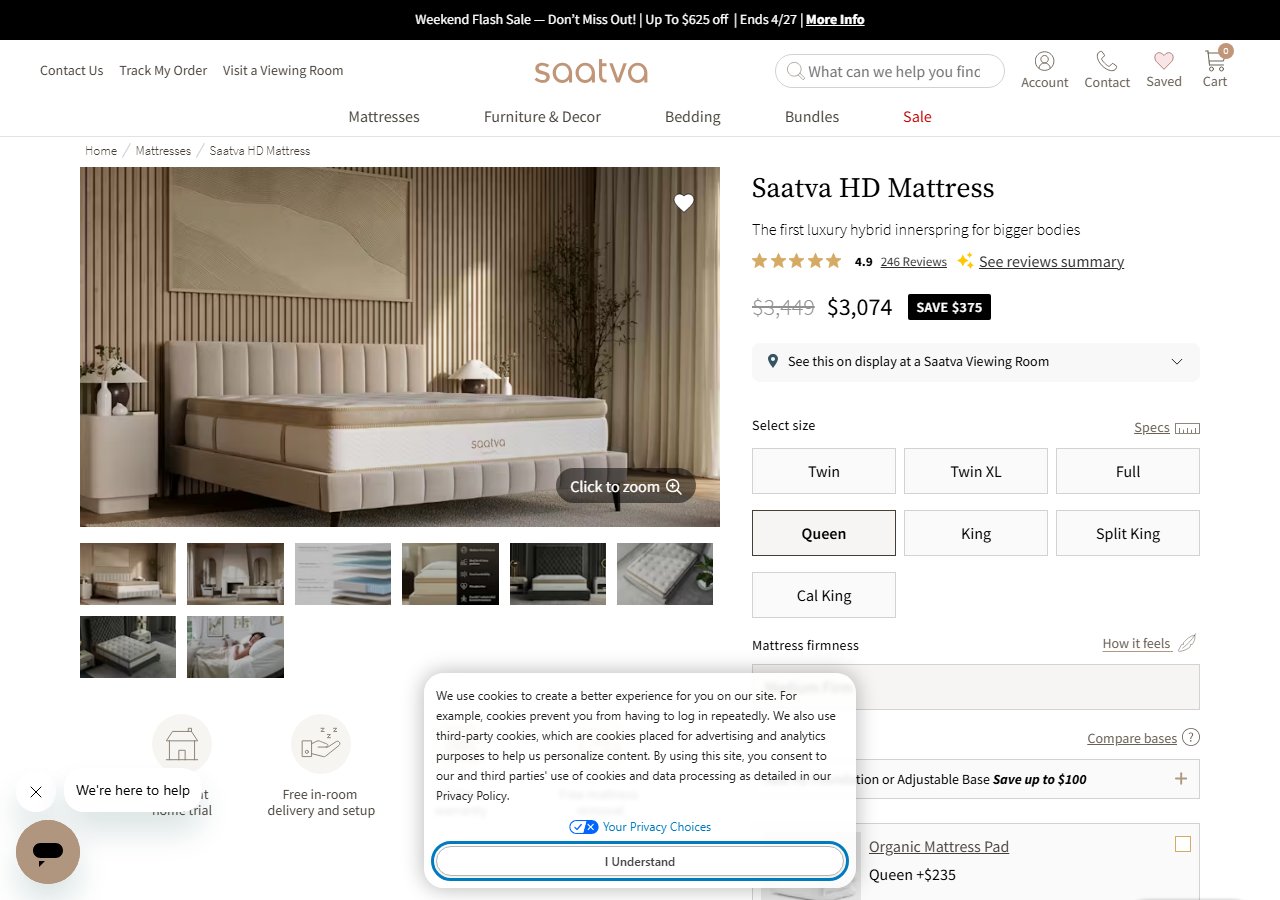
Saatva HD Mattress (Heavy-Duty)
$2,395-$3,995
See Price at Saatva →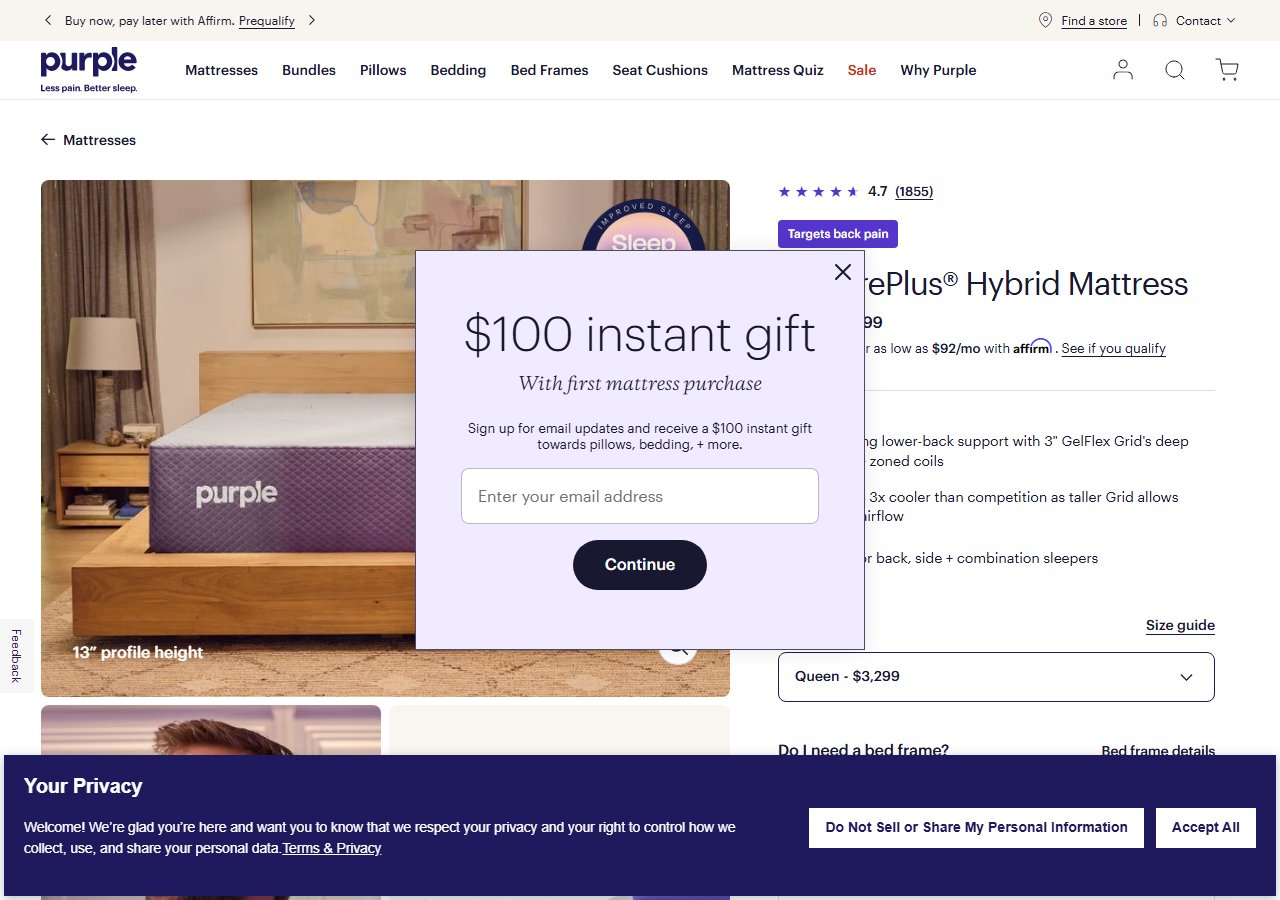
Purple Hybrid Premier Mattress
$2,499-$4,799
See Price at Purple →Pulling the Evidence Together
The federal data record on chronic back pain converges on a picture that the mattress industry consistently obscures: most back pain is occupational and behavioral in origin, most of the effective interventions are free or low-cost, and sleep surface selection is a meaningful but secondary variable that only becomes the decisive one after primary interventions have been exhausted.
CDC NCHS data shows 20% of U.S. adults in chronic pain, with the lower back leading. BLS occupational injury data shows the back as the most-injured body part across every sector. AHRQ shows it as one of the most expensive conditions in U.S. healthcare. SSA data shows musculoskeletal disorders driving more new disability claims than any other category. These are not statistics about a rare condition affecting a vulnerable minority — they are the statistical fingerprint of a workforce being systematically injured by movement patterns and recovery conditions that are largely modifiable.
The hierarchy is: fix your mechanics, fix your sleep position, address any clinical red flags, then evaluate whether your sleep surface is contributing to the problem. If it is — if you wake stiffer than you went to bed, if your mattress is visibly sagging, if it is older than 8 years and you are using it after a physically demanding occupation — a thoughtfully selected sleep surface is a legitimate intervention. The Saatva Loom & Leaf for most chronic lumbar sufferers, the Saatva HD for larger or heavier workers in high-MSD occupations, and the Purple Hybrid Premier for pressure-sensitive sleepers with arthritis or hip involvement represent the current best alignment between clinical guidance and commercial construction. But the mattress comes last in the sequence — not because it does not matter, but because it matters less than movement, and a lot less than the clinical evaluation you may be avoiding.