The federal numbers are not abstract — they describe your spine
If you weigh 250 lbs or more and your back hurts, you are not experiencing a personal failure of discipline. You are experiencing a documented occupational and biomechanical phenomenon that federal agencies have been tracking in granular detail for decades. BLS Musculoskeletal Disorder surveillance identifies the back as the single most injured body part across all U.S. occupations with days away from work — not the shoulder, not the knee, the back. That finding holds across warehousing, healthcare, construction, transportation, and retail. And when bodyweight is elevated, every force acting on those spinal structures is amplified.
The CDC NHANES data, summarized in NCHS Data Brief 390, finds that approximately 20% of U.S. adults live with chronic pain, with the lower back identified as the most common pain location. Chronic back pain is not the same as a pulled muscle from moving a couch. It is a systemic condition with healthcare cost consequences: AHRQ HCUP data ranks back pain among the most expensive conditions in U.S. healthcare by combined inpatient and outpatient cost. AHRQ MEPS data shows that adults with chronic back conditions carry substantially higher annual personal healthcare expenditures than adults without them. And at the population level, SSA Disability Insurance reports identify musculoskeletal disorders as the largest single category of new disability claims annually in the United States — a statistic that should be read as a policy crisis, not a footnote.
This article is built from that federal data. It will explain why the problem is worse at higher bodyweights, what free interventions to try first, when to see a clinician, and finally — only after all of that — what sleep surface construction features matter if equipment is genuinely needed.
Why high bodyweight amplifies spinal load: the biomechanics
The spine is an engineering structure. It bears compressive load, manages shear forces, and transmits force between the lower and upper body through intervertebral discs, facet joints, and the surrounding musculature. At any bodyweight, repetitive loading without adequate recovery degrades these structures over time. At higher bodyweights, the baseline compressive forces are higher even at rest — and the delta between safe and unsafe loading is smaller.
The NIOSH Lifting Equation provides the most rigorous federal framework for understanding this. NIOSH documents that manual material-handling tasks across warehousing, construction, and healthcare routinely exceed safe spinal loading limits — defined as the load at which the probability of injury to lumbar disc structures rises meaningfully. For a worker at 250 lbs lifting a 50-lb box at a suboptimal horizontal distance, the compressive force at the L4-L5 disc can exceed 6,000 Newtons. NIOSH's Recommended Weight Limit (RWL) model treats the lifter's own body as part of the mechanical system — and higher bodyweight is a variable that increases internal loading even when external load is held constant.
This creates a specific risk profile for high-bodyweight workers in physically demanding occupations. They arrive at the end of a shift with spinal structures that have absorbed more cumulative load than their lower-bodyweight colleagues performing the same tasks. The BLS Workers' Compensation data captures the downstream cost: industries with high MSD incidence carry workers' compensation insurance rates 3-5 times higher than low-MSD industries. That premium is not arbitrary — it reflects actuarial reality about how consistently high-demand physical work injures workers.
CDC arthritis surveillance finds that approximately 25% of U.S. adults report doctor-diagnosed arthritis, with prevalence concentrated in occupations involving sustained physical demand — the same occupational cluster that appears in the BLS MSD data. Arthritis in the facet joints of the lumbar spine is a particularly common finding among high-bodyweight adults over 40 who have worked physical jobs. It changes the pain pattern: instead of purely disc-mediated pain, the facet arthritis produces morning stiffness, pain with extension, and sensitivity to prolonged static postures. The last point matters for sleep surface selection: a surface that holds a higher-bodyweight body in a sustained poor posture for 7-8 hours accelerates rather than recovers from that daily load.
The CMS Drug Spending Dashboard identifies opioid and non-opioid pain medication spending among the most expensive Medicare drug categories — direct evidence of how many Americans are managing chronic back pain pharmacologically rather than mechanically or behaviorally. A new sleep surface will not replace clinical pain management for severe chronic conditions. But a sleep surface that actively worsens nightly spinal posture can perpetuate the pain cycle that drives medication use.
Sleep as the recovery window — and why high-bodyweight sleepers are underserved
For most working adults, sleep is the longest period of horizontal rest the spine gets. An 8-hour sleep window represents roughly one-third of every 24-hour cycle. During sleep, intervertebral discs rehydrate through imbibition — a process that requires offloading the compressive forces of the waking day. This is physiologically established: discs are approximately 1-2 mm taller in the morning than in the evening, reflecting the fluid absorbed during horizontal rest. If the sleep surface does not maintain spinal neutrality — if it allows the spine to sag into flexion or forces it into lateral flexion — that recovery window is partially lost.
CDC sleep data shows that approximately 35% of U.S. adults sleep fewer than 7 hours per night, the threshold associated with elevated chronic disease risk. High-bodyweight adults with chronic back pain are disproportionately represented in this group, because pain disrupts sleep architecture, and disrupted sleep reduces pain tolerance — a documented bidirectional relationship in the clinical literature. The practical result is a cycle: inadequate sleep worsens pain sensitivity, worsened pain makes it harder to sleep, and the sleep surface either helps break that cycle or compounds it.
The mainstream mattress market is poorly calibrated for sleepers above 200 lbs. Most mattress specifications — firmness ratings, foam density numbers, coil gauge descriptions — are benchmarked to a 150-175 lb reference sleeper. At 250+ lbs, a mattress rated "firm" by that benchmark may perform as a "medium" or even "medium-soft" under the actual load. The hip and shoulder regions, which are the heaviest single-point loads in a side-sleeping posture, will compress a standard foam layer further and faster than manufacturers model. This is not a marketing problem. It is a materials engineering problem with direct consequences for the spinal loading the mattress is supposed to relieve.
Try these first — the cheapest interventions require no purchase
Before spending $2,000 or more on a sleep surface, federal evidence supports several free or low-cost interventions that address the same underlying problem. The principle is straightforward: the cheapest intervention is the one that does not require buying anything.
The most impactful free variable is sleep position. NIH NIAMS back pain guidance is explicit: side-sleeping with a pillow between the knees, or back-sleeping with a pillow under the knees, maintains lumbar spine neutrality. Stomach-sleeping torques the lumbar spine into extension and forces the cervical spine into rotation — a posture that, sustained for 6-8 hours, actively loads the same structures that physical work loads during the day. For high-bodyweight adults with chronic lower back pain, eliminating stomach-sleeping is a zero-cost intervention with biomechanical logic behind it.
Daytime movement is the second free variable, and its effect size is larger than most people expect. NIH NCCIH's evidence review of low-back pain treatments finds that walking 30 minutes most days reduces chronic low-back pain as effectively as most non-drug clinical treatments. For high-bodyweight adults in sedentary recovery phases post-injury, walking is often the highest-yield single intervention. The mechanism is partly vascular — walking increases blood flow and nutrient delivery to intervertebral disc structures — and partly neuromuscular, reinforcing the paraspinal muscle activation that protects the spine under load.
For workers in physical occupations, lifting and movement mechanics during the workday are a third lever. OSHA's ergonomics guidance recommends hinging at the hips rather than the lumbar spine, keeping loads close to the body, and avoiding twisting under load. Most acute back episodes are mechanical and, critically, rehearsable — meaning that changing movement patterns during the workday can reduce the cumulative spinal load that a sleep surface then needs to recover from.
Finally, mattress replacement timing matters. CDC sleep hygiene guidance notes that visible mattress sag, waking stiffer than you went to bed, or a mattress older than 7-10 years are legitimate triggers for replacement. But a new mattress does not offset poor sleep hygiene, sedentary days, or untreated pain conditions. It is one element of a system.
For readers who have addressed sleep position, added daily walking, fixed daytime lifting mechanics, and still wake up with back pain on a sagging or undersupported surface — a purpose-built sleep surface is a legitimate next step. The key is selecting construction features that are calibrated to actual bodyweight, not to the 150-lb industry benchmark.
When to see a clinician before buying anything
Some back pain presentations require clinical evaluation before any equipment purchase is appropriate. NIH NINDS back pain guidance specifies clear red flags that indicate a need for prompt evaluation: back pain that radiates below the knee (possible nerve root compression), pain following trauma, pain accompanied by leg weakness, bowel or bladder changes, unexplained fever, or unintentional weight loss. These presentations can indicate disc herniation with nerve involvement, spinal stenosis, fracture, infection, or — rarely — malignancy. No mattress addresses any of these conditions, and delay for equipment research is not appropriate.
For high-bodyweight adults specifically, the combination of chronic facet arthritis, degenerative disc changes, and significant spinal loading from physical work creates a clinical picture that benefits from a physical therapist or physiatrist evaluation before self-treating with equipment. A clinician can identify whether the pain is primarily discogenic, facet-mediated, myofascial, or some combination — and that distinction changes what interventions are appropriate. The AHRQ MEPS data documents that chronic back condition patients incur substantially higher annual healthcare costs than those without — which is an argument for getting the diagnosis right early, not for spending money on equipment before knowing what you are treating.
Where sleep surface construction features matter for 250+ lb sleepers
With the mechanism understood, free interventions tried, and clinical red flags ruled out, equipment selection becomes a legitimate question. The features that matter for high-bodyweight sleepers are specific and not universally present in mainstream mattress marketing.
Coil gauge and zoned support are the two most functionally important features. A mattress built for higher bodyweights needs a coil system with sufficient wire gauge to resist progressive compression under sustained higher loads — typically 14-gauge or lower (lower number = thicker wire). Zoned support systems, which place firmer support under the heavier hip and lumbar regions and softer comfort under the shoulder, are mechanically sound for side-sleepers at higher bodyweights: they allow the shoulder to sink enough to keep the thoracic spine aligned without allowing the hip to sink so far that the lumbar spine curves laterally.
Foam density in comfort layers is the second critical variable. Standard memory foam in mainstream mattresses runs 3-4 lbs per cubic foot density. At 250+ lbs, that density compresses quickly and may bottom out — meaning the sleeper is effectively sleeping on the support core, not on the comfort layer. Higher-density foam (5+ lbs per cubic foot) resists that compression more effectively and retains its support properties longer under higher sustained loads.
The Saatva HD Mattress is the product in this roundup most explicitly engineered for this load profile. Saatva specifies it for sleepers up to 500 lbs per side, uses a dual-tempered steel coil system, and incorporates a lumbar zone with enhanced support beneath the heaviest body regions. For warehouse workers, construction laborers, and healthcare workers in the 250+ lb range — the exact demographic BLS MSD data identifies as high-risk — this construction approach addresses the biomechanical problem directly rather than incidentally.
For readers whose primary symptom pattern involves pressure buildup at the hips and shoulders — common in side-sleeping, and common when facet arthritis or hip bursitis accompanies lower back pain — the Saatva Loom & Leaf Memory Foam Mattress offers a premium memory foam construction with 5-lb density foam in its comfort layers. Higher-density memory foam distributes pressure more broadly across the contact surface, reducing peak pressure at bony prominences. This is the relevant mechanism for pain that is worse at the hip or shoulder contact points rather than in the lumbar spine specifically. The Loom & Leaf is also Saatva's closest analog to an orthopedic-grade memory foam product, using a multi-layer foam stack without the steel coil base — which changes the feel profile for sleepers who prefer the contouring of a full-foam surface.
The Purple Hybrid Premier Mattress takes a different material science approach. Purple's GelFlex Grid replaces traditional foam comfort layers with a hyperelastic polymer grid that is designed to collapse under bony pressure points (allowing pressure relief) while supporting flatter body regions (maintaining spinal alignment). The grid does not compress and conform the way memory foam does — it either supports or it doesn't, with the transition happening at a defined pressure threshold. For higher-bodyweight sleepers who find memory foam too confining or who sleep hot, the grid architecture offers a legitimate alternative mechanism for pressure relief. The Hybrid Premier adds a pocketed coil base for the load-bearing support that higher bodyweights require.
Sleep Surfaces Built for High-Bodyweight Spinal Load Recovery
Each product below was selected specifically for its construction features relevant to sleepers at 250+ lbs with back pain: coil gauge, foam density, zoned support architecture, and weight capacity specifications — not for mainstream softness ratings calibrated to lighter reference sleepers.

Saatva Loom & Leaf Memory Foam Mattress
$1,695-$3,295
See Price at Saatva →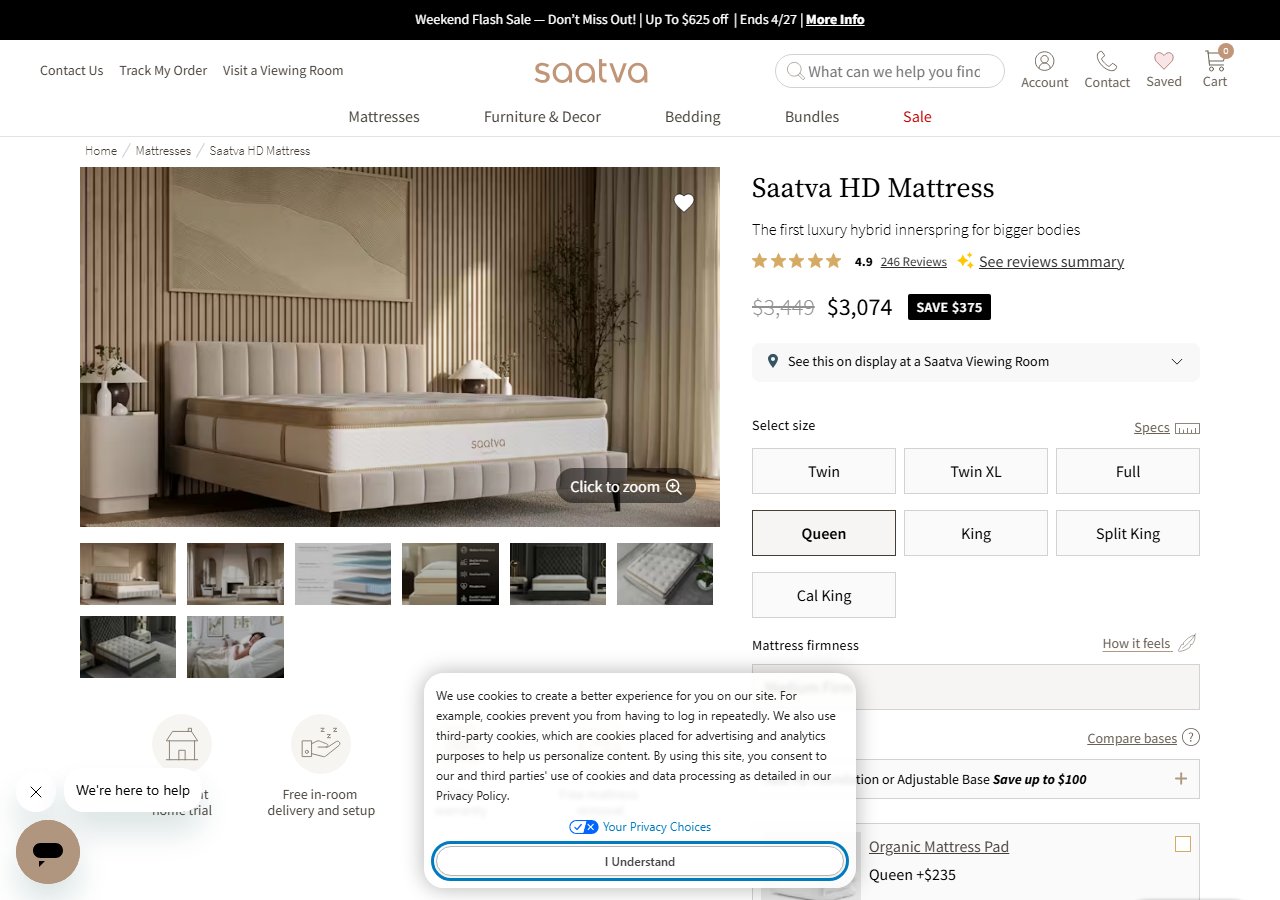
Saatva HD Mattress (Heavy-Duty)
$2,395-$3,995
See Price at Saatva →
Purple Hybrid Premier Mattress
$2,499-$4,799
See Price at Purple →The data-to-decision hierarchy
Federal surveillance data tells a consistent story: physical demand at work loads the spine, high bodyweight amplifies that loading, and inadequate sleep recovery compounds the cycle. BLS data shows the back as the most common injured body part across U.S. occupations. NIOSH data shows spinal loading routinely exceeds safe limits in physical work. CDC data shows 20% of adults living with chronic pain at the lower back. And SSA data shows musculoskeletal disorders as the dominant category of new disability claims.
The right response to that data is not to immediately spend $3,000 on a mattress. It is to fix sleep position, add daily walking, correct lifting mechanics during the workday, and rule out clinical red flags with a clinician. If those steps are genuinely insufficient — if the mattress is old, visibly sagging, and the sleeper wakes every morning stiffer than they went to bed — then a sleep surface purpose-built for higher bodyweights is a legitimate investment in the recovery window that sleep represents.
The three products reviewed here — the Saatva HD, the Saatva Loom & Leaf, and the Purple Hybrid Premier — represent meaningfully different engineering approaches to the same underlying problem. The right choice depends on sleep position, pain location, temperature preference, and budget. But all three are specified or constructed with the load requirements of higher-bodyweight sleepers in mind, which is more than can be said for the majority of the mainstream mattress market.