One in Five Americans Wakes Up in Pain — and the Federal Data Explains Why
CDC NCHS Data Brief 390 puts a number on something millions of Americans already know in their bodies: approximately 20% of U.S. adults live with chronic pain, and the lower back is the single most common pain location in that population. That is not a rounding error. That is one in five adults managing a condition that shapes how they sit, how they sleep, how they work, and — critically — how well they recover overnight.
The cost is not abstract. AHRQ HCUP data identifies back pain as one of the most expensive conditions in the entire U.S. healthcare system by total inpatient and outpatient spending. AHRQ MEPS data shows that adults with chronic back conditions carry personal healthcare expenditures that substantially exceed those of adults without such conditions. And CMS drug spending data identifies opioid and non-opioid pain medication as among the most expensive Medicare drug categories — a direct downstream consequence of undertreated or chronically mismanaged lumbar pain. The SSA Disability Insurance program names musculoskeletal disorders the single largest category of new disability claims every year.
For most chronic back pain sufferers, the conversation about treatment focuses on daytime interventions: physical therapy, anti-inflammatories, ergonomic workstations, spinal injections. What gets almost no systematic attention is the one environment every sufferer returns to for seven to nine hours every single night — their sleep surface. This article uses federal data to explain why that oversight matters, what the research says about how sleep surface and position interact with lumbar pathology, and what interventions — starting with the ones that cost nothing — can meaningfully shift outcomes.
Why Chronic Back Pain and Poor Sleep Are a Self-Reinforcing Loop
To understand why the sleep surface question is not trivial, you need to understand the biomechanics of what happens to the lumbar spine overnight. The lumbar region — L1 through L5 — carries the body's compressive load during all upright activity. Intervertebral discs act as hydraulic shock absorbers, and they rely on a process called imbibition — passive fluid exchange — that occurs primarily during non-weight-bearing rest. When you sleep, the discs rehydrate. When you sleep poorly, or on a surface that fails to maintain spinal alignment, that restorative process is interrupted or incomplete.
This is not theoretical. The lumbar spine has a natural inward curve (lordosis) that must be supported, not flattened, during sleep. A surface that is too soft allows the pelvis to sink, rotating the lumbar spine into flexion. A surface that is too firm creates a pressure point at the hips and shoulders, forcing the spine into lateral deviation. Either failure mode increases paraspinal muscle activation during sleep — muscles that should be at rest are recruiting to stabilize a misaligned spine — and the sleeper wakes stiff, inflamed, and less recovered than when they lay down.
BLS Musculoskeletal Disorders by Occupation data shows that the back is the most common body part injured across all U.S. occupations with days away from work. Workers in warehousing, construction, and healthcare — the sectors where the NIOSH Lifting Equation documents routine exceedance of safe spinal loading limits — arrive home with lumbar spines already stressed by cumulative loading. Their nights are the only window for tissue repair. A sleep surface that disrupts spinal alignment is not merely a comfort issue for these workers. It is a recovery failure with measurable occupational consequences.
CDC sleep data adds another layer: approximately 35% of U.S. adults already report sleeping fewer than 7 hours per night, the threshold below which chronic disease risk is elevated. Among chronic pain sufferers, sleep disruption rates are even higher — pain interrupts sleep architecture, reducing time in slow-wave and REM sleep, which are the stages most critical for inflammatory regulation and tissue repair. The result is a feedback loop: pain disrupts sleep, disrupted sleep worsens pain sensitivity and delays tissue healing, which makes the next night worse.
Approximately 25% of U.S. adults report doctor-diagnosed arthritis, with prevalence concentrated in physically demanding occupations. Arthritis in the facet joints of the lumbar spine is directly affected by sleep surface — morning stiffness from arthritis is worsened by static positioning on surfaces that compress rather than offload affected joint surfaces.
The Cheapest Interventions Are the Ones That Don't Require Buying Anything
Before we discuss what to sleep on, we need to discuss what you do before you lie down — and how you lie down. Federal clinical guidance is consistent on this point: behavioral and positional interventions carry significant evidence and zero cost. They should be the first line of action for anyone with chronic lumbar pain, not an afterthought.
NIH NCCIH's evidence review on low back pain is direct: walking 30 minutes most days reduces chronic low back pain as effectively as most non-drug clinical treatments. This is not folk medicine. This is a federal evidence synthesis concluding that the most accessible form of movement humans perform is also one of the most therapeutically potent interventions available for the condition affecting one in five adults. Daily walking is the lever that most people with chronic back pain are not fully pulling.
NIH back pain guidance from the National Institute of Arthritis and Musculoskeletal and Skin Diseases is equally specific about sleep position: side-sleeping with a pillow between the knees, or back-sleeping with a pillow under the knees, keeps the spine in a neutral alignment. Stomach-sleeping, by contrast, forces the neck into rotation and torques the lumbar spine into extension — a position that compresses facet joints and can worsen diskogenic pain. If you are a chronic stomach sleeper and you also have chronic back pain, the position itself may be a larger variable than the firmness of your mattress.
OSHA's ergonomics guidance covers the daytime side of the equation: hinge at the hips, not the lumbar spine, when lifting; keep loads close to the body; never twist under load. Most acute exacerbations of chronic back conditions are mechanical events — a poorly executed lift, a reach while rotated — and they are preventable with rehearsed mechanics. What happens during the day directly determines how inflamed the lumbar region is when you lie down at night.
Finally, CDC sleep hygiene guidance is clear that the mattress itself warrants replacement when there is visible sag, when you consistently wake stiffer than when you went to bed, or when the mattress is more than 7 to 10 years old. Even a premium mattress does not compensate for poor sleep hygiene, sedentary days, or a sleep position that mechanically stresses the lumbar spine.
For readers who have already addressed position, movement, and daytime mechanics — and who are still waking with significant lumbar stiffness or pain — the evidence does support targeted investment in a sleep surface designed for lumbar conditions. A well-constructed mattress is not a cure. It is an adjunct to everything above. But it is a meaningful adjunct, particularly for people whose occupational loading (warehousing, construction, healthcare) means their lumbar spines are entering sleep already stressed.
When Back Pain Needs a Clinician, Not a New Mattress
NIH National Institute of Neurological Disorders and Stroke back pain guidance identifies specific red flags that require prompt medical evaluation — not sleep surface optimization. These are the presentations where a new mattress is not only insufficient but could delay necessary diagnosis and treatment.
If your back pain radiates below the knee, you may be dealing with nerve root compression (radiculopathy or sciatica) that requires imaging and possibly interventional treatment. If pain follows a traumatic event, spinal fracture must be ruled out. Leg weakness, loss of sensation in the groin or inner thighs (saddle anesthesia), or any change in bowel or bladder control are signs of possible cauda equina syndrome — a surgical emergency. Back pain accompanied by fever and chills raises the possibility of spinal infection. Pain that is constant, non-positional, and worsening at rest can indicate a systemic cause including malignancy.
None of these presentations are appropriate for home management with a new sleep surface. They require clinical evaluation, likely imaging, and possibly urgent intervention. If any of these red flags describe your situation, stop reading mattress reviews and call your provider.
For the majority of chronic back pain sufferers — those with mechanical low back pain, facet arthropathy, mild-to-moderate disk disease, or arthritis without neurological signs — sleep surface optimization is a legitimate and evidence-adjacent intervention. The federal data on sleep disruption and inflammatory pain cycles supports the logic even where randomized controlled trials on specific mattress constructions are limited. This is the population this article is written for.
How Sleep Surface Construction Maps to Lumbar Pathology
Not all mattresses are constructed to handle the specific mechanical demands of a lumbar pain sufferer. Here is what the construction science looks like for this reader population.
Firmness is not a single variable. The clinical literature on sleep surface firmness for back pain consistently points to medium-firm as the optimal range for most mechanical back pain presentations — firm enough to prevent pelvic sinking, compliant enough to allow shoulder and hip contouring that preserves lumbar lordosis. A mattress that feels firm on a healthy adult body may be too firm for someone with significant hip or shoulder arthritis, because the pressure points created at those sites can themselves cause compensatory postures during sleep.
Zoning matters. Higher-end constructions use differentiated support zones — firmer coils or foam under the lumbar region, softer zones under the shoulders and hips. This construction approach directly addresses the biomechanical problem: it supports the lumbar curve while allowing the heavier body sections to contour into the surface without tilting the pelvis.
Material matters for heat. Chronic pain is inflammatory, and sleep temperature dysregulation worsens inflammatory pain. Memory foam's heat-retention characteristics are relevant for people who already run warm or who sleep in warm environments. Hybrid constructions (foam comfort layers over individually wrapped coils) and grid-based polymer systems generally sleep cooler than dense all-foam constructions.
Edge support matters for large-body users. BLS data shows back injuries concentrated in physically demanding occupations that skew toward larger, heavier workers. A mattress with poor edge support effectively reduces the usable surface area — a problem for anyone who sleeps near the edge or who uses the bed edge for sit-to-stand transfers, which is a functionally significant movement for people with lumbar pain.
The Saatva Loom & Leaf: Premium Memory Foam Engineered for Lumbar Support
For most chronic back pain sufferers seeking a dedicated memory foam solution, the Saatva Loom & Leaf Memory Foam Mattress is the first place to look. Priced from $1,695, the Loom & Leaf uses a layered American-made foam construction with a targeted lumbar zone — a 5-inch high-density support base with a centered lumbar enhancement pad that provides additional support specifically in the L1–L5 region, where most chronic back pain originates. The comfort layers use gel-infused memory foam to mitigate the heat-retention problem that plagues cheaper all-foam constructions. It is available in Relaxed Firm and Firm configurations, and Saatva includes white-glove delivery and setup, which matters significantly for people who cannot safely move or flip a heavy mattress due to lumbar limitations.
The Loom & Leaf is the right starting point for side- and back-sleepers with chronic lumbar pain who want the pressure contouring of memory foam with an engineered lumbar support zone rather than a uniform slab construction.
The Saatva HD: Built for Higher-Load Bodies
For workers in warehousing, construction, or any physically demanding sector — where the NIOSH Lifting Equation documents that spinal loading routinely exceeds safe limits — body weight and frame size are directly relevant to mattress selection. A mattress engineered for a 150-pound person will not provide appropriate lumbar support for a 250-pound person, because the compression dynamics of the foam layers change at higher body weights.
The Saatva HD Mattress, priced from $2,395, is purpose-built for this problem. It uses a dual coil system — individually wrapped comfort coils over a tempered steel support coil base — with a foam encasement for edge support and a 3-inch Euro pillow top. The construction is explicitly rated for users up to 500 pounds per side and is engineered to maintain lumbar support at higher body weights where standard mattress constructions begin to bottom out and lose their spinal alignment properties. For physically demanding-occupation workers with chronic back pain and larger frames, this is the construction specification that actually matches their load profile.
The Purple Hybrid Premier: Grid-Based Pressure Relief for Inflammatory Pain
For chronic back pain sufferers whose primary complaint is pressure sensitivity — facet arthritis, hip bursitis alongside lumbar pain, or significant morning stiffness from inflammatory conditions — the Purple Hybrid Premier Mattress, priced from $2,499, offers a materially different construction approach. Purple's GelFlex Grid is a polymer grid system that collapses under pressure points (shoulders, hips) while remaining firm under lower-pressure regions (lumbar, legs). This creates a dynamic pressure map that neither memory foam nor traditional coil systems can replicate — the grid is simultaneously pressure-relieving at the hip and shoulder and supportive at the lumbar without requiring zone-differentiated construction.
The Purple Hybrid Premier layers this grid system over individually wrapped coils, which adds responsiveness and airflow that all-foam constructions lack. For back pain sufferers who have tried medium-firm foam mattresses and still wake with hip or shoulder soreness that compounds their lumbar symptoms, the grid construction offers a genuinely different mechanical solution worth evaluating.
Sleep Surfaces Matched to Chronic Lumbar Pain — Federal-Data-Informed Picks
These three mattresses were selected for construction features — zoned lumbar support, high-load capacity, and pressure-relief grid technology — that directly address the biomechanical failure modes identified in federal data on chronic back conditions.

Saatva Loom & Leaf Memory Foam Mattress
$1,695-$3,295
See Price at Saatva →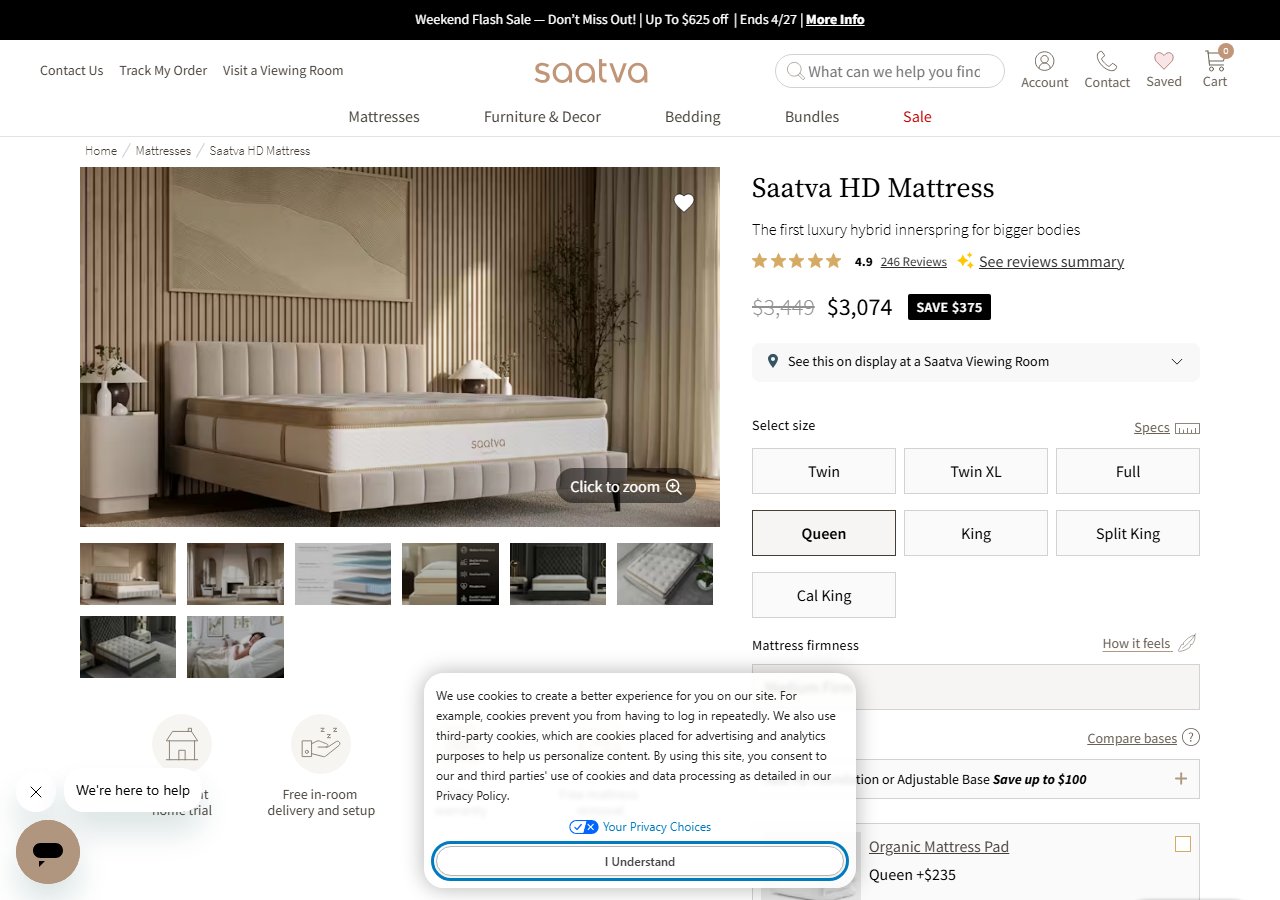
Saatva HD Mattress (Heavy-Duty)
$2,395-$3,995
See Price at Saatva →
Purple Hybrid Premier Mattress
$2,499-$4,799
See Price at Purple →What the Federal Data Hierarchy Actually Tells You
Zoom out from the product level and the federal data tells a coherent story about chronic back pain and sleep that most mattress marketing ignores entirely.
BLS identifies back injury as the leading cause of occupational days-away-from-work across every sector. NIOSH documents that the physical demands of the jobs most Americans perform routinely exceed safe spinal loading parameters. CDC counts 20% of American adults living in chronic pain, lower back leading. AHRQ measures the resulting healthcare costs as among the highest of any condition category. SSA counts musculoskeletal disorders as the primary driver of new disability claims.
This is a population-level crisis. No mattress solves a population-level crisis. But for individuals within that population who have addressed position, movement, daytime mechanics, and clinical red flags — and who are sleeping on surfaces that actively undermine lumbar recovery — the right sleep surface is a meaningful part of a complete evidence-informed response.
The intervention hierarchy is: move more, position correctly, see a clinician if red flags are present, then optimize the surface you sleep on. In that order. A mattress that supports lumbar alignment during the eight hours you spend on it every night is not a luxury purchase for someone with chronic back pain. It is a functional piece of healthcare infrastructure — the last line of a recovery protocol that should have started with a 30-minute walk.