One in Five American Adults Wakes Up in Pain — and the Data Explains Why
According to CDC NCHS Data Brief 390, approximately 20% of U.S. adults experience chronic pain, and lower back pain is the single most common location. That is roughly 50 million people navigating workdays, commutes, and sleeping hours with a lumbar spine that never fully resets. If you are among them, you already know the morning ritual: the slow roll out of bed, the tentative first steps, the assessment of how bad today is going to be. Federal data gives that lived experience a clinical frame — and it points clearly toward what helps and what doesn't.
The scale of the problem is not abstract. The Social Security Administration's Disability Insurance data identifies musculoskeletal disorders as the largest single category of new disability claims filed in the United States each year — larger than heart disease claims, larger than mental health claims. AHRQ's Hospital Cost and Utilization Project data ranks back pain among the most expensive conditions in U.S. healthcare when you add inpatient and outpatient costs together. AHRQ's Medical Expenditure Panel Survey reinforces this: adults with chronic back conditions spend substantially more on personal healthcare every year than adults without back conditions — and that gap compounds over decades. The CMS Drug Spending Dashboard shows that opioid and non-opioid pain medications rank among the most expensive Medicare drug categories, which tells you something important: the healthcare system's dominant response to chronic back pain has been pharmaceutical, not mechanical. That is worth sitting with before we talk about sleep surfaces.
Why Your Back Hurts at Night — The Biomechanical Mechanism
Understanding why back pain worsens during sleep requires understanding spinal loading across the full day. The NIOSH Lifting Equation documents that manual material-handling tasks in warehousing, construction, and healthcare routinely exceed safe spinal compression limits — meaning that for a substantial share of people with chronic back pain, the lumbar spine arrives at bedtime already inflamed, compressed, and mechanically stressed. The BLS Musculoskeletal Disorder tracking data confirms this: the back is the most frequently injured body part across all U.S. occupations that result in days away from work. Construction workers, nurses, warehouse associates, and delivery drivers are not just at elevated risk during working hours — they carry that cumulative load into every night of sleep.
The lumbar spine has a natural inward curve (lordosis) that functions as a mechanical shock absorber. When you lie down, the goal is to maintain that curve in a neutral position — neither over-flattened nor over-arched. A sleep surface that is too soft allows the hips and torso to sink unevenly, torquing the lower spine into lateral flexion for seven or eight hours. A surface that is too firm creates pressure concentration at the hips and shoulders that forces the spine to compensate. Neither extreme produces recovery; both produce morning stiffness that compounds over weeks and months into the chronic presentation that brings people to this article.
The complicating factor is that back pain is not a single condition. Degenerative disc disease, lumbar facet arthropathy, sacroiliac joint dysfunction, lumbar stenosis, and myofascial pain syndrome all involve the back but have distinct biomechanical profiles. The sleep surface prescription differs across these diagnoses. CDC data on doctor-diagnosed arthritis shows approximately 25% of U.S. adults carry that diagnosis, with higher concentration in physically demanding occupations — meaning a large share of chronic back pain sufferers also have concurrent arthritic changes in the facet joints that change what firmness level works for them. This is why generic advice to "buy a medium-firm mattress" misses the point. Firmness is a variable, not a solution.
Sleep deprivation compounds the injury cycle in ways that are underappreciated. CDC sleep surveillance data shows that approximately 35% of U.S. adults sleep fewer than 7 hours per night, the threshold at which elevated chronic disease risk — including increased pain sensitivity — is consistently documented. Pain disrupts sleep; inadequate sleep lowers pain thresholds; lower pain thresholds make the pain experience worse; worse pain further disrupts sleep. A compromised sleep surface that adds mechanical stress to this feedback loop accelerates the cycle in a direction that no amount of ibuprofen fully reverses.
The Occupational Dimension — Who This Data Is Really About
The workers most represented in BLS back injury data are not desk workers with mild posture complaints. They are the laborers, assemblers, nursing aides, and freight handlers whose spines absorb cumulative compressive load across full careers. BLS Employer Costs data shows that industries with high musculoskeletal disorder incidence carry workers' compensation insurance rates 3 to 5 times higher than low-MSD industries — a premium that is ultimately passed through to those workers in the form of suppressed wages and reduced benefits. The economic penalty for back injury extends far beyond the individual healthcare bill.
For this reader — someone whose back pain has an occupational component, or whose chronic lumbar condition is longstanding enough to be affecting sleep quality and daily function — the analysis has to start with mechanism, not product. What is compressing your spine during the day? What position are you sleeping in at night? Is your current mattress visibly sagging or more than a decade old? Answering those questions honestly will do more for your outcomes than any single product decision.
Try These First — Free Interventions That Federal Evidence Supports
The cheapest intervention is the one that does not require buying anything. Before we discuss sleep surfaces, here is what the federal evidence base says works for chronic lower back pain:
Sleep position is the most immediately actionable and zero-cost variable in your sleep environment. NIH guidance on back pain from the National Institute of Arthritis and Musculoskeletal and Skin Diseases is explicit: side-sleeping with a pillow between the knees keeps the hips stacked and the lumbar spine in neutral. Back-sleeping with a pillow under the knees relieves pressure on the lumbar discs. Stomach-sleeping, by contrast, forces the cervical spine into rotation and the lumbar spine into hyperextension for the duration of sleep — a biomechanical insult that no mattress fully compensates for. If you are a stomach sleeper with chronic lower back pain, changing that position is the single highest-leverage intervention available to you, and it costs nothing.
Daily walking is the movement intervention with the strongest evidence base for chronic low back pain. The NIH NCCIH evidence review on low back pain finds that 30 minutes of walking most days reduces chronic low back pain as effectively as most non-drug clinical treatments. This is not a minor finding. Walking promotes lumbar disc hydration through cyclic loading, activates the deep stabilizing musculature around the spine, and reduces the central sensitization that amplifies pain perception. People who are sedentary between physically demanding work shifts — the nurse who sits during breaks, the warehouse worker who lies on the couch after a 10-hour shift — often experience worse back pain than their movement patterns on the job would predict.
Lifting and bending mechanics address the root mechanical input for the majority of occupational back injuries. OSHA's ergonomics guidance recommends hinging at the hips rather than rounding the lumbar spine, keeping loads close to the body's center of mass, and eliminating twisting under load. Most acute back episodes — the ones that land people in urgent care or produce lost workdays — are mechanical events triggered by poor load handling, and they are largely rehearsable with body mechanics training. This is not glamorous, but the federal occupational health data is unambiguous on this point.
Mattress replacement timing matters, but not in the way marketers present it. CDC sleep hygiene guidance frames the question clearly: replace a mattress when it shows visible sag, when you consistently wake stiffer than you went to bed, or when it is older than 7 to 10 years. Even the most expensive mattress does not undo poor sleep hygiene, sedentary days, or unaddressed occupational loading. The mattress is a variable in a system, not a cure.
For many readers, working through those interventions — sleeping in a neutral position, walking daily, correcting load mechanics, and eliminating an obviously deteriorated sleep surface — produces meaningful reduction in chronic back symptoms without any additional product investment. But some readers have already done that work. They sleep on their side with proper pillow support, they walk, they are not sleeping on a decade-old mattress, and their pain is still disrupting sleep. For those readers, a properly matched sleep surface is a defensible next step — and the evidence around firmness, material construction, and spinal support is specific enough to be useful.
When to See a Clinician First
Before we discuss products, a direct statement is necessary: certain back pain presentations require clinical evaluation before any sleep surface change. A new mattress does not diagnose spinal stenosis, lumbar fracture, or cauda equina syndrome. NIH neurological disorder guidance identifies specific presentations that warrant prompt clinical evaluation and possible imaging — and these should not be filtered through a purchasing decision. See the red flags section below for the specific criteria.
For the majority of people with non-specific chronic lower back pain — pain without neurological signs, without recent trauma, without fever — the evidence supports a conservative-first approach that includes position therapy, movement, and appropriate sleep surface selection. The 20% chronic pain prevalence figure from CDC and the SSA disability data both reflect a population whose pain has become chronic in part because early mechanical interventions were not applied consistently. Getting clinical evaluation early, and applying behavioral interventions before pain becomes entrenched, changes trajectories.
Where a Properly Matched Sleep Surface Fits In
With mechanism understood and free interventions established, the sleep surface question becomes tractable. The research framing here is specific: what construction characteristics best preserve neutral lumbar alignment for adults with chronic lower back pain across the full sleep duration, including postural shifts during sleep?
The answer is not a single firmness number. It is a combination of zoned support (firmer under hips and lumbar spine, softer under shoulders to allow for natural spinal curves), pressure relief at bony prominences (hips and shoulders for side sleepers), and edge support that does not create a hammock effect at the sleeping surface perimeter. Medium-firm constructions consistently outperform soft and firm extremes in the clinical literature for non-specific lower back pain, but "medium-firm" describes a range, not a point.
For adults with serious chronic lumbar conditions — the reader who has been through physical therapy, possibly had imaging, and whose pain is specifically affecting sleep quality — the Saatva Loom & Leaf Memory Foam Mattress is the premium memory foam pick that addresses both pressure relief and lumbar support simultaneously. Loom & Leaf is constructed with a 5-lb density memory foam comfort layer over a lumbar zone enhancement pad — a higher-density support insert positioned specifically under the lumbar spine to prevent the excessive sinking that collapses lumbar lordosis. This is the kind of construction detail that matters for chronic pain sufferers: not just "memory foam," but density-differentiated memory foam with targeted lumbar reinforcement. It is available in a relaxed firm and firm option, which allows matching to body weight and sleep position. At $1,695 to $3,295 depending on size, it sits at a premium price point that reflects its material quality — this is not a product recommendation for a reader whose pain might resolve with better sleep position habits.
For readers whose chronic back pain has an occupational component involving heavy physical labor — the warehouse associate, the construction worker, the long-haul driver whose spine takes compressive loading well beyond NIOSH recommended limits — body weight and frame size interact with mattress construction in ways that standard consumer mattresses do not address. The Saatva HD Mattress is built specifically for this loading pattern. It is engineered for users up to 500 pounds with a dual steel coil system — an 884-count individually wrapped coil layer over a tempered steel base coil system — plus a high-density foam perimeter that eliminates edge softening. For heavier-framed adults, standard mattresses create progressive sag over months that standard medium-firm recommendations do not account for. The Saatva HD is priced at $2,395 to $3,995 and represents a product that does not have a meaningful equivalent in standard retail.
For readers whose primary complaint is pressure-point pain — hip and shoulder pain that accompanies lower back pain in side sleepers, or pain associated with arthritis in the facet joints and hip joints — pressure distribution across the sleep surface is the primary construction variable. The Purple Hybrid Premier Mattress uses a grid-based polymer comfort system that distributes weight across the full surface area rather than concentrating it at pressure points the way traditional foam does. The GelFlex Grid is designed to remain neutral in temperature (a common complaint with memory foam), flex under shoulder and hip pressure, and maintain firmness under the lumbar spine. For the 25% of U.S. adults with doctor-diagnosed arthritis — particularly those with concurrent hip and lower back arthritis — this pressure-distribution approach addresses a different biomechanical problem than the Loom & Leaf targets. Priced at $2,499 to $4,799, it is the most expensive option in this group and is most appropriate for readers whose pressure-point pain is the dominant sleep disruptor.
Sleep Surfaces Matched to Chronic Back Pain Patterns
These three mattresses were selected for readers with documented chronic lumbar conditions — each addresses a distinct pain pattern identified in federal occupational health and CDC prevalence data.

Saatva Loom & Leaf Memory Foam Mattress
$1,695-$3,295
See Price at Saatva →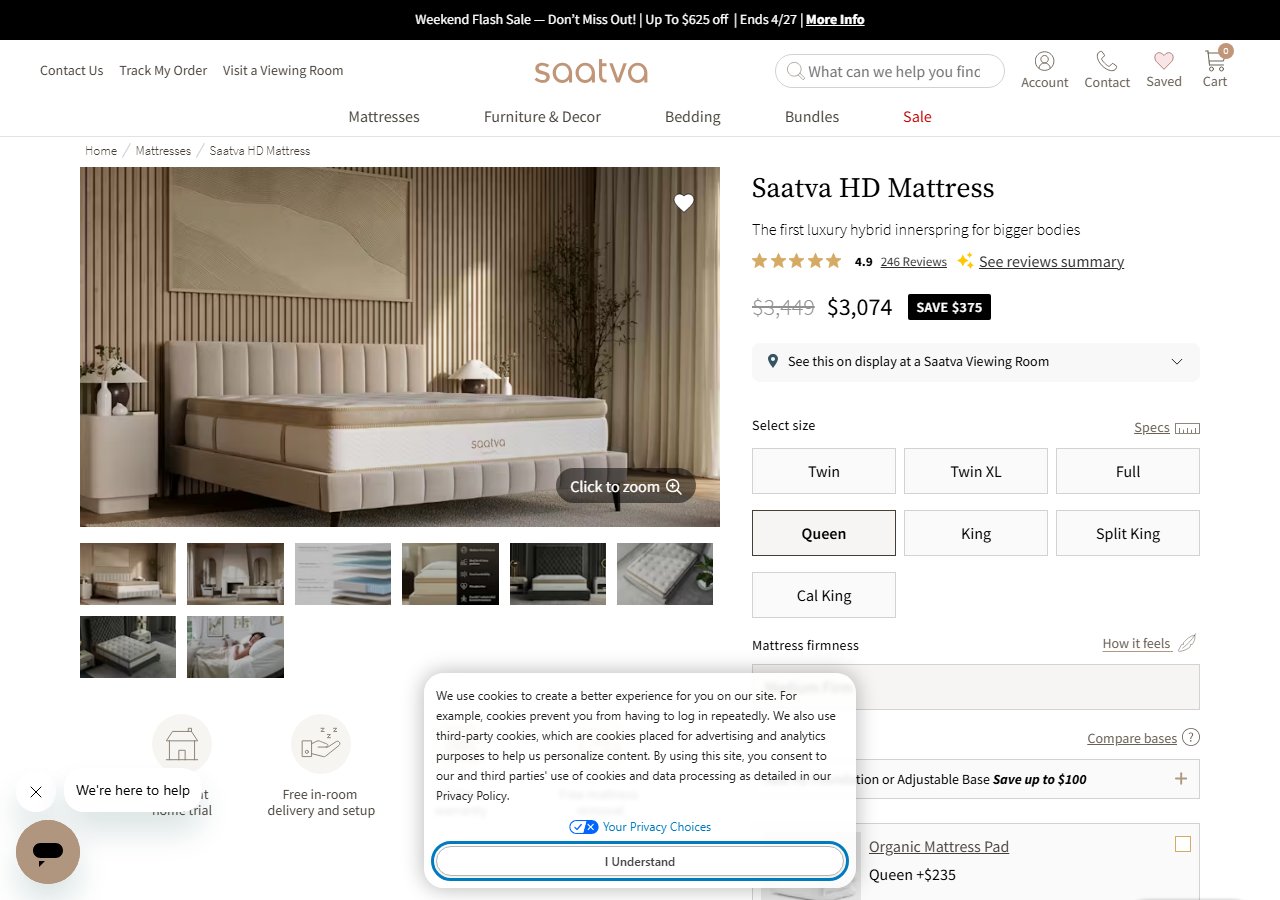
Saatva HD Mattress (Heavy-Duty)
$2,395-$3,995
See Price at Saatva →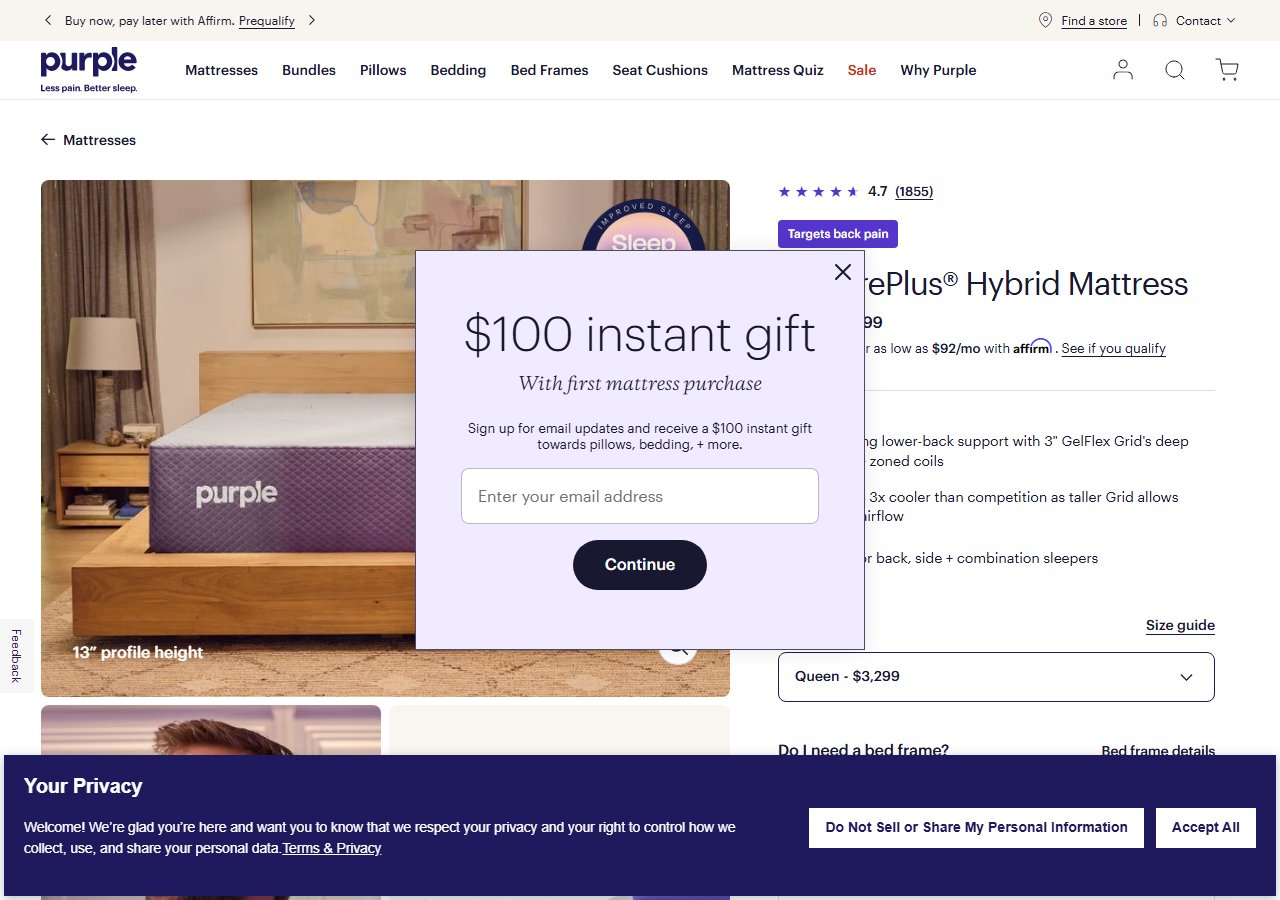
Purple Hybrid Premier Mattress
$2,499-$4,799
See Price at Purple →How to Match These Products to Your Specific Pain Pattern
The three products above address distinct presentations. Here is the matching logic:
- Degenerative disc disease or lumbar facet pain where you need both pressure relief and lumbar reinforcement: Saatva Loom & Leaf in Relaxed Firm or Firm, depending on body weight (heavier sleepers generally benefit from firmer constructions that prevent excessive lumbar sinking).
- Occupational back pain with higher body weight or frame size, where standard mattresses sag progressively: Saatva HD, particularly if your current mattress shows visible body impressions within a year or two of purchase — that is a sign the coil system and foam density are undersized for your load.
- Arthritis-related hip and lower back pain in side sleepers, where pressure-point pain is as prominent as lumbar pain: Purple Hybrid Premier, where the grid construction addresses pressure concentration rather than just lumbar support.
None of these products replaces the behavioral interventions. A person sleeping on a Saatva Loom & Leaf in a stomach-sleeping position is still torquing their lumbar spine for eight hours. The interventions and the sleep surface work together — the surface creates the mechanical environment, but your sleep position determines what that environment actually does to your spine.
The Economic Argument for Getting This Right
AHRQ MEPS data shows that adults with chronic back conditions spend substantially more on healthcare annually than those without — and CMS drug spending data shows that pain medication spending represents one of the heaviest cost categories in the Medicare system. The aggregate picture from federal data is of a condition that is undertreated mechanically and overtreated pharmaceutically. Sleep surface optimization is not a luxury intervention for chronic back pain sufferers — it is a mechanical variable that affects eight hours of every day. Getting it wrong over years compounds the same way that poor lifting mechanics compound.
The data hierarchy is clear: position first, movement second, clinical evaluation when red flags are present, equipment when the mechanical environment genuinely warrants it. For the one in five Americans with chronic back pain, that framework — applied consistently — changes outcomes in ways that no single product decision does on its own.