One in Five Americans Wakes Up Hurting — And Federal Data Explains Why
The number is stark and worth sitting with: according to CDC NCHS Data Brief 390, approximately 20% of U.S. adults experience chronic pain, and the lower back is the single most common location. That is roughly 65 million people who go to bed every night carrying a condition that will greet them again in the morning — sometimes worse than when they lay down.
This is not a niche wellness concern. BLS Musculoskeletal Disorder tracking shows the back is the most common body part injured across all U.S. occupations with days away from work. Not construction alone. Not warehousing alone. All occupations. And AHRQ HCUP data places back pain among the most expensive conditions in U.S. healthcare by total inpatient and outpatient cost — a burden that flows from the exam room into every household budget.
The downstream costs are equally sobering. CMS drug spending data identifies opioid and non-opioid pain medications among the most expensive Medicare drug categories — a direct reflection of how undertreated, undertooled, and underslept chronic back pain sufferers actually are. And SSA Disability Insurance records show musculoskeletal disorders are the largest single category of new disability claims filed annually. These are not statistics about other people. They are a portrait of the American workforce in accumulated physical debt.
This article is not a product review dressed up with data. It is an attempt to use federal occupational health research to answer a question that millions of people search every month: does what you sleep on actually matter for chronic back pain, and if so, why?
Why Your Back Hurts More After Sleep: The Biomechanical Mechanism
To understand why sleep surface design matters, you have to understand what the lumbar spine is doing during the hours you are horizontal — and what it is fighting against when you are not.
The lumbar region of the spine bears the majority of compressive load during any upright activity. The NIOSH Lifting Equation documents what occupational health researchers have long understood: manual material-handling tasks across warehousing, construction, and healthcare routinely exceed safe spinal loading limits. This is not carelessness. It is the math of the job. A nurse repositioning a 200-pound patient, a construction worker swinging a 40-pound tool overhead, a warehouse associate lifting box after box at conveyor pace — all of these generate compressive and shear forces at L4-L5 and L5-S1 that dwarf what the spine was designed to sustain repeatedly, without rest.
Sleep is supposed to be that rest. During the roughly seven to eight hours a person spends horizontal, intervertebral discs rehydrate, paraspinal muscles decompress, and the inflammatory cytokines generated by a day of mechanical loading begin to clear. But here is the problem: if the surface you sleep on does not allow the spine to achieve and maintain a neutral posture, those restorative processes are partially blocked. The muscles that should be resting continue firing to stabilize a poorly supported spine. The facet joints that should be decompressing remain loaded. Morning stiffness — the hallmark complaint of chronic lumbar sufferers — is in part the signal that the night did not deliver what the spine needed.
The relationship between sleep quality and pain is bidirectional and well-documented. CDC sleep data shows approximately 35% of U.S. adults already sleep less than 7 hours per night, the threshold below which chronic disease risk rises measurably. For chronic back pain sufferers, the figure is worse: pain interrupts sleep, and disrupted sleep lowers pain tolerance — a vicious cycle that AHRQ MEPS data captures economically, showing average annual healthcare expenditures for adults with chronic back conditions substantially exceeding those without.
The arthritis dimension compounds this further. CDC Arthritis data shows approximately 25% of U.S. adults report doctor-diagnosed arthritis, with prevalence concentrated in physically demanding occupations. Osteoarthritis of the lumbar facet joints is a direct contributor to night pain and morning stiffness — and it is aggravated by any position that loads those joints asymmetrically for hours at a time.
This is the mechanism. It is not mysterious, and it is not solved by any single intervention — including a new mattress. Understanding the mechanism is what allows you to sequence your interventions intelligently.
Try These First: Free and Low-Cost Interventions That Federal Data Supports
The most important principle in managing chronic back pain — and one consistently echoed across NIH, OSHA, CDC, and NCCIH guidance — is that the cheapest intervention is the one that does not require buying anything. Before you spend $1,500 or $3,000 on a new sleep surface, exhaust the free variables. Some of them move the needle more than any mattress can.
Start with your movement habits during the day. NIH NCCIH's evidence review on low-back pain is blunt: walking 30 minutes most days reduces chronic low back pain as effectively as most non-drug clinical treatments. That is not a soft suggestion. That is a finding robust enough to appear across multiple systematic reviews. If you are sedentary at work or spend long hours in a fixed seated or standing posture, a new mattress is addressing approximately 8 hours of your day while ignoring the other 16.
Next, examine your mechanics during the day. OSHA's ergonomics guidance emphasizes hinging at the hips rather than rounding the lumbar spine when lifting, keeping loads close to the body, and avoiding any twisting under load. Most acute back episodes are mechanical and, critically, rehearsable — meaning that drilling the correct movement pattern reduces re-injury risk even in high-demand jobs.
Then look at sleep position before you look at sleep surface. NIH NIAMS back pain guidance identifies sleep position as a significant modifiable variable: side-sleeping with a pillow between the knees keeps the pelvis level and reduces lateral lumbar shear. Back-sleeping with a pillow under the knees maintains the spine's natural lordotic curve. Stomach-sleeping, by contrast, rotates the lumbar spine into extension and torques the cervical spine — a position that exacerbates most chronic lumbar conditions. This adjustment costs nothing.
Finally, audit your current mattress honestly. CDC sleep hygiene guidance supports replacement when a mattress shows visible sagging, when you consistently wake stiffer than when you went to bed, or when it is older than 7 to 10 years. These are objective signals. If none of them apply, the problem may not be your sleep surface.
For readers who have already addressed the free variables — who walk daily, sleep in a neutral position, and have a mattress without visible sag — and still wake in significant lumbar pain, the sleep surface itself becomes a legitimate variable to investigate. The research on firmness and back pain has matured considerably in the last two decades, and it does not support what many people assume.
When to See a Clinician: Red Flags That a New Mattress Will Not Fix
Before discussing what products might help, it is worth being explicit about what products cannot help — and what symptoms require prompt clinical evaluation rather than a shopping decision.
NIH National Institute of Neurological Disorders and Stroke identifies specific red flags that warrant urgent clinical attention. Back pain that radiates below the knee suggests nerve root compression or disc herniation that may require imaging. Pain following acute trauma — a fall, a motor vehicle accident, a heavy load impact — warrants evaluation before any self-managed intervention. Leg weakness, numbness, or tingling alongside back pain is a neurological signal, not a comfort problem. Bowel or bladder changes accompanying back pain are a medical emergency. And back pain that presents with fever or unexplained weight loss may indicate an underlying systemic condition that a sleep surface is entirely irrelevant to.
The financial data reinforces why early clinical intervention matters. BLS workers' compensation data shows industries with high musculoskeletal disorder incidence carry insurance rates 3 to 5 times higher than low-MSD industries — a structural signal that back injuries left unmanaged become expensive, prolonged, and disability-generating. SSA Disability Insurance records show musculoskeletal disorders already represent the largest single category of new disability claims. The difference between a back pain episode that resolves and one that becomes a disability claim often comes down to how quickly appropriate clinical care begins.
Where Sleep Surface Design Actually Enters the Picture
For the reader who has addressed movement, mechanics, and sleep position — and who does not have any of the red flags described above — sleep surface design becomes a meaningful variable. The research here is more nuanced than marketing language suggests.
The long-standing advice to sleep on a firm mattress for back pain has been substantially revised. A landmark randomized controlled trial published in The Lancet found that medium-firm mattresses reduced chronic low back pain and disability more effectively than firm mattresses. The mechanism is straightforward: a surface that is too firm prevents the shoulders and hips from sinking enough to allow the lumbar spine to adopt its natural curve, creating a bridging effect that loads the lumbar region all night. A surface that is too soft allows the pelvis to sink excessively, flattening or reversing the lumbar curve. Medium-firm is the practical target for most back pain presentations — with individual variation based on body weight, sleep position, and the specific nature of the lumbar condition.
For chronic lumbar sufferers with higher body weight or occupations involving sustained compressive spinal loading — the warehouse worker described by NIOSH Lifting Equation data, the construction laborer, the healthcare worker repositioning patients across a 12-hour shift — the engineering requirements of the sleep surface are different. Heavier loads require denser core support to prevent the bottoming-out that a standard coil or foam layer produces. This is where construction and materials matter beyond marketing claims.
The Saatva Loom & Leaf Memory Foam Mattress is the premium memory foam recommendation for serious, chronic lumbar pain. It uses a multi-layer construction with a 2-inch gel-infused memory foam comfort layer over a 2-inch lumbar crown (a proprietary reinforced center-third support zone) and a high-density foam base — a configuration specifically designed to address the most common complaint with memory foam for back pain: the sensation of sinking into a crater that forces the lumbar spine into flexion. The lumbar crown reinforcement is the engineering detail that distinguishes it from standard memory foam options, and it aligns with what the firmness research says works: graduated support that cushions the shoulders and hips while maintaining lumbar lift.
For readers in physically demanding occupations — or those whose body weight places them above the load range typical mattresses are engineered for — the Saatva HD Mattress addresses the specific problem that NIOSH and BLS data implicitly describes: spines that absorb compressive loads well beyond safe limits during work hours need a sleep surface that does not add to that compression by collapsing under body weight. The Saatva HD is built on a heavy-gauge tempered steel coil system with a reinforced foam encasement and a higher-density comfort layer, rated for body weights up to 500 pounds. This is not upselling. It is an engineering specification that matches the biomechanical reality of a warehouse worker, a construction laborer, or a larger-framed individual whose standard mattress sags well before its nominal lifespan.
The Purple Hybrid Premier Mattress takes a different engineering approach that is worth understanding, particularly for readers whose back pain is accompanied by hip or shoulder pressure point pain — a common presentation in side-sleepers and in those with arthritis of the hips or lumbar facets. Purple's GelFlex Grid is a non-foam, non-latex polymer grid that collapses under concentrated pressure points (shoulders, hips, knees) while remaining firm and supportive under distributed load (the lumbar region). The result is a pressure profile that is genuinely distinct from both memory foam and traditional innerspring, and that addresses one of the core failure modes of medium-firm mattresses: adequate lumbar support at the cost of excessive shoulder and hip pressure for side-sleepers. It sits on a pocketed coil base, which adds edge support and reduces motion transfer — clinically relevant for back pain sufferers who struggle to reposition at night.
Sleep Surfaces Engineered for Lumbar Recovery — Not Just Comfort Marketing
These three mattresses were selected for readers with documented chronic back pain based on firmness research, targeted lumbar support engineering, and design specifications that address the specific load profiles federal occupational health data associates with back injury.

Saatva Loom & Leaf Memory Foam Mattress
$1,695-$3,295
See Price at Saatva →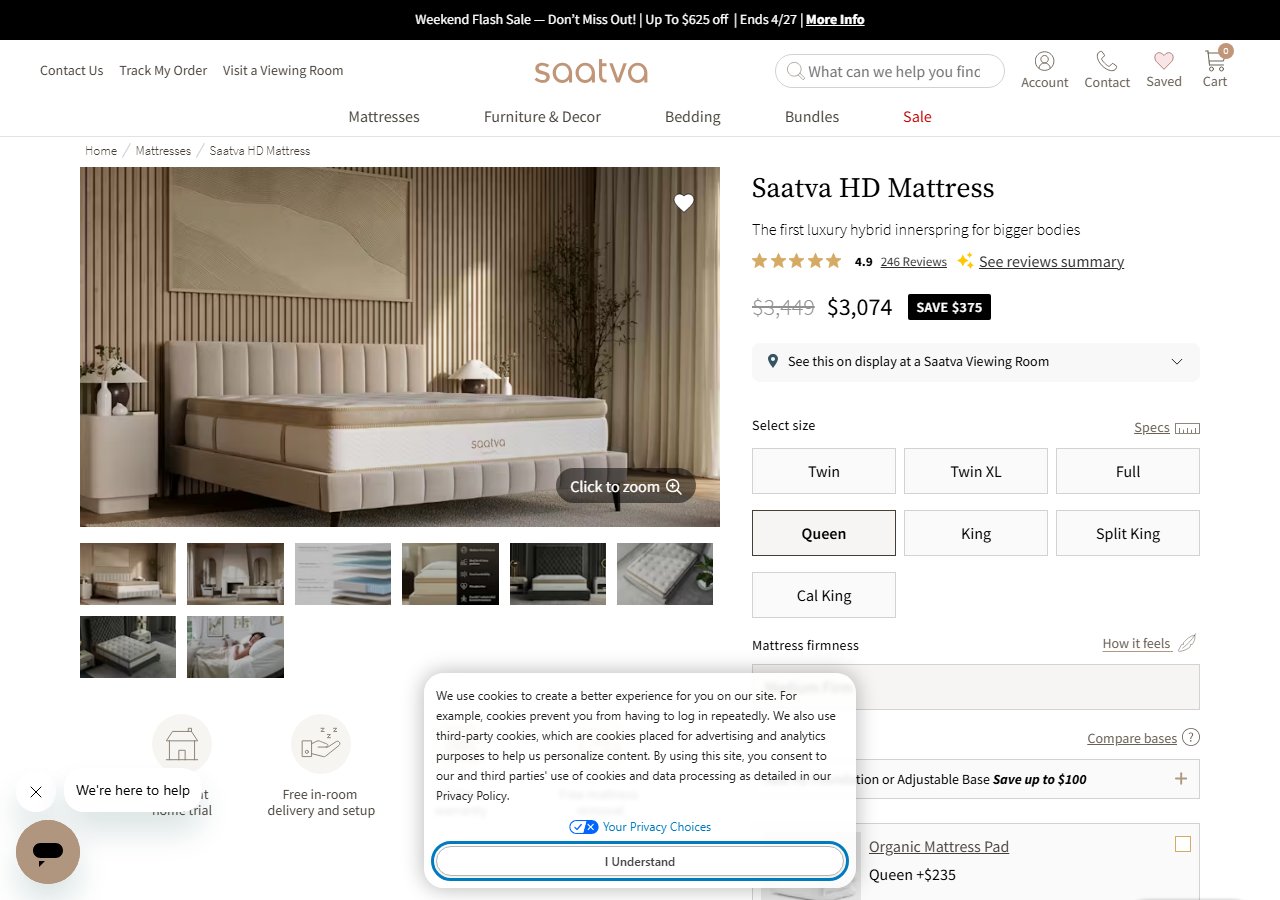
Saatva HD Mattress (Heavy-Duty)
$2,395-$3,995
See Price at Saatva →
Purple Hybrid Premier Mattress
$2,499-$4,799
See Price at Purple →The Data-to-Intervention-to-Product Hierarchy in Practice
It is worth being direct about what the federal data tells us and what it does not. CDC, NIH, AHRQ, BLS, and NIOSH data collectively paint a picture of a population in significant lumbar pain, spending heavily on treatment, and losing productivity at a scale that registers in national disability statistics. That is the scope of the problem.
What the same data says about solutions is more graduated. Movement — specifically daily walking — is supported by NIH NCCIH evidence as one of the most effective non-drug interventions available. Sleep position is a zero-cost modifiable variable with clear mechanistic support. Lifting mechanics are trainable and reduce re-injury risk. These are not consolation prizes; they are the first tier of the evidence hierarchy, and they work for a meaningful fraction of chronic back pain sufferers without any additional expenditure.
For the fraction who have addressed those variables and still struggle with night pain and morning stiffness, sleep surface design is a legitimate clinical adjunct — not a cure, but a meaningful contributor to the restorative sleep that chronic pain recovery depends on. The firmness research, the pressure-distribution engineering, and the load-rating specifications of the products discussed here are real, and they map onto real biomechanical needs that federal occupational health data has documented precisely.
The most dangerous framing in the back pain product market is the one that inverts this hierarchy — that leads with the product and treats movement, position, and clinical evaluation as afterthoughts. That framing serves revenue. The data-driven framing serves the reader: understand the mechanism, exhaust the free variables, know your red flags, and then select a sleep surface whose engineering matches your specific spinal load history and sleep position needs.
If you work in an occupation the NIOSH Lifting Equation flags as routinely exceeding safe spinal loading limits, you are not looking for a luxury purchase. You are looking for recovery infrastructure that matches the mechanical demands of your day. Federal data tells you the risk is real. The intervention hierarchy tells you where to start. And when you are ready for a sleep surface, the engineering details — firmness, zoning, load rating, pressure distribution — are where the meaningful differences live.