One in Five American Adults Is Sleeping on a Problem That Compounds Every Night
According to CDC NCHS Data Brief 390, approximately 20% of U.S. adults experience chronic pain, and the lower back is the single most common pain location reported. That is roughly 50 million people waking up every morning with a lumbar spine that did not fully recover overnight — and in many cases, a sleep surface that actively made the situation worse. This is not a minor wellness concern. AHRQ HCUP data identifies back pain as one of the most expensive conditions in U.S. healthcare by total inpatient and outpatient expenditure. SSA Disability Insurance data shows musculoskeletal disorders are the largest single category of new disability claims filed annually. And CMS drug spending data identifies opioid and non-opioid pain medications among the most expensive drug categories in Medicare, reflecting a treatment system stretched thin by a condition that starts, in many cases, in the muscles and discs of the lumbar spine.
The purpose of this article is not to sell a mattress. It is to walk through what federal epidemiological data and peer-reviewed biomechanics research actually say about chronic lower back pain, what interventions the evidence supports — starting with the free ones — and where sleep surface construction genuinely matters for people who have exhausted every other variable.
Why Chronic Back Pain Persists: The Biomechanical and Occupational Mechanism
Chronic lower back pain is not a single condition. It is a cluster of overlapping pathologies — disc degeneration, facet joint arthritis, sacroiliac dysfunction, paraspinal muscle fatigue — that share a common upstream cause: cumulative spinal loading that exceeds the tissue's repair capacity. Understanding this mechanism matters because it determines what interventions actually interrupt the cycle.
The lumbar spine absorbs compressive and shear forces throughout every waking hour. NIOSH Lifting Equation data documents that manual material-handling tasks in warehousing, construction, and healthcare routinely exceed safe spinal loading limits — meaning a large share of the workforce is accumulating microdamage daily before they ever reach the sleep surface. BLS MSD by Occupation data confirms the back is the most commonly injured body part across all U.S. occupations with days away from work. For these workers, the overnight window is the primary — sometimes the only — recovery window available.
Spinal disc tissue is largely avascular: it exchanges nutrients and metabolic waste through a process called imbibition, which depends on alternating cycles of compression and decompression. During sleep, when axial loading from body weight drops dramatically, discs rehydrate and partial repair occurs. If the sleep surface keeps the lumbar spine in sustained flexion (as a mattress that is too soft allows), or in hyperextension (as a mattress that is too firm forces for side-sleepers), the recovery window is wasted. The discs cannot fully decompress. Paraspinal muscles that should relax into a supported neutral position remain in low-level contraction to stabilize a misaligned spine.
This is not theoretical. CDC sleep data shows approximately 35% of U.S. adults report sleeping fewer than 7 hours per night — already below the threshold associated with elevated chronic disease risk. For chronic back pain sufferers, the issue is not just duration but quality: a painful, poorly supported sleeping posture fragments sleep architecture, suppresses slow-wave sleep (the phase most associated with tissue repair), and generates a debt that accumulates over weeks and months.
CDC Arthritis data shows approximately 25% of U.S. adults have doctor-diagnosed arthritis, with prevalence concentrated in physically demanding occupations. Facet joint arthritis in the lumbar spine is particularly sensitive to sustained end-range loading — exactly what the wrong sleep surface produces night after night.
The economic signal here is not subtle. AHRQ MEPS data shows that adults with chronic back conditions carry substantially higher personal healthcare expenditures than adults without — a gap driven by imaging, specialist visits, interventional procedures, and medications rather than by any upstream behavioral change. The system is paying enormous sums to manage a condition that, at its mechanical core, is heavily influenced by how the spine is positioned for eight hours every night.
Try These First: The Evidence-Backed Free Interventions
Before this article discusses any mattress, it needs to be direct about something: the cheapest intervention is the one that does not require buying anything. Federal evidence consistently shows that behavioral and positional changes outperform passive interventions — including sleep surface upgrades — for the majority of chronic lower back pain sufferers. A new mattress on top of a sedentary day, poor lifting mechanics, and a supine-with-no-support sleep position will underperform a no-cost behavioral change applied consistently.
The four interventions below are drawn from federal evidence sources and are ranked roughly by evidence weight. Work through each one before concluding that your next purchase is the problem.
Daily walking is the single most supported intervention in the NIH NCCIH evidence review on low back pain: 30 minutes of walking most days reduces chronic low back pain as effectively as most non-drug clinical treatments. The mechanism is straightforward — ambulatory movement pumps synovial fluid through facet joints, drives imbibition in lumbar discs, and activates the paraspinal stabilizer chain in the low-load, high-repetition pattern that chronic pain responds to best.
Sleep position is the most immediately modifiable variable and costs nothing. NIH NIAMS back pain guidance specifically recommends side-sleeping with a pillow between the knees, or back-sleeping with a pillow under the knees, to maintain a neutral lumbar curve. Stomach sleeping is contraindicated for lumbar conditions: it forces the lumbar spine into extension while rotating the cervical spine to one side, loading multiple segments simultaneously for the entire night.
Lifting and bending mechanics are responsible for a disproportionate share of acute-on-chronic exacerbations. OSHA's ergonomics guidance documents the correct pattern: hinge at the hips, keep loads close to the body, avoid twisting under load. Most acute back episodes in otherwise-chronic sufferers are mechanical events — rehearsable, preventable, and not solved by any mattress upgrade.
Mattress replacement timing matters more than mattress brand in many cases. CDC sleep hygiene guidance and occupational health literature both point to visible sag, waking stiffer than you went to bed, or a mattress older than 7–10 years as reliable indicators that the sleep surface is contributing to — rather than merely failing to solve — chronic back symptoms. A saggy mattress cannot be compensated for by sleep position alone.
For readers who have already worked through these behavioral changes — who walk regularly, sleep in a supported position, use proper mechanics, and whose mattress is less than a decade old and structurally sound — the question of sleep surface construction becomes legitimate and worth taking seriously. The remainder of this article addresses that question with the same evidence standard.
When to See a Clinician: Red Flags That Override Everything Else
No mattress, position change, or walking program is appropriate when the back pain presentation includes neurological or systemic red flags. NIH National Institute of Neurological Disorders and Stroke back pain guidance is explicit: back pain that radiates below the knee, follows significant trauma, accompanies leg weakness, or presents with bowel or bladder dysfunction requires prompt clinical evaluation — not a new sleep surface. These presentations can signal disc herniation with nerve root compression, cauda equina syndrome (a surgical emergency), spinal stenosis, or vertebral fracture.
Additional red flags include back pain in adults over 50 with no prior history, pain that wakes the patient from sleep and is unrelieved by position change (which can indicate malignancy or infection), or back pain accompanied by unexplained weight loss or fever. The AHRQ clinical practice guidance framework for chronic pain management consistently distinguishes mechanical low back pain — which responds to behavioral and conservative interventions — from pathological back pain, which requires imaging, specialist referral, and in some cases urgent intervention. If any of these red flags apply to your situation, close this article and call a clinician.
Where Sleep Surface Construction Actually Matters
For readers with mechanical chronic lower back pain — the kind driven by occupational loading, postural habit, and tissue fatigue rather than structural pathology — sleep surface construction is a legitimate therapeutic variable. The research literature, synthesized in NIH NCCIH's low back pain review, supports medium-firm mattresses as the optimal range for most chronic lower back pain sufferers, with the caveat that individual body weight, sleep position, and the specific pain mechanism all modify the ideal firmness.
Here is what the construction variables mean in practice:
Pressure relief determines whether the heaviest body segments — hips and shoulders in side-sleepers, sacrum and heels in back-sleepers — sink into the surface enough to allow the lumbar spine to rest in neutral rather than bridge in an unsupported curve. Memory foam and gel-infused foam layers excel at this because they conform to body contour under sustained load.
Spinal alignment support is the counter-variable. A surface that provides excellent pressure relief but no pushback eventually allows the hips to sink too far, creating lumbar flexion rather than neutral. The best sleep surfaces for chronic back pain combine a conforming comfort layer with a firmer support core that arrests excessive sink.
Edge support matters more than many buyers anticipate: people with chronic back pain often need to use the perimeter of the mattress to rise from a lying position. A mattress with poor edge support forces the kind of asymmetric, twisting rise that loads the lumbar spine at its most vulnerable moment.
Weight capacity and durability are critical for larger-bodied sleepers. A mattress engineered for average body weights will develop sag patterns much faster under higher loads, and sag — as noted above — is one of the clearest evidence-based signals that a sleep surface is worsening rather than supporting a chronic back condition.
The Saatva Loom & Leaf: Premium Memory Foam for Serious Lumbar Conditions
For readers whose primary complaint is pressure-driven pain — the kind that produces hip or shoulder pain that migrates into the lumbar spine — the Saatva Loom & Leaf Memory Foam Mattress is the first recommendation in this roundup. The Loom & Leaf is built around a multi-layered memory foam construction that distributes pressure across a larger surface area than innerspring systems, reducing the peak-pressure loading that facet joint arthritis and disc-adjacent inflammation respond badly to. It comes in two firmness options — Relaxed Firm and Firm — both of which sit in the medium-firm range that federal and clinical evidence consistently supports for chronic lumbar conditions. The organic cotton cover and gel cooling layer address the sleep-quality fragmentation that chronic pain patients often experience, since overheating is a secondary fragmenter of slow-wave sleep. At $1,695–$3,295 depending on size, this is a serious purchase — but AHRQ MEPS data on the annual healthcare cost differential for adults with chronic back conditions puts a durable sleep surface investment in a different frame than a discretionary one.
The Saatva HD: Engineered for High-Load Spinal Recovery
For readers who carry larger body weights — or whose occupational profile involves the kind of sustained spinal loading that NIOSH Lifting Equation data documents in warehouse, construction, and healthcare work — a standard mattress construction will not hold up under repeated nightly compression. The Saatva HD Mattress is purpose-built for this user: it is rated for body weights up to 500 pounds per sleeper, uses a reinforced lumbar zone in the support core, and employs a higher-density foam encasement than Saatva's standard lines. The reinforced lumbar zone is not a marketing feature — it directly addresses the biomechanical reality that larger-bodied back pain sufferers experience greater sag-induced lumbar flexion in standard mattresses, which defeats the alignment goal entirely. At $2,395–$3,995, it is the highest price point in this list, but it is the only construction in this roundup specifically engineered for the load patterns that BLS MSD by Occupation data documents as the most common driver of occupational back injury.
The Purple Hybrid Premier: Pressure Relief Without Heat Retention
For readers who find that memory foam's heat retention disrupts sleep — a genuine issue for chronic pain sufferers, since thermal discomfort fragments the slow-wave sleep that drives tissue repair — the Purple Hybrid Premier Mattress offers a differentiated construction path. Purple's GelFlex Grid is an open-grid polymer structure that does not trap heat the way traditional memory foam does, while providing pressure relief that rivals foam in peak-pressure reduction. The grid collapses under pressure points and remains rigid under lighter loads, which means it approximates the zoned-support behavior that back pain biomechanics calls for without relying on a foam layer. The hybrid base adds a pocketed coil system that reinforces spinal alignment and improves edge support — critical for the reasons discussed above. At $2,499–$4,799, the Purple Hybrid Premier sits at the top of this price range; it earns that position for readers who have confirmed that heat is a secondary sleep fragmenter on top of their pain.
Mattresses Matched to Chronic Back Pain Biomechanics
These three mattresses were selected for readers with confirmed mechanical chronic lower back pain who have already optimized sleep position and daily movement — constructions that translate the medium-firm, pressure-relief, and spinal-alignment evidence into real-world products.

Saatva Loom & Leaf Memory Foam Mattress
$1,695-$3,295
See Price at Saatva →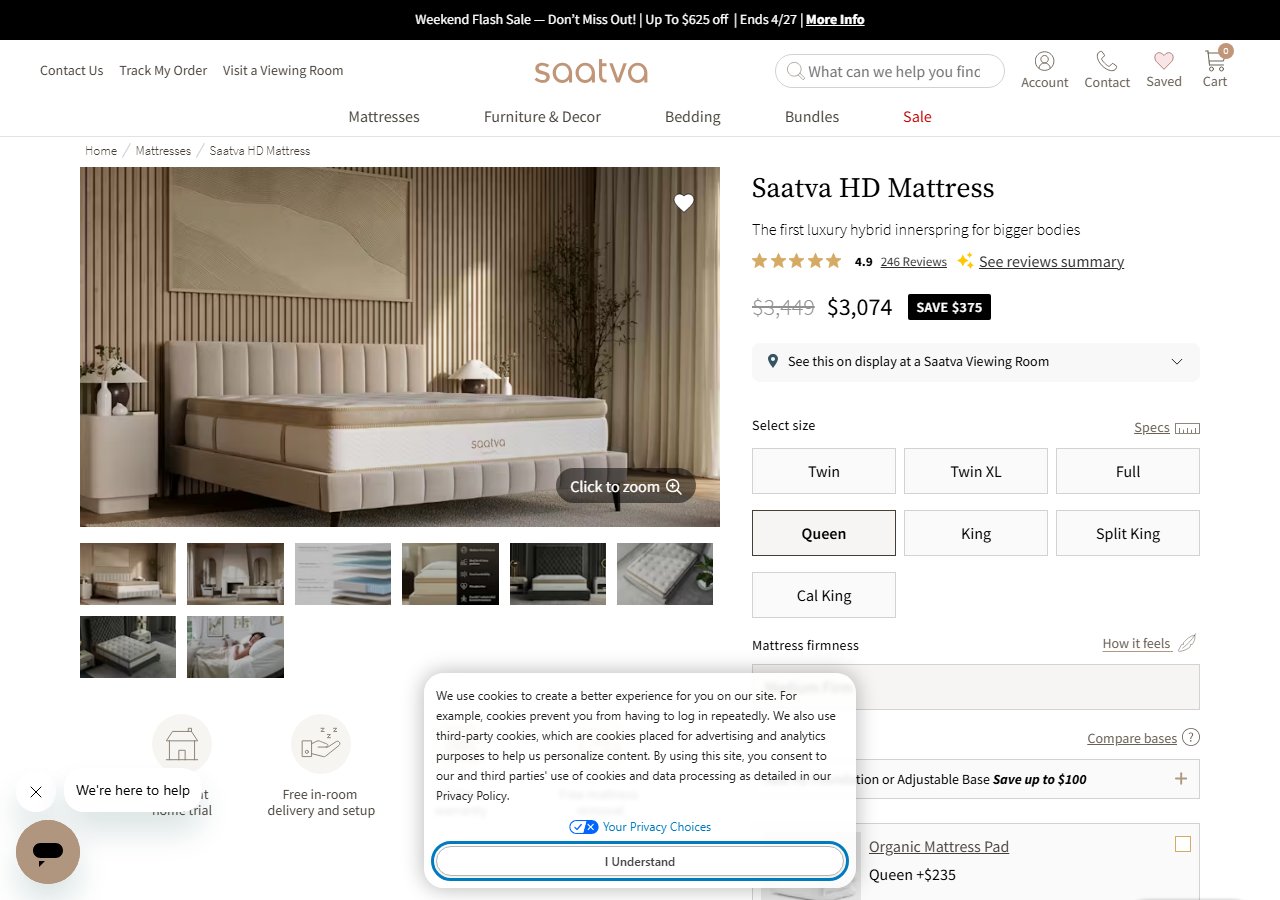
Saatva HD Mattress (Heavy-Duty)
$2,395-$3,995
See Price at Saatva →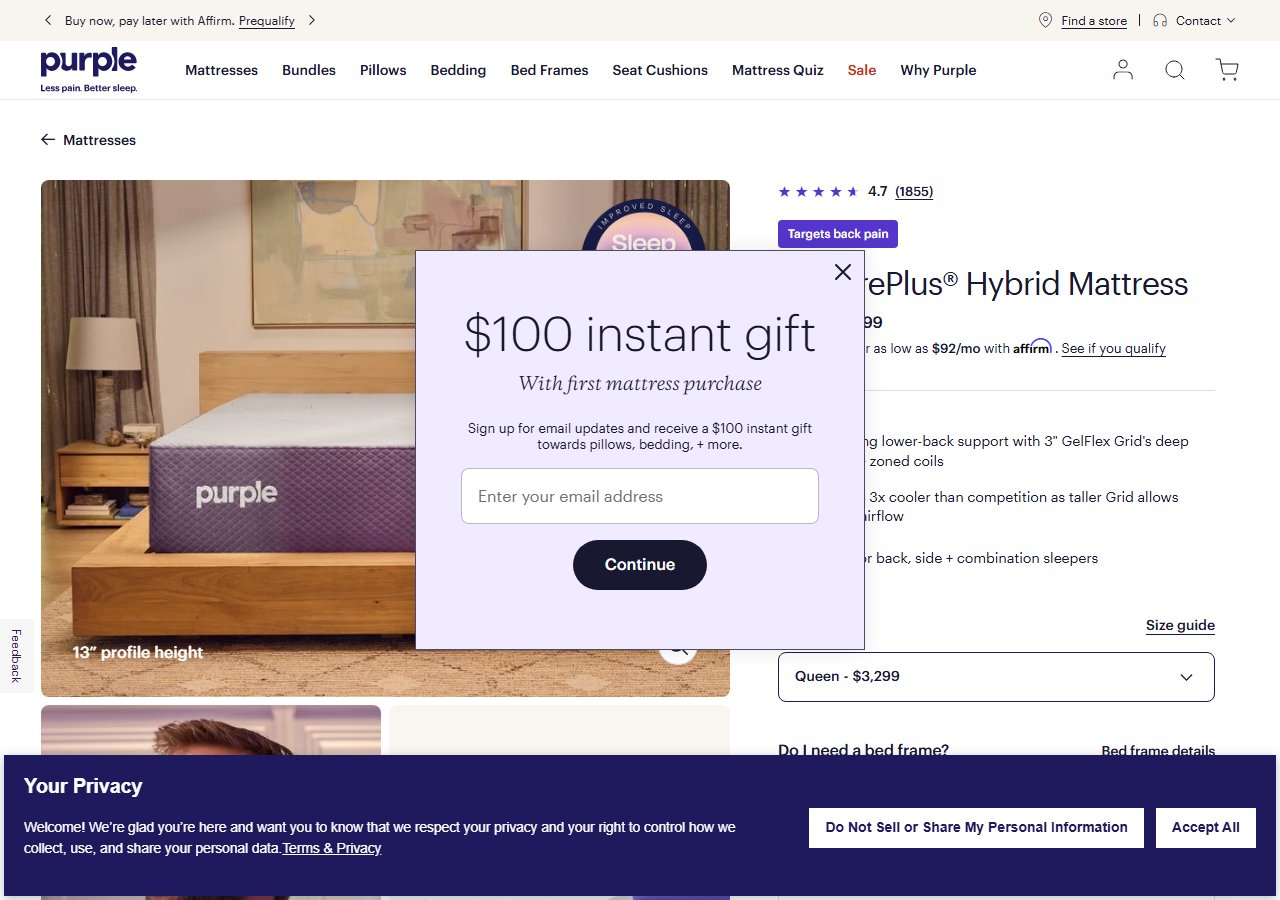
Purple Hybrid Premier Mattress
$2,499-$4,799
See Price at Purple →Putting the Evidence Hierarchy Together
The federal data presents a clear picture: chronic lower back pain is a population-scale condition, driven by occupational loading, positional habits, and tissue recovery deficits, that costs the U.S. healthcare system enormous sums — primarily because the upstream behavioral variables get less attention than downstream pharmaceutical and procedural ones. CDC NCHS data showing 20% chronic pain prevalence, SSA data showing musculoskeletal disorders as the top disability claim category, and CMS drug spending data showing pain medication as among Medicare's costliest line items all point to a system managing symptoms rather than addressing mechanism.
The intervention hierarchy the evidence supports is:
- Movement first — daily walking, per NIH NCCIH, is as effective as most non-drug clinical treatments.
- Position second — neutral lumbar alignment during sleep, achievable with pillow placement and sleep position change before any purchase.
- Mechanics third — proper lifting and bending patterns, per OSHA ergonomics guidance, prevent acute exacerbations in chronic sufferers.
- Sleep surface fourth — once behavioral variables are optimized, the construction of the sleep surface determines whether the overnight recovery window is used or wasted.
For readers who are genuinely at step four — the Saatva Loom & Leaf for pressure-driven lumbar pain, the Saatva HD for high-load or larger-bodied users, and the Purple Hybrid Premier for readers who need pressure relief without heat — represent constructions that are defensible against the biomechanical evidence, not just marketing claims.
The one thing no mattress can do is substitute for the behavioral work. Move every day. Fix your sleep position tonight. That costs nothing and has the strongest federal evidence base of anything on this page.