Chronic Back Pain Is a Federal Health Crisis — And Sleep Is a Neglected Variable
CDC NCHS Data Brief 390 puts the number plainly: approximately 20% of U.S. adults live with chronic pain, and the lower back is the single most common location. That is roughly 50 million Americans waking up every morning — if they slept at all — with lumbar pain that did not begin yesterday and will not resolve by next week. The scale of this is not a wellness-industry talking point. It is a federal public health emergency documented across multiple agencies.
AHRQ HCUP data ranks back pain among the most expensive conditions in the U.S. healthcare system by combined inpatient and outpatient cost. AHRQ's Medical Expenditure Panel Survey shows that adults with chronic back conditions carry average annual personal healthcare expenditures that substantially exceed those of adults without such conditions — a gap that compounds over years and decades. Meanwhile, SSA Disability Insurance data consistently identifies musculoskeletal disorders as the single largest category of new disability claims filed annually. Back pain is not merely inconvenient. It ends careers and it costs the U.S. healthcare system hundreds of billions of dollars per year.
And yet the intervention most universally available to every adult with chronic back pain — the sleep surface and sleep position they use for seven to nine hours every night — receives almost no clinical attention in a standard fifteen-minute primary care visit. This article exists to close that gap, using federal evidence, not marketing copy.
Why Back Pain Gets Worse at Night (and Why Your Mattress Might Be Making It Worse)
Understanding the mechanism matters before you spend a dollar. Chronic lumbar pain has multiple overlapping etiologies, but the most common involve one or more of three structural problems: intervertebral disc degeneration, facet joint inflammation, and paraspinal muscle imbalance. All three are sensitive to spinal loading — the compressive and shear forces placed on the lumbar vertebrae.
During waking hours, the paraspinal muscles are active. They absorb and distribute load, partially protecting the disc and facet joints. During sleep, those muscles relax completely. Whatever position the spine is placed in — and whatever the sleep surface allows — becomes the sustained mechanical environment for seven or eight hours. A surface that sags under the hips creates lumbar hyperextension. A surface that is too firm prevents the shoulders and hips from sinking to a neutral spine position. Either error, repeated nightly across years, is clinically relevant.
The BLS Musculoskeletal Disorders by Occupation data documents that the back is the most common body part injured across all U.S. occupations with days away from work. That means most people with chronic back pain accumulated their injury load during work hours — and then come home to sleep on a surface that either supports spinal recovery or compounds the damage. The NIOSH Lifting Equation further documents that manual material-handling tasks in warehousing, construction, and healthcare routinely exceed safe spinal loading limits. Workers in those sectors are not just tired when they go to bed; they are structurally stressed in ways that require genuine overnight recovery.
The epidemiology compounds further when you layer in sleep duration. CDC sleep surveillance data shows 35% of U.S. adults sleep fewer than 7 hours per night, the threshold associated with elevated chronic disease risk. The relationship between poor sleep and pain amplification is well-established in the clinical literature: pain disrupts sleep, and sleep deprivation lowers pain thresholds, creating a feedback loop that is genuinely difficult to break without addressing both variables simultaneously. A person working a physically demanding job, sleeping fewer than 7 hours, on a sagging mattress, in a spine-torquing prone position, is stacking risk factors that federal data shows drive disability claims, healthcare costs, and lost productivity.
CMS drug spending data identifies opioid and non-opioid pain medication spending among the most expensive Medicare drug categories — a direct reflection of how the U.S. healthcare system is currently managing chronic pain at population scale. Pharmaceuticals are downstream of the structural problem. The upstream variables — posture, sleep surface, movement — are where prevention lives.
Arthritis adds another dimension. CDC arthritis surveillance shows approximately 25% of U.S. adults report doctor-diagnosed arthritis, with prevalence concentrated in occupations involving sustained physical demand. Lumbar arthritis — specifically osteoarthritis of the facet joints — is a common driver of chronic morning stiffness. The characteristic complaint is pain that is worst in the first thirty minutes after waking and gradually loosens with movement. For this specific population, a sleep surface that allows sustained inflammatory joint compression for eight hours is a genuine clinical variable, not a lifestyle preference.
The Cheapest Intervention Is the One That Does Not Require Buying Anything
Before discussing any product, federal and NIH evidence points to a clear stack of non-purchase interventions that move the needle on chronic lumbar pain. These are not consolation prizes for people who cannot afford a new mattress. They are the primary treatment according to the evidence base — and they should be attempted first, documented, and made habitual before any equipment purchase.
Sleep position is the highest-leverage free variable. NIH NIAMS back pain guidance is specific: side-sleeping with a pillow between the knees maintains lumbar neutrality by preventing the top leg from internally rotating and pulling the pelvis into a twisted position. Back-sleeping with a pillow under the knees flattens the lumbar curve slightly, reducing facet joint extension load. Stomach-sleeping forces cervical rotation for airway access and places the lumbar spine in hyperextension — the worst possible sustained position for disc and facet pathology. Changing sleep position costs nothing and can produce measurable pain reduction within days.
Daily walking is the most evidence-backed non-drug intervention for chronic low back pain. NIH NCCIH's evidence review on low back pain is unambiguous: walking 30 minutes on most days reduces chronic low back pain as effectively as most non-drug clinical treatments. The mechanism involves paraspinal muscle activation, disc nutrition (discs are avascular and depend on movement for nutrient exchange), and the endorphin-mediated pain modulation that aerobic activity reliably produces. A $2,500 mattress does not produce these effects. A pair of walking shoes and a consistent schedule might.
Lifting and bending mechanics are rehearsable and directly preventable. OSHA's ergonomics guidance is clear that most acute back episodes are mechanical — they result from loading the spine in a flexed, twisted, or hyperextended position rather than hinging at the hips and keeping the load close to the body. For workers whose chronic pain began as a workplace injury, relearning movement mechanics is both a treatment and a prevention strategy. OSHA and NIOSH have produced freely available guidance on this.
Mattress replacement has a clear and specific indication. CDC sleep hygiene guidance provides the practical standard: replace a mattress when it shows visible sag, when you wake stiffer than when you went to bed, or when it is older than 7 to 10 years. A mattress that fails any of these tests is contributing to your pain. One that passes all three is not the variable to optimize first.
For readers who have already addressed sleep position, are walking regularly, have corrected their lifting mechanics, and are sleeping on a mattress that is neither sagging nor more than a decade old — yet still wake with significant lumbar pain — a sleep surface upgrade is a rational next step. The remainder of this article is for you.
When to See a Clinician Before You Shop
No mattress review should send a reader toward a purchase when what they actually need is a physician. The following red flags — drawn from NIH National Institute of Neurological Disorders and Stroke back pain guidance — indicate that imaging, referral, or urgent evaluation is indicated before any other intervention:
- Pain that radiates below the knee, especially with numbness or tingling: this pattern suggests nerve root compression (radiculopathy) or, in severe cases, spinal stenosis. A new mattress does not decompress a nerve.
- Back pain following trauma — a fall, motor vehicle accident, or significant impact — which may indicate fracture that requires imaging before any loading.
- Leg weakness, foot drop, or difficulty with coordination: these are signs of neurological compromise that require prompt evaluation.
- Bowel or bladder dysfunction accompanying back pain: this is the red flag for cauda equina syndrome, a surgical emergency.
- Back pain with unexplained fever, weight loss, or night sweats: this triad can indicate infectious or malignant etiologies that require immediate workup.
- Pain that is consistently worst at rest or at night and does not improve with position change: inflammatory or neoplastic etiologies must be ruled out.
If any of these apply, stop reading this article and call your physician. The BLS workers' compensation cost data shows that industries with high MSD incidence carry workers' compensation insurance rates three to five times higher than low-MSD industries — a downstream indicator of how severely untreated or mismanaged back conditions escalate. Early clinical evaluation is not a detour from recovery; it is the beginning of it.
What the Research Actually Says About Sleep Surfaces and Lumbar Pain
For readers cleared of red flags and already implementing the behavioral interventions above, sleep surface characteristics matter. The research is more nuanced than the mattress industry's marketing suggests.
The peer-reviewed literature on mattress firmness and back pain has evolved significantly since the early clinical assumption that firm mattresses were universally better. Studies published in the Spine journal and summarized in NIH NCCIH resources indicate that medium-firm surfaces — not hard, not soft — produce the best outcomes for most people with chronic lumbar pain. The mechanism is straightforward: a medium-firm surface allows the shoulders and hips (the body's two widest bony prominences in a side-sleeping position) to sink enough to keep the spine horizontal and neutral, while providing enough resistance to prevent hammocking of the lumbar region.
Pressure relief matters most at the trochanter (outer hip) and shoulder. In side-sleeping positions, which NIH NIAMS recommends for lumbar pain, the hip and shoulder absorb body weight. A surface that creates high sustained pressure at these points causes pain-related micro-arousals throughout the night — you wake up without knowing why, and you accumulate the sleep deficit that CDC data shows 35% of adults already carry. Adaptive or zoned materials — memory foam, latex, and certain polymer grid technologies — address this more effectively than uniform innerspring coils alone.
For the specific population of workers in physically demanding occupations — warehouse workers, construction laborers, healthcare workers — body weight distribution and edge support are additional variables. The NIOSH Lifting Equation documents that workers in these sectors routinely exceed safe spinal loading limits, which means their discs and paraspinal muscles are already under higher cumulative stress than sedentary adults. A sleep surface that compresses fully under higher body weight provides no more support than the floor by morning's end.
The Saatva Loom & Leaf Memory Foam Mattress
For adults with chronic lumbar pain who are not in the heavy-duty category, the Saatva Loom & Leaf is the premium memory foam pick in this analysis. It is built on a gel-infused, high-density memory foam core with a spinal zone quilting pattern — a lumbar support system that provides targeted firmness in the center third of the mattress where the lower back makes contact, while maintaining adaptive pressure relief at the shoulders and hips. This addresses the mechanical problem directly: the lumbar zone resists sag while the shoulder zone allows enough sink for spinal neutrality in side-sleeping positions.
The Loom & Leaf is available in two firmness options: Relaxed Firm and Firm. For most people with chronic lumbar pain, Relaxed Firm is the appropriate choice — firm enough to prevent hammocking, compliant enough to allow shoulder and hip sink. The Firm option is appropriate for back-sleepers above 230 lbs or for those who have consistently found softer surfaces worsen their pain. Pricing runs $1,695–$3,295 depending on size.
The Saatva HD Mattress
For warehouse workers, construction laborers, and larger-bodied adults — the demographic that BLS MSD data and NIOSH lifting research identifies as carrying the highest occupational spinal load — standard mattresses are engineered for an average that may not apply. The Saatva HD is purpose-built for this population, with a weight capacity rated to 500 lbs per sleeper and a coil-on-coil construction that maintains consistent support at higher body weights without the progressive compression that causes standard mattresses to lose their supportive properties under load.
The HD's lumbar crown technology — a graduated support system in the center third — mirrors the functional logic of the Loom & Leaf's zoned quilting but is engineered for the higher compressive forces of larger-bodied sleepers. For a warehouse worker with chronic L4-L5 disc pain who has been sleeping on a consumer-grade mattress that fully compresses under their weight by 3 a.m., the Saatva HD represents a meaningful clinical upgrade, not a luxury purchase. Pricing runs $2,395–$3,995.
The Purple Hybrid Premier Mattress
For adults whose primary complaint is pressure-point pain at the hip or shoulder — often the side-sleeper who wakes with hip bursitis flares or shoulder impingement in addition to lumbar pain — the Purple Hybrid Premier offers a genuinely different pressure-relief mechanism. Purple's GelFlex Grid is a polymer grid that collapses under bony prominences and remains supportive under soft tissue. This is not marketing language; the physics are measurable. Compared to memory foam, the grid does not trap body heat and does not create the slow-response conformity that some patients find exacerbates pain when changing position during the night.
The Hybrid Premier's coil layer provides the edge support and lumbar resistance that a grid-only construction lacks. For adults with both chronic lumbar pain and significant hip or shoulder pressure complaints, this combination addresses multiple pain generators simultaneously. The grid technology also makes it a reasonable option for hot sleepers whose sleep disruption (contributing to the sleep deficit CDC documents in 35% of adults) is compounded by thermoregulation issues. Pricing runs $2,499–$4,799.
Sleep Surfaces Built Around Lumbar Support and Pressure Relief
These three mattresses were selected for adults with chronic back pain who have already optimized sleep position and daily movement and need a surface engineered for spinal neutrality, sustained support, and genuine overnight recovery.

Saatva Loom & Leaf Memory Foam Mattress
$1,695-$3,295
See Price at Saatva →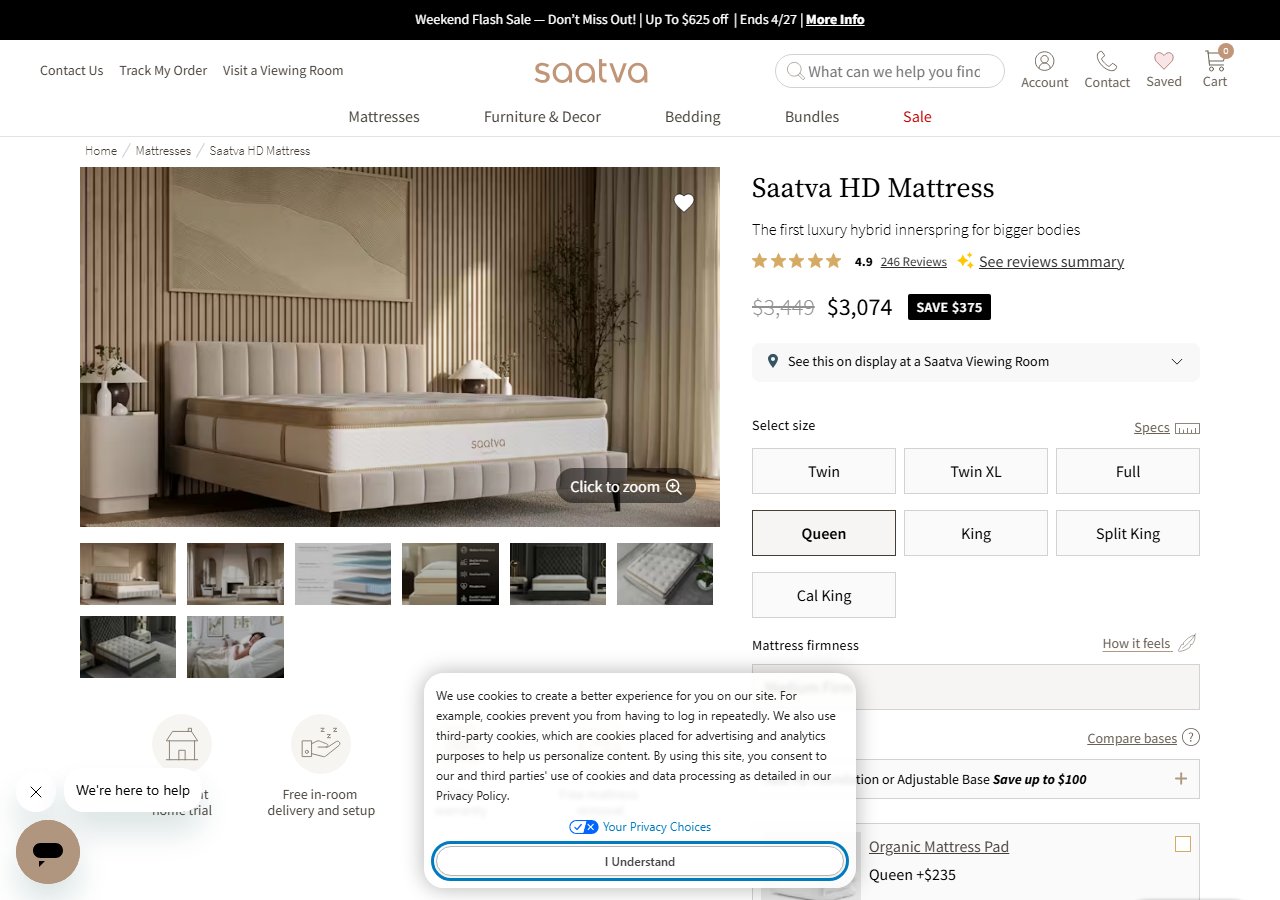
Saatva HD Mattress (Heavy-Duty)
$2,395-$3,995
See Price at Saatva →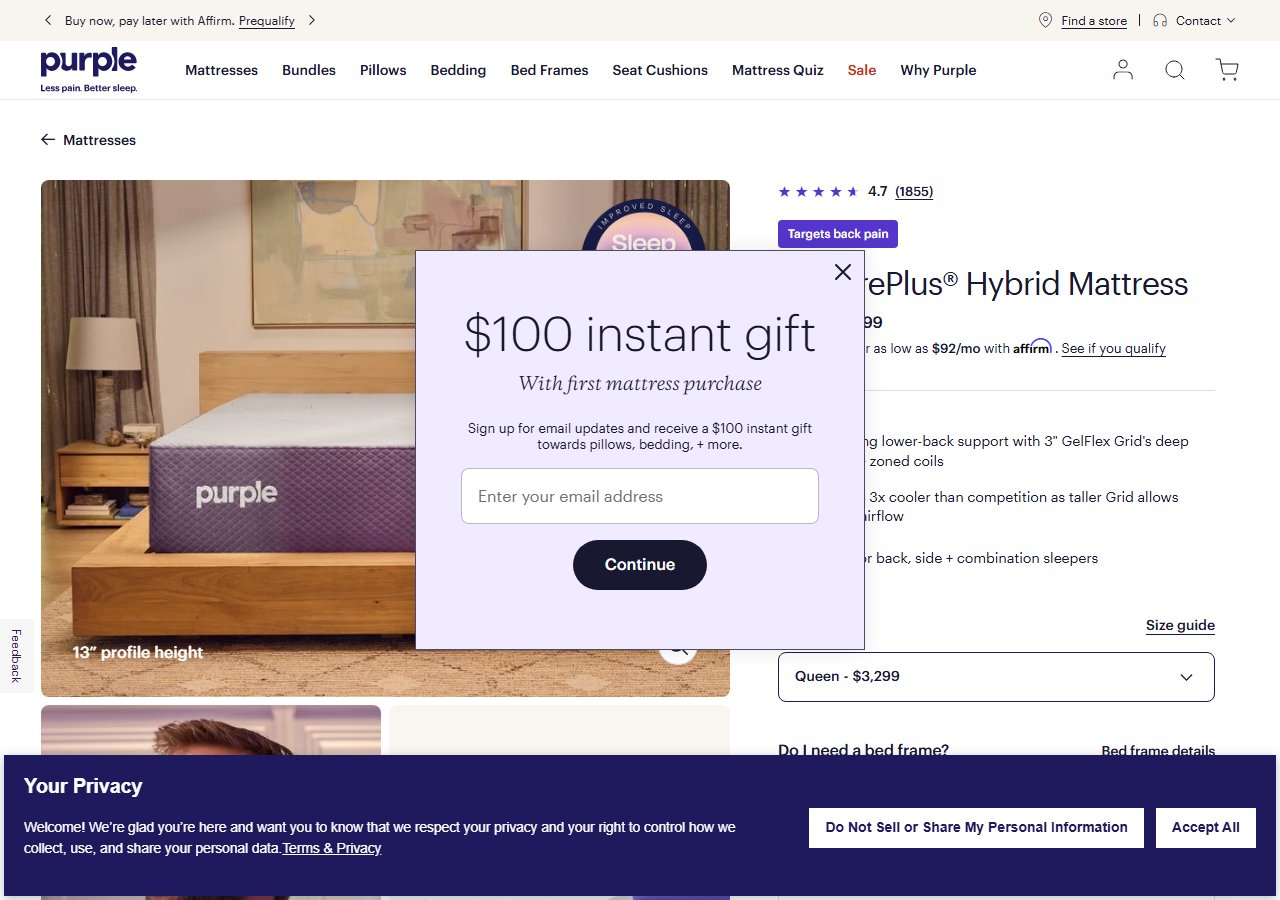
Purple Hybrid Premier Mattress
$2,499-$4,799
See Price at Purple →The Hierarchy That Federal Data Supports
The evidence base is consistent across agencies and disciplines: chronic lower back pain is a structural problem with behavioral, occupational, and environmental contributors. SSA disability data shows where unmanaged back pain leads. AHRQ MEPS shows what it costs. CDC prevalence data shows how many Americans are in this situation right now.
The intervention hierarchy that federal and NIH evidence supports is clear:
- Sleep position first — free, immediate, evidence-backed by NIH NIAMS.
- Movement daily — 30 minutes of walking, per NIH NCCIH, is as effective as most non-drug treatments.
- Lifting mechanics — OSHA ergonomics guidance is free and directly applicable to the most common injury mechanism.
- Mattress assessment — CDC sleep hygiene criteria tell you whether your current mattress is the problem.
- Clinical evaluation — for anyone with neurological red flags, before any other step.
- Sleep surface upgrade — a rational adjunct for readers who have completed steps one through five and still have unmet recovery needs.
The products profiled in this article represent the best-supported options at that final step. They are not shortcuts past the first five. They are the equipment layer of a comprehensive approach — and for someone who has done the work, they are worth the investment.