One in Five Americans Is Living in Pain Right Now
CDC NCHS Data Brief 390 puts the number plainly: approximately 20% of U.S. adults experience chronic pain, and when researchers drill into the anatomical distribution, the lower back is the single most common location. That is roughly 50 million people waking up every morning with a lumbar spine that already hurts — before the commute, before the shift, before the desk chair. And for many of them, nighttime is when the cycle compounds: poor sleep amplifies pain sensitivity, and unresolved pain disrupts the deep sleep stages the nervous system needs to modulate inflammation.
The financial weight behind those numbers is staggering. AHRQ's Healthcare Cost and Utilization Project (HCUP) identifies back pain as one of the most expensive conditions in U.S. healthcare by total combined inpatient and outpatient cost. AHRQ's Medical Expenditure Panel Survey (MEPS) confirms that adults with chronic back conditions spend substantially more out-of-pocket on personal healthcare each year than adults without these conditions. Meanwhile, CMS drug spending data places opioid and non-opioid pain medications among the most costly Medicare drug categories — a direct downstream consequence of a pain epidemic that is undertreated at its root and overtreated at its pharmacological end.
If you are one of those 50 million people reading this because your back hurts and you are not sleeping well, this article is for you. But it will not start with a mattress. It will start with the mechanism — because understanding why your back hurts at night is the fastest way to figure out which interventions are actually going to help.
Why Chronic Back Pain Gets Worse at Night: The Biomechanical and Occupational Mechanism
The lumbar spine is a load-bearing column that was engineered for dynamic movement, not for holding still under compressive load for 8 or more hours. During the day, intervertebral discs rehydrate and decompress when the spine is unloaded — that is why you are slightly taller in the morning than at night. But when you sleep on a surface that either sags under your body weight or is too rigid to accommodate your hip-to-shoulder width differential, the lumbar spine never fully unloads. Instead, it is held in either flexion (rounded, fetal-position curve) or hyperextension (arched, as happens when a heavy sleeper's midsection sinks), and the paraspinal muscles fire isometrically for hours to compensate.
The occupational dimension makes this dramatically worse for a large segment of back pain sufferers. BLS Musculoskeletal Disorder tracking data consistently identifies the back as the most commonly injured body part across all U.S. occupations resulting in days away from work. The NIOSH Lifting Equation formally documents that manual material-handling tasks in warehousing, construction, and healthcare routinely exceed safe spinal loading limits — meaning millions of workers are accumulating compressive spinal load debt throughout the day that they bring into bed with them at night. BLS Employer Costs for Employee Compensation data shows that industries with high musculoskeletal disorder incidence carry workers' compensation insurance rates 3–5 times higher than low-MSD industries — a signal that these injuries are not edge cases but structural occupational hazards.
Beyond acute occupational injury, there is the arthritis dimension. CDC arthritis surveillance data shows approximately 25% of U.S. adults report doctor-diagnosed arthritis, with prevalence concentrated among workers in physically demanding occupations. Arthritis in the facet joints — the small stabilizing joints along the back of the lumbar spine — means that sustained static positioning during sleep creates inflammatory swelling that registers as morning stiffness. This is not simply "sleeping wrong." It is inflammation responding to immobility, and it is a clinical phenomenon distinct from muscle soreness.
Finally, the sleep quality loop: CDC sleep data shows approximately 35% of U.S. adults sleep fewer than 7 hours per night — the threshold the CDC identifies with elevated chronic disease risk. Back pain is both a cause and an effect of this sleep deficit. Pain reduces sleep duration and suppresses slow-wave sleep; sleep deprivation lowers pain threshold, making the same mechanical stress feel more severe the next day. It is a feedback loop that no single intervention breaks alone — which is why the evidence hierarchy matters.
The downstream consequence of all this is captured starkly by SSA Disability Insurance data: musculoskeletal disorders are the single largest category of new disability claims filed annually. Back pain does not just hurt. Unmanaged, it ends careers.
Try These First: The Interventions That Cost Nothing
The most important principle in chronic pain management is also the one most often violated by the consumer market: the cheapest intervention is the one that does not require buying anything. Before a single product is discussed, there are four evidence-backed, zero-cost or near-zero-cost behaviors that the federal literature consistently identifies as effective for chronic low back pain — and that primary care clinicians are increasingly required to document as "tried" before prescribing pharmacological or surgical escalation.
Sleep position is the variable most back pain sufferers can change tonight. NIH National Institute of Arthritis and Musculoskeletal and Skin Diseases guidance recommends side-sleeping with a pillow between the knees, or back-sleeping with a pillow under the knees, as the two positions that best maintain lumbar neutral alignment during sleep. Both strategies decompress the sacroiliac joint and reduce torque on the lumbar facets. Stomach-sleeping, by contrast, forces the lumbar spine into extension and rotates the cervical spine — two mechanical insults that compound overnight. If your current sleep position is stomach-down, this single change costs nothing and has a measurable evidence base.
Movement is the second lever — and according to NIH NCCIH's evidence review on low back pain, walking 30 minutes most days reduces chronic low back pain as effectively as most non-drug clinical treatments. This is not a minor finding. It means that a consistent daily walk outperforms passive interventions — including most topical treatments, most bracing protocols, and yes, most mattress upgrades — in the peer-reviewed literature. The mechanism is straightforward: walking promotes intervertebral disc nutrition through cyclic loading and unloading, activates the deep stabilizer muscles (multifidus, transverse abdominis) that support the lumbar spine, and reduces systemic inflammation through cardiovascular conditioning.
For workers whose back pain has an occupational component — which, given the BLS and NIOSH data above, means a majority of chronic back pain sufferers — OSHA's ergonomics guidance on lifting mechanics is directly relevant. Hinging at the hips rather than rounding the lumbar spine, keeping loads close to the body, and eliminating spinal rotation under load are not just workplace rules; they are behavioral interventions that reduce cumulative disc loading whether you are moving furniture or unloading groceries. Most acute back episodes are mechanical and can be substantially reduced by practicing these patterns deliberately.
Finally, assess the sleep surface itself before replacing it. CDC sleep hygiene guidance and clinical consensus both point to the same practical threshold: replace a mattress if it has visible sag, you consistently wake stiffer than you went to bed, or it is older than 7–10 years. A worn mattress is a legitimate back-pain contributor. But even the highest-performing mattress on the market does not undo poor sleep hygiene, sedentary days, or a structurally demanding job without postural correction.
For readers who have already addressed sleep position, established a walking habit, and are sleeping on a structurally sound surface — and whose back pain persists — the research supports considering whether a new sleep surface with documented pressure-distribution and spinal alignment properties would close the remaining gap. That is the clinical context in which a mattress becomes a legitimate therapeutic tool rather than a purchase rationalization. The three options discussed below were selected because their construction approaches map directly onto the biomechanical problems described above: pressure distribution at the shoulder and hip, lumbar support in the mid-zone, and temperature regulation that does not interfere with sleep architecture.
When to See a Clinician First
No discussion of chronic back pain management is complete without a clinical triage section, and this one is not boilerplate. Back pain exists on a spectrum from benign mechanical strain to serious pathology, and the warning signs that distinguish the two are specific enough to memorize.
NIH National Institute of Neurological Disorders and Stroke back pain guidance identifies the following as clinical red flags requiring prompt evaluation — not a new mattress, not a new pillow, but an in-person assessment with imaging capability. Pain that radiates continuously below the knee (not just hip tightness), back pain following trauma, pain accompanied by progressive leg weakness or numbness, any change in bowel or bladder function associated with back pain onset, or back pain accompanied by unexplained fever or weight loss are all signals that the etiology may be structural neurological compromise, infection, fracture, or malignancy. These presentations require imaging and clinical referral before any passive intervention is trialed.
Even without red flags, back pain that fails to improve after 4–6 weeks of consistent conservative management — meaning position correction, daily movement, and anti-inflammatory support — warrants a clinical visit for a differential diagnosis. The AHRQ and CDC cost data cited above reflects, in part, the cost of delayed clinical engagement: conditions that could have been addressed with targeted physical therapy become surgical candidates because the mechanical problem was not evaluated early enough. If you are unsure whether your pain pattern is benign or not, the clinical consultation is the highest-ROI step available to you.
Where the Sleep Surface Actually Matters: Product Context
With mechanism understood, free interventions trialed, and clinical red flags ruled out, the mattress question becomes genuinely answerable. The research on sleep surface and chronic low back pain points to several consistent findings: medium-to-firm support combined with adaptive pressure relief at the hip and shoulder outperforms both very soft and very firm surfaces for most chronic back pain presentations. Zoned support — where the lumbar region is firmer than the hip and shoulder zones — is the construction approach most aligned with maintaining spinal neutral through position changes during the night.
For chronic lumbar pain, the Saatva Loom & Leaf Memory Foam Mattress represents the premium memory foam approach to this problem. Loom & Leaf uses a multi-layer memory foam construction with a quilted organic cotton cover and a cooling spinal gel layer targeted at the lumbar zone. This gel layer addresses one of the two documented failure modes of traditional memory foam for back pain sufferers: heat retention that disrupts sleep architecture, which the CDC sleep data identifies as already compromised in approximately a third of U.S. adults. The lumbar-targeted support layer provides firmer resistance at the center-third of the mattress — exactly where the lumbar spine sits in back or side sleeping positions — without creating the rigid pressure points that cause hip discomfort in side sleepers. For a reader whose chronic pain is driven by facet joint arthritis or lumbar disc pathology, this zoned approach is clinically coherent.
For back pain sufferers who carry more body weight — including the substantial portion of warehouse workers and construction workers whose occupational spinal loading already exceeds NIOSH safe limits by the end of a shift — standard mattress construction often fails by allowing the lumbar and pelvic zone to sink below neutral, which places the lumbar spine in sustained flexion overnight. The Saatva HD Mattress was engineered specifically for this load pattern, built to support users up to 500 pounds with a dual-coil system and high-density foam perimeter that resists the edge sag and midpoint compression that renders lighter-gauge coil systems ineffective for heavier sleepers. For warehouse workers carrying accumulated spinal load debt from daily NIOSH-limit-exceeding lifts, sleeping on a mattress that compounds that load through inadequate support is a measurable risk factor — and the HD's construction directly addresses it.
The third approach in this framework prioritizes pressure distribution over firmness grading. The Purple Hybrid Premier Mattress uses Purple's proprietary GelFlex Grid — a hyper-elastic polymer grid that collapses under direct pressure points (hip greater trochanter, shoulder acromion) while remaining firm under distributed load (lumbar, thoracic spine). For back pain sufferers whose primary symptom is pressure-point pain at the hip or shoulder that causes them to shift positions repeatedly through the night — disrupting the sleep continuity that the CDC identifies as critical to chronic disease management — the GelFlex architecture addresses the biomechanical problem at its source rather than relying on foam density gradients alone. The hybrid configuration adds a pocketed coil base for lumbar support and edge stability.
Mattresses Built for Chronic Back Pain: Three Approaches, Three Load Profiles
Each of these mattresses was selected because its construction approach maps onto a specific biomechanical failure mode in chronic back pain sleepers — not because of brand recognition or price point.

Saatva Loom & Leaf Memory Foam Mattress
$1,695-$3,295
See Price at Saatva →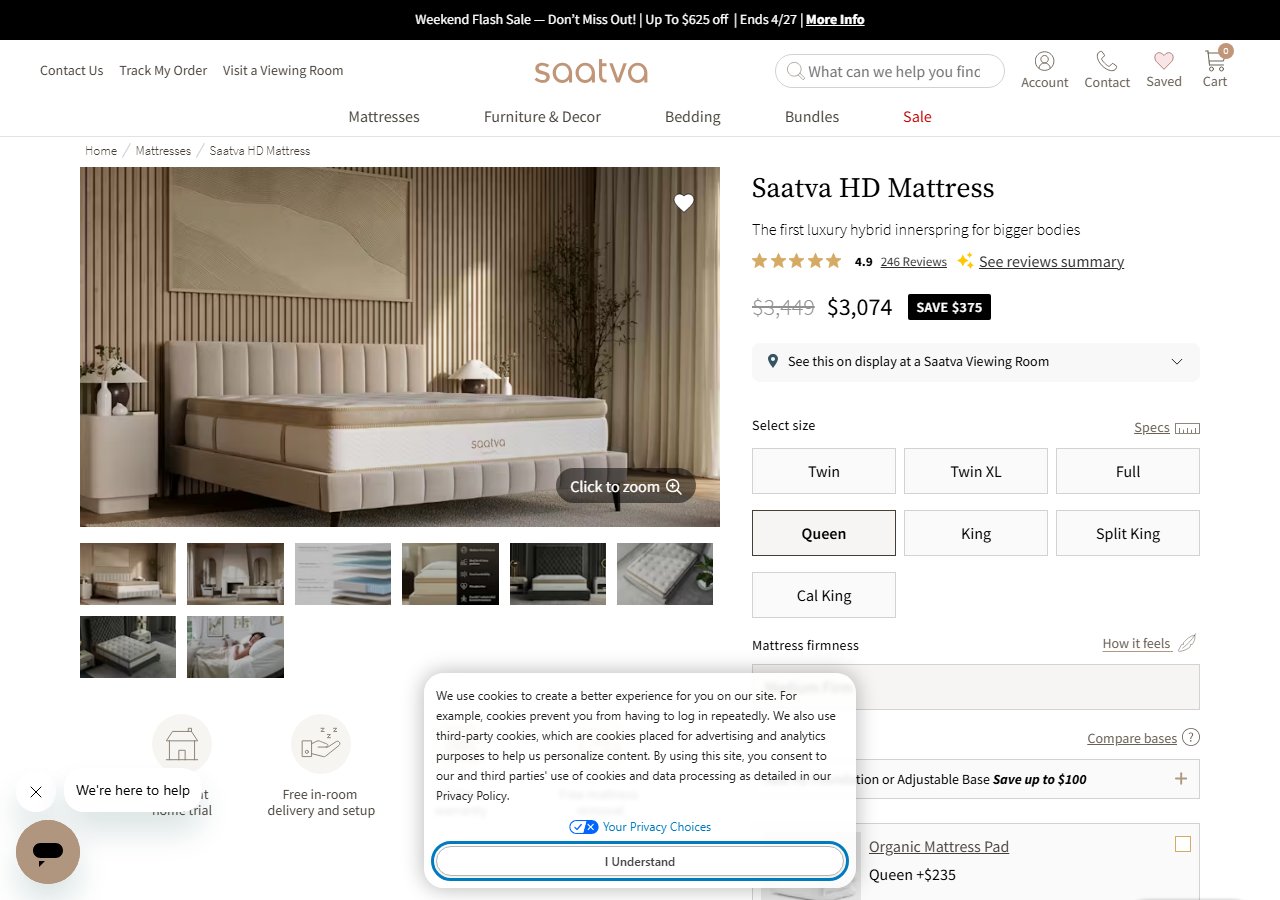
Saatva HD Mattress (Heavy-Duty)
$2,395-$3,995
See Price at Saatva →
Purple Hybrid Premier Mattress
$2,499-$4,799
See Price at Purple →What the Federal Data Actually Tells You to Do
Pull back from the product details and the federal data picture is consistent and actionable. Back pain is a structural epidemic: 20% chronic pain prevalence, the back as the leading injury site across all occupations, musculoskeletal disorders as the single largest SSA disability category, and healthcare costs that dwarf most other chronic conditions in per-patient annual expenditure. The system is failing to address root causes.
The evidence hierarchy is clear. Start with position: side-sleep with a pillow between your knees or back-sleep with a pillow under them, and eliminate stomach-sleeping. Add 30 minutes of walking most days — the NCCIH evidence review places this intervention on par with most non-drug clinical treatments for chronic low back pain. Correct your lifting mechanics whether at work or at home, using OSHA's hip-hinge framework. Assess your current mattress against the CDC's practical threshold: visible sag, waking stiffer than you went to bed, or age beyond 7–10 years.
If all of that is in place and your back still hurts at night, a sleep surface with zoned support, adaptive pressure relief, and appropriate load capacity for your body weight is a legitimate clinical tool — not a luxury purchase. The three options above represent the best available construction approaches for the specific biomechanical problems chronic back pain sufferers bring to bed. But they are one tool in a stack, not the stack itself.
The most expensive outcome in the federal data is inaction. The SSA disability data, the AHRQ cost data, and the CMS drug spending data all describe what happens when back pain is managed passively and pharmacologically rather than mechanically and behaviorally. The cheapest version of this problem to solve is the one you solve early, with position, movement, and — when the evidence supports it — the right sleep surface.