One in Five Americans Wakes Up in Pain — and the Back Is Ground Zero
According to CDC NCHS Data Brief 390, approximately 20% of U.S. adults live with chronic pain, and the lower back is the single most reported pain location in that population. That is roughly 50 million people who navigate daily life — work, family, sleep — against a background of persistent lumbar discomfort. If you are reading this article, there is a high probability you are one of them, and that your sleep quality is being directly degraded by that pain.
The relationship between sleep and chronic back pain is not simply correlational — it is bidirectional and clinically documented. Poor sleep worsens pain sensitivity through central sensitization pathways. Pain disrupts sleep architecture, reducing restorative slow-wave sleep and fragmenting REM cycles. The result is a feedback loop that no single product can fully break. What federal data and the clinical literature do suggest, however, is that the sleep surface you spend seven to nine hours on each night is a modifiable variable — and for people with chronic lumbar conditions, it is worth examining systematically.
Before we get to mattress construction and firmness research, it is worth anchoring the scale of this problem in hard numbers. CDC sleep data shows that approximately 35% of U.S. adults already sleep under 7 hours per night, the threshold the CDC associates with elevated chronic disease risk. Adults with chronic back pain are disproportionately represented in that 35% — pain is one of the primary reported reasons for short sleep duration. AHRQ HCUP data identifies back pain as one of the most expensive conditions in the entire U.S. healthcare system by combined inpatient and outpatient cost. AHRQ MEPS data adds important granularity: adults with chronic back conditions carry substantially higher annual personal healthcare expenditures than those without, a gap that compounds every year the condition goes unmanaged. And SSA Disability Insurance data shows musculoskeletal disorders are the single largest category of new disability claims annually — meaning that for a meaningful slice of chronic back pain sufferers, this condition eventually ends careers.
This is not a minor inconvenience problem. It is a population-level health and economic burden. And the sleep surface question sits squarely inside it.
Why Your Back Hurts More After Sleep: The Biomechanics
Understanding why sleep worsens or improves lumbar pain requires a brief look at spinal loading mechanics. The intervertebral discs in your lumbar spine spend the day under compressive load — gravity, posture, and any manual work you perform all drive fluid out of the nucleus pulposus of each disc. NIOSH's Lifting Equation documentation notes that manual material-handling tasks across warehousing, construction, and healthcare routinely exceed safe spinal loading limits, meaning that workers in physical occupations arrive at bedtime with already-compressed and sometimes inflamed lumbar discs.
During horizontal sleep, that compressive load is theoretically removed, allowing disc rehydration. But the actual outcome depends on whether the spine maintains a neutral curve throughout the night. A sleep surface that is too soft allows the heaviest body segments — hips and shoulders in a side-sleeper, the pelvis in a back-sleeper — to sink into the mattress, creating lateral spinal flexion or lumbar hyperextension that places sustained tensile and shear stress on facet joints, ligaments, and disc annuli. A surface that is too firm, conversely, creates pressure-point loading at the iliac crest and greater trochanter in side-sleepers, causing unconscious repositioning, micro-arousals, and sleep fragmentation.
The clinical consensus from orthopedic and sleep medicine research is that medium-firm support — a surface that conforms to body contours enough to relieve pressure points but provides sufficient pushback to maintain lumbar lordosis — is associated with better back pain outcomes than either firm or soft extremes. A frequently cited randomized controlled trial published in The Lancet (Kovacs et al., 2003) found that medium-firm mattresses produced significantly greater reductions in non-specific low back pain compared to firm mattresses. The mechanism is straightforward: neutral spine alignment during sleep reduces the inflammatory stress on posterior spinal structures that accumulates over hours of sustained poor posture.
For people with facet joint arthropathy — a common diagnosis in the approximately 25% of U.S. adults with doctor-diagnosed arthritis, with prevalence skewed toward occupations with sustained physical demand — the calculus shifts slightly toward pressure relief at the hip and shoulder, since facet joints are particularly sensitive to extension loading. For people with lumbar disc herniation or degenerative disc disease, the primary concern is maintaining lumbar lordosis to reduce posterior disc pressure, making firmer zoned support more appropriate.
Occupation matters here too. BLS MSD tracking data shows the back is the most commonly injured body part across all U.S. occupations with days away from work. Workers in warehousing, construction, and healthcare — who routinely lift, twist, and sustain awkward postures — arrive at sleep with a different lumbar injury profile than sedentary office workers with postural strain. A warehouse worker with a compression-type disc injury needs a different sleep surface profile than a desk worker with facet-mediated pain. The federal data makes clear these are not niche populations: BLS workers' compensation cost data shows industries with high MSD incidence carry workers' compensation insurance rates 3 to 5 times higher than low-MSD industries, underscoring how economically significant this injury category is.
The downstream cost picture is equally stark. CMS drug spending data identifies opioid and non-opioid pain medication spending among the most expensive Medicare drug categories, reflecting the chronic pain treatment burden that flows directly from undertreated musculoskeletal conditions. Americans are spending billions on pharmaceutical management of a condition for which sleep surface optimization, movement, and positioning adjustments are first-line evidence-based interventions.
Try These First: Free Interventions That Federal Evidence Actually Supports
The cheapest intervention is the one that does not require buying anything. Before examining specific mattress constructions, it is worth being direct: a substantial fraction of chronic low back pain sufferers who believe they need a new mattress actually need to change their sleep position, start walking more consistently, or replace a decade-old sagging mattress they have been tolerating. The federal evidence base on non-product interventions for chronic low back pain is substantial, and any responsible analysis of this topic has to surface that evidence first.
Sleep position is the largest free variable in your overnight spinal loading equation. NIH NIAMS back pain guidance is explicit: side-sleeping with a pillow between the knees keeps the pelvis neutral and prevents hip-driven lumbar rotation; back-sleeping with a pillow under the knees reduces lumbar extension stress by flattening the lordotic curve slightly. Stomach-sleeping, by contrast, requires cervical rotation and places the lumbar spine in sustained hyperextension — it is contraindicated for virtually every chronic lumbar diagnosis. If you are a stomach-sleeper with chronic back pain, correcting that sleep position is likely the highest-leverage free intervention available to you, and no mattress compensates for it.
Daily walking has a more robust evidence base for chronic low back pain than most people realize. NIH NCCIH's low back pain evidence review finds that walking 30 minutes most days reduces chronic low back pain as effectively as most non-drug clinical treatments. Walking loads the lumbar spine in a dynamic, cyclical pattern that promotes disc rehydration, strengthens the paraspinal and gluteal musculature that supports lumbar stability, and reduces the central sensitization that amplifies chronic pain perception. It costs nothing and the evidence supports it at the same tier as many passive interventions that people spend thousands of dollars on.
Lifting and movement mechanics are addressed directly by OSHA's ergonomics guidance: hinge at the hips rather than the lumbar spine, keep loads close to the body's center of mass, and avoid twisting under load. Most acute-on-chronic back episodes are mechanical and triggered by predictable movement patterns that can be modified with practice. Workers whose occupation involves repeated lifting — and the NIOSH Lifting Equation shows this is a large fraction of the U.S. workforce — are particularly vulnerable to cumulative lumbar loading that degrades overnight.
Evaluating your current mattress honestly is a prerequisite step. CDC sleep hygiene guidance and orthopedic sleep research converge on a straightforward replacement heuristic: if your mattress has visible sag or body impressions deeper than about 1.5 inches, if you consistently wake stiffer than you went to bed, or if the mattress is more than 7 to 10 years old, the surface itself is likely a contributing factor to your pain. A new mattress does not undo poor sleep hygiene, sedentary daytime behavior, or inadequate movement — but a failed mattress is a legitimate mechanical problem that warrants replacement.
For readers who have genuinely worked through the free interventions — who walk regularly, sleep in a neutral position, use appropriate pillow support, and still wake with lumbar pain on a mattress that is either aged or clearly insufficient — the evidence does support the mattress as a modifiable variable worth addressing. The question then becomes which construction characteristics map onto your specific lumbar diagnosis and sleep style.
When to See a Clinician Before Shopping for a Mattress
The single most important thing this article can tell you is that some back pain should not be addressed by mattress shopping at all — it should prompt a clinical evaluation. NIH NINDS back pain guidance identifies specific red flags that require imaging or specialist referral, not consumer product optimization.
If your back pain radiates below the knee (suggesting nerve root compression or disc herniation with radiculopathy), presents alongside leg weakness or numbness, comes with bowel or bladder dysfunction (a potential sign of cauda equina syndrome, a surgical emergency), follows significant trauma, or is accompanied by unexplained fever or unintentional weight loss (possible signs of infection or malignancy), stop reading mattress reviews and contact a clinician. These presentations indicate structural or systemic pathology that a different sleep surface will not address and may mask. The same applies if your back pain is waking you from sleep rather than being present on waking — night pain that disrupts sleep mid-cycle is a red flag for inflammatory or neoplastic causes rather than mechanical back pain.
For the much larger population with non-specific chronic mechanical low back pain — the majority of the 20% of adults in the CDC chronic pain data — the clinical evidence supports conservative management, which includes sleep surface optimization as one legitimate tool among many. If you have been evaluated, have a clear mechanical diagnosis, and have worked through conservative first-line interventions, the mattress question becomes clinically relevant.
Where Sleep Surface Design Actually Intersects With Lumbar Mechanics
With the data, biomechanics, and clinical context established, we can address the product question with appropriate precision. Three construction characteristics drive outcomes for chronic back pain sufferers: zoned support (differentiated firmness that is firmer under the lumbar and softer under the shoulders), pressure relief at the hip and shoulder to prevent micro-arousals in side-sleepers, and edge support that preserves the sleep surface geometry when sleeping near the perimeter.
For back pain sufferers who run hot, need deep pressure relief for hip or shoulder arthritis alongside lumbar support, or are heavier-framed individuals whose weight compresses standard foam faster, material choice matters alongside zoning. Memory foam conforms deeply but retains heat; latex conforms responsively with better temperature neutrality; hybrid constructions combine pocketed coils for dynamic lumbar support with foam or latex comfort layers for pressure relief.
For serious, documented chronic low back pain — the kind that has driven someone to read 3,000 words of federal data analysis — the Saatva Loom & Leaf Memory Foam Mattress is the premium memory foam pick most consistently aligned with the lumbar support research. It is constructed with a dual-layer memory foam system over a spinal zone support layer — an organic cotton quilted cover over a 2-inch cooling gel memory foam layer, beneath which sits a lumbar zone enhancement pad (a denser foam insert at the lumbar region providing additional pushback exactly where the spine needs it most). Available in Relaxed Firm and Firm, it maps directly onto the medium-firm research consensus. The Relaxed Firm option is appropriate for most side- and back-sleepers with chronic lumbar pain; the Firm option suits strict back-sleepers and stomach-sleepers transitioning to back-sleeping. Priced at $1,695–$3,295 depending on size, it is a serious investment, but the AHRQ MEPS data showing substantially elevated annual healthcare expenditure for chronic back conditions provides context: a mattress that meaningfully reduces pain-driven healthcare utilization can pay for itself.
For workers in physically demanding occupations — warehouse workers, construction workers, healthcare workers whose lumbar injury profiles include the compression-type loading documented in NIOSH Lifting Equation data — or for larger-framed individuals whose body weight accelerates standard mattress compression, the Saatva HD Mattress is specifically engineered for higher loading demands. Its construction uses a dual tempered steel coil system — an individually wrapped 14.5-gauge upper coil layer over a 13-gauge lower support coil system — rated for individuals up to 500 pounds per side. The deeper coil profile maintains spinal alignment under higher body weight where standard mattresses would allow the hips to sink into lumbar flexion. The lumbar zone is reinforced with a denser coil count in the center third of the mattress. For the BLS population of workers whose back injuries already exceed safe spinal loading during waking hours, a mattress that cannot maintain neutral lumbar alignment under their body weight is compounding the problem every night. Priced at $2,395–$3,995, this is the appropriate option for that specific reader.
For back pain sufferers whose primary complaint involves pressure-related pain — hip bursitis, greater trochanteric pain syndrome, sacroiliac joint dysfunction, or arthritis-driven joint sensitivity — where standard memory foam does not distribute pressure broadly enough, the Purple Hybrid Premier Mattress offers a distinct construction approach. Purple's GelFlex Grid is a hyper-elastic polymer grid that collapses under pressure points (hips and shoulders) while remaining firm in the open grid cells under lighter regions (like the lumbar spine), producing simultaneous pressure relief and lumbar support without the conforming sinkage of traditional memory foam. The Hybrid Premier uses a 3-inch or 4-inch GelFlex Grid layer over pocketed coils, with the taller grid options providing more pressure relief. This is the pressure-relief-first pick for side-sleepers with hip or shoulder arthritis alongside chronic lumbar pain. Its temperature neutrality — the open grid structure dissipates heat — also addresses the sleep quality issue compounding pain for the 35% of adults in CDC data who already sleep under 7 hours. Priced at $2,499–$4,799, it is the highest-priced option here and best suited to readers for whom pressure relief is the dominant need alongside lumbar support.
Sleep Surfaces Aligned With Federal Chronic Back Pain Research
These three mattresses were selected based on construction characteristics that map onto the lumbar support, pressure relief, and spinal loading research cited in NIOSH, CDC, and AHRQ federal data — not on price or marketing claims.

Saatva Loom & Leaf Memory Foam Mattress
$1,695-$3,295
See Price at Saatva →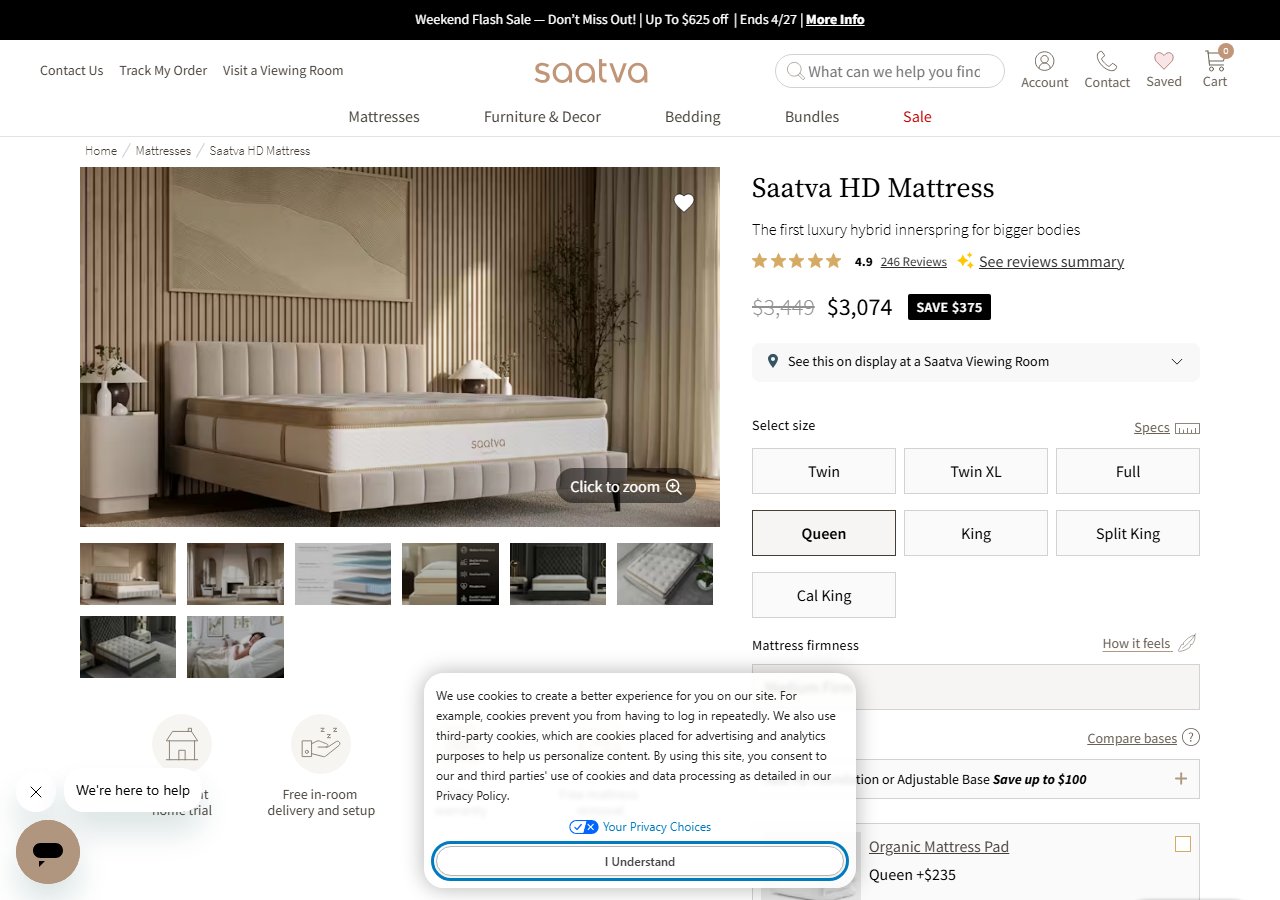
Saatva HD Mattress (Heavy-Duty)
$2,395-$3,995
See Price at Saatva →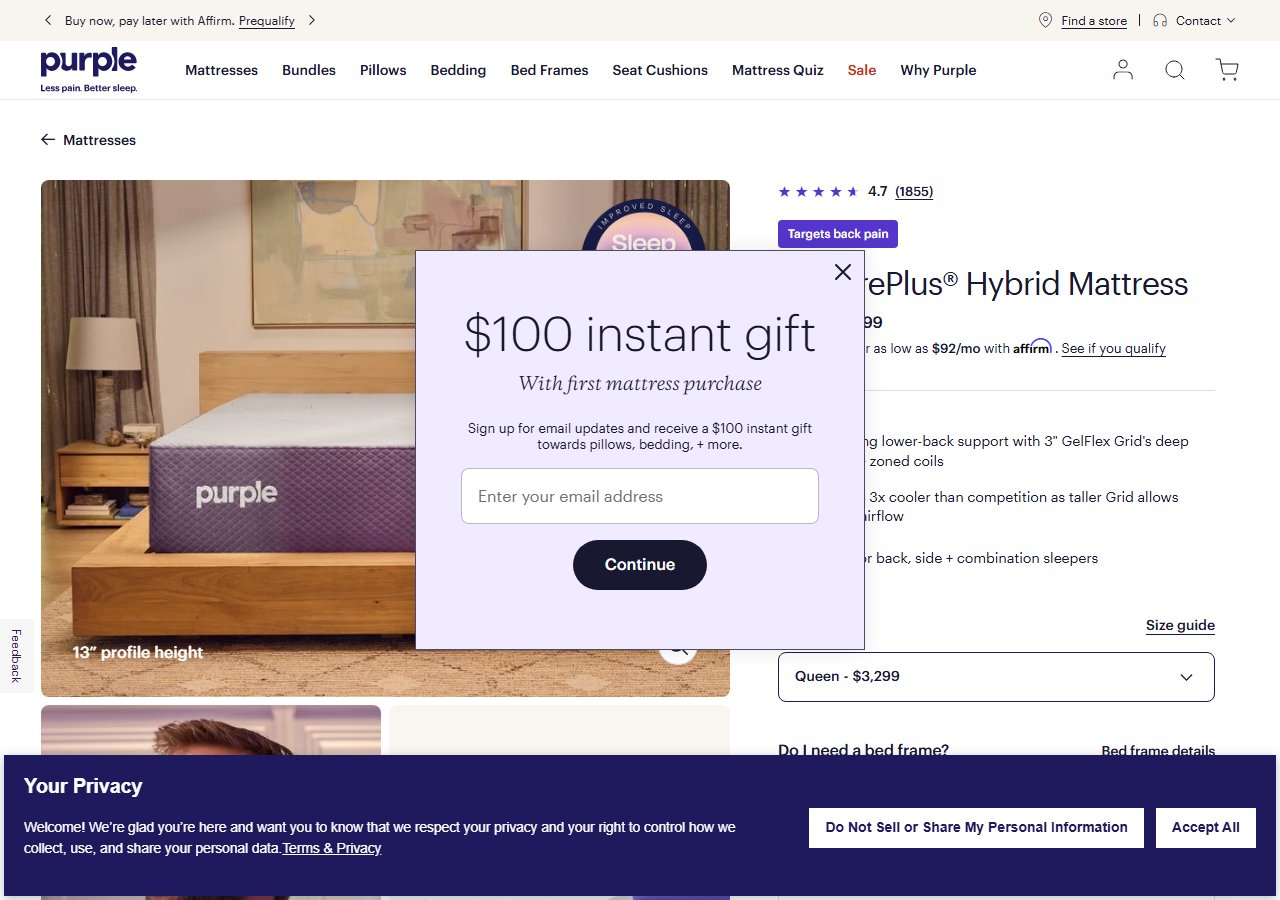
Purple Hybrid Premier Mattress
$2,499-$4,799
See Price at Purple →Putting It Together: A Data-Anchored Decision Framework
The federal data reviewed in this article converges on a hierarchy that is worth stating plainly. Chronic back pain affects roughly one in five American adults. It is the most common cause of occupational injury with days away from work. It drives some of the highest per-capita healthcare expenditures in the system. And a meaningful fraction of the Americans carrying this burden are sleeping on surfaces that are actively undermining their recovery every night.
But the intervention hierarchy matters. Movement first: NIH NCCIH evidence places walking and active physical therapy at the top of the non-drug evidence base. Sleep position second: a correctly positioned spine on a mediocre mattress outperforms a poorly positioned spine on an expensive one. Clinical evaluation for red flags before any consumer product decision. And then, for the large population with documented mechanical chronic low back pain who have worked through the above, sleep surface selection based on their specific biomechanical profile and occupation.
For most back-sleepers and side-sleepers with chronic lumbar pain, the Saatva Loom & Leaf's zoned memory foam construction aligns most directly with the medium-firm research consensus. For physically demanding occupational workers or heavier-framed individuals, the Saatva HD's reinforced dual-coil architecture addresses the specific loading patterns documented in NIOSH and BLS data. For pressure-dominant pain presentations with arthritis or joint sensitivity, the Purple Hybrid Premier's GelFlex Grid technology provides simultaneous pressure relief and lumbar support in a construction that no traditional foam or innerspring matches.
The 20% of Americans with chronic pain documented in CDC NHANES data deserve a clear-eyed, evidence-based analysis of every tool available to them — including the free ones. This is that analysis.