One in Five American Adults Wakes Up in Pain — and the Back Is Ground Zero
The United States is quietly living through a chronic pain epidemic. CDC NCHS Data Brief 390 places the share of U.S. adults experiencing chronic pain at approximately 20%, and the lower back is the single most common pain location in that population. That is roughly 50 million people for whom getting out of bed is not a fresh start — it is the first test of the day, one they often fail before 7 a.m.
The cost of this epidemic is staggering and measurable. AHRQ HCUP data ranks back pain among the most expensive conditions in U.S. healthcare, measured by combined inpatient and outpatient spending. AHRQ MEPS data reinforces that finding at the individual level: adults with chronic back conditions carry substantially higher annual personal healthcare expenditures than adults without them. And when patients cannot get adequate relief through conservative treatment, the downstream costs compound: CMS Drug Spending Dashboard data identifies opioid and non-opioid pain medications among the most expensive Medicare drug categories — a downstream reflection of how undertreated chronic spinal pain becomes.
For working Americans, the occupational data is equally sobering. BLS Musculoskeletal Disorders by Occupation tracking confirms that the back is the most frequently injured body part across all U.S. occupations that result in days away from work. SSA Disability Insurance reports identify musculoskeletal disorders as the single largest category of new disability claims filed annually. The workers most exposed — warehouse and distribution employees, construction laborers, home health aides, nurses — spend their days loading the lumbar spine in ways that far exceed safe limits, as documented by the NIOSH Lifting Equation. Then they go home and sleep on a surface that may compound every hour of loading they accumulated on the job.
This is the feedback loop at the center of chronic lumbar pain: occupational loading during the day, inadequate spinal decompression at night, and an 8-hour window that is either part of the solution or part of the problem. Understanding which requires understanding the mechanism.
Why Sleep Disrupts — or Reinforces — Chronic Lumbar Pain
The Biomechanics of a Bad Night's Sleep
The lumbar spine supports the majority of the body's axial load during waking hours. In healthy spinal mechanics, the intervertebral discs act as hydraulic cushions, absorbing compressive force and distributing load across the vertebral endplates. During sleep, in a supine or lateral position, that compressive load drops dramatically and the discs rehydrate — a process that depends on the spine maintaining a neutral alignment throughout the night.
When that alignment fails — because the sleep surface sags under the heaviest body segments (hips and shoulders), because the sleeper defaults to a prone (stomach) position, or because a too-firm surface bridges across the lumbar curve rather than filling it — the discs cannot fully decompress. Paraspinal muscles that should relax remain in low-grade contraction to compensate for the unsupported spine. Ligaments are held in sustained stretch rather than slack. By morning, the cumulative effect is morning stiffness, elevated baseline pain, and a lumbar spine that enters the next workday already partially loaded.
This is not theoretical. The CDC's sleep disorder data documents that approximately 35% of U.S. adults are sleeping fewer than 7 hours per night — the threshold below which chronic disease risk, including pain amplification, rises measurably. Poor sleep is both a symptom and a driver of chronic pain: pain disrupts sleep architecture, and disrupted sleep lowers the pain threshold, creating a cycle that no single intervention fully breaks.
For workers in physically demanding occupations, this cycle has measurable economic consequences. BLS Employer Costs for Employee Compensation data shows that industries with high musculoskeletal disorder incidence carry workers' compensation insurance rates 3–5 times higher than low-MSD industries. The employer ultimately bears part of the cost of every preventable spinal injury — but the worker bears it in their body first.
Who Is Most Vulnerable
Not all back pain sufferers sleep the same, and the research makes important distinctions. Adults with facet joint arthropathy or lumbar stenosis typically experience pain with extension (arching the back) and find relief in a slightly flexed lumbar position — which side-sleeping with a pillow between the knees or fetal positioning provides. CDC arthritis data places the share of U.S. adults with doctor-diagnosed arthritis at approximately 25%, with prevalence concentrated in occupations involving sustained physical demand — exactly the population most likely to be reading this article.
Adults with disc herniation or radiculopathy often have the opposite presentation: flexion aggravates their symptoms. They may find a firm surface in supine position, with a pillow under the knees, is the only position that allows adequate rest. Adults with sacroiliac joint dysfunction are often side-sleepers for whom a mattress that allows the pelvis to sink into appropriate alignment makes the difference between a restorative night and a sleepless one.
The take-home point: "back pain" is not a monolithic diagnosis, and the idea of a single "best mattress" for all back pain is a marketing claim, not a clinical one. What the research supports is the concept of spinal neutrality — the capacity of a sleep surface to hold the lumbar spine in the same gentle S-curve it assumes when standing in a relaxed posture. The path to that neutrality differs by body weight, sleep position, and the specific spinal pathology involved.
Try These First — Before You Spend a Dollar
The cheapest intervention is the one that does not require buying anything. Federal occupational health guidance identifies several behavioral and positional changes that reduce chronic lumbar pain during sleep and throughout the day. These are not consolation prizes for people who cannot afford a new mattress. For a meaningful share of chronic back pain sufferers, they are sufficient.
Sleep position correction is the most immediately actionable and most underutilized intervention. NIH NIAMS back pain guidance is explicit: side-sleeping with a pillow between the knees keeps the lumbar spine and pelvis aligned and reduces rotational stress on the sacroiliac joint. Back-sleeping with a pillow under the knees maintains the natural lumbar curve without requiring the paraspinal muscles to work. Stomach-sleeping torques the lumbar spine into extension and lateral rotation simultaneously — a position that worsens disc and facet pathology and should be avoided entirely for anyone with chronic lumbar symptoms. This costs nothing to implement tonight.
Daily walking is consistently underestimated as a pain management tool. NIH NCCIH's evidence review on low-back pain finds that walking 30 minutes most days reduces chronic low back pain as effectively as most non-drug clinical treatments. Walking loads the spine dynamically, promotes disc rehydration through cyclic compression, strengthens lumbar stabilizers, and — critically — reduces the sedentary load patterns that compound occupational injury. Workers in physically demanding jobs who assume they are already active enough are often surprised to learn that repetitive load in a fixed pattern (lifting, bending) does not substitute for varied locomotion.
Lifting and bending mechanics matter not just on the job but at home. OSHA ergonomics guidance specifies hinging at the hips rather than rounding the lumbar spine, keeping loads close to the body's center of mass, and avoiding twisting under load. Most acute back episodes are mechanical events — a single poorly-executed lift, a reach-and-twist to load the dishwasher — and they are rehearsable and preventable. Workers whose employers fall under OSHA jurisdiction should know that ergonomics standards exist and that OSHA offers free consultation services.
Mattress assessment is a lifestyle intervention before it is a product decision. CDC sleep hygiene guidance and clinical consensus both support replacing a mattress when it shows visible sag, when you wake stiffer than when you went to bed consistently, or when it is older than 7 to 10 years. A mattress that has lost structural integrity cannot be compensated for by position changes or pillow placement. But equally, even the most technically sophisticated mattress cannot undo poor sleep hygiene, sedentary days, or elevated systemic inflammation.
For readers who have already adjusted their sleep position, walked daily for 6 to 8 weeks, audited their mattress for sag, and still wake with significant lumbar pain — the question of a new sleep surface becomes legitimate. Equipment is an adjunct to behavioral change, not a substitute for it. But for the right candidate, a sleep surface engineered for lumbar support can extend the benefit of everything else.
When to See a Clinician First
Before researching mattresses, certain symptoms require a clinical evaluation. A new mattress is not the right intervention for pain that has a surgical or neurological cause, and delaying care in these cases carries real risk. NIH NINDS back pain guidance identifies specific red flags that warrant prompt evaluation rather than a product purchase:
Pain that radiates below the knee — particularly with numbness, tingling, or a burning quality — suggests nerve root compression that may require imaging and, in some cases, surgical consultation. Pain that follows trauma, even a seemingly minor one, warrants X-ray or MRI to rule out fracture. Back pain accompanied by leg weakness, difficulty with balance, or changes in bowel or bladder function is a neurological emergency. Back pain in the context of unexplained fever, night sweats, or significant unintentional weight loss raises concern for infectious or oncologic causes.
None of these presentations are managed by changing your sleep surface. If any of them describe your situation, the right next step is a clinician visit, not a product page. The clinical red flags are detailed in the section below.
Where a Sleep Surface Becomes the Intervention
For readers without red-flag symptoms, who have corrected their sleep position, who are exercising consistently, and whose current mattress either shows structural failure or was never appropriate for lumbar support — this is where the evidence on sleep surfaces becomes directly relevant.
The research on mattress firmness and back pain, while limited in scale compared to pharmaceutical trials, consistently points away from extremes. Very soft mattresses allow the heaviest body segments to sink too deeply, placing the lumbar spine in flexion for the entire night. Very firm mattresses bridge across the lumbar region, creating a gap between the curve of the low back and the surface — which paraspinal muscles then work through the night to fill. Medium-firm to firm surfaces, depending on body weight and sleep position, have the most consistent support in peer-reviewed literature for reducing morning pain and improving sleep quality in back pain patients.
Body weight is a critical modifier. Adults in the 130–200 lb range on a medium-firm surface will experience appropriate contouring at the shoulders and hips while their lumbar region is supported. Adults over 250 lbs on the same surface may sink through the comfort layer entirely, causing the same unsupported lumbar sag as a too-soft mattress. This is why manufacturer firmness ratings are necessary starting points but not final answers — the functional firmness any individual sleeper experiences depends on their weight distribution.
The Saatva Loom & Leaf: Premium Memory Foam Engineered for Lumbar Conditions
For back pain sufferers who want the conforming properties of memory foam without the off-gassing, temperature retention, and structural inconsistency of lower-tier foam products, the Saatva Loom & Leaf Memory Foam Mattress is the strongest premium option in this category. Saatva produces the Loom & Leaf in two firmness options — Relaxed Firm and Firm — both designed to deliver lumbar zone support without the pressure buildup that causes side-sleepers with hip and shoulder pain to shift positions repeatedly through the night.
The construction is relevant: the Loom & Leaf uses a dual-layer memory foam system with a targeted lumbar support insert in the transition layer, which means the lower back receives additional resistance precisely where most back pain sufferers need it most. The gel-infused top layer addresses the temperature regulation issue that keeps many foam-averse sleepers away from this material class. At $1,695 to $3,295 depending on size, the Loom & Leaf sits in the premium tier — appropriate for someone treating their sleep surface as a chronic pain management tool rather than a furniture purchase.
The Saatva HD: For High-Load Users Whose Mattress Was Never Designed for Them
Among the populations carrying the highest burden of chronic back pain are workers whose occupations involve sustained heavy manual labor — warehouse and distribution employees, construction workers, long-haul drivers — many of whom also have above-average body weight. Standard mattresses are not engineered for their load profiles, and the result is premature structural failure of comfort layers, bottoming-out through the support core, and sleep surfaces that functionally feel far softer than their rated firmness within months of purchase.
The Saatva HD Mattress is built explicitly for this population, rated to 500 lbs per side and featuring a high-density foam encasement, dual tempered steel coil system, and a lumbar crown enhancement that adds targeted spinal support in the zone most heavily loaded in heavier sleepers. This is not simply a firmer version of a standard mattress — it is a structurally different product. The NIOSH Lifting Equation documents that manual material-handling tasks in warehousing, construction, and healthcare routinely exceed safe spinal loading limits; workers in those occupations deserve a sleep surface that acknowledges the cumulative load they carry. The Saatva HD, priced at $2,395 to $3,995, represents a significant investment — but one calibrated for a user whose standard alternatives will fail structurally within a year or two.
The Purple Hybrid Premier: Pressure Relief Without Foam's Trade-Offs
For back pain sufferers whose primary complaint is pressure point pain — the hip and shoulder aching that causes constant position-shifting through the night — the Purple Hybrid Premier Mattress offers a materially different approach than either foam or traditional innerspring. Purple's proprietary GelFlex Grid disperses pressure across a larger surface area than conventional foam, eliminating the peak pressure points that foam creates at bony prominences while maintaining adequate lumbar support through the grid's column-buckling response to heavier loads.
The hybrid construction — GelFlex Grid over pocketed coils — gives the Purple Hybrid Premier the pressure relief properties of foam with the motion isolation and temperature neutrality benefits of a coil system. For side-sleepers with both lumbar pain and hip bursitis or greater trochanteric pain syndrome (common comorbidities in physically demanding workers with arthritis), the pressure distribution profile is clinically meaningful, not just a marketing claim. Priced at $2,499 to $4,799, the Purple Hybrid Premier is the most expensive option in this group, but it serves a specific clinical profile — high pressure sensitivity combined with lumbar instability — that neither foam nor standard innerspring addresses as well.
Sleep Surfaces Built for Chronic Lumbar Pain — Curated by Federal Evidence
These three mattresses were selected based on their structural alignment with the sleep position, body-weight, and pressure-relief profiles most relevant to adults managing chronic lower back pain, as defined by CDC, NIOSH, and AHRQ data.

Saatva Loom & Leaf Memory Foam Mattress
$1,695-$3,295
See Price at Saatva →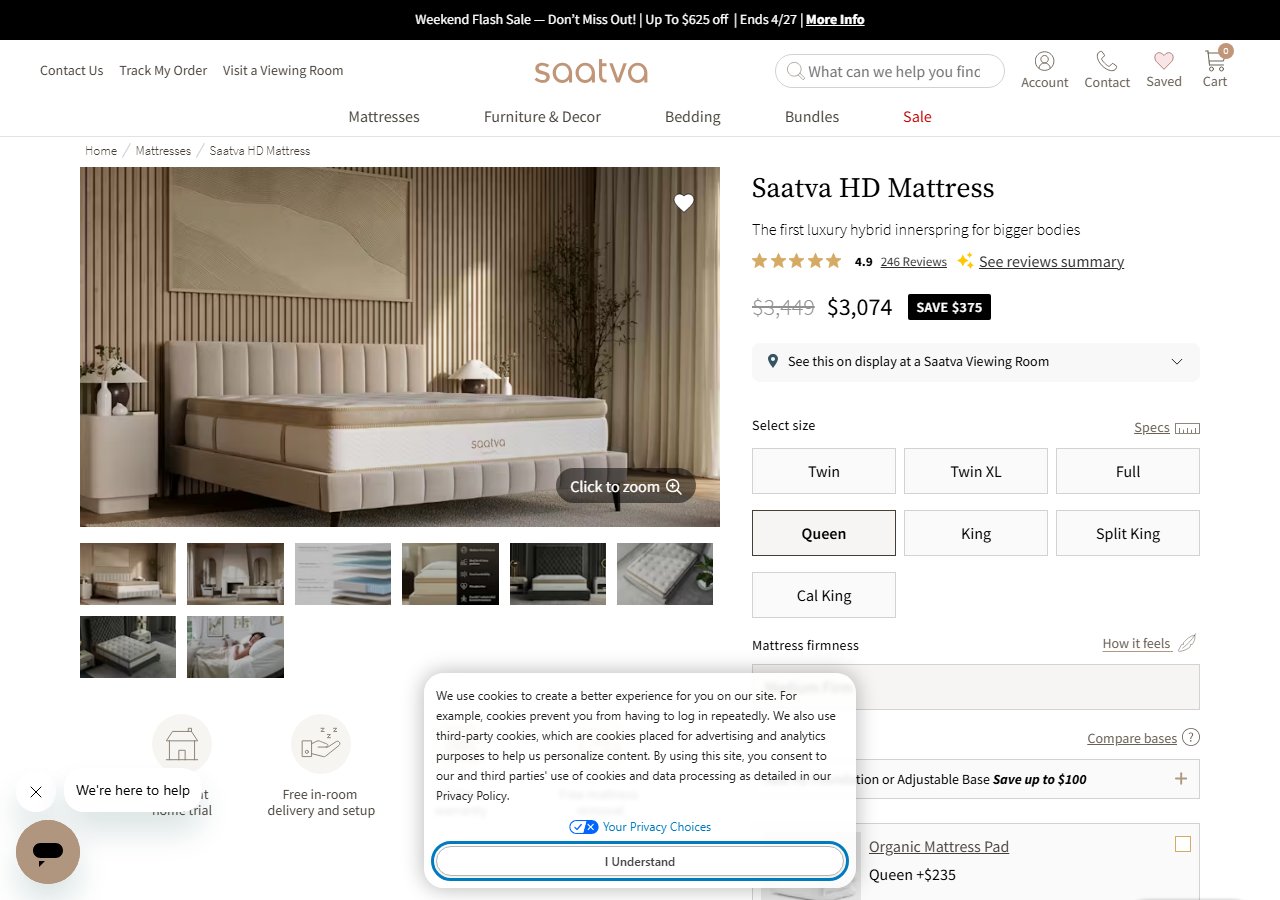
Saatva HD Mattress (Heavy-Duty)
$2,395-$3,995
See Price at Saatva →
Purple Hybrid Premier Mattress
$2,499-$4,799
See Price at Purple →The Data-to-Intervention-to-Product Hierarchy
The federal data on chronic back pain is unambiguous in scale: 20% of U.S. adults living with chronic pain, back the most injured body part in the American workforce, musculoskeletal disorders the leading driver of new disability claims. The economic toll — in AHRQ healthcare spending data, in BLS workers' compensation premium differentials, in CMS drug expenditure data — is measured in hundreds of billions of dollars annually.
The hierarchy of response to that data is equally clear. Position correction, consistent walking, proper lifting mechanics, and mattress assessment are the first tier — free or near-free, backed by NIH and NIOSH evidence, and sufficient for a meaningful share of back pain sufferers. Clinical evaluation is the mandatory second step when red-flag symptoms are present. Equipment — including the Saatva Loom & Leaf for classic back pain sufferers, the Saatva HD for high-load and higher-weight users, and the Purple Hybrid Premier for pressure-sensitive sleepers — is the third tier: a legitimate and research-informed adjunct for the right candidate, but never a substitute for the first two.
Buying a better mattress without addressing sleep position, movement, and occupational loading is like buying a high-end running shoe without treating the gait abnormality causing the injury. The shoe can help at the margin. The gait work is where the meaningful change happens. Both matter. In that order.