The Chronic Pain Math That Older Active Adults Are Living In
Start with a number that federal epidemiologists have been tracking for years: according to CDC NCHS Data Brief 390, approximately 20% of U.S. adults — roughly 50 million people — live with chronic pain, and about 7% experience high-impact chronic pain that limits daily activity or work. That statistic looks different when you're 52 and still training, still working a physically demanding job, or still hiking the same trails you've been hiking since your thirties. At that age, chronic pain isn't an abstraction. It's the question of whether you get out of bed on Tuesday feeling recovered or feeling like you lost a fight.
The federal data on who carries this burden is sobering. BLS Survey of Occupational Injuries and Illnesses (SOII) data shows that musculoskeletal disorders account for approximately 30% of all nonfatal occupational injuries with days away from work across U.S. private industry. Construction workers, warehouse workers, landscapers, and tradespeople in their 50s are often working alongside colleagues half their age while their joints accumulate decades of cumulative loading those younger workers haven't experienced yet. Even for adults over 50 who are recreationally active rather than occupationally burdened, the biomechanical math is the same: more years of load means more inflammatory residue to manage between sessions.
This is the specific context in which cold-water immersion becomes worth examining as a recovery tool — not as a wellness trend, and not as a luxury purchase, but as an intervention with a documented physiological mechanism that maps directly onto the recovery demands of older active adults.
Why Inflammation Compounds Differently After 50
To understand why cold plunge is worth the science discussion for this demographic specifically, you have to understand what changes biomechanically and immunologically after 50. The phenomenon is sometimes called "inflammaging" in the research literature — a low-grade, chronic, systemic inflammatory state that accumulates with age and is amplified by physical stress, inadequate recovery, and cumulative musculoskeletal loading.
Here is the mechanism in plain terms. After intense physical exertion — whether that's a construction shift, a heavy deadlift session, or a long trail run — your muscle tissue experiences microdamage. The inflammatory cascade that follows is necessary and productive in younger adults: cytokines signal repair, satellite cells proliferate, and the tissue rebuilds stronger. In adults over 50, that cascade is both slower and noisier. The inflammatory signal lingers longer, serum creatine kinase (a marker of muscle damage) stays elevated for more days, and delayed-onset muscle soreness (DOMS) often peaks harder and later than it did at 30.
The relevance to NIOSH Total Worker Health Program framing is direct. NIOSH research explicitly identifies that workers in physically demanding occupations face cumulative biomechanical loading that requires deliberate recovery interventions — and frames those interventions as occupational health infrastructure, not optional wellness. For the 50-plus worker or athlete, that framing is especially apt: the cumulative load is not just today's shift or today's workout. It's thirty years of shifts and workouts, stacked in the connective tissue and joints.
NOAA data reinforces how acute this problem becomes in warm months. NOAA Heat-Related Workplace Risk Data documents elevated injury and recovery demand for outdoor occupations — agriculture, construction, roadwork — during summer heat exposure. Core temperature elevation during heat-stressed work accelerates muscle protein breakdown and extends recovery timelines. An older worker finishing a July roofing shift or a 60-year-old trail runner finishing a summer long run faces a compounded recovery demand: the musculoskeletal inflammatory load plus the physiological stress of heat exposure.
The Physiology of Cold-Water Immersion: What the Research Actually Measured
Cold-water immersion (CWI) at 50–59°F (10–15°C) for 10–15 minutes post-exertion is the protocol that appears consistently in NIOSH-cited recovery research. The documented outcomes are specific and worth stating precisely, because a lot of wellness marketing collapses them into vague claims.
First: vasoconstriction and the flushing mechanism. Cold water causes peripheral vasoconstriction — blood vessels in the limbs narrow, pushing blood toward the core. When you exit the cold water and your body rewarms, vasodilation follows, creating a flushing effect that accelerates metabolite clearance. This is why CWI has shown consistent efficacy for reducing DOMS: it's mechanically clearing the inflammatory byproducts that accumulate in worked tissue.
Second: serum creatine kinase reduction. CKase is the protein released into the bloodstream when muscle fibers are damaged. Elevated CK is the biological signature of the soreness you feel two days after a hard workout or a demanding physical shift. NIOSH-cited literature documents that properly dosed CWI reduces CK elevation — meaning the immune system is dealing with less damage signal, and the inflammatory response is shorter and more targeted.
Third: neural analgesic effect. Cold water reduces nerve conduction velocity in superficial tissues. For adults over 50 managing arthritis, tendinopathies, or chronic joint irritation from accumulated occupational loading, this has a direct pain-management implication. It's not treating the underlying condition, but it's reducing the pain signal that otherwise accumulates over a training week or a work week and eventually forces a rest day.
For older active adults specifically, the protocol matters. The research is built around 10–15 minutes at 50–59°F. Colder water for shorter durations has not shown equivalent outcomes for DOMS reduction. Longer immersions at those temperatures carry cardiovascular risk that becomes relevant quickly when we talk about the 50-plus demographic, where cardiovascular disease accounts for approximately 1 in 3 U.S. deaths annually per CDC tracking. Temperature precision and time discipline are not details — they're the difference between the intervention that works and the intervention that harms.
Try These First: Free Interventions Before You Spend a Dollar
The cheapest intervention is the one that doesn't require buying anything. Federal occupational health guidance provides a clear hierarchy of recovery tools, and cold-water immersion sits downstream of several behavioral and lifestyle practices that are both free and well-validated. Before you evaluate any cold plunge unit, work through this list honestly.
NIOSH work-rest cycles are the upstream intervention that prevents the injury cold plunge tries to recover from. For physically demanding work in heat or under load, NIOSH recommends scheduled rest in cool environments as the primary heat and load management strategy. Cold immersion is one validated cooling intervention, but pacing the work itself is the first line of prevention — and no recovery tool compensates for a work pattern that consistently exceeds safe loading thresholds.
Sleep is the recovery multiplier that no equipment replaces. CDC guidance is clear: adults need 7 or more hours per night. Sleep deprivation directly increases workplace injury rates and blunts the inflammatory resolution that recovery interventions are trying to support. If you're sleeping five hours a night and considering a $1,200 cold plunge, the math doesn't work.
Hydration is the other non-negotiable. Cold immersion does not replace fluid loss, and CDC NIOSH guidance for heat-stressed workers recommends one cup (8 oz) of water every 15–20 minutes during exposure, with electrolyte replacement on shifts longer than two hours. Entering a cold plunge in a dehydrated state amplifies the cardiovascular stress of the cold shock response — a risk that is not trivial for adults over 50.
Active recovery is the physiological foundation that CWI gets layered on top of. CDC physical activity guidance and exercise science research both support 10–15 minutes of light walking or cycling post-exertion as the primary lactate-clearing mechanism. Cold plunge amplifies an active recovery protocol; it does not substitute for it.
For readers who have worked through that list and are still dealing with recovery deficits — persistent DOMS, joint inflammation that lingers through the week, mornings where getting out of bed requires negotiation with your body — equipment becomes relevant. That's the honest framing. Cold plunge is not a shortcut around sleep, hydration, and paced activity. It's a precision tool for adults who are already doing those things and need another lever.
When to See a Clinician Before You Get in Cold Water
This section is not a disclaimer inserted for legal coverage. For adults over 50, the cardiovascular contraindications to cold-water immersion are real and the federal data on cardiovascular mortality in this demographic makes them impossible to ignore. CDC WONDER data shows cardiovascular disease accounting for approximately 1 in 3 U.S. deaths annually. The cold shock response — the involuntary gasp, heart rate spike, and blood pressure surge that occurs in the first 30–90 seconds of cold-water immersion — is a cardiovascular event. In a healthy 55-year-old, it's manageable and dissipates within minutes. In someone with uncontrolled hypertension, an arrhythmia, or a recent cardiac history, it can be dangerous.
NIH National Heart, Lung, and Blood Institute guidance is explicit: clear cold therapy with a clinician before starting if any cardiovascular condition is present. Beyond cardiac risk, Raynaud's phenomenon (a circulatory condition that causes extreme cold sensitivity in the extremities) is a direct contraindication. Peripheral artery disease, active wound sites, and certain medications that affect thermoregulation also require physician review before initiating cold immersion. The approximately 76% of U.S. adults who do not meet weekly aerobic activity guidelines — a figure that implies significant cardiovascular deconditioning across the population — are precisely the adults who need that clinical conversation before interpreting cold plunge as a cardiovascular training tool.
Where Equipment Enters the Equation
For active adults over 50 who have cleared the clinical checklist and are building a structured recovery protocol, the equipment question reduces to one specification: can this unit hold 50–59°F reliably, and can I use it consistently without it becoming a hassle? Consistency is the operant variable. A unit you use twice a week because filling it with ice bags is a 45-minute project delivers a fraction of the dose of a unit you use five times a week because it maintains temperature automatically.
The Ice Barrel 400 is the entry-level answer to that question for older active adults who want a purpose-built unit without a chiller system price tag. At $1,200, it's a vertical barrel design built for outdoor use — the ergonomics matter for the 50-plus user because getting in and out of a low-profile tub requires more hip and knee mobility than many people in this demographic have consistently available. The barrel format means you lower yourself in rather than stepping over a tub wall. It's UV-resistant for outdoor placement and insulated to extend the cold hold time when you're working with ice. For adults managing recovery on a budget who are willing to use ice, the Ice Barrel 400 delivers the research-validated format without the chiller overhead.
For adults who have decided that consistency is the priority and manual ice management is the friction that will kill the habit, the Sun Home Cold Plunge Pro is the upper-tier answer. At $4,499, it's a self-contained unit with a built-in chiller that maintains precise temperature — critical for the protocol precision the research measured. The self-cleaning filtration system matters for the everyday user who is not going to maintain water chemistry on a separate schedule. For an older active adult who is using this unit five to six times per week as part a structured recovery protocol — post-workout, post-demanding workday, or during periods of elevated training load — the elimination of ice logistics and water management friction is what turns a recovery tool into a recovery habit.
The price gap between these two units is real and it reflects a genuine difference in daily-use convenience. Neither unit is a luxury purchase if you're the adult that SSA Disability Insurance data describes as disproportionately at risk for musculoskeletal disability claims — and neither one works if you haven't addressed the sleep, hydration, and pacing variables first.
Cold Plunges for Active Adults Over 50: Two Tiers Built Around the Research Protocol
Both units below were selected because they can hold the 50–59°F temperature range documented in NIOSH-cited recovery literature — the threshold that separates a research-validated intervention from a cold shower. They represent two distinct price tiers for two distinct usage patterns.
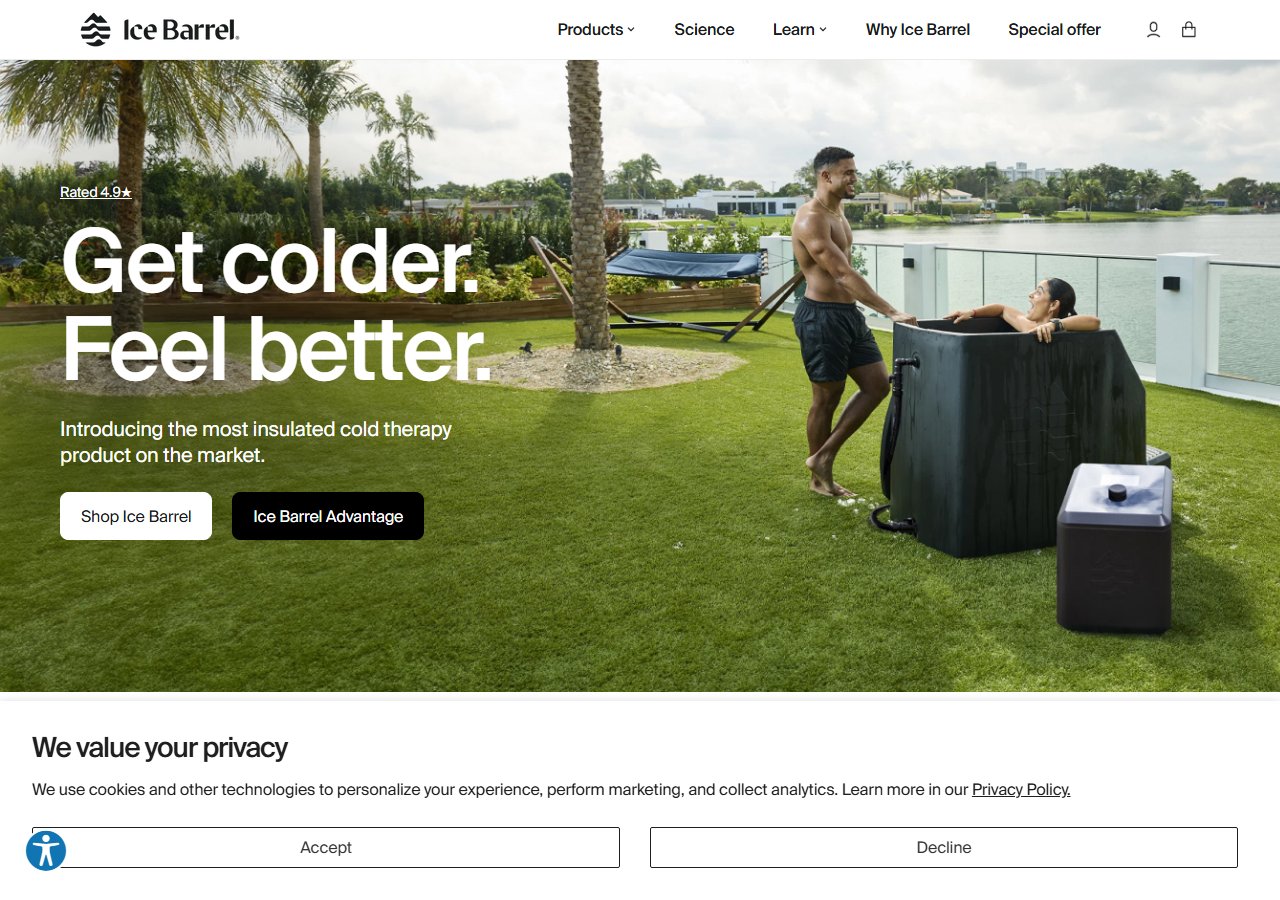
Ice Barrel 400
$1,200
See Price at Ice Barrel →
Sun Home Cold Plunge Pro
$4,499
See Price at Sun Home →The Recovery Infrastructure Argument for Adults Over 50
The NIOSH Total Worker Health Program frames recovery infrastructure as occupational health, not luxury. That framing deserves to be taken seriously by every adult over 50 who is still physically active — whether that activity is a career in construction, a serious amateur athletic practice, or simply the commitment to not becoming sedentary before you have to be.
The BLS SOII data that shows musculoskeletal disorders driving 30% of occupational injuries with days away from work represents a preventable burden at the population level. At the individual level, it represents the accumulated consequence of years of physical demand without sufficient recovery infrastructure. Cold-water immersion is one evidence-supported tool in that infrastructure. It's not magic, and it doesn't operate in isolation from sleep, hydration, movement quality, and clinical management of underlying conditions.
But for the active adult over 50 who has those foundations in place and is still fighting the inflammatory residue of a life well-used, the research case for a properly dosed cold plunge protocol is solid. The temperature is 50–59°F. The duration is 10–15 minutes. The frequency is structured around exertion, not calendar. And the unit you use is the one you'll actually get into consistently — which is a different answer for a $1,200 ice-management setup than for a $4,499 automated chiller system, depending on your budget, your usage pattern, and your tolerance for friction.
The federal data frames the problem. The mechanism explains why cold water is one legitimate solution. The equipment question is about which version of that solution fits your life.
Summary: What the Data Says
Federal occupational health data, CDC chronic disease surveillance, and NIOSH recovery research converge on a consistent picture for adults over 50: inflammatory burden is real, cumulative, and manageable with deliberate intervention. CDC NCHS data puts 20% of U.S. adults in chronic pain. BLS puts musculoskeletal disorders at 30% of occupational injury burden. NIOSH puts recovery infrastructure in the category of occupational health necessity. The recovery math for older active adults is not flattering — but it is solvable. Sleep, hydration, paced activity, and clinical guidance first. Then, for the adults who have those foundations and need another lever: a cold plunge unit calibrated to the temperature and duration that the research actually measured.