The Stiffness You Wake Up With Isn't Random
If you work heavy trades—framing, ironwork, masonry, roofing, concrete—you already know the feeling: you peel yourself off the mattress in the morning moving like a man or woman twice your age. Your lower back protests every first step. Your hips need five minutes before they function at operating temperature. You've written it off as part of the job. Federal occupational health data says you're right that it's job-related—but wrong that nothing can be done.
BLS Musculoskeletal Disorder tracking is unambiguous: the back is the most commonly injured body part across all U.S. occupations that result in days away from work. Construction is not an outlier in that data—it's a leading contributor. And the NIOSH Lifting Equation documents that manual material-handling tasks across construction, warehousing, and healthcare routinely exceed safe spinal loading limits. When your spine absorbs loads above those thresholds repeatedly across a working life, it doesn't fully recover in the hours between shifts—not without intentional intervention.
The economic downstream is severe. BLS Employer Costs data shows industries with high MSD incidence carry workers' compensation insurance rates 3–5 times higher than low-MSD industries. AHRQ HCUP data identifies back pain as one of the most expensive conditions in U.S. healthcare by total inpatient and outpatient cost. And SSA Disability Insurance reports name musculoskeletal disorders the single largest category of new disability claims filed annually—a statistic that should stop every ironworker and roofer cold. This is not background noise. This is the career-ending trajectory that begins with ignored morning stiffness.
Why Heavy-Trade Workers Wake Up Stiff: The Biomechanical Mechanism
Understanding morning stiffness requires understanding what happens to the lumbar spine across a construction shift—not just while you sleep.
The intervertebral discs in your lower back function as hydraulic shock absorbers. They are avascular—they receive nutrients and hydration passively through diffusion, not direct blood supply. During a day of heavy lifting, carrying, and twisting, those discs are repeatedly compressed. Fluid is expelled. By end of shift, your lumbar discs are measurably thinner and more dessicated than they were at 6 a.m. This is normal in modest doses. The problem is scale and repetition.
The NIOSH Lifting Equation establishes recommended weight limits based on a formula incorporating load weight, horizontal distance from the spine, vertical lift height, asymmetry angle, and coupling quality. In practice, construction tasks—hoisting drywall sheets, carrying concrete blocks, maneuvering structural lumber—routinely violate multiple NIOSH parameters simultaneously. The spinal compressive forces generated by these tasks exceed 3,400 Newtons, the threshold NIOSH identifies as the action limit above which musculoskeletal injury risk rises substantially.
Repeat that exposure daily for years. The discs and facet joints accumulate microtrauma. Paraspinal muscles develop chronic low-grade inflammation. Ligamentous laxity develops in the joints that stabilize the lumbar vertebrae. By bedtime, your lumbar spine is in a state of biochemical inflammation and structural fatigue.
Now add a poor sleep surface. A mattress that sags at the lumbar region allows the spine to collapse into flexion overnight—the very load-bearing geometry that caused the injury in the first place. A mattress that is too firm for your body weight creates point pressure at the hips and shoulders, forcing compensatory spinal curvature. Neither condition allows the paraspinal muscles to fully relax, the disc nutrition cycle to complete, or the inflammatory cascade to resolve.
CDC NCHS Data Brief 390 reports that approximately 20% of U.S. adults experience chronic pain, with lower back as the most common location. For construction workers, that figure almost certainly understates the occupational concentration. And CDC arthritis data shows approximately 25% of U.S. adults carry a doctor-diagnosed arthritis diagnosis, with prevalence concentrated in occupations involving sustained physical demand—a category construction occupies at the extreme end.
Then factor in sleep duration. CDC Sleep and Sleep Disorders data shows 35% of U.S. adults sleep fewer than 7 hours per night, the threshold linked to elevated chronic disease risk. Construction workers—whose shifts start at 5 or 6 a.m. and whose job demands leave them physically exhausted but physiologically overstimulated—are disproportionately represented in that 35%. Insufficient sleep impairs the tissue repair cycle that should be clearing the inflammatory metabolites produced during a high-load workday. The combination of spinal microtrauma, inadequate surface support, and truncated sleep duration creates the morning stiffness loop that construction workers treat as inevitable.
It is not inevitable. It is addressable. But you have to work through it in the right sequence.
The Cheapest Intervention Is the One That Costs Nothing
Before any product discussion, it is worth being direct: the evidence base for non-product interventions in occupational low back pain is stronger than the evidence base for any specific mattress brand. Federal agencies have published extensive guidance on what works before you spend money on sleep equipment.
First, movement mechanics matter more than most people realize. OSHA's Ergonomics guidance emphasizes that most acute back episodes are mechanical and rehearsable—meaning the patterns that injure the spine can be replaced with patterns that protect it. Hinging at the hips rather than rounding the lumbar spine, keeping loads close to the body, and avoiding twisting under load are not complicated techniques, but they require deliberate practice. A construction professional who ingrains proper hip-hinge mechanics reduces cumulative spinal loading over a career in ways no mattress can compensate for.
Second, daily walking outperforms most passive treatments. An NIH NCCIH evidence review concludes that 30 minutes of walking most days reduces chronic low back pain as effectively as most non-drug clinical interventions. This finding surprises people who feel their backs are already working hard enough during a construction shift—but job-site movement is loaded, asymmetric, and postural; it does not replicate the decompressive, rhythmic mechanics of walking. The two are physiologically different.
Third, sleep position is a free variable that most people waste. NIH guidance on back pain identifies side-sleeping with a pillow between the knees or back-sleeping with a pillow under the knees as the two positions most protective of lumbar neutral alignment overnight. Stomach-sleeping torques the lumbar spine into extension and rotation simultaneously—worsening the exact structural load pattern that is already being driven by construction work. Changing sleep position costs zero dollars and takes three nights of deliberate practice.
Fourth, assess the mattress you already own before replacing it. CDC Sleep Hygiene guidance recommends replacing a mattress if there is visible sag, if you consistently wake stiffer than you went to bed, or if the mattress is older than 7–10 years. Many construction workers sleep on mattresses well past that threshold. A replacement may be necessary—but a $3,000 mattress on an inadequate foundation, or a new mattress that doesn't fit the body weight of a 230-pound tradesperson, will not deliver the results its price suggests.
For construction workers who have already addressed movement mechanics, optimized sleep position, and still wake with significant lumbar stiffness—or who sleep on a mattress that objectively needs replacement—sleep surface selection becomes a legitimate ergonomic intervention. At that point, the engineering of the mattress matters in ways that are worth understanding.
When to See a Clinician First
Not all morning back pain in construction workers is mechanical stiffness. Some symptoms require clinical evaluation before any other intervention—including a new mattress.
NIH National Institute of Neurological Disorders and Stroke guidance on back pain establishes clear red flags that warrant prompt clinical referral: back pain that radiates below the knee (suggesting nerve root compression or disc herniation), pain following a traumatic event (fall, struck-by incident on a job site), pain accompanied by leg weakness or numbness, bowel or bladder dysfunction, or fever with back pain (possible spinal infection). These presentations require imaging and clinical diagnosis, not a new sleep surface.
AHRQ MEPS data documents that average annual personal healthcare expenditures for adults with chronic back conditions substantially exceed costs for adults without such conditions—and CMS drug spending data identifies opioid and non-opioid pain medication spending among the most expensive Medicare drug categories, reflecting the chronic-pain treatment burden that results when mechanical back problems go untreated long enough to become neuropathic or structural. Early clinical intervention, when red flags are present, is substantially cheaper than late-stage management. Ignoring radiating pain and buying a mattress is not a clinical strategy.
For construction workers without red flags—typical morning lumbar stiffness, general soreness across the hips and thoracic spine, difficulty getting comfortable overnight—product selection becomes appropriate after the free interventions have been applied.
What Sleep Surface Features Actually Matter for High-Load Body Types
Construction workers are not average-BMI office workers. The median framer, ironworker, or heavy-equipment operator has more lean mass than the average American adult, often weighs 210–260 pounds, and presents a body geometry that standard mattress firmness ratings—based on average-weight consumers—systematically underperform for.
There are three engineering variables that matter most for this reader:
1. Zoned support under the lumbar spine. A mattress that is uniformly firm or uniformly soft fails high-load body types in different ways. Uniform softness allows the heavier lumbar region to sag below neutral. Uniform firmness creates excessive pressure at the greater trochanter (hip) and shoulder. Zoned support—firmer at the lumbar zone, softer at the shoulder—keeps the spine in the same neutral alignment that proper sleep position tries to achieve. This matters more at higher body weights because gravity is working harder against you.
2. Edge support. Construction workers who sleep near the edge of the bed, or who use the edge to push themselves upright in the morning (a common pattern for people with lumbar stiffness), need mattress edge reinforcement. Without it, the sleeping surface compresses at the perimeter, creating a tilt that loads the lumbar spine asymmetrically all night.
3. Weight-capacity engineering. Standard consumer mattresses are typically tested and warranted to around 250 pounds per side. A 230-pound construction worker with a 220-pound partner is operating outside that parameter on many mid-market mattresses—and the premature compression that results negates whatever initial firmness rating the mattress was sold with.
The Saatva HD Mattress was specifically engineered for high-load users. Saatva rates it to 500 pounds per side—double the standard consumer spec—using a dual-coil construction with a 14.5-gauge tempered steel innerspring base and a 13.75-gauge comfort coil layer on top. For a 240-pound ironworker whose lumbar spine has been under compressive load since 6 a.m., that structural capacity matters: the mattress does not bottom out under the heaviest part of the anatomy, which means the zoned support it was designed to provide actually delivers at the body weights it was built for. This is the most targeted option in this list for heavy-trade workers who are large-framed or high-weight.
For construction professionals dealing specifically with pressure buildup in the hips and shoulders—common in side sleepers who spend all day carrying weight on one shoulder or favoring a load-side hip—the Purple Hybrid Premier Mattress takes a materially different engineering approach. Its GelFlex Grid redistributes pressure across a larger surface contact area rather than creating point resistance, which reduces the local tissue ischemia that causes the aching-hip sensation at 3 a.m. The hybrid construction—GelFlex Grid over pocketed coils—provides enough base firmness to prevent lumbar sag while still conforming to the asymmetric pressure map of a body that has been carrying load on one side all day.
For construction workers managing documented chronic back pain who want premium memory foam with deep lumbar contouring, the Saatva Loom & Leaf is the direct-brand premium memory foam option. It uses a multi-layer American-made memory foam construction with a gel-infused memory foam comfort layer and a spinal zone quilting pattern designed to reinforce lumbar support. At 5.5-inch foam depth above the base, it provides the progressive resistance that prevents a heavier lumbar region from bottoming out while still conforming to hip contours. The Relaxed Firm version is the appropriate specification for most construction workers—the Firm version is engineered for back-sleeping at higher body weights.
Sleep Surfaces Engineered for High-Load Construction Body Types
These three mattresses were selected for construction workers specifically: high weight-capacity ratings, zoned lumbar support, and pressure-relief engineering suited to the asymmetric body wear patterns of heavy-trade work.

Saatva Loom & Leaf Memory Foam Mattress
$1,695-$3,295
See Price at Saatva →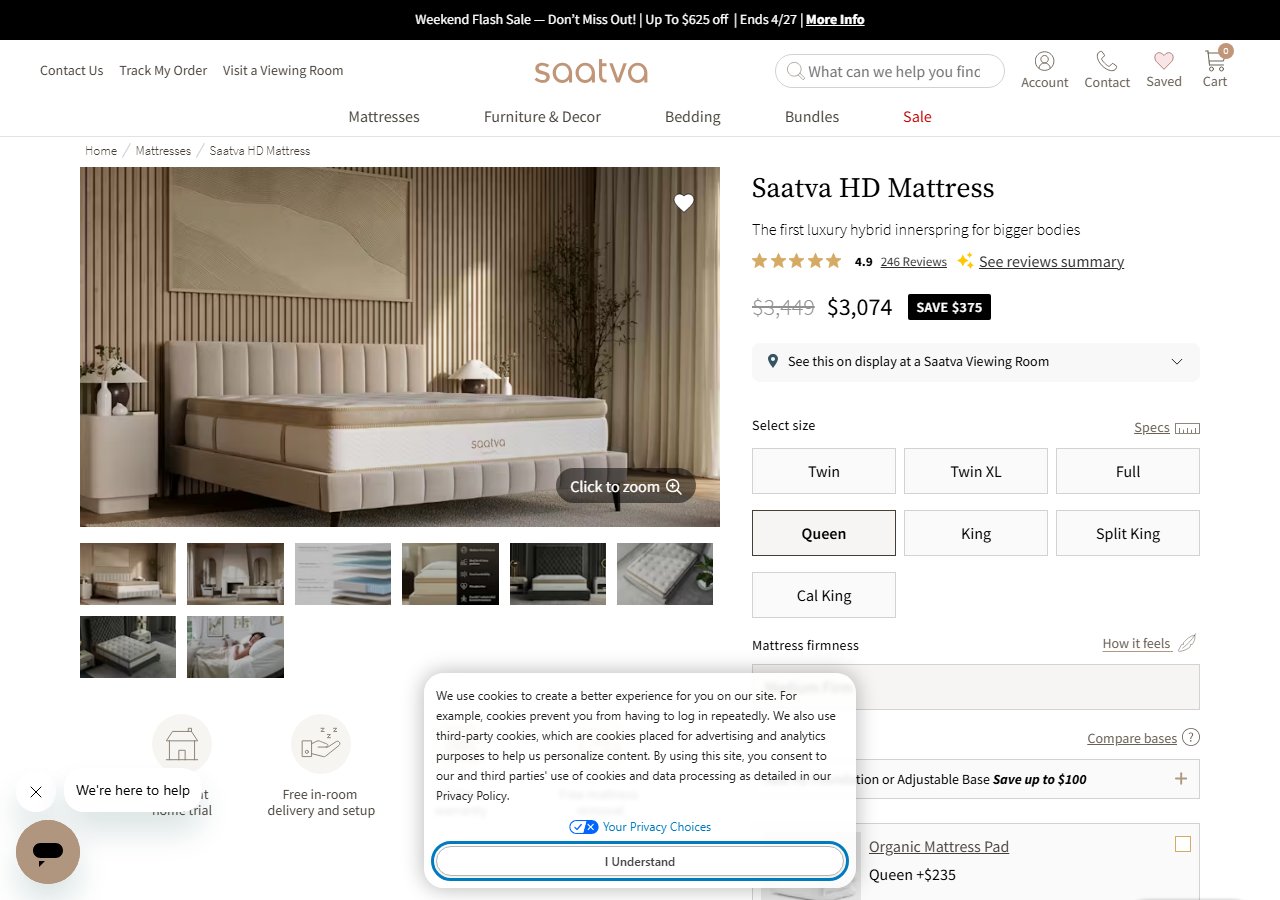
Saatva HD Mattress (Heavy-Duty)
$2,395-$3,995
See Price at Saatva →
Purple Hybrid Premier Mattress
$2,499-$4,799
See Price at Purple →Putting the Data Hierarchy Together
The federal data tells a coherent story. Construction work produces cumulative spinal load that exceeds safe parameters documented by NIOSH. That load, compounded by the 35% of U.S. adults sleeping fewer than 7 hours that CDC tracks, and concentrated in a workforce carrying the MSD injury rates BLS records, creates a back-pain trajectory that SSA disability data identifies as the leading driver of new disability claims.
A mattress does not reverse that trajectory on its own. The evidence is clear that movement mechanics, daily walking, and sleep position are each interventions with stronger independent evidence bases than any specific sleep surface. Clinical red flags—radiating pain, weakness, trauma-associated pain—require evaluation before anything else.
But for construction workers who have addressed the free variables and still sleep on a surface that cannot support their body weight at the firmness level their lumbar spine requires, the engineering of the sleep surface becomes a legitimate occupational health intervention. The Saatva HD for high-load body types, the Purple Hybrid Premier for pressure redistribution, and the Saatva Loom & Leaf for deep lumbar contouring all address specific biomechanical failure modes that standard mattresses—designed for median-weight, office-working consumers—were not built to handle.
The data says the problem is real and the consequences are severe. The intervention hierarchy says start free, escalate deliberately, and buy equipment that was engineered for your body geometry and occupational load—not for the average consumer the mattress industry defaults to.