The Federal Data Behind That Morning Stiffness
Most construction workers don't need a federal database to tell them their back hurts. But the scale of what those databases reveal is worth sitting with for a moment. According to BLS Musculoskeletal Disorders by Occupation tracking, the back is the most common injured body part across all U.S. occupations resulting in days away from work — and construction sits near the top of every high-incidence industry table the Bureau produces. This isn't soreness from a bad week. It's a structural feature of the trade.
The downstream costs confirm the severity. AHRQ HCUP data identifies back pain as one of the most expensive conditions in U.S. healthcare by total inpatient and outpatient cost. AHRQ's Medical Expenditure Panel Survey shows average annual personal healthcare expenditures for adults with chronic back conditions substantially exceed costs for adults without such conditions. And SSA Disability Insurance Reports identify musculoskeletal disorders as the single largest category of new disability claims annually — a statistic that should land hard for anyone who relies on their body for income.
Then there's the workers' compensation dimension. BLS Employer Costs for Employee Compensation data shows that industries with high MSD incidence carry workers' compensation insurance rates 3 to 5 times higher than low-MSD industries. Construction employers know this number intimately. Workers live it.
Why Construction Work Loads the Spine Differently
Understanding the morning stiffness that construction workers describe — the first 20 minutes out of bed that feel like moving through wet concrete — requires understanding what actually happens to the spine during a heavy-trade workday.
The NIOSH Lifting Equation was developed precisely because researchers recognized that manual material-handling tasks routinely exceed safe spinal loading thresholds. In construction, those thresholds are crossed repeatedly and in combination: a framing carpenter carrying lumber operates at high compressive loads; a mason lifting 40-pound block units while twisting adds shear force to that compression; a plumber working in a crawl space sustains lumbar flexion under load for minutes at a time. Each of these exposure patterns is distinct, and each produces a different injury signature.
The compressive loading that defines most heavy trade work has a well-documented nocturnal consequence: intervertebral discs, which lose fluid volume during the day under axial load, need horizontal rest to rehydrate. The disc's nucleus pulposus — the gel-like core that absorbs compressive shock — draws fluid back in during sleep through a process called imbibition. When a sleep surface is too soft and allows the lumbar spine to sag into flexion, or too firm and creates pressure points that interrupt sleep architecture, that overnight rehydration is compromised. The worker wakes with discs that haven't fully recovered, and the next shift begins from a deficit.
This isn't a minor inconvenience. CDC NCHS Data Brief 390 reports that approximately 20% of U.S. adults experience chronic pain, with lower back as the most common pain location. In occupations with sustained physical demand, that prevalence is higher. CDC Arthritis Data shows approximately 25% of U.S. adults report doctor-diagnosed arthritis, with concentration in physically demanding occupations — meaning that many construction workers are managing not just acute MSD episodes but underlying degenerative joint changes that alter how they respond to sleep surfaces.
There's a fatigue compounding layer as well. CDC Sleep and Sleep Disorders data shows approximately 35% of U.S. adults sleep fewer than 7 hours per night, the threshold associated with elevated chronic disease risk. Construction workers, who often start shifts before 6 AM and work physically exhausting days, are plausible overrepresentatives in that statistic. Sleep deprivation reduces pain tolerance, slows soft-tissue repair, and elevates inflammatory markers — which means the worker who sleeps poorly is effectively more injured the next morning than their tissue damage alone would predict.
The body weight dimension matters too. Construction work selects for larger, heavier body types — or, more precisely, it builds them. Sustained physical labor increases lean muscle mass, and many experienced tradespeople carry 200 to 250-plus pounds. A standard consumer mattress is typically engineered for a body weight range of 130 to 200 pounds. A 230-pound ironworker sleeping on a mattress designed for a 160-pound office worker is not getting the support geometry the mattress manufacturer intended. The mattress deflects further than designed, the lumbar support zone collapses, and the spine spends 7 or 8 hours in a position it should not be in.
The Cheapest Fix Is Often Free: Try These First
Before evaluating any sleep surface, it's worth being honest about the hierarchy of interventions. The federal occupational health literature is consistent on this point: most modifiable back pain risk factors are behavioral, not equipment-based. The interventions below are drawn directly from OSHA, NIH, and CDC guidance. They cost nothing. They move the needle on back pain more reliably than any product for the majority of workers.
Lifting and bending mechanics are the first lever. OSHA's Ergonomics Solutions guidance is explicit: hinge at the hips rather than the lumbar spine, keep loads close to the body's center of mass, and avoid twisting under load. Most acute back episodes are mechanical events — a movement pattern executed under load at a moment of fatigue. They are, to a significant degree, rehearsable and preventable. A worker who has genuinely internalized hip-hinge mechanics will generate fewer acute episodes than one sleeping on a $4,000 mattress with poor lift technique.
Sleep position is the largest free variable on the sleep side of the equation. NIH National Institute of Arthritis and Musculoskeletal and Skin Diseases back pain guidance recommends side-sleeping with a pillow between the knees, or back-sleeping with a pillow under the knees — both positions keep the lumbar spine in a neutral alignment. Stomach-sleeping torques the lumbar spine and worsens chronic pain. A worker who corrects from stomach-sleeping to side-sleeping with knee support may reduce morning stiffness more than any mattress upgrade would produce.
Daily walking is arguably the most underutilized intervention in construction back pain. NIH NCCIH's evidence review on low back pain shows that walking 30 minutes most days reduces chronic low back pain as effectively as most non-drug clinical treatments. Workers who do physical labor all day sometimes assume they don't need additional movement — but occupational physical exertion is not the same as therapeutic movement. A 30-minute walk at a comfortable pace mobilizes the lumbar spine, reduces compressive load accumulation, and promotes the kind of tissue circulation that accelerates overnight repair.
Mattress assessment before replacement is also worth doing honestly. CDC Sleep Hygiene guidance is practical on this point: replace a mattress if it shows visible sag, if you consistently wake stiffer than you went to bed, or if it is older than 7 to 10 years. A mattress that passes those tests is probably not the primary driver of morning stiffness — other variables deserve attention first.
For workers who have genuinely worked through the behavioral checklist — who lift with correct mechanics, who sleep in spine-neutral positions, who walk regularly, and who are still waking stiff on a mattress that has visible center sag or is a decade old — a sleep surface assessment becomes legitimate. The question then is not whether to replace the mattress, but what construction-specific features to look for. That's a distinct question from what a sedentary office worker needs, and it deserves a distinct answer.
When to See a Clinician First
A new mattress is not a medical device. There is a category of back pain for which buying any sleep product is the wrong next step — the right step is a clinical evaluation.
NIH National Institute of Neurological Disorders and Stroke back pain guidance identifies several presentations that require prompt clinical attention rather than self-management. Construction workers, who often normalize pain as occupational background noise, are at particular risk of delaying care for symptoms that are actually red flags.
- Back pain that radiates below the knee, especially with numbness, tingling, or burning quality — this pattern suggests nerve root compression and warrants imaging evaluation, not a mattress upgrade.
- Back pain following significant trauma — a fall from height, a struck-by incident, a vehicle collision — should be evaluated before attributing symptoms to sleep surface.
- Leg weakness or foot drop in conjunction with back pain is a neurological red flag requiring urgent evaluation.
- Bowel or bladder changes accompanying back pain suggest cauda equina involvement, which is a surgical emergency.
- Back pain with fever, unexplained weight loss, or history of cancer requires immediate clinical evaluation to rule out infectious or oncological etiology.
CMS Drug Spending Dashboard data shows opioid and non-opioid pain medication spending among the most expensive Medicare drug categories — a downstream consequence of undertreated and mistreated musculoskeletal conditions. Early clinical evaluation and evidence-based treatment, when indicated, consistently produces better long-term outcomes and lower total cost than deferred care.
What Construction Workers Actually Need From a Sleep Surface
For workers who have cleared the clinical red flag checklist and established that their morning stiffness is mechanical and sleep-surface-related, the product evaluation criteria for construction professionals differ materially from mainstream mattress guidance.
Weight capacity and support geometry matter first. Most consumer innerspring and hybrid mattresses are engineered to a center-of-mass load assumption that doesn't account for 220-plus-pound workers with dense muscle mass distributed across broad shoulders and hips. The coil count, gauge, and zone distribution need to match that load profile. A mattress that performs well for a 165-pound reviewer is not necessarily a reliable predictor of performance for a 240-pound carpenter.
Lumbar zoning — the practice of using firmer coil zones or denser foam in the lumbar region specifically — is particularly important for workers with existing MSD history. When the lumbar spine has been exposed to years of high compressive loads, it often carries degenerative changes that reduce the spine's intrinsic ability to maintain neutral alignment. A mattress that provides additional lumbar support compensates for that reduced intrinsic capacity.
Pressure point relief at the shoulders and hips is the countervailing requirement. A mattress that is uniformly firm enough to support a heavy lumbar load will often create excessive pressure at the shoulder girdle and greater trochanter for side sleepers — which is problematic because side-sleeping is the recommended position for chronic back pain. The ideal construction-worker sleep surface creates a firm lumbar foundation with enough surface compliance at bony prominences to prevent pressure-point waking.
For workers managing serious chronic back pain, the Saatva Loom & Leaf Memory Foam Mattress represents a premium memory foam option specifically designed with lumbar zone support. Its dual-layer construction pairs a firmer foundational support layer with a gel-enhanced comfort layer, allowing the lumbar zone to maintain spinal alignment while the shoulder and hip regions accommodate pressure distribution. The organic cotton quilted cover adds breathability for workers who run warm — a common characteristic in workers who spend days doing physical labor. For a trade professional who has diagnosed the problem as a mismatched sleep surface and wants a high-quality memory foam solution, Loom & Leaf is built for that use case.
For workers on the heavier end of the body weight spectrum — the 220 to 300-plus-pound range that is common in structural trades — the Saatva HD Mattress is engineered specifically for high-load body types. The HD designation is not marketing language: it refers to a construction approach that includes a reinforced lumbar support system, a higher coil count per square foot than the standard Saatva Classic, and a higher weight-capacity specification than most consumer mattresses. For an ironworker, a heavy equipment operator, or a masonry contractor whose body weight and muscle density exceed the design envelope of standard mattresses, the Saatva HD directly addresses the structural mismatch described earlier in this article. It is the option most directly correlated to the BLS data on high-load occupational back injury.
For workers whose primary symptom is pressure-point pain — who wake with hip or shoulder soreness that prevents them from maintaining the side-sleeping position recommended by NIH — the Purple Hybrid Premier Mattress takes a materially different engineering approach. Purple's proprietary GelFlex Grid is a polymer grid structure that behaves unlike foam or coil systems: it collapses selectively under bony prominences to eliminate pressure points while remaining firm in the areas between prominences that need postural support. For a construction worker managing both lumbar MSD history and significant shoulder wear from overhead work — a combination common in framers, drywallers, and painters — the Purple Hybrid Premier's pressure-relief profile addresses multiple simultaneous pain generators that other mattress constructions trade off against each other.
Mattresses Engineered for High-Load Construction Body Types
These three options were selected for their documented weight capacity, lumbar support architecture, and pressure-relief geometry — the specific features that matter when a sleep surface needs to serve a worker carrying significant occupational spinal load.

Saatva Loom & Leaf Memory Foam Mattress
$1,695-$3,295
See Price at Saatva →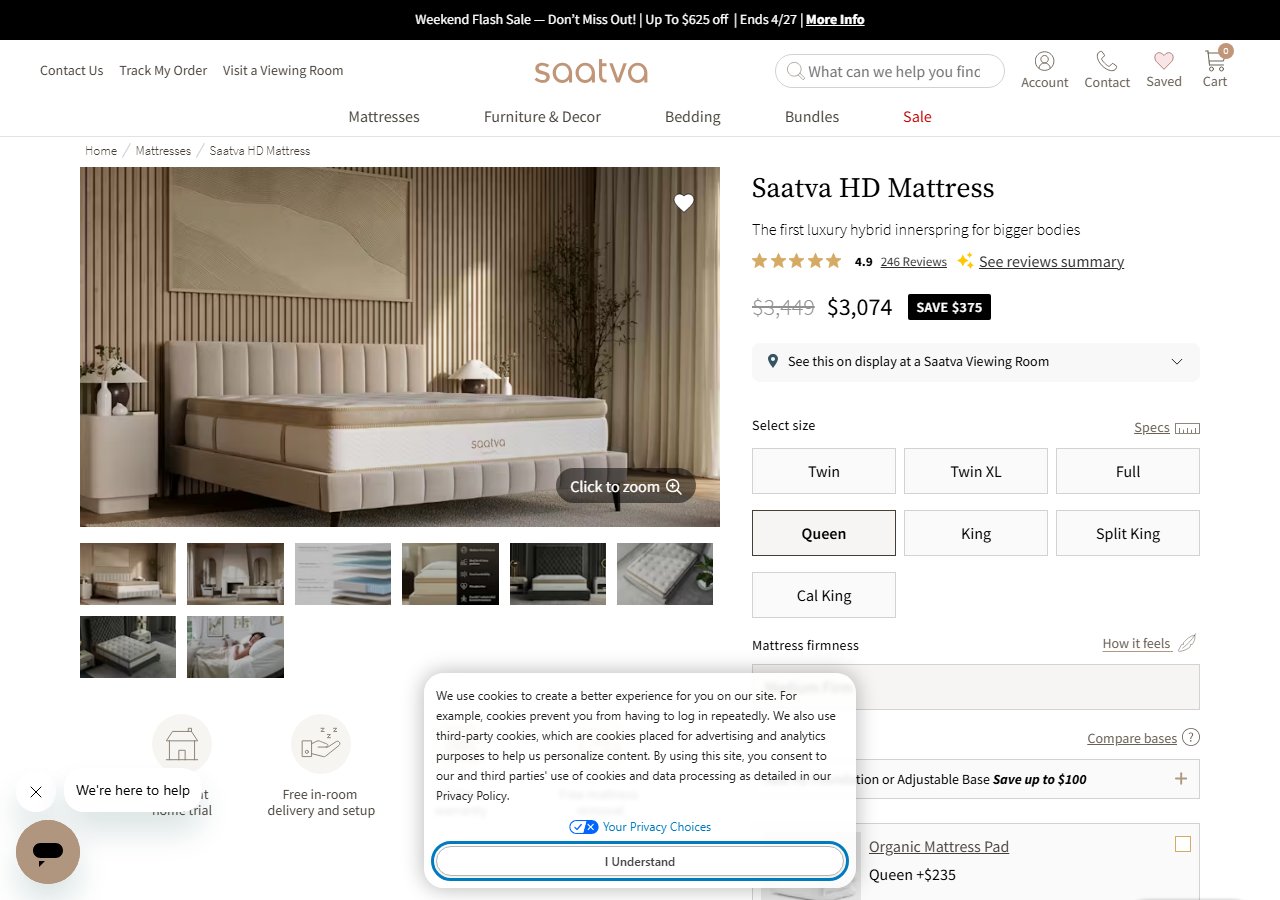
Saatva HD Mattress (Heavy-Duty)
$2,395-$3,995
See Price at Saatva →
Purple Hybrid Premier Mattress
$2,499-$4,799
See Price at Purple →Putting the Data Hierarchy Together
The federal data on construction musculoskeletal disorders tells a clear story: back injury is not an outlier event in heavy trades — it is a statistical feature of the occupation. BLS tracking establishes the back as the most commonly injured body part across all occupations with lost work days. NIOSH documents that construction tasks routinely exceed safe spinal loading thresholds. SSA disability data shows where that cumulative exposure ends for workers whose bodies eventually reach their structural limit.
The appropriate response to that data is not to buy a new mattress. The appropriate response is to work through the intervention hierarchy in order: mechanics before equipment, movement before products, clinical evaluation before self-treatment for red-flag presentations, and then — for workers who have genuinely addressed the behavioral variables and still sleep on a sagging or mismatched surface — a sleep surface evaluation grounded in the construction-specific load profile described above.
The workers most likely to benefit from a high-quality sleep surface are those who combine high body weight, existing lumbar MSD history, and a mattress that is visibly sagging or more than a decade old. For those workers, the biomechanics of overnight disc rehydration and spinal decompression are genuinely compromised by their current sleep surface, and a construction-grade replacement — engineered for the load profile of a 200-plus-pound worker with lumbar wear — represents a legitimate recovery investment. For everyone else, the free interventions move the needle further.