The data is unambiguous: construction breaks backs
If you work in heavy trades — framing, concrete, ironwork, roofing, electrical, plumbing — you already know the morning ritual: swing your legs over the bed, pause, wait for the low back to negotiate the terms of the day. What you may not know is how precisely federal data has quantified that experience.
According to BLS Musculoskeletal Disorders by Occupation tracking, the back is the single most commonly injured body part across all U.S. occupations that result in days away from work. Construction consistently lands at the top of that list. These are not soft numbers — they represent insurance claims, lost wages, modified-duty assignments, and in many cases, permanent functional limitations. The SSA Disability Insurance Reports identify musculoskeletal disorders as the largest single category of new disability claims filed annually. For construction workers, the pathway from a stiff morning to a disability filing is shorter than most people in the trade want to admit.
The financial weight is significant too. AHRQ HCUP data identifies back pain as one of the most expensive conditions in U.S. healthcare when measured by total inpatient and outpatient cost. AHRQ MEPS data shows that adults with chronic back conditions carry personal healthcare expenditures substantially above those without. And BLS Employer Costs for Employee Compensation data shows that industries with high MSD incidence — construction prominent among them — carry workers' compensation insurance rates 3 to 5 times higher than low-MSD industries. Every morning you negotiate with your lower back, that negotiation has a dollar figure attached.
Why this happens: the biomechanics of heavy-trade work
Understanding why construction workers wake stiff requires a brief excursion into spinal loading mechanics. The NIOSH Lifting Equation — the federal government's primary tool for evaluating manual material-handling risk — documents that construction and warehousing tasks routinely exceed recommended spinal compression limits. The equation defines a Recommended Weight Limit (RWL) based on load distance from the body, lifting frequency, trunk asymmetry, and grip quality. On a typical framing or concrete crew, tasks such as carrying OSB sheets, loading rebar, or hoisting HVAC components violate multiple variables simultaneously. The cumulative spinal loading across an 8- to 10-hour shift is not a theoretical risk — it is a documented biomechanical overload.
The specific injury pattern for construction workers differs from, say, office workers with back pain. Office workers tend toward flexion-dominant dysfunction: prolonged sitting shortens hip flexors, weakens glutes, and loads the lumbar discs in chronic forward-lean compression. Construction workers experience compressive and shear loading under dynamic conditions — carrying weight on uneven terrain, twisting under load, working in confined overhead or low positions, and doing this repeatedly at a pace set by project timelines rather than their bodies' recovery needs.
This distinction matters for sleep surface selection because the tissue damage and inflammatory response from compressive/shear loading requires different pressure-relief geometry than the flexion-pattern pain typical of sedentary workers. Construction workers also tend toward larger body mass and higher muscle density — the average experienced ironworker or concrete finisher is not a 160-pound office worker, and most mainstream mattress tests are conducted with subjects in that weight range. A mattress that tests well for a 160-pound back-pain sufferer may bottom out or fail to maintain spinal alignment for a 220-pound tradesperson.
CDC NCHS Data Brief 390 reports that approximately 20% of U.S. adults experience chronic pain, with the lower back as the most common location. But chronic pain prevalence is not distributed evenly across the workforce. CDC Arthritis Data shows that roughly 25% of U.S. adults have doctor-diagnosed arthritis, with concentration in occupations involving sustained physical demand. Construction workers are statistically overrepresented in both chronic pain and arthritis populations — the morning stiffness is not random.
The sleep dimension compounds everything. CDC Sleep and Sleep Disorders Data shows approximately 35% of U.S. adults sleep fewer than 7 hours per night, the threshold the CDC links to elevated chronic disease risk. For a construction worker already carrying tissue inflammation, spinal loading damage, and elevated cortisol from physically demanding work, insufficient sleep removes the primary physiological window for soft tissue repair. The musculoskeletal system does its most significant repair work during slow-wave sleep. Interrupt that window — through pain-disrupted sleep, an inadequate sleep surface, or simply short sleep duration — and the cumulative tissue debt grows.
The downstream cost is not abstract. CMS Drug Spending Dashboard data identifies opioid and non-opioid pain medication spending among the most expensive Medicare drug categories, a direct reflection of the chronic-pain treatment burden that inadequately managed musculoskeletal injury creates. The construction worker who manages morning stiffness with ibuprofen today is statistically more likely to enter that drug spending category later.
The cheapest interventions do not require buying anything
Before we discuss sleep surfaces, it is worth being direct: the most effective intervention for construction-related back pain is usually not a mattress. Federal evidence reviews consistently show that movement, mechanics correction, and clinical referral when warranted outperform passive product-based interventions. The following evidence-based approaches should be tried, evaluated, and sustained before a new sleep surface is considered.
NIH NCCIH's evidence review on low back pain finds that walking 30 minutes most days reduces chronic low back pain as effectively as most non-drug clinical treatments. This finding surprises many construction workers who assume that more physical load — even walking — will worsen pain. For most mechanical back pain, the opposite is true: controlled, low-impact movement promotes disc hydration, reduces inflammatory cytokine levels, and maintains the muscular support that keeps spinal loading within tolerable ranges. For a construction worker already doing heavy labor, this recommendation does not mean adding to work demands — it means substituting a 30-minute structured walk for an equivalent period of sedentary recovery, particularly on off days.
OSHA's Ergonomics Solutions guidance on lifting mechanics reinforces what experienced tradespeople know intellectually but often override under schedule pressure: hinge at the hips, keep loads close to the body, avoid twisting under load. Most acute back episodes in construction are mechanically generated and mechanically preventable. The challenge is that crew pacing and production pressure routinely override individual mechanics discipline. Still, self-auditing lifting form costs nothing and has measurable injury prevention value per OSHA's own documentation.
NIH National Institute of Arthritis and Musculoskeletal and Skin Diseases guidance on back pain identifies sleep position as a significant free variable. Side-sleeping with a pillow between the knees maintains lumbar neutral and reduces hip rotation torque. Back-sleeping with a pillow under the knees achieves similar lumbar relief by reducing the extension demand on the lower back musculature. Stomach-sleeping places the lumbar spine in sustained extension with cervical rotation — a combination that is directly counterproductive for construction workers whose lumbar structures are already load-damaged. This intervention costs the price of a bed pillow, or nothing if one is already on hand.
Finally, CDC Sleep Hygiene guidance provides a practical framework for evaluating whether your current mattress is actually the problem. The relevant criteria: visible sag, waking stiffer than you went to bed, or a mattress older than 7 to 10 years. If none of these apply, the sleep surface may not be the primary variable. Even the most precisely engineered mattress cannot compensate for poor sleep hygiene, irregular sleep schedules, or the residual inflammatory load from inadequate nutrition and recovery.
For readers who have applied the interventions above, addressed their sleep hygiene, corrected their lifting mechanics, and still wake with significant back pain — particularly those whose mattress is visibly sagging or older than a decade — sleep surface selection becomes a legitimate evidence-informed decision. What follows is specific guidance for the construction worker body type and injury profile.
When to see a clinician before doing anything else
A new mattress is not a medical device. There are specific back pain presentations in construction workers that require imaging, referral, or clinical workup before any passive intervention — including mattress replacement — is appropriate. NIH National Institute of Neurological Disorders and Stroke back pain guidance is explicit: do not self-manage back pain that radiates below the knee, follows significant trauma, comes with leg weakness, or is accompanied by bowel or bladder changes. These presentations suggest nerve root compression or structural pathology that a sleep surface will not address and could mask by providing short-term comfort while a clinically significant condition progresses.
For construction workers specifically, the risk of under-triaging back pain is real. The culture of the trade rewards stoicism, and the financial pressure of missing work days creates an incentive to manage symptoms rather than investigate causes. But SSA Disability Insurance data showing musculoskeletal disorders as the top driver of new disability claims reflects exactly this pattern: conditions that were manageable at an early stage becoming permanently disabling because investigation was deferred. If you are experiencing any of the red flags listed below, the appropriate next step is a clinician visit, not a mattress purchase.
What the data implies for sleep surface selection
For construction workers without clinical red flags, whose back pain is mechanical and whose mattress meets the replacement criteria above, sleep surface selection should be driven by three factors the federal data directly implies: weight capacity and structural durability, zoned support that maintains lumbar neutrality under higher body mass, and pressure relief adequate for the compressive tissue damage pattern common in heavy trades.
Most standard mattresses are engineered and tested with a body weight distribution centered around 130–180 pounds. A 220-pound ironworker or a 240-pound concrete finisher exceeds the effective support range of most foam-dominant consumer mattresses within three to five years. The physics are straightforward: foam density and coil gauge determine how much compressive load a mattress can absorb before the support layer deflects enough to allow spinal malalignment. When that threshold is crossed, the mattress that initially felt supportive begins actively contributing to the problem it was purchased to solve.
The Saatva HD Mattress is the most directly relevant product for construction workers in the higher weight range. Saatva engineered this mattress specifically for body types up to 500 pounds, using a dual coil system — individually wrapped upper coils over a tempered steel base coil unit — that maintains consistent support geometry under loads that would compress standard foam cores into premature failure. The zoned lumbar support in the HD's construction directly addresses the spinal alignment problem that BLS MSD data implies: a back that has been mechanically loaded all day needs a sleep surface that actively maintains neutral lumbar curvature, not one that allows the lumbar region to sink into flexion throughout the night.
For construction workers in the standard weight range who carry significant inflammatory load from compressive and shear tissue damage, the pressure-relief profile matters as much as structural support. The Saatva Loom & Leaf Memory Foam Mattress applies high-density memory foam in a layered construction that distributes pressure across a wider surface area, reducing point loading at the hip and shoulder contact zones that are most problematic for side-sleeping tradespeople. Where a standard innerspring mattress creates concentrated pressure at the greater trochanter and acromion, the Loom & Leaf's foam geometry allows these bony prominences to sink into the comfort layer while the lumbar region is held in neutral. This is relevant because the construction worker sleeping on their side is managing not just spinal alignment but also the soft-tissue recovery of the hip and shoulder structures that absorb significant compressive load during the workday.
The Purple Hybrid Premier Mattress offers a different engineering approach to the same pressure-relief problem. Purple's GelFlex Grid — a hyper-elastic polymer lattice — collapses under direct pressure at bony contact points while remaining supportive under distributed load areas. For construction workers who report that traditional memory foam traps heat (a common complaint among people whose physical work elevates resting body temperature), the Purple Hybrid Premier's open-grid structure provides significantly better airflow. The underlying coil system also provides the edge support and structural durability that is missing from all-foam constructions — relevant for heavier users who sit on the mattress edge routinely when putting on boots or work gear.
All three products merit evaluation against your specific profile. The Saatva HD is the clearest engineering match for higher-weight construction workers — it is the only mattress on this list built from the ground up for that load range. The Loom & Leaf is the stronger option for standard-weight workers whose primary complaint is pressure-point pain and inflammatory tissue soreness. The Purple Hybrid Premier is the alternative for heat-sensitive sleepers or those who have found traditional memory foam uncomfortable.
Sleep Surfaces Built for Construction-Worker Load Profiles
These three mattresses were selected based on the weight capacity, zoned lumbar support, and pressure-relief geometry that BLS MSD injury data implies construction workers specifically need — not for general back pain, but for the compressive and shear loading pattern of heavy-trade work.

Saatva Loom & Leaf Memory Foam Mattress
$1,695-$3,295
See Price at Saatva →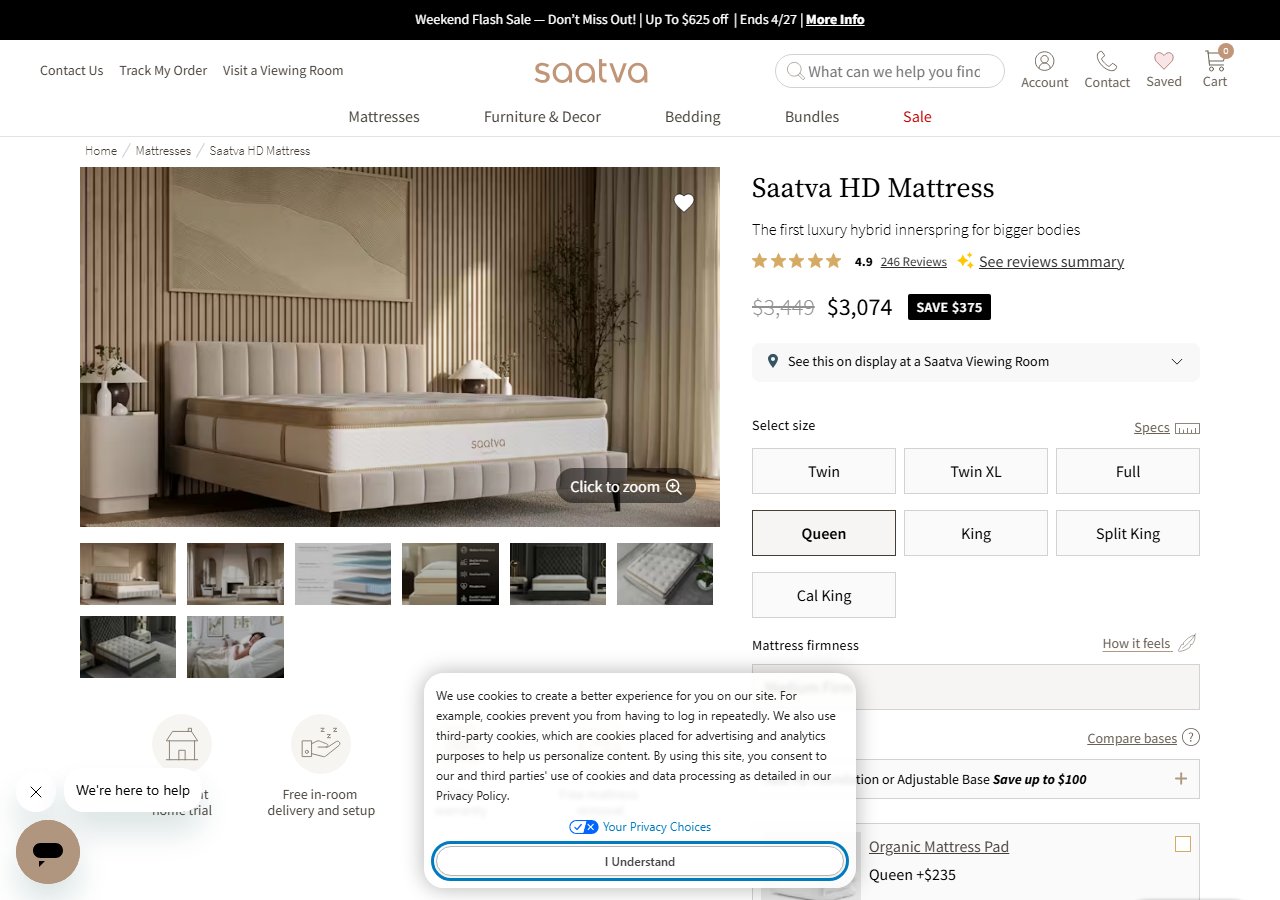
Saatva HD Mattress (Heavy-Duty)
$2,395-$3,995
See Price at Saatva →
Purple Hybrid Premier Mattress
$2,499-$4,799
See Price at Purple →The hierarchy matters: data, then interventions, then products
The federal data on construction musculoskeletal injury is not ambiguous, and neither is its implication for sleep. A body that absorbs compressive and shear spinal loads for 8 to 10 hours per day, inadequately supported during the night's primary tissue repair window, accumulates a musculoskeletal debt that SSA data shows eventually becomes disabling for a significant fraction of the construction workforce. The intervention hierarchy is clear: movement and mechanics correction first, clinical evaluation when red flags are present, sleep surface optimization as a legitimate but downstream tool.
The sleep surface features that the federal data implies matter for construction workers — weight-appropriate structural support, zoned lumbar neutrality, adequate pressure relief for compressive tissue damage — are engineering specifications, not marketing claims. The Saatva HD, the Loom & Leaf, and the Purple Hybrid Premier each address those specifications through different design approaches. The right choice depends on your weight, your primary symptom pattern, and your thermal preferences during sleep.
What none of them can do is substitute for the upstream interventions. Walk 30 minutes on your off days. Hinge at the hips on the job. Sleep on your side with a pillow between your knees. See a clinician if the pain is radiating, following trauma, or accompanied by neurological symptoms. Do those things, and the mattress you sleep on becomes one well-chosen tool among many. Skip them, and even the best-engineered sleep surface is carrying a load it was not designed to bear alone.