The Federal Data Behind Your Morning Stiffness
If you work in construction — framing, roofing, concrete, plumbing, electrical, ironwork — waking up stiff is so common it barely registers as a complaint anymore. It is just Tuesday. But there is federal data behind that numbness, and it tells a more serious story than most workers realize until a disability claim is filed or a surgeon gets involved.
BLS Musculoskeletal Disorders by Occupation tracking identifies the back as the single most commonly injured body part across all U.S. occupations with days away from work. Construction trades are not statistical outliers in that dataset — they are among the driving forces behind it. Separately, SSA Disability Insurance data identifies musculoskeletal disorders as the largest single category of new disability claims filed annually in the United States. These two data points, read together, describe a pipeline: repetitive occupational loading accumulates into chronic injury, chronic injury disables workers at rates that dwarf other condition categories, and the cost lands on workers, employers, and the federal insurance system simultaneously.
AHRQ HCUP data quantifies what that pipeline costs the healthcare system: back pain ranks as one of the most expensive conditions in U.S. healthcare by total inpatient and outpatient expenditure. AHRQ's Medical Expenditure Panel Survey further shows that adults with chronic back conditions carry substantially higher average annual healthcare costs than adults without such conditions. And BLS Employer Costs for Employee Compensation data shows industries with high MSD incidence pay workers' compensation insurance rates 3 to 5 times higher than low-MSD industries — a cost that ultimately flows through wages, benefits, and hiring decisions for the entire construction workforce.
None of this is abstract policy data. For a journeyman ironworker or a concrete finisher in their mid-forties, these statistics describe a career arc that is already in motion.
Why Construction Work Breaks Your Back — The Biomechanical Mechanism
Understanding why construction workers experience disproportionate spinal loading requires looking at what the NIOSH Lifting Equation was specifically designed to measure. The equation calculates a Recommended Weight Limit for any manual lifting task by factoring in horizontal distance from the body, vertical height of the lift, asymmetric trunk rotation, frequency, and coupling quality (how well a worker can grip the load). When actual task weight exceeds the calculated RWL, the task is classified as presenting a risk of musculoskeletal injury.
NIOSH's own documentation confirms that manual material-handling tasks across construction, warehousing, and healthcare routinely exceed safe spinal loading limits. In construction specifically, this is not an edge case. A roofer carrying bundles of shingles up a ladder, a mason lifting 80-pound concrete blocks at waist height for an eight-hour shift, a plumber torquing pipe fittings in a crawl space with a compromised trunk position — each of these tasks generates compressive and shear forces on the lumbar discs that exceed the biomechanical thresholds the NIOSH equation was designed to flag.
The mechanism is cumulative. Intervertebral discs are avascular — they receive nutrients through diffusion, not direct blood supply. That means disc tissue damaged during the workday repairs slowly, and if the rate of damage exceeds the rate of repair over months and years, the disc progressively desiccates and loses height. Facet joints, compensating for disc height loss, develop arthritic changes. Paraspinal muscles, chronically overloaded, develop trigger points that fire during rest as well as activity. This is the biomechanical backstory behind morning stiffness — by the time a construction professional wakes up feeling wrecked, the mechanism has typically been in place for years.
CDC NCHS Data Brief 390 reports that approximately 20% of U.S. adults experience chronic pain, with the lower back as the most common location. Among construction professionals, that prevalence is almost certainly higher, though federal data does not always parse chronic pain rates by occupation at the granularity needed to confirm the exact differential. What is well-established is that CDC arthritis data shows approximately 25% of U.S. adults report doctor-diagnosed arthritis, with prevalence concentrated specifically in occupations involving sustained physical demand — a category construction occupies unambiguously.
And then there is sleep. CDC Sleep and Sleep Disorders data shows approximately 35% of U.S. adults report sleeping fewer than 7 hours per night, the threshold the CDC associates with elevated risk for chronic disease. For construction workers starting shifts at 5:30 or 6:00 a.m., compressed sleep windows are structural rather than behavioral. When sleep is both shortened and degraded in quality by musculoskeletal pain — which interrupts sleep architecture regardless of total duration — the physiological repair window that should be offsetting daily spinal loading is itself compromised. The result is the morning stiffness that feels like the body never fully recovered from yesterday.
The Weight Variable — Why Body Type Matters for Sleep Surfaces
Construction work selects for body types that general mattress engineering does not always account for. Workers in heavy trades frequently carry 200 to 280 pounds of muscle and bone — not excess body weight but functional mass built by years of physical labor. Standard mattress testing protocols, particularly the ASTM F1566 durability standard, use 170-pound test surrogates. A mattress tested at 170 pounds and rated for a 10-year lifespan may compress significantly faster under a 240-pound framer who sleeps on the same side every night.
This matters mechanically. When a mattress compresses unevenly — the hip zone sagging more than the lumbar zone — the spine is no longer supported in a neutral position during sleep. The lumbar spine either sags into flexion (common in side sleepers without adequate support) or hyperextends (common in back sleepers whose mattress has lost its lumbar support). Either deviation sustained over six to eight hours of sleep extends the daily spinal loading window well past the work shift. The mattress is not recovering the worker; it is continuing the insult.
Visible sag is a definitive signal: if your mattress shows body impressions deeper than about one inch, or if you wake more stiff than you went to bed, or if your mattress is older than seven to ten years, the surface itself is contributing to your pain load. The CDC Sleep Hygiene guidance frames this practically: even the most expensive mattress does not undo poor sleep hygiene or sedentary recovery days — but a failed sleep surface actively undermines whatever else you are doing correctly.
Try These First — The Interventions That Cost Nothing
Before discussing any equipment, the data-supported hierarchy is worth stating plainly: the cheapest intervention is the one that does not require buying anything. Federal and NIH evidence reviews consistently show that behavioral and movement-based interventions deliver back pain relief that equals or outperforms most passive interventions, including sleep surface changes. A new mattress is a tool with a real role, but it is not the first tool.
NIH NCCIH's evidence review on low back pain is unambiguous on one point: walking 30 minutes most days reduces chronic low back pain as effectively as most non-drug clinical treatments. For construction workers who are physically active during work hours but sedentary during off hours — sitting in a truck, on a couch, without structured movement — a 30-minute daily walk is a higher-return intervention than most products sold for back pain relief. The mechanism is real: walking promotes disc hydration through cyclic loading and unloading, activates the paraspinal stabilizers at sub-maximal loads, and maintains the hip flexor length that compressed sitting positions destroy.
NIH guidance on back pain sleep position identifies sleep position as the largest free variable most people never optimize. Side-sleeping with a pillow between the knees keeps the pelvis level and reduces hip-drop that torques the lumbar spine. Back-sleeping with a pillow under the knees reduces lumbar hyperextension. Stomach-sleeping — the default position for a significant portion of the population — rotates the lumbar spine and sustains cervical rotation for hours at a time. If you are a stomach sleeper with chronic back pain, changing that one behavior is more impactful than changing your mattress brand.
OSHA's ergonomics guidance on lifting mechanics is standard content for construction site safety training, but the research on skill transfer is sobering: most workers know the correct technique and revert to the fastest technique under time pressure. Hinging at the hips rather than the lumbar spine, keeping loads close to the body, avoiding trunk rotation under load — these mechanics reduce acute injury risk in ways that no mattress can replicate. Most acute back episodes are mechanical events with rehearsable causes.
For the subset of construction workers who have already made these behavioral changes, who are sleeping on a structurally intact mattress in a neutral position, and who are still waking with significant stiffness and pain — the evidence supports looking at sleep surface construction more carefully. This is also the population for whom the weight-capacity and pressure-relief engineering of specific mattress models becomes clinically relevant rather than marketing language.
When to See a Clinician First
Before any mattress purchase decision, certain symptoms require clinical evaluation rather than equipment changes. NIH National Institute of Neurological Disorders and Stroke guidance on back pain establishes clear referral criteria that construction workers in particular should internalize, given the elevated trauma and cumulative load exposure in the trade.
Do not buy a new mattress for these symptoms. Get imaging and a clinical referral:
- Pain that radiates below the knee, particularly with associated numbness or tingling in the foot or toes — this is a red flag for nerve root compression (radiculopathy) or, in more serious presentations, cauda equina involvement. A mattress change does not decompress a disc.
- Pain that followed a specific trauma — a fall, a drop load, a vehicle accident. Structural damage needs to be ruled out before attributing symptoms to a sleep surface.
- Leg weakness accompanying back pain — motor involvement suggests nerve compression significant enough to warrant urgent evaluation.
- Bowel or bladder changes concurrent with back pain — this is a medical emergency presentation (cauda equina syndrome) and requires emergency evaluation, not a product decision.
- Back pain with fever — infectious etiologies (discitis, spinal epidural abscess) are rare but require immediate clinical attention.
For construction workers who have experienced cumulative trauma over a multi-decade career, the baseline imaging question — do I have disc disease that is being worsened by my current sleep surface — is legitimately worth a clinical conversation. An occupational medicine physician or a physiatrist (physical medicine and rehabilitation specialist) can bridge the gap between worksite injury patterns and sleep surface recommendations in a way that mattress marketing cannot.
CMS Drug Spending Dashboard data identifies opioid and non-opioid pain medication spending among the most expensive Medicare drug categories — a downstream indicator of how many older construction workers are managing chronic back pain pharmacologically when earlier structural interventions might have reduced that burden. The clinical conversation is worth having before the prescription becomes the only remaining tool.
Where a Better Sleep Surface Actually Helps
For construction workers who have cleared the clinical red flags, optimized sleep position, maintained a walking habit, and are still sleeping on a mattress that is failing — or who are sleeping on a mattress that was never engineered for their weight class — sleep surface construction becomes a legitimate variable to optimize.
The features that matter for high-load body types in heavy trades are specific: weight capacity ratings above 500 pounds (to account for partner weight and dynamic loading), individually wrapped coil systems (which distribute weight laterally without compressing adjacent coils and creating the hammock effect), lumbar zone differentiation (firmer support in the lumbar third of the mattress relative to the shoulder zone, which needs to compress more to maintain spinal alignment in side sleepers), and pressure-relief layers thick enough to cushion the hip prominences of heavier bodies without bottoming out.
The Saatva HD Mattress was engineered specifically for what Saatva calls "big and tall" body types — the weight-capacity and coil-system engineering in this mattress addresses the construction worker's body-type problem directly. The HD uses a dual-coil system (micro coils on top of a heavier-gauge base coil unit) rated to handle heavier users without the progressive compression that accelerates in standard mattresses. For a 240-pound ironworker or a 260-pound carpenter who has burned through multiple mattresses in five years, this is the engineering difference that makes the HD a functionally different product rather than a marketing category.
For workers whose primary complaint is pressure buildup at the hips and shoulders after a full shift — the aching that starts around 3 a.m. and makes staying asleep impossible — the Saatva Loom & Leaf Memory Foam Mattress offers a different approach. The Loom & Leaf uses a gel-infused memory foam construction that contours more deeply to body curves than hybrid mattresses, reducing the point pressure that wakes side sleepers. For construction workers who are not at the extreme end of the weight range but who have developed hip and shoulder pain from years of physical work, deep-contour foam can reduce the peak pressure that standard innerspring mattresses generate at bony prominences.
The Purple Hybrid Premier Mattress takes a different engineering approach — its GelFlex Grid replaces traditional foam comfort layers with a polymer grid that collapses under pressure points while remaining firm under broader distributed weight. The practical effect is pressure relief without the body-conforming sink of memory foam, which some workers prefer because it makes repositioning during the night easier. Purple's grid also runs cooler than traditional memory foam, which matters for workers whose core body temperature stays elevated after physical labor. The Hybrid Premier pairs this grid with a pocketed coil support core, giving it the edge-support and weight distribution of a hybrid alongside the pressure-relief characteristics of the grid.
Mattresses Engineered for High-Load Construction Body Types
These three mattresses were selected for weight-capacity ratings, pressure-relief engineering, and lumbar zoning features that address the specific sleep surface failure modes construction workers experience — not for general consumer ratings.

Saatva Loom & Leaf Memory Foam Mattress
$1,695-$3,295
See Price at Saatva →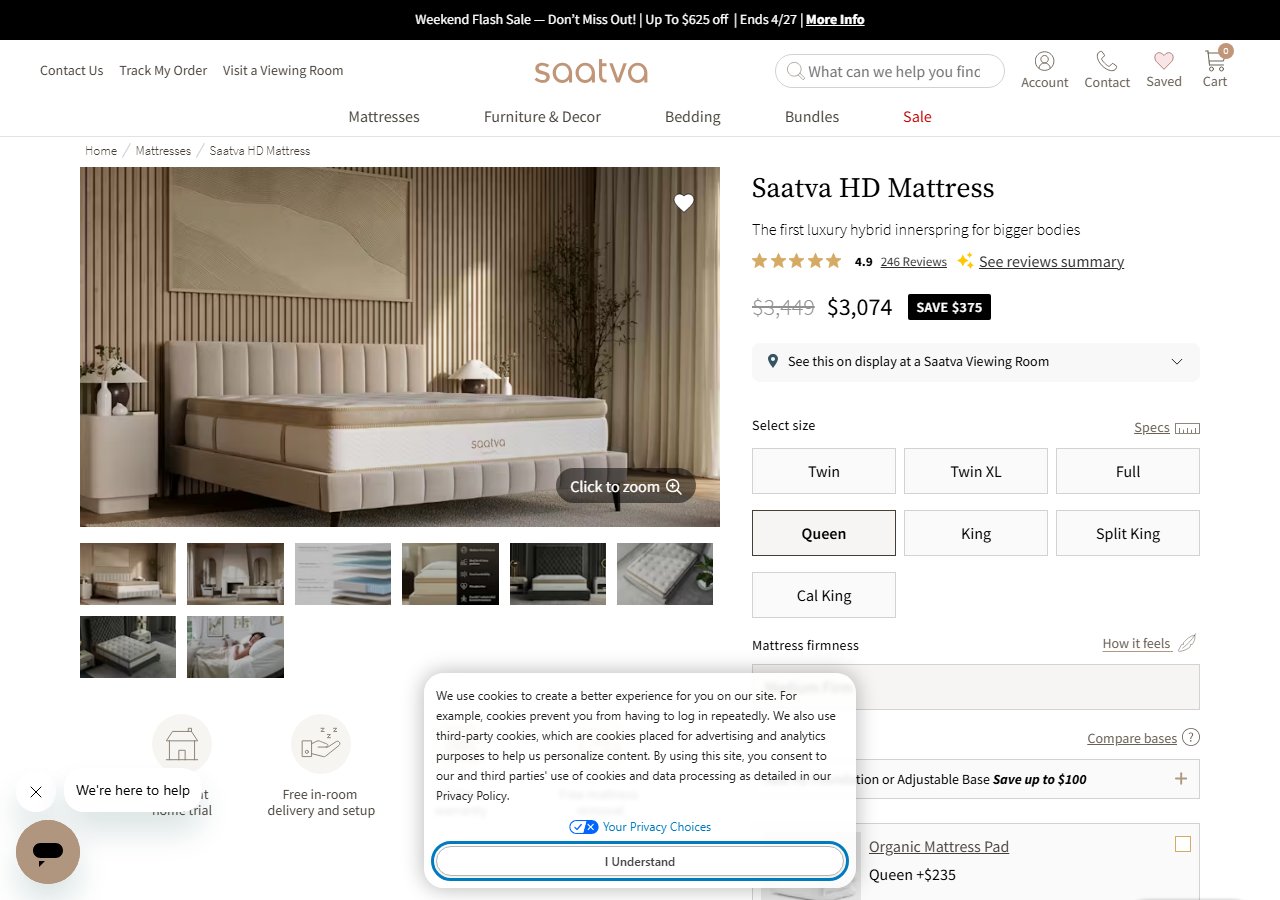
Saatva HD Mattress (Heavy-Duty)
$2,395-$3,995
See Price at Saatva →
Purple Hybrid Premier Mattress
$2,499-$4,799
See Price at Purple →What the Data Actually Tells You to Do
The federal data on construction-related musculoskeletal disorders is not ambiguous about the scale of the problem. BLS tracking places the back at the top of the injury frequency distribution across all U.S. occupations. NIOSH's Lifting Equation documents that the tasks producing that injury pattern regularly exceed safe spinal loading thresholds. SSA disability data shows where the trajectory ends when the loading is not addressed. And CDC chronic pain data shows that 20% of U.S. adults — a number that construction occupation data suggests is a floor, not a ceiling, for heavy-trade workers — are already living with the outcome.
The intervention hierarchy this data supports is consistent: movement first (walking, hip mobility, structured activity on non-work days), mechanics second (lift pattern, trunk position, load management), sleep position third, clinical evaluation when red flags are present, and sleep surface optimization as a meaningful but downstream variable for workers who have addressed the higher-leverage items.
A mattress engineered for a construction worker's body type — weight-rated, lumbar-zoned, pressure-relief calibrated — is a real tool in that hierarchy. It is not the first tool, and it does not substitute for any tool that comes before it. But for a worker sleeping eight hours a night on a surface that is actively extending the spinal loading window past the work shift, the engineering difference between a standard consumer mattress and a mattress built for high-load body types is measurable in morning stiffness, sleep continuity, and — at the timescales the SSA disability data is tracking — career longevity.