The Federal Numbers Behind a Construction Worker's Back Pain
If you spend your days framing walls, pouring concrete, running conduit overhead, or swinging a demo hammer, the following statistic will not surprise you — but it should sharpen your attention: according to BLS Musculoskeletal Disorders by Occupation tracking, the back is the single most commonly injured body part across all U.S. occupations that result in days away from work. Construction does not merely appear in that dataset — it drives it. And when the workday ends, the tissue damage accumulated over eight to twelve hours of physical load does not evaporate. It follows you to your mattress.
The financial stakes are not abstract. AHRQ's HCUP database ranks back pain among the most expensive conditions in U.S. healthcare by combined inpatient and outpatient cost. The SSA's Disability Insurance annual reports identify musculoskeletal disorders — the category that includes chronic low back conditions — as the single largest source of new disability claims every year. And BLS Employer Costs for Employee Compensation data documents that industries with high MSD incidence carry workers' compensation insurance rates three to five times higher than low-MSD industries. These are not numbers from an academic journal. They are the financial architecture of a career in the trades.
For construction professionals specifically, the pathway from job-site load to chronic back condition is well-documented at the federal level. The NIOSH Lifting Equation — the federal government's primary tool for evaluating manual material-handling risk — consistently finds that tasks across construction, warehousing, and heavy industry routinely exceed safe spinal compression limits. A framer carrying bundled lumber up a staircase, a concrete laborer lifting bags at the mixer, a roofer humping shingles up a ladder: each of these tasks generates spinal loading that exceeds NIOSH's recommended limits when performed repetitively over a full shift. Multiply that by a 30-year career, and you understand why approximately 20% of U.S. adults report chronic pain with lower back as the most common location, per CDC NCHS Data Brief 390, and why that prevalence skews toward physically demanding occupations.
Why Construction Bodies Break Down Differently
The biomechanics of construction work create a specific injury signature that distinguishes trades workers from office workers or even from other manual labor categories. Three mechanisms dominate.
Compressive axial loading is the most straightforward. Carrying materials, operating jack hammers, and working with heavy hand tools compress the intervertebral discs of the lumbar spine repeatedly throughout the day. Unlike acute trauma, this compression is cumulative: fluid is slowly forced from the disc nucleus pulposus, reducing disc height over the course of a shift. This is why construction workers often report being shorter by late afternoon — it is a measurable, documented effect. When a compressed, dehydrated disc meets a sagging mattress that allows the lumbar spine to fall into flexion for eight hours, the disc's overnight rehydration cycle is impaired.
Whole-body vibration (WBV) exposure is a second, underappreciated mechanism. Equipment operators — excavator drivers, compactor operators, skid-steer operators — absorb vibration frequencies that research has linked to accelerated disc degeneration and nerve root irritation. OSHA's ergonomics resources acknowledge WBV as a recognized occupational back-pain driver. A worker whose discs are already irritated by vibration exposure arrives home with a nervous system that is sensitized to pressure stimuli, which makes mattress firmness and pressure distribution more clinically meaningful, not less.
Sustained awkward postures round out the triad. Electricians working in crawl spaces, plumbers under sinks, tile setters kneeling on concrete — these workers maintain lumbar flexion or extension under load for extended periods, fatiguing the paraspinal musculature and placing sustained stress on posterior spinal ligaments. Muscle fatigue of this type is associated with delayed-onset soreness that peaks 24 to 48 hours after the provocative activity, which is exactly the window when sleep quality is most critical for recovery.
Layer on the CDC's finding that approximately 35% of U.S. adults sleep fewer than 7 hours per night — a threshold associated with elevated chronic disease risk — and you have a population of workers absorbing significant physical load, recovering inadequately on sleep surfaces that may not be engineered for their body weight or injury pattern. The problem compounds.
It is also worth noting that approximately 25% of U.S. adults report doctor-diagnosed arthritis, with prevalence concentrated in occupations involving sustained physical demand. Construction workers are not just at elevated risk for acute disc injury and muscle strain; they are at elevated risk for the inflammatory joint conditions that develop over decades of cumulative joint loading. Arthritis in the facet joints of the lumbar spine is particularly common in this population and creates a distinct pressure-sensitivity pattern at the sleep surface level.
Finally, AHRQ's Medical Expenditure Panel Survey (MEPS) data documents that adults with chronic back conditions incur substantially higher annual healthcare costs than those without — costs that compound over a working lifetime. The choice of sleep surface, viewed through this lens, is not a consumer preference question. It is a long-term cost management question.
Free Interventions That Should Come Before Any Purchase
The cheapest intervention is the one that does not require buying anything. Before evaluating a single mattress, every construction professional with back pain should work through the following evidence-based behavioral and ergonomic changes. Federal health agencies — NIOSH, OSHA, the NIH, the CDC — have documented the efficacy of these approaches, and several of them will outperform a mattress upgrade in isolation.
The single most powerful free intervention is daily walking. NIH's National Center for Complementary and Integrative Health evidence review on low back pain finds that walking 30 minutes on most days reduces chronic low back pain as effectively as most non-drug clinical treatments. For construction workers who are physically active on the job but whose movement is load-bearing and repetitive rather than rhythmic and decompressive, a daily walk is a genuinely different physiological stimulus. It promotes disc nutrition through cyclic loading and unloading, reduces paraspinal muscle guarding, and improves sleep quality independently of pain reduction.
Lifting and bending mechanics deserve serious attention even for workers who consider themselves experienced. OSHA's ergonomics guidance specifies hinging at the hips rather than flexing the lumbar spine, keeping loads close to the body's center of mass, and eliminating rotational torque under load. Most acute back episodes in construction are mechanical — meaning they are precipitated by a specific movement pattern — and movement patterns are trainable. A worker who spends 30 days consciously rehearsing proper hip-hinge mechanics under load is running a more effective intervention than most passive treatments.
Sleep position is the largest free variable in the overnight recovery equation. NIH's National Institute of Arthritis and Musculoskeletal and Skin Diseases guidance on back pain identifies side-sleeping with a pillow between the knees, or back-sleeping with a pillow under the knees, as the positions that best maintain lumbar spinal neutrality during sleep. Stomach sleeping — common among workers who find it comfortable — creates sustained lumbar hyperextension that is mechanically provocative for facet joints and posterior disc annulus. No mattress fully compensates for a biomechanically poor sleep position.
Finally, mattress replacement timing matters more than mattress brand. CDC sleep hygiene guidelines support replacing a mattress if it shows visible sag, if you consistently wake stiffer than you went to bed, or if it is older than 7 to 10 years. Even the most expensive mattress on the market does not undo poor sleep hygiene or sedentary recovery days. The mattress is one variable in a system; it is not the system.
For workers who have worked through those behavioral interventions and still wake with significant stiffness or pain, or whose current mattress clearly fails the replacement criteria above, the case for a purpose-built sleep surface becomes stronger. The key word is purpose-built: mattresses designed for average adult weight ranges and loading patterns do not perform the same way under the body composition typical of construction professionals, who frequently carry 200 to 280 pounds of muscle mass and work in conditions that generate chronic joint inflammation.
When to See a Clinician First
A mattress is not a medical device, and certain back pain presentations require clinical evaluation before any product purchase. NIH's National Institute of Neurological Disorders and Stroke back pain guidance identifies several red flags that warrant prompt medical attention and should not be addressed by sleep surface changes alone.
If your back pain radiates below the knee — particularly if accompanied by numbness, tingling, or the sensation of electric shock — you may be experiencing nerve root compression from a herniated disc or stenotic lesion. If your pain followed a specific traumatic event (a fall from height, a heavy equipment accident, or a significant impact), imaging is indicated before making any assumptions about the musculoskeletal source. Pain accompanied by fever, unexplained weight loss, or bowel and bladder changes represents a different diagnostic category entirely and requires immediate evaluation. Leg weakness that is new, progressive, or asymmetric is a neurological red flag that overrides any sleep optimization strategy.
For construction workers, the occupational exposure to whole-body vibration over many years also creates elevated risk for certain spinal conditions — including spondylolisthesis and stress fractures of the pars interarticularis — that present with back pain but require imaging for accurate diagnosis. If your pain has a characteristic pattern of being worse with extension (leaning backward) and relieved with flexion (leaning forward), clinical evaluation is warranted before assuming the cause is soft-tissue or disc-related.
Where a Purpose-Built Mattress Adds Measurable Value
With interventions in place and red flags ruled out, the construction professional faces a mattress market that was largely designed for people who weigh less and load their joints less aggressively than the average trades worker. Standard mattresses — even many marketed as "firm" or "orthopedic" — are engineered for average adult weight ranges, typically 130 to 200 pounds. A 240-pound framer with significant muscle mass and chronic lumbar inflammation will bottom out the comfort layers of most standard mattresses within months, creating a progressive hammock effect that places the lumbar spine in sustained flexion overnight.
The solution is not simply a firmer mattress. Firmness without appropriate pressure relief creates a different problem: point loading at the shoulder, hip, and sacrum that restricts blood flow, creates pressure-point pain, and causes frequent positional shifting that fragments sleep architecture. The engineering target for a high-load body type is a mattress that provides sufficient foundational support to maintain spinal neutrality while distributing pressure across a large contact surface area. Those are not contradictory requirements, but achieving both simultaneously requires specific construction approaches.
For construction professionals dealing with serious, documented back pain, the Saatva Loom & Leaf Memory Foam Mattress represents the premium memory foam approach to this engineering challenge. Saatva constructs the Loom & Leaf with a dense, high-resiliency foam core that resists the progressive compression typical of standard memory foam under sustained heavy use. The slow-moving memory foam comfort layer provides genuine pressure relief at the shoulder and hip contact points — critical for side-sleeping construction workers with joint inflammation — while the firm core prevents the hammocking that undermines lumbar alignment. At $1,695 to $3,295 depending on size, it sits in the premium tier, but for a worker whose back pain is generating the healthcare costs documented in AHRQ MEPS data, the cost calculus is different than for a consumer without that chronic condition burden.
For construction professionals at the heavier end of the weight spectrum — particularly those above 230 pounds, which describes a substantial fraction of framing, masonry, and ironwork crews — the Saatva HD Mattress is the purpose-built answer. Saatva engineered the HD specifically for what the company terms "big and tall" users, with a reinforced coil system rated for higher weight loads, a dual-tempered steel coil structure that resists edge compression (relevant for workers who sit on the side of the bed to put on boots or gear), and a foam comfort layer calibrated for pressure relief without sacrificing the foundational firmness that prevents spinal malalignment under higher loads. At $2,395 to $3,995, it carries the price premium you would expect from purpose-built heavy-load engineering. For workers whose body mass sits above what standard mattresses are designed to support, this is not a luxury upgrade — it is the baseline engineering specification.
For workers whose primary complaint is pressure-point pain — particularly those with diagnosed facet joint arthritis, hip bursitis from repeated kneeling, or shoulder joint inflammation from overhead work — the Purple Hybrid Premier Mattress offers a mechanically distinct solution. Purple's proprietary GelFlex Grid replaces traditional foam comfort layers with a polymer grid structure that collapses under high-pressure contact points (shoulders, hips, sacrum) while remaining firm under lower-pressure regions (lumbar spine, mid-back). The result is genuine pressure relief without the full-body sinking effect of memory foam, combined with a responsive pocketed coil base that maintains spinal alignment. At $2,499 to $4,799, it is the most expensive option in this comparison and the most specialized — best suited to workers whose sleep disruption is primarily driven by contact-pressure pain rather than global spinal malalignment.
Heavy-Duty Mattresses Built for Construction-Worker Recovery
These three mattresses were selected specifically for construction professionals dealing with MSD-related back pain, high body weight loads, and the pressure-point demands of joint-inflamed sleep — not for general consumer appeal.

Saatva Loom & Leaf Memory Foam Mattress
$1,695-$3,295
See Price at Saatva →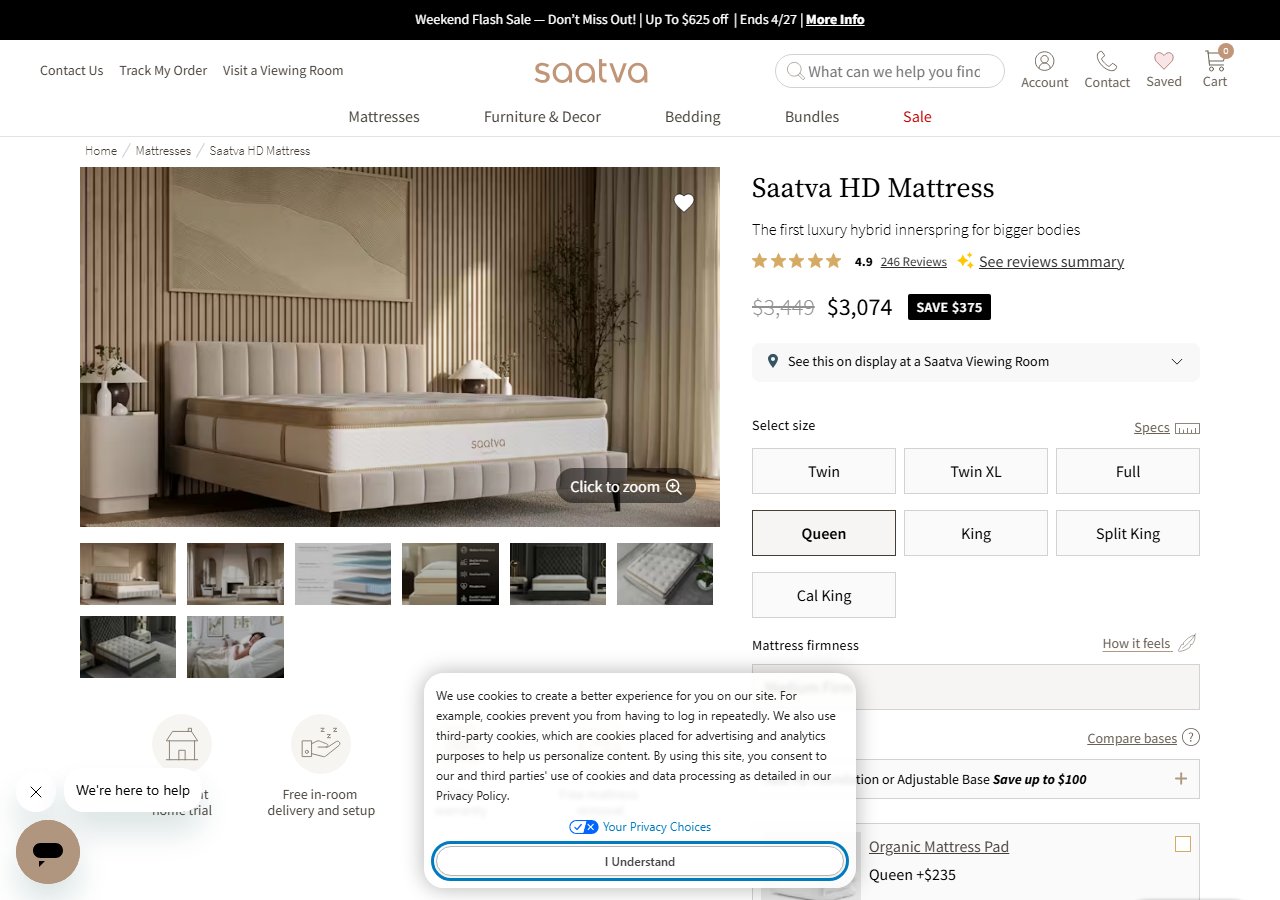
Saatva HD Mattress (Heavy-Duty)
$2,395-$3,995
See Price at Saatva →
Purple Hybrid Premier Mattress
$2,499-$4,799
See Price at Purple →Matching Engineering to Injury Pattern: A Practical Framework
The three products above cover three distinct construction-worker injury profiles, and the choice between them should follow the injury pattern, not the price point.
If your dominant complaint is general back stiffness and lumbar pain that worsens with overnight flexion — common in disc-related conditions — and your weight falls in the 160 to 230 pound range, the Loom & Leaf's memory foam construction targets your injury signature. The pressure relief is meaningful; the core density is sufficient to prevent hammocking.
If you are above 230 pounds, work in a physically demanding trade that generates whole-body fatigue, and your mattress is visibly sagging or showing wear, the Saatva HD is the appropriate engineering specification. Standard mattresses were not built for your load profile. The HD was.
If your pain is localized to specific pressure points — hip, shoulder, sacrum — and you find that firmer mattresses create point-loading discomfort while softer mattresses create alignment problems, the Purple Hybrid Premier's grid architecture offers a genuinely different physical mechanism. It is the right tool for a specific pressure-relief problem.
In all three cases, the mattress is an adjunct to the behavioral and ergonomic interventions documented above — not a replacement for them. OSHA's ergonomics program and NIH's low-back pain evidence review are both clear that passive interventions, including optimized sleep surfaces, produce the best outcomes when combined with active movement strategies and corrected biomechanics. A construction worker who walks daily, lifts with proper hip-hinge mechanics, sleeps in a neutral spinal position, and sleeps on a surface engineered for their body weight and injury pattern has addressed the full recovery equation. A worker who buys the most expensive mattress on this list without addressing posture, mechanics, and movement has optimized one variable while leaving the larger ones untouched.
Summary: The Federal Evidence Hierarchy for Construction-Worker Back Health
The federal data tells a consistent story. BLS documents that back injuries dominate the occupational injury landscape. NIOSH documents that the lifting demands of construction routinely exceed safe spinal load limits. AHRQ documents that the resulting back conditions generate enormous healthcare costs. SSA documents that MSDs are the leading driver of permanent disability. And CDC documents that most American workers are already sleep-deprived, compounding every recovery deficit.
The intervention hierarchy that emerges from that data is: movement first, mechanics second, sleep position third, mattress engineering fourth, clinical evaluation when red flags appear. Within the mattress engineering category, construction professionals need surfaces engineered for higher load profiles, greater pressure-distribution demands, and longer expected use cycles under heavier occupational loading than standard mattresses are designed to deliver.
The products in this analysis were selected specifically because their construction approaches — dense foam cores, reinforced coil systems, and polymer pressure-relief grids — address the biomechanical reality of construction-worker bodies rather than the median consumer. That is the appropriate standard for this population, and it is the standard against which every sleep surface purchase in this category should be evaluated.