The back injury epidemic hiding in plain sight on hospital floors
Among all U.S. workers who take days away from work due to on-the-job injury, the single most commonly injured body part is the back — not the hand, not the knee, not the shoulder — the back. That finding comes directly from BLS Musculoskeletal Disorders by Occupation tracking, and it implicates every industry. But if you want to find the workers who are living this statistic in the most concentrated form, look at the nursing stations, the ICU floors, and the emergency departments of American hospitals.
Healthcare shift workers — registered nurses, nursing assistants, patient care technicians, surgical techs, and emergency responders — spend 8 to 12 consecutive hours performing tasks that biomechanically stress the lumbar spine in ways that would concern a structural engineer. They reposition immobile patients. They assist transfers from bed to chair. They reach across gurney rails under awkward angles. They do all of this while wearing compression socks and rubber-soled shoes on hard vinyl floors, often without enough staff to allow safe two-person lifts. Then they go home and try to sleep.
The federal data paints the full picture. CDC NCHS Data Brief 390 estimates that approximately 20% of U.S. adults experience chronic pain, with the lower back as the most common pain location. CDC Arthritis Data shows that approximately 25% of U.S. adults report doctor-diagnosed arthritis, with prevalence concentrated specifically in occupations involving sustained physical demand — a description that fits every role in a clinical care setting. And the financial toll is severe: AHRQ MEPS data shows that adults with chronic back conditions carry substantially higher annual personal healthcare expenditures than those without, and AHRQ HCUP data identifies back pain as one of the most expensive conditions in U.S. healthcare measured by total inpatient and outpatient cost.
At the most serious end of the spectrum, SSA Disability Insurance Reports identify musculoskeletal disorders as the largest single category of new disability claims filed annually in the United States. These are not abstract statistics for healthcare workers — they are career trajectories.
Why healthcare work breaks the lumbar spine: the biomechanical mechanism
Understanding why off-duty sleep quality matters so much requires understanding what healthcare shift work actually does to the body during those 12 hours on the clock.
The NIOSH Lifting Equation is the federal government's primary tool for evaluating whether a manual handling task is within safe spinal loading limits. NIOSH researchers have documented repeatedly that patient-handling tasks — repositioning a patient in bed, assisting a pivot transfer, lifting from a low surface — routinely exceed the Recommended Weight Limit the equation establishes. This is not because healthcare workers are performing the tasks incorrectly. It is because the tasks themselves, by their geometry and weight demands, exceed what the lumbar spine can safely tolerate at high repetition.
The specific mechanism is compressive and shear loading of the intervertebral discs. When a nurse leans forward over a bed rail with arms extended, the lever arm created by the distance between the load and the spine multiplies the effective force on the L4-L5 and L5-S1 disc levels by a factor of 5 to 10. Over the course of a 12-hour shift, with dozens of patient-handling events, the cumulative disc compression is substantial. The discs respond by losing hydration — they literally compress and thin over the course of a workday — and the surrounding musculature responds with protective spasm.
That protective spasm is the stiffness healthcare workers describe when they say their back is "locked up" at the end of a shift. The muscles are guarding against further loading. The problem is that this guarding response persists into off-duty hours, and it profoundly affects sleep quality. A body in low-grade muscular guarding cannot fully relax into a mattress. Every position shift becomes a negotiation between comfort and pain. Sleep architecture — particularly the deep slow-wave stages where physical tissue repair is most active — is disrupted.
Now layer in the shift-work schedule. CDC Sleep and Sleep Disorders Data shows that approximately 35% of U.S. adults already sleep fewer than 7 hours per night, the threshold associated with elevated chronic disease risk. Night-shift nurses and rotating-shift workers are overrepresented in that 35%. When sleep is shortened or fragmented, the body has less time in the restorative stages that would otherwise allow disc rehydration, muscle repair, and inflammatory clearance. The next shift begins with a body that has not fully recovered from the last one.
This is the compounding loop that federal data describes but rarely names directly: occupational spinal loading → pain-disrupted sleep → incomplete recovery → elevated vulnerability to the next shift's loading → worsening chronic MSD. Breaking that loop requires addressing both the occupational exposure and the sleep-surface environment simultaneously.
The cheapest interventions are the ones that don't require buying anything
Before discussing sleep surfaces, it is worth being direct about what the evidence actually supports. The federal agencies tasked with occupational health and chronic pain management — OSHA, NIOSH, NIH, and CDC — consistently prioritize behavioral and movement-based interventions over equipment purchases. This is not a caveat. It is the actual hierarchy of evidence.
NIH NCCIH's evidence review on low-back pain concludes that walking 30 minutes most days reduces chronic low back pain as effectively as most non-drug clinical treatments. That finding should be read carefully: a free, accessible behavior outperforms the majority of passive interventions. For healthcare workers who spend their entire shift on their feet, this may seem counterintuitive — but the distinction is between reactive standing and loading versus purposeful, rhythmic walking that activates the paraspinal stabilizers and promotes disc rehydration through cyclical compression-and-release.
OSHA's Ergonomics Solutions guidance provides specific lifting mechanics that reduce acute injury risk: hinge at the hips rather than rounding the lumbar spine, keep loads close to the body's midline, never twist under load. Most acute back episodes in healthcare are mechanical and, to a meaningful degree, rehearsable. Workers who drill these mechanics until they are automatic — including during the rushed, high-volume moments of a shift — sustain fewer acute injuries than those who rely on instinct.
NIH guidance on back pain from the National Institute of Arthritis and Musculoskeletal and Skin Diseases is specific about sleep position: side-sleeping with a pillow between the knees keeps the pelvis neutral and reduces lumbar torque; back-sleeping with a pillow under the knees flattens the lumbar curve and reduces disc pressure. Stomach-sleeping forces the lumbar spine into extension and rotates the cervical spine — both of which worsen the very symptoms that shift workers are trying to recover from. This costs nothing to change.
Finally, CDC Sleep Hygiene guidance offers a useful test for whether the mattress itself is the problem: visible sag, waking more stiffly than you went to bed, or a mattress older than 7 to 10 years are the relevant criteria. Even the most precisely engineered sleep surface does not undo poor sleep hygiene — inconsistent sleep timing, blue-light exposure before bed, caffeine after 2 p.m. — or offset the effects of a sedentary recovery day.
For healthcare workers who have already addressed sleep position, corrected their lifting mechanics, and are still waking in pain on a mattress that is visibly sagging or more than a decade old, a sleep-surface upgrade becomes a legitimate clinical adjunct. The word "adjunct" is deliberate: the mattress is one variable in a multi-variable recovery system, not the solution to occupational MSD.
When to see a clinician before you buy anything
A new mattress is not the appropriate response to certain categories of back pain. Federal clinical guidance is unambiguous on this, and healthcare workers — who are professionally trained to apply clinical criteria to others — sometimes fail to apply the same rigor to themselves.
NIH National Institute of Neurological Disorders and Stroke guidance on back pain identifies the following as red flags requiring prompt clinical evaluation rather than self-management: back pain that radiates below the knee (suggesting nerve root compression or disc herniation beyond the scope of ergonomic intervention), pain following direct trauma, pain accompanied by leg weakness or sensory changes, bowel or bladder dysfunction, or back pain with systemic signs like fever or unexplained weight loss. These presentations need imaging and clinical assessment — not a different foam density.
The financial context for appropriate care-seeking also matters. AHRQ MEPS data shows that chronic back conditions drive substantially higher lifetime healthcare expenditure. Early clinical intervention — particularly physical therapy, which has a strong evidence base for mechanical low back pain — is far less expensive than the downstream costs of untreated disc disease or delayed MSD management. CMS Drug Spending Dashboard data identifies opioid and non-opioid pain medication spending among the most expensive Medicare drug categories, which reflects what happens when structural back problems are managed pharmacologically rather than mechanically. The message from federal data is consistent: treat the mechanism early, not the symptom chronically.
Healthcare workers who clear the red-flag checklist — whose back pain is chronic, positional, clearly tied to shift-work loading, improved somewhat with rest, and not associated with neurological signs — are appropriate candidates for evaluating their sleep surface as part of a comprehensive recovery strategy.
What sleep-surface engineering actually addresses for healthcare MSD
Once the behavioral interventions are in place and red flags are ruled out, the specific features of a sleep surface that matter for healthcare workers' recovery profiles become addressable. The relevant engineering variables are pressure distribution, zoned support, and temperature management — not simply firmness level, which is the dimension most consumers over-index on.
Pressure distribution matters because a body in muscular guarding — the end-of-shift state described earlier — has already elevated muscle tension in the paraspinals and glutes. A surface that creates focal pressure points at the shoulder, hip, or sacrum will trigger additional muscle activation to protect those areas, interrupting the relaxation necessary for deep sleep. High-conformance foam layers address this by distributing load over a larger surface area, reducing peak pressure at bony prominences.
Zoned support matters because the lumbar spine needs both conformance and support simultaneously — a paradox that uniform-density foam cannot resolve. A mattress with a firmer core under the lumbar region and softer material at the shoulder and hip can keep the spine neutral without the stiffer surface creating pressure points at adjacent areas.
Temperature management matters specifically for healthcare workers because fatigue-induced core temperature dysregulation is well-documented in shift workers. Dense foam that traps heat shortens time in slow-wave sleep — exactly the stage where tissue repair occurs. Gel infusions, open-cell foam structures, and phase-change material covers each address this through different mechanisms.
With those criteria established, three sleep surfaces are worth evaluating for healthcare workers with chronic MSD:
The Saatva Loom & Leaf Memory Foam Mattress is the premium memory foam pick for serious chronic back pain in this population. Loom & Leaf uses a multi-layer construction with organic cotton quilting, a gel-infused memory foam comfort layer, and a high-density foam support core with a lumbar zone enhancement — a denser section precisely placed to provide additional support under the lumbar region. For a nurse or surgical tech who side-sleeps and needs a surface that conforms to the shoulder and hip while maintaining lumbar alignment, this construction addresses the specific biomechanical problem. Saatva also provides white-glove in-home delivery and setup, which is meaningful for workers who should not be maneuvering a heavy mattress alone after a 12-hour shift.
For heavier healthcare workers — or those whose body mass has increased as a result of the metabolic changes associated with chronic pain and disrupted sleep — the Saatva HD Mattress is engineered specifically for higher body weights. Standard mattresses, including premium ones, are designed around a load distribution assumption that underestimates the compressive forces generated by heavier individuals. The Saatva HD uses a denser coil system, a heavier-gauge spring layer, and reinforced edge support that maintains consistent spinal alignment across the full sleep surface rather than concentrating the sleeper toward the center. BLS Employer Costs for Employee Compensation data shows that industries with high MSD incidence carry workers' compensation rates 3 to 5 times higher than low-MSD industries — the cost signal that makes an appropriate sleep surface a genuine occupational health investment for high-physical-demand workers.
For healthcare workers whose primary complaint is pressure-point pain — hip pain that wakes them at night, shoulder pain from side-sleeping, sacral discomfort — the Purple Hybrid Premier Mattress takes a fundamentally different engineering approach. Purple's proprietary GelFlex Grid creates a two-dimensional pressure-distribution mechanism that neither foam nor traditional innerspring achieves: the grid collapses under pressure points (shoulder, hip, knee) while remaining supportive under lower-pressure areas (lumbar, legs). For a body that has been in sustained pressure and loading through a shift, the transition to a surface that genuinely unloads those pressure points can meaningfully change sleep architecture. The Hybrid Premier pairs this grid with pocketed coils for responsiveness and edge support.
Sleep Surfaces Engineered for Healthcare Shift-Worker MSD Recovery
These three mattresses were selected specifically for healthcare workers dealing with chronic lumbar loading, pressure-point pain, and the sleep-disruption patterns associated with 12-hour clinical shifts.

Saatva Loom & Leaf Memory Foam Mattress
$1,695-$3,295
See Price at Saatva →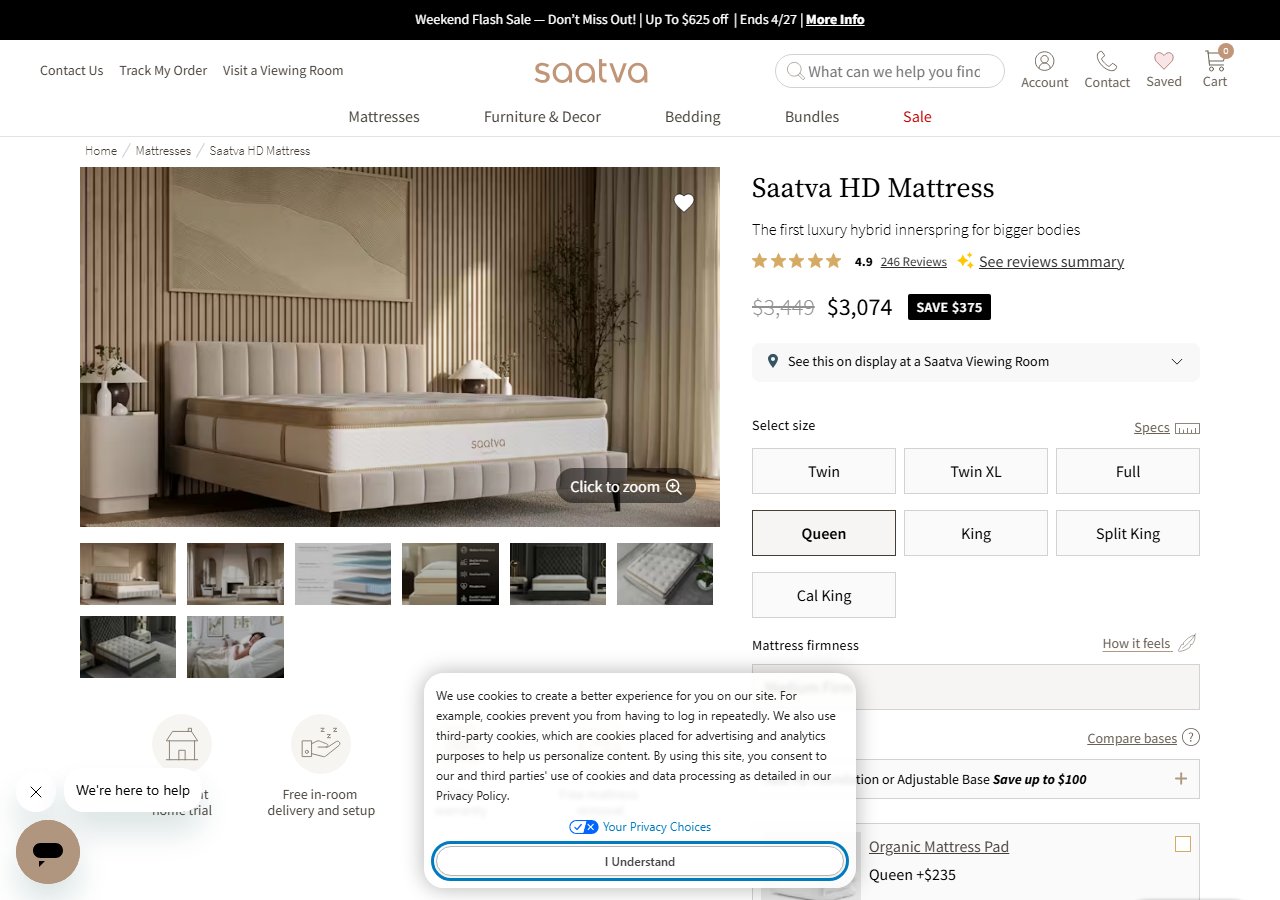
Saatva HD Mattress (Heavy-Duty)
$2,395-$3,995
See Price at Saatva →
Purple Hybrid Premier Mattress
$2,499-$4,799
See Price at Purple →Synthesizing the data: what healthcare workers should actually do
The federal data reviewed here supports a specific sequence of action, not a product purchase. Start with the free variables: correct sleep position (side or back, never stomach), establish consistent sleep timing even across rotating shifts where possible, and address lifting mechanics during shifts. If chronic pain persists, seek clinical evaluation to rule out structural pathology that needs imaging or physical therapy before a mattress change.
If the mattress is visibly sagging, more than 7 to 10 years old, or consistently producing a worse sleep experience than hotel beds or other surfaces, it is a legitimate variable to change. When choosing a replacement, match the engineering features to the specific symptom profile: lumbar pain from sustained loading responds to zoned support; pressure-point pain responds to high-conformance and pressure-distribution features; heat-related sleep disruption responds to open-cell or gel-based temperature management.
The downstream cost of undertreated healthcare-worker MSD is documented across multiple federal datasets — AHRQ expenditure data, SSA disability claims, CMS drug spending — and it is substantial. The goal of addressing sleep-surface quality is not comfort optimization. It is protecting a clinical professional's ability to continue working at full capacity, reducing the risk of the chronic MSD trajectory that federal data shows ends careers and drives lifetime healthcare costs. That is a different frame than "buying a better mattress," and it is the correct one.