The Occupational Math Is Unforgiving
If you work a 12-hour nursing shift, you may transfer, reposition, or ambulate a dozen patients before your lunch break. You do it again in the afternoon. Then you drive home, try to sleep for six or seven hours in a compressed recovery window, and return to do it again 48 hours later. Over a 30-year career, this is not an edge case — it is the job description for roughly 3 million registered nurses and hundreds of thousands of CNAs, surgical techs, respiratory therapists, and patient transporters across the United States.
The federal data on what this does to the human spine is not ambiguous. According to BLS Musculoskeletal Disorders by Occupation tracking, the back is the most common body part injured across all U.S. occupations with days away from work — and healthcare and social assistance consistently ranks among the top industries for MSD incidence rates. The financial consequence flows directly from the injury data: BLS Employer Costs for Employee Compensation data shows industries with high MSD incidence carry workers' compensation insurance rates 3 to 5 times higher than low-MSD industries. That premium is not an abstraction — it reflects decades of cumulative spinal loading that ends careers early, generates chronic pain, and fills disability claim pipelines.
The Social Security picture is equally stark. SSA Disability Insurance data identifies musculoskeletal disorders as the largest single category of new disability claims filed annually in the United States. When a healthcare worker's back finally fails — a herniated disc at L4-L5, a stress fracture, a piriformis syndrome that degrades into sciatic nerve compression — the worker does not simply miss a few shifts. They enter a clinical and bureaucratic journey that costs the system and the individual dearly. AHRQ HCUP data identifies back pain as one of the most expensive conditions in U.S. healthcare by total inpatient and outpatient cost, a figure that includes surgery, imaging, physical therapy, and the pain medication pipeline that CMS Drug Spending data shows is anchored by opioid and non-opioid pain medications among the most expensive Medicare drug categories.
For the individual healthcare worker, AHRQ Medical Expenditure Panel Survey data shows average annual personal healthcare expenditures for adults with chronic back conditions substantially exceed those for adults without such conditions. This is not a wellness trend. It is a financial and physiological emergency hiding inside a normal-looking work schedule.
Why Healthcare Workers Break Down Faster
The biomechanics of healthcare work are genuinely brutal, and they differ from other high-MSD occupations in ways that matter for recovery planning. Construction and warehousing workers lift heavy discrete loads — a beam, a pallet. Healthcare workers lift an awkward, unpredictable, sometimes resistive load: a human body. A 200-pound patient does not balance like a pallet. A patient mid-transfer may shift their weight, grab a rail, or collapse. The spinal loading is asymmetric, uncontrolled, and repeated dozens of times per shift.
The NIOSH Lifting Equation provides the clearest federal benchmark here. The equation establishes a Recommended Weight Limit for manual material-handling tasks based on load weight, distance from the spine, lift height, and frequency. NIOSH documents that tasks in warehousing, construction, and healthcare routinely exceed these safe spinal loading limits — but patient-handling in particular is almost structurally impossible to perform within NIOSH guidelines, because the load (the patient) is neither predictable nor stable. Mechanical lift equipment reduces but does not eliminate this exposure. Many facilities lack adequate lift equipment, and emergency situations bypass whatever protocols exist.
The secondary mechanism is cumulative fatigue. A single 12-hour shift would not destroy a spine. Rotating through three or four of them per week, often with irregular sleep patterns due to shift rotation, does. CDC sleep data shows approximately 35% of U.S. adults sleep fewer than 7 hours per night — the threshold below which chronic disease risk measurably rises. For shift-rotating healthcare workers, that figure is likely higher. Night-shift nurses sleep at the biologically wrong time, fighting circadian pressure to stay awake. Day-shift workers returning from a 7 a.m. to 7 p.m. shift arrive home after 8 p.m. and need to be asleep before 10 p.m. to get 7 hours before a 6 a.m. alarm. The margin for poor sleep-surface quality is essentially zero.
CDC NHANES survey data finds that approximately 20% of U.S. adults experience chronic pain, with lower back as the most common pain location. Among healthcare workers, anecdotal and occupational health survey data consistently puts that prevalence higher. Approximately 25% of U.S. adults report doctor-diagnosed arthritis, with prevalence concentrated in occupations involving sustained physical demand — again, a category that healthcare work occupies definitively.
The third mechanism is positional asymmetry during sleep. Healthcare workers who spend 12 hours on their feet, bending over beds, reaching across patients, and performing procedures in awkward postures, arrive home with muscle groups in a state of chronic contraction. The paraspinal muscles, hip flexors, and piriformis are typically shortened and overloaded. If the sleep surface then fails to support neutral spinal alignment — if a worn mattress creates a hammock effect, or if a mattress that is too firm forces lateral curvature in a side-sleeper — the musculature cannot decompress during the night. The worker wakes more inflamed, not less.
The Interventions That Cost Nothing
The most important principle in occupational health data journalism is this: the cheapest intervention is the one that does not require buying anything. Federal research institutions have invested significant resources in identifying non-product interventions that produce measurable improvements in chronic low back pain outcomes. Healthcare workers should exhaust these before reaching for a credit card.
The strongest evidence goes to daily walking. The NIH National Center for Complementary and Integrative Health evidence review concludes that walking 30 minutes most days reduces chronic low back pain as effectively as most non-drug clinical treatments. For healthcare workers who have been on their feet for 12 hours, this may feel counterintuitive — but ambulatory movement at a moderate pace differs biomechanically from sustained standing and bending. Walking engages the posterior chain through full range of motion, promotes intervertebral disc hydration, and reduces paraspinal muscle tension. A 20-minute walk after a shift, before sleep, costs nothing and has federal evidence behind it.
Sleep position is the second highest-leverage free variable. NIH guidance from the National Institute of Arthritis and Musculoskeletal and Skin Diseases is direct: side-sleeping with a pillow between the knees, or back-sleeping with a pillow under the knees, maintains spinal neutrality during sleep. Stomach-sleeping torques the lumbar spine and worsens chronic pain. For shift workers sleeping in compressed windows, every hour of spine-neutral rest is more valuable. A $5 pillow correctly positioned can change outcomes measurably.
Lifting and bending mechanics at work are the upstream cause of most acute episodes. OSHA's ergonomics guidance is clear: hinge at the hips rather than flexing at the lumbar spine, keep loads close to the body, and avoid twisting under load. Most acute back episodes in healthcare are mechanical — they arise from a specific movement pattern, and they are partly rehearsable. Healthcare workers who consciously practice OSHA's hip-hinge mechanics, even under time pressure, reduce their acute injury exposure. This is free, it is federal-evidence-based, and it requires only awareness.
Finally, knowing when the mattress is actually the problem matters. CDC sleep hygiene guidance frames mattress replacement as appropriate when a mattress has visible sag, when you wake stiffer than you went to bed consistently, or when the mattress is older than 7 to 10 years. Even the most expensive mattress on the market does not undo poor sleep hygiene or a sedentary day. The mattress is a recovery surface — it performs best in combination with movement, position discipline, and adequate sleep duration.
For healthcare workers who have already tried the position adjustments, who walk regularly, who practice safe lifting mechanics at work, and who are still waking with back pain on a mattress that fails the visual sag test — equipment is the next rational step. The federal data establishes why sleep quality is not optional for this occupational group, and why the stakes of a failing sleep surface are higher for a shift-rotating nurse than for a sedentary desk worker. The sections below address the clinical threshold, and then the products.
When to See a Clinician First
A new mattress is not a medical device, and several back-pain presentations require clinical evaluation before anything else. NIH guidance from the National Institute of Neurological Disorders and Stroke identifies specific red flags that indicate a structural or systemic problem requiring imaging or specialist referral, not a sleep-surface upgrade. Healthcare workers — who often normalize pain as occupational noise — are particularly prone to delaying evaluation for symptoms that warrant it.
The red flags that require prompt clinical attention include back pain that radiates below the knee (suggesting nerve root compression), any pain that follows significant trauma, pain accompanied by new leg weakness or sensory changes, pain that includes bowel or bladder dysfunction, and pain accompanied by unexplained fever. These presentations can indicate herniated disc with nerve impingement, spinal stenosis, cauda equina syndrome, vertebral fracture, or rarely, spinal infection or malignancy. Buying a new mattress for any of these symptoms is not just unhelpful — it delays diagnosis and treatment. The mattress conversation belongs after the clinical conversation, not before it.
For the majority of healthcare workers with chronic nonspecific low back pain — diffuse aching, morning stiffness, fatigue-related flares without neurological symptoms — there is no red flag, and the interventions described above, combined with a sleep surface that supports spinal neutrality, constitute a reasonable first-line approach.
How Sleep-Surface Selection Fits Into the Recovery Strategy
Once the clinical threshold is cleared and the free interventions are in place, the sleep surface becomes a legitimate variable. For healthcare workers, the parameters are different from the average consumer. The loading pattern is not sedentary stiffness from a desk job — it is inflammatory load from a day of sustained manual patient-handling. The spine arrives at bedtime in a state of active physiological stress. The sleep surface needs to accomplish three things: decompress the lumbar spine, maintain neutral alignment across the night (typically 6 to 8 hours of continuous position), and distribute pressure away from inflamed joint surfaces.
Memory foam performs well on pressure distribution but historically runs hot — a problem for workers returning from a physically demanding shift with elevated core temperature. Hybrid constructions (coil support core with foam or latex comfort layer) offer better airflow and edge support, which matters for workers who may need to sit on the edge of the bed to pull on compression socks or remove footwear without twisting. Firmness selection depends on body weight and sleep position: side-sleepers generally need a medium to medium-soft to allow shoulder and hip sink that keeps the thoracic spine level; back-sleepers need medium-firm to prevent lumbar hyperextension.
For healthcare workers dealing with serious, persistent back pain, the Saatva Loom & Leaf Memory Foam Mattress is the premium memory foam pick in this analysis. Saatva builds it with an 80-ounce density memory foam comfort layer — denser than the commodity foam used in most bed-in-a-box products — above a convoluted foam layer designed to reduce heat retention. The organic cotton cover adds moisture-wicking performance for workers arriving home from high-exertion shifts. It comes in Relaxed Firm and Firm, making it appropriate for back-sleepers and combination sleepers who need lumbar support without the sinkage that worsens morning stiffness. At $1,695 to $3,295 depending on size, it is not the cheapest option in this category, but the construction quality is commensurate with a serious back-pain application.
Healthcare workers who are larger-framed or who are purchasing for a household where a partner is significantly heavier should examine the Saatva HD Mattress. The HD is specifically engineered for users up to 500 pounds per side, with a zoned coil system that provides firmer support in the lumbar zone and softer support at the shoulders and hips. Standard consumer mattresses are tested to 250 to 300 pounds per side. For heavier healthcare workers whose mass amplifies the already-excessive spinal loading from patient-handling, a mattress failing prematurely under that load creates the same hammock-sag problem as an old mattress — and does so within years rather than decades. The HD runs $2,395 to $3,995 depending on size.
For healthcare workers whose dominant complaint is pressure at the hips and shoulders — a pattern common in side-sleeping nurses with hip bursitis or rotator cuff involvement — the Purple Hybrid Premier Mattress brings a meaningfully different engineering approach. Purple's GelFlex Grid replaces traditional foam in the comfort layer with a hyper-elastic polymer grid that neither compresses fully (avoiding the stuck feeling of memory foam) nor provides rigid resistance. The grid allows the hip and shoulder to sink while keeping the waist supported, which is precisely the load distribution a side-sleeping healthcare worker needs. The Hybrid Premier adds a pocketed coil support core for edge support and airflow. It runs $2,499 to $4,799 depending on the grid thickness option and size — a significant investment, but one with a distinct biomechanical rationale for this occupational group.
Mattresses Engineered for Healthcare Worker Spinal Recovery
These three mattresses were selected specifically for shift workers dealing with chronic back loading from patient-handling: each addresses a distinct back-pain profile, from serious lumbar support needs to pressure-point relief for side-sleeping nurses.

Saatva Loom & Leaf Memory Foam Mattress
$1,695-$3,295
See Price at Saatva →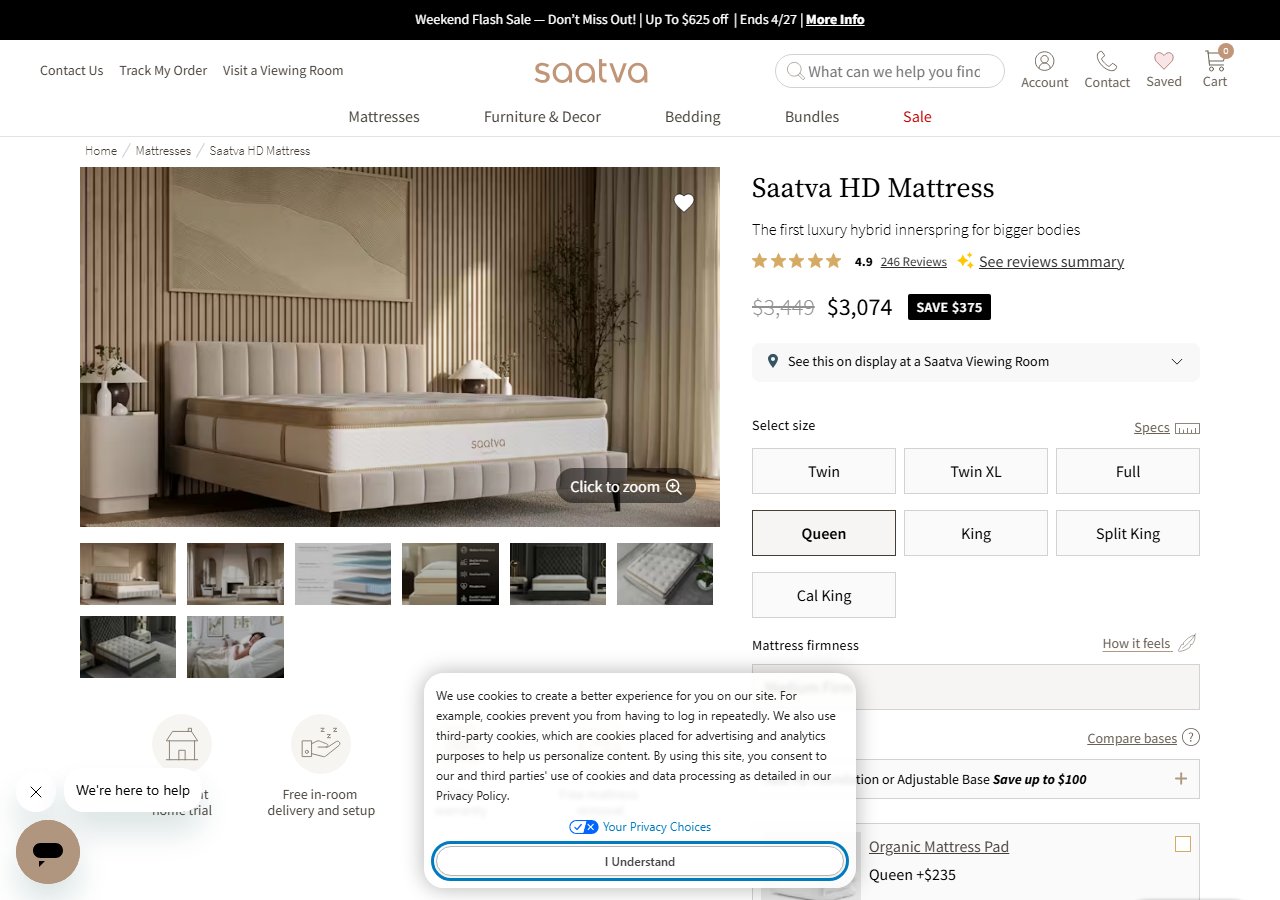
Saatva HD Mattress (Heavy-Duty)
$2,395-$3,995
See Price at Saatva →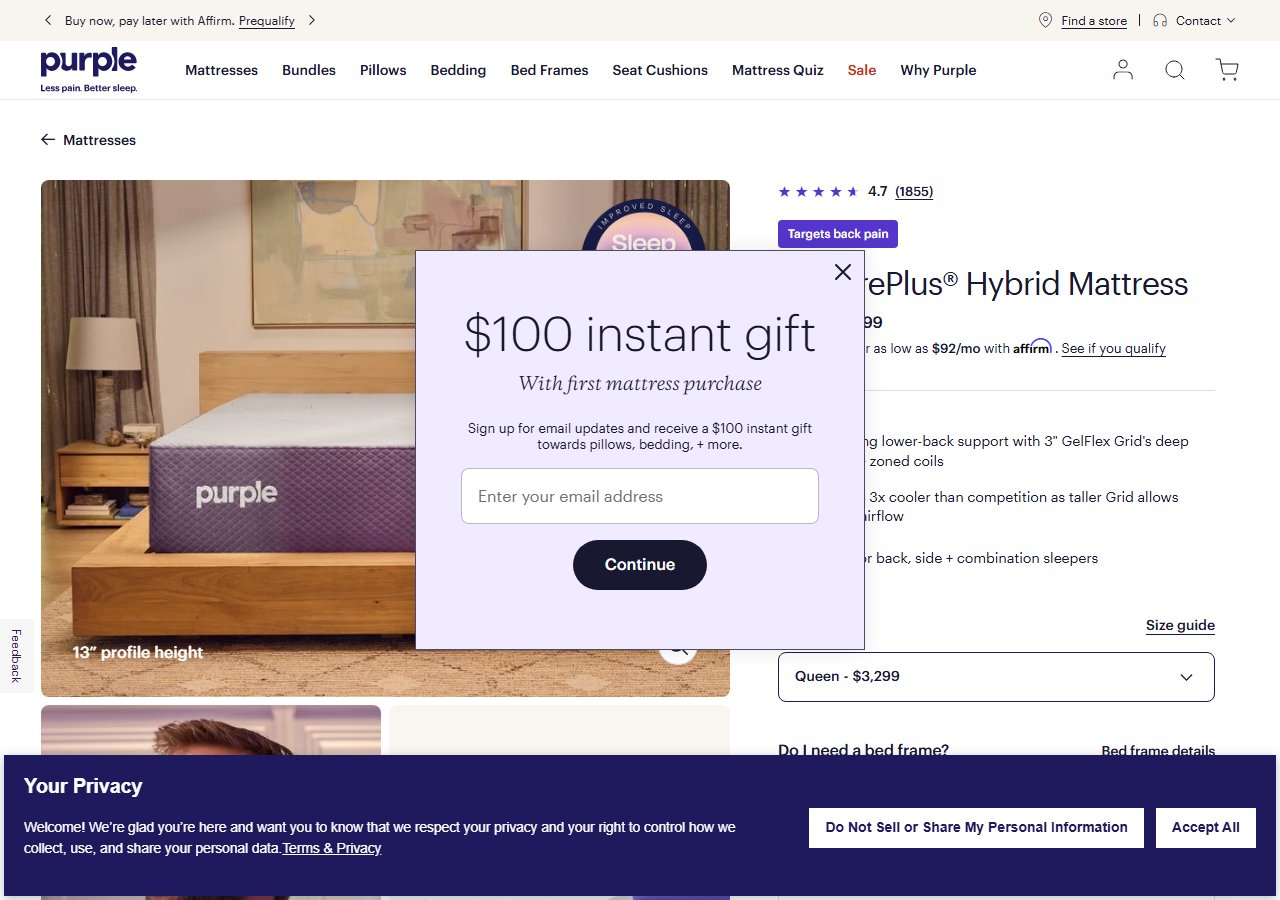
Purple Hybrid Premier Mattress
$2,499-$4,799
See Price at Purple →The Recovery Window Is the Asset — Protect It
The federal data assembled here converges on a single operational conclusion for healthcare workers: the off-duty recovery window is not a lifestyle preference, it is a clinical and occupational necessity. When BLS data documents the back as the most injured body part across all occupations, and when NIOSH documents that patient-handling tasks routinely exceed safe spinal loading limits, and when CDC data shows 35% of all adults are already sleep-deprived below the 7-hour threshold — the healthcare worker sleeping on a sagging, unsupportive mattress is absorbing injury exposure on both ends of their day.
The intervention hierarchy matters. Walk. Adjust sleep position. Practice OSHA's hip-hinge mechanics on the unit. Replace a mattress that visually sags or that consistently produces morning stiffness worse than the night before. Get clinical evaluation if red flags are present. And treat the sleep surface as one component of a recovery system, not as the entirety of one.
The most expensive chronic back pain outcome is the one that ends a healthcare career early. Against the cost of disability, lost income, and chronic pain medication documented in federal spending data, a quality sleep surface is an inexpensive line item. The math is in the federal record. The infrastructure for recovery is within reach.