The Injury Load Hiding Inside Every Healthcare Shift
Before a nurse reaches the end of a 12-hour shift, she may have repositioned a 200-pound patient six times, stood on hard linoleum for the better part of nine hours, and twisted at the lumbar spine in ways that would fail a NIOSH biomechanical audit. According to BLS Musculoskeletal Disorders by Occupation tracking, the back is the single most common body part injured across all U.S. occupations resulting in days away from work—and healthcare consistently ranks among the industries with the highest absolute MSD case counts. This is not anecdote; it is federal occupational surveillance data.
The downstream cost is enormous. AHRQ HCUP data identifies back pain as one of the most expensive conditions in the entire U.S. healthcare system by combined inpatient and outpatient cost—a bitter irony for a workforce that generates much of that cost while employed in healthcare itself. AHRQ Medical Expenditure Panel Survey (MEPS) data shows that adults with chronic back conditions spend substantially more on personal healthcare annually than adults without such conditions, a gap that compounds across a healthcare career.
This article is not a generic mattress roundup. It is a data-driven analysis of why healthcare shift workers experience spinal injury and sleep disruption at rates that exceed population averages, what interventions actually move the needle, and where a carefully chosen mattress fits into that recovery protocol—as one tool among many, not a cure.
Why Healthcare Shift Work Is Uniquely Destructive to the Spine
Understanding the biomechanical and occupational mechanism is not academic throat-clearing—it directly determines what recovery interventions will help and which mattress characteristics matter most.
Spinal loading under real clinical conditions. The NIOSH Lifting Equation was developed specifically to define safe limits for manual material-handling tasks. Patient repositioning, lateral transfers, and even routine tasks like leaning over a bed rail to adjust IV lines apply compressive and shear forces to the lumbar spine that the NIOSH model flags as exceeding safe limits—particularly because these tasks combine load, awkward posture, and high repetition across a 10-to-12-hour shift. Unlike warehouse work, where loads are often predictable and the NIOSH equation can be systematically applied in advance, patient-care tasks are reactive and variable. You cannot fully pre-engineer a fall assist.
Cumulative loading and disc fatigue. Intervertebral discs absorb compressive load throughout the day and rehydrate during recumbent sleep. When a healthcare worker works three 12-hour shifts in four days—a scheduling pattern common in hospital staffing—the recovery window between episodes of high spinal loading is compressed. The disc does not fully rehydrate if the sleep opportunity is short, fragmented by alarm clocks, or spent on a mattress that places the lumbar spine in sustained flexion or extension. This is the direct mechanistic link between mattress quality and back health for this population: the mattress either facilitates disc rehydration or it impedes it.
Shift rotation compounds sleep deprivation. CDC sleep data shows that approximately 35% of U.S. adults sleep fewer than the recommended 7 hours per night—and shift workers, particularly rotating-shift healthcare workers, skew significantly worse than that national average. Sleep deprivation impairs pain modulation through established neuroendocrine pathways: insufficient sleep elevates inflammatory cytokines and lowers pain thresholds, meaning the same underlying musculoskeletal injury will generate more perceived pain in a sleep-deprived worker than in a rested one. This is not speculation; it is consistent with the mechanistic literature on sleep and pain sensitization.
The chronic pain accumulation trajectory. CDC NCHS Data Brief 390 reports that approximately 20% of U.S. adults experience chronic pain, with the lower back as the most common single location. In occupations with the loading profile described above, that national prevalence is almost certainly a floor, not a ceiling. SSA Disability Insurance Reports confirm that musculoskeletal disorders are the largest single category of new disability claims each year—and healthcare workers are not exempt from that pipeline. The trajectory from acute occupational back strain to chronic pain to disability is documented in federal data, and it is a trajectory that well-chosen recovery interventions can interrupt.
Arthritis as a complicating factor. CDC arthritis data shows approximately 25% of U.S. adults have doctor-diagnosed arthritis, with prevalence concentrated in occupations involving sustained physical demand. A healthcare worker in her 40s who has been transferring patients for 15 years is not dealing with a single disc injury; she is dealing with a spine that has accumulated degenerative changes in the facet joints, reduced disc height, and periarticular inflammation that makes every sleep surface choice consequential. Arthritis changes the mattress equation: a surface that is too firm creates painful pressure points at the hips and shoulders; too soft and the spine sags into sustained flexion.
The Financial Stakes of Getting Recovery Right
The cost argument for investing in recovery infrastructure is straightforward. BLS Employer Costs for Employee Compensation data shows that industries with high MSD incidence carry workers' compensation insurance rates 3 to 5 times higher than low-MSD industries—a cost employers pass through in hiring constraints and wage decisions that ultimately affect every worker. For the individual healthcare worker, AHRQ MEPS data documents that chronic back conditions generate substantially higher annual personal healthcare expenditures. CMS Drug Spending Dashboard data identifies opioid and non-opioid pain medication spending among the most expensive Medicare drug categories—the downstream cost of undertreated occupational MSDs that progressed to chronic pain and pharmacological management.
A $1,700 to $4,000 mattress sounds expensive in isolation. Against a lifetime trajectory of escalating prescription costs, lost workdays, and potential disability, it is a modest line item in a recovery budget—provided the mattress is one component of a complete protocol, not a substitute for the behavioral and clinical interventions that have stronger evidence bases.
Try These First — Free and Low-Cost Interventions That Outperform Most Products
The cheapest intervention is the one that does not require buying anything. Before evaluating any mattress, every healthcare worker with back pain should have these five practices locked in. Federal data supports each of them as effective. None cost money. None require a prescription.
First, sleep position is the biggest free variable in your recovery. NIH National Institute of Arthritis and Musculoskeletal and Skin Diseases guidance recommends side-sleeping with a pillow between the knees, or back-sleeping with a pillow under the knees, to keep the lumbar spine in a neutral position during sleep. Stomach-sleeping torques the lumbar spine and extends the cervical spine simultaneously—a documented aggravator of the exact loading patterns that healthcare work imposes during the day. If a healthcare worker is stomach-sleeping on even an expensive mattress, she is negating a significant portion of its support benefit.
Second, daily walking is the most evidence-supported active intervention for chronic low back pain. NIH NCCIH evidence review finds that 30 minutes of walking on most days reduces chronic low back pain as effectively as most non-drug clinical treatments. For healthcare workers who spend their working hours in high-load, awkward postures, post-shift walking serves the dual function of reducing lumbar muscle tension and restoring normal disc fluid dynamics. It is not glamorous, but the evidence base is better than for most products marketed at this problem.
Third, lifting and bending mechanics need deliberate practice, not just theoretical knowledge. OSHA Ergonomics guidance emphasizes hinging at the hips rather than the lumbar spine, keeping loads close to the body, and avoiding rotation under load. Healthcare workers often know these principles and violate them under time pressure. Rehearsing the mechanics during low-stakes moments—lifting a chart, reaching into a supply cabinet—builds the motor pattern that transfers to patient-transfer situations where deliberate thought is not possible.
Fourth, mattress replacement is a legitimate clinical decision, not just a consumer preference. CDC Sleep Hygiene guidance supports replacing a mattress that shows visible sag, one that leaves you stiffer in the morning than you were at bedtime, or one more than 7 to 10 years old. This is a decision criterion, not a marketing claim: if your mattress is failing these tests, no sleep position technique or walking routine will fully compensate.
Fifth, walking and movement need to complement, not replace, clinical care. If you have back pain, you should be using the movement and sleep position interventions above. If those interventions are not providing relief within several weeks, or if any of the red flags described in the next section are present, a clinician should evaluate you before you spend money on equipment.
For healthcare workers who have already addressed sleep position, are walking regularly, are practicing proper lifting mechanics, and whose mattress genuinely shows signs of failure—those readers have earned the right to evaluate mattress hardware. The interventions above are not a gate to delay the product discussion; they are the foundation that determines whether a new mattress will actually help. A $3,000 mattress on top of stomach-sleeping and a sedentary recovery week will underperform a $1,200 mattress combined with the free interventions above.
When to See a Clinician First
A mattress is not a medical device, and mattress selection is not appropriate as the primary response to certain back pain presentations. NIH National Institute of Neurological Disorders and Stroke back pain guidance is explicit about the red flags that require clinical evaluation before any self-management approach—including equipment purchases. If you are a healthcare worker experiencing any of the symptoms listed in the clinical red flags section below, a new mattress should not be your next step. An appointment should.
The financial case for early clinical evaluation is also strong: AHRQ HCUP data shows that delayed diagnosis of serious spinal pathology drives substantial inpatient cost that earlier outpatient evaluation could reduce. Healthcare workers, ironically, often delay their own care while facilitating others'. The CDC chronic pain data—20% of U.S. adults with chronic pain, lower back the most common site—represents a population where a significant proportion allowed acute, addressable episodes to progress to chronic conditions through delayed evaluation and inadequate early management.
Where Products Fit: Mattress Selection for Healthcare Workers With Back Pain
With the mechanism understood, the free interventions in place, and clinical red flags ruled out, mattress selection becomes a meaningful decision. For healthcare workers specifically, the relevant mattress characteristics are not the same as for a sedentary office worker with occasional back tightness. The healthcare worker's spine arrives at bedtime carrying accumulated compressive load from hours of patient handling. It needs a surface that provides lumbar support without creating pressure points at the hips and shoulders, that responds to position changes (which happen more frequently in people with chronic pain), and that maintains its support properties across years of nightly use.
The Memory Foam Case: Saatva Loom & Leaf
For healthcare workers whose primary complaint is pressure-point pain—the hip and shoulder pain that comes from arthritis-related joint sensitivity combined with a mattress that is too firm—memory foam offers the best contouring-to-support ratio of any mattress category. The Saatva Loom & Leaf Memory Foam Mattress is our primary recommendation in this category. It uses multi-layer organic cotton and plant-based memory foam construction, available in Relaxed Firm and Firm configurations, with a price range of $1,695–$3,295 depending on size. For a nurse with facet joint arthritis who is side-sleeping on the NIH-recommended knee-pillow configuration, the Loom & Leaf's pressure-relieving top layers allow the shoulder and hip to sink appropriately while the denser support core keeps the lumbar spine from flexing into a hammock curve. This is the correct mechanical response for that presentation.
The Loom & Leaf's white-glove delivery and old-mattress removal are also practically important for healthcare workers: a 50-to-70-pound mattress delivery is itself a patient-handling equivalent, and asking a person with chronic back pain to manage a compressed foam delivery is a poor design choice. Saatva's delivery model removes that barrier.
For Larger-Frame or Higher-Load Healthcare Workers: Saatva HD
Not all healthcare workers have the same body weight or loading profile. Emergency department nurses, OR nurses who stand for 6-hour procedures, and male nursing assistants doing the heaviest patient transfers may carry more body weight or generate more sustained compression loading of the mattress surface. Standard mattresses—even premium ones—are engineered around a median weight distribution that does not apply to all users.
The Saatva HD Mattress is specifically engineered for users up to 500 pounds per side, using a dual-coil system with a tempered steel support layer and lumbar zone quilting that specifically reinforces the center third of the mattress—exactly where lumbar support matters most for back pain. At $2,395–$3,995, it is not inexpensive, but for a heavier-framed healthcare worker who has watched multiple standard mattresses develop a sag channel within two to three years, the HD's durability engineering is a direct economic argument. A mattress that sags early is worse than the mattress it replaced: the sag creates sustained lumbar flexion during sleep that directly opposes disc rehydration.
The Pressure-Relief Alternative: Purple Hybrid Premier
For healthcare workers who run consistently warm—a common complaint among nurses who wear multiple layers, move constantly during shifts, and arrive home with core temperature elevated—the material science of the Purple Hybrid Premier Mattress is meaningfully different from foam or coil alternatives. Purple's proprietary GelFlex Grid is an open-grid polymer that does not trap heat the way traditional memory foam does. It provides pressure relief through column-buckling mechanics rather than viscous deformation: the grid columns under pressure points (shoulders, hips) collapse to relieve load, while columns in non-pressure zones remain firm and provide support.
For a healthcare worker with both chronic back pain and sleep-disrupting heat, the Purple Hybrid Premier at $2,499–$4,799 solves two problems simultaneously. The pocketed coil base provides the deep-compression support that heavier loads require, while the GelFlex Grid top handles pressure relief and temperature regulation. The higher price point reflects the unique material engineering; there is no comparable open-grid polymer product at a lower price that replicates these properties.
Mattresses Built for Healthcare Workers With Chronic Back Pain
These three mattresses were selected specifically for the spinal loading patterns, pressure-point sensitivity, and sleep disruption profile documented in federal occupational health data for healthcare shift workers.

Saatva Loom & Leaf Memory Foam Mattress
$1,695-$3,295
See Price at Saatva →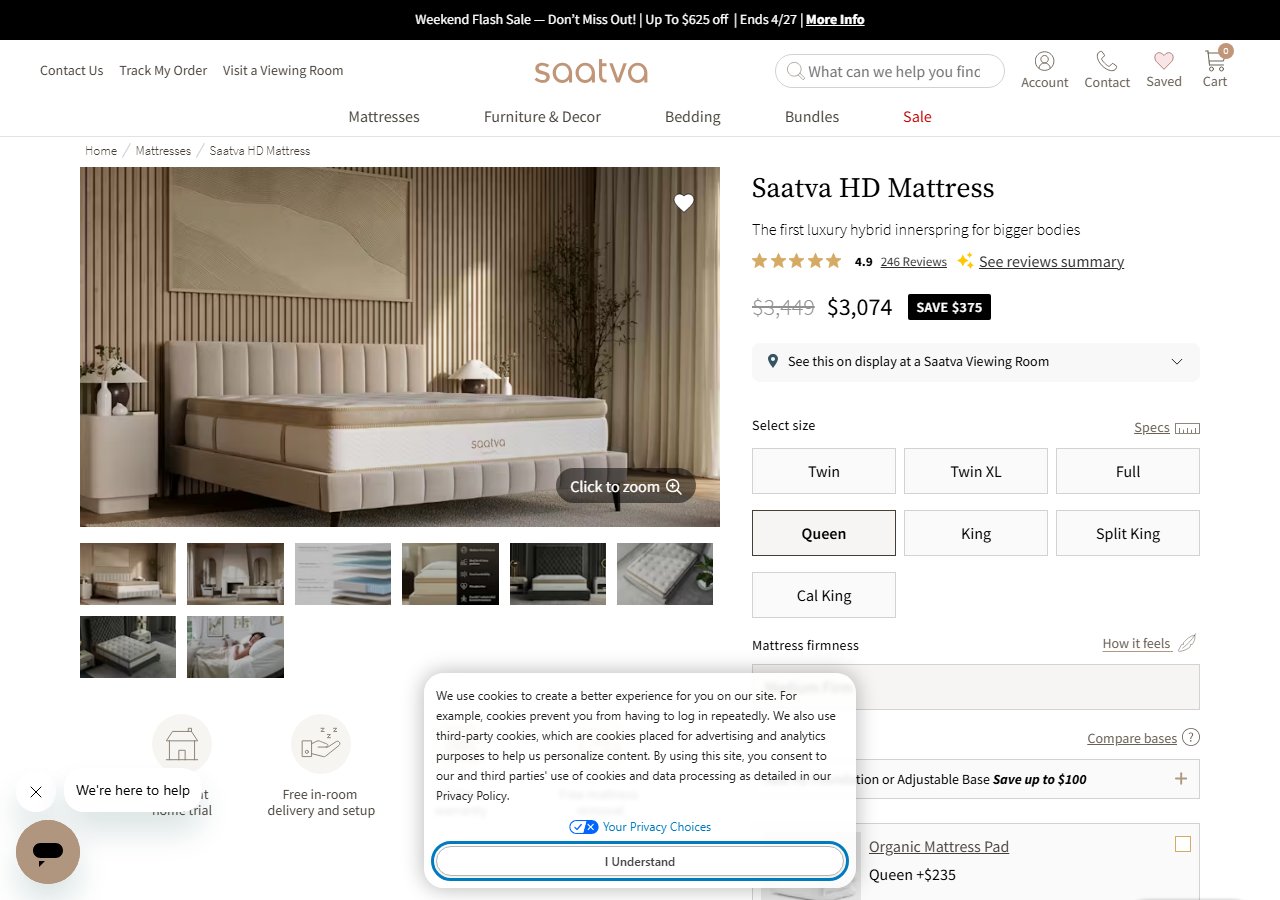
Saatva HD Mattress (Heavy-Duty)
$2,395-$3,995
See Price at Saatva →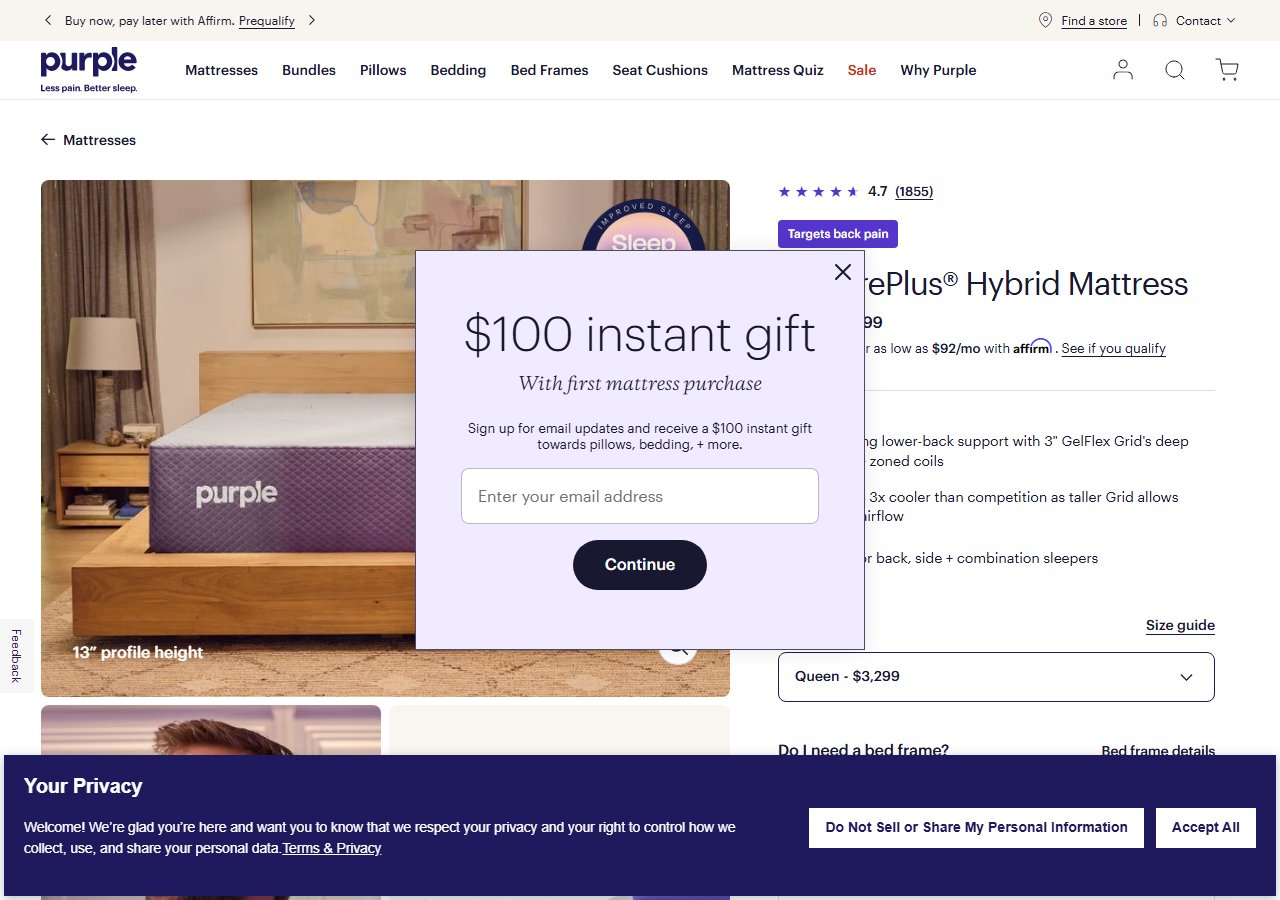
Purple Hybrid Premier Mattress
$2,499-$4,799
See Price at Purple →Choosing Between These Three Options: A Decision Framework for Healthcare Workers
These are not interchangeable products at different price points. They are meaningfully different solutions for meaningfully different presentations within the healthcare worker population.
Choose the Saatva Loom & Leaf if your primary complaint is pressure-point pain (hip and shoulder tenderness when side-sleeping), you are in a normal weight range for your height, you prioritize organic materials, and you want a well-supported premium memory foam experience from a brand with strong delivery logistics.
Choose the Saatva HD if you are a larger-framed healthcare worker—above roughly 230 pounds—or if you have watched previous mattresses develop premature sag. The dual-coil construction and lumbar zone reinforcement are engineering responses to loading patterns that standard mattress construction does not handle adequately.
Choose the Purple Hybrid Premier if heat is a significant sleep disruptor for you in addition to back pain, or if you find that traditional foam mattresses leave you feeling stiff and immobile in the morning. The open-grid polymer behaves mechanically differently from foam and suits sleepers who need pressure relief without the sinking, enveloping feel of memory foam.
The Protocol Summary: Data to Intervention to Product
Federal data tells a clear story. BLS confirms that the back is the most injured body part in U.S. occupational settings. NIOSH documents that healthcare patient-handling tasks routinely exceed safe spinal load limits. CDC reports that 35% of Americans are chronically undersleeping. SSA shows musculoskeletal disorders are the leading category of disability claims. These are not background statistics; they are the exact forces acting on a healthcare worker's spine across a career.
The response to those forces has a hierarchy. Movement first: NIH NCCIH evidence supports daily walking as one of the most effective non-drug interventions for chronic back pain. Sleep position second: NIH back pain guidance recommends specific postures that keep the lumbar spine neutral during sleep. Mechanics third: OSHA ergonomics guidance provides the framework for reducing the loading events that create the injury in the first place. Clinical evaluation when red flags are present. Mattress selection last—but not least—as the sleep surface infrastructure that either supports or undermines all of the above.
The Saatva Loom & Leaf, Saatva HD, and Purple Hybrid Premier are the three options in this analysis that have the construction characteristics relevant to healthcare workers' specific spinal loading and sleep disruption profile. Used as the final layer of a complete recovery protocol rather than as a standalone fix, any of the three represents a rational allocation of recovery investment for a workforce that federal data identifies as bearing one of the highest MSD burdens in the U.S. economy.