The Federal Data Portrait of a Body in Pain
According to BLS Musculoskeletal Disorders by Occupation tracking, the back is the single most common body part injured across all U.S. occupations that result in days away from work. That is not a rounding error or a statistical artifact — it is the dominant signal in decades of occupational injury surveillance. If you work a physically demanding job and you are reading this at 250 pounds or above, the federal data is describing you with uncomfortable precision.
The scale of the problem extends far beyond any single industry. CDC NCHS Data Brief 390 reports that approximately 20% of U.S. adults — roughly 65 million people — experience chronic pain, and lower back pain is the most common location. SSA Disability Insurance reports confirm the downstream consequence: musculoskeletal disorders represent the largest single category of new disability claims filed annually in the United States. AHRQ HCUP data places back pain among the most expensive conditions in U.S. healthcare measured by combined inpatient and outpatient cost. And AHRQ MEPS data shows that adults with chronic back conditions carry substantially higher annual personal healthcare expenditures than adults without those conditions — the financial burden is personal, not just systemic.
For workers in warehousing, construction, healthcare, and transportation — occupations with disproportionate shares of higher-bodyweight employees — the picture sharpens further. BLS Employer Costs for Employee Compensation data shows that industries with high musculoskeletal disorder incidence carry workers' compensation insurance rates 3–5 times higher than low-MSD industries. The back pain epidemic is not abstract: it is being priced into payroll costs across every high-demand sector in the U.S. economy.
Why Bodyweight Changes the Biomechanics — and Why Sleep Is the Hidden Variable
Understanding why individuals at 250 pounds or above face elevated spinal risk requires a brief but honest look at load mechanics. The spine is a compressive structure: it bears the weight of the torso, manages shear forces during movement, and relies on the intervertebral discs to distribute load across vertebral end plates. Every pound of body mass above the spine's neutral resting position adds compressive force — not linearly, but multiplicatively, because posture angle amplifies load through lever-arm mechanics.
The NIOSH Lifting Equation documents that manual material-handling tasks in warehousing, construction, and healthcare routinely exceed safe spinal loading limits even for average-sized workers. For a worker at 270 pounds performing the same lift, the compressive load on the L4–L5 disc — already the most injury-prone segment in the lumbar spine — is meaningfully higher because trunk mass itself contributes to the load equation. Lift repetitions that are marginal at 180 pounds become frank overloads at 270 pounds under the same task conditions.
The sleep connection is not intuitive, but the data supports it. CDC sleep surveillance data shows approximately 35% of U.S. adults report sleeping fewer than 7 hours per night — the threshold associated with elevated chronic disease risk. For someone managing back pain, poor sleep is not merely an inconvenience: sleep is the primary window for intervertebral disc rehydration. Discs are avascular, meaning they receive nutrition and fluid through osmotic exchange that is most efficient during unloaded, horizontal sleep. A mattress that fails to maintain spinal neutrality — because it sags, bottoms out, or lacks the density to support a higher-bodyweight sleeper — disrupts this rehydration cycle night after night.
Standard consumer mattresses are typically engineered around a 180–200 lb body-weight model. The foam density specifications, coil gauge ratings, and comfort layer depths that feel supportive at that weight often compress past their functional threshold for someone at 250, 280, or 300-plus pounds. The result is a hammock effect: the hips sink, the lumbar spine loses its lordotic curve, and the musculature surrounding the spine fires to compensate throughout the night. By morning, the muscles are fatigued, the discs are under-rehydrated, and the pain cycle that began at the warehouse or the job site is reinforced rather than interrupted.
Approximately 25% of U.S. adults report doctor-diagnosed arthritis, with prevalence concentrated in occupations involving sustained physical demand — exactly the population most likely to be reading this article. Arthritis in the facet joints of the lumbar spine is particularly sensitive to sleep-surface quality: inflammatory joint pain worsens when sustained positional loading compresses already-degraded cartilage for 6–8 hours.
The Occupational Context: Who This Data Is Describing
The BLS injury surveillance data is not describing desk workers. The occupations with the highest rates of musculoskeletal disorders with days away from work are concentrated in warehousing and storage, construction, nursing and residential care, and truck transportation. These are also occupations that skew toward higher average body weight in the U.S. workforce, for reasons that include shift-work eating patterns, limited access to exercise during long shifts, and the physiological effects of chronic pain itself — which reduces physical activity and promotes weight gain through both behavioral and neuroendocrine pathways.
This creates a compounding cycle that federal data tracks with precision: physical demand at work loads the spine → pain reduces activity → reduced activity promotes weight gain → higher body weight amplifies spinal load → sleep quality degrades → disc health deteriorates → pain worsens → repeat. Interrupting that cycle requires intervention at multiple points simultaneously. A reinforced sleep surface is one intervention point. It is not the only one, and it is not the first.
Try These First — The Cheapest Interventions Don't Require Buying Anything
The cheapest intervention is the one that does not require buying anything. Before any discussion of sleep surfaces, the federal evidence base supports a sequence of behavioral, positional, and mechanical changes that cost nothing and have meaningful clinical backing.
Lift mechanics first. OSHA's ergonomics guidance is unambiguous: hinge at the hips rather than the lumbar spine, keep loads close to the body, and avoid twisting under load. Most acute back episodes are mechanical and are caused by patterned errors that are entirely rehearsable. If you are doing dozens of lifts per shift with poor hip-hinge mechanics, no mattress will compensate for what that is doing to your L4–L5 disc over a 20-year career.
Sleep position is the biggest free variable in your recovery. NIH back pain guidance from the National Institute of Arthritis and Musculoskeletal and Skin Diseases recommends side-sleeping with a pillow between the knees, or back-sleeping with a pillow under the knees, to maintain spinal neutrality through the night. Stomach-sleeping torques the lumbar spine into extension and rotation simultaneously — the exact mechanical position that aggravates facet joint arthritis and disc pathology. Changing sleep position costs nothing and produces measurable reductions in morning pain for many chronic back pain sufferers.
Walking is a real clinical intervention. NIH NCCIH's evidence review on low-back pain concludes that walking 30 minutes most days reduces chronic low back pain as effectively as most non-drug clinical treatments. This is not wellness advice — it is a finding from controlled research. For shift workers who spend 10 hours on their feet, the recommendation may need to be modified (low-impact movement, not additional high-impact standing), but the principle holds: movement is the lever that no passive intervention — mattress, medication, or otherwise — fully replaces.
Know when the mattress actually is the problem. CDC Sleep Hygiene guidance provides a practical threshold: replace a mattress if it has visible sag, if you consistently wake stiffer than you went to bed, or if it is older than 7–10 years. Even the most expensive mattress on the market does not undo poor sleep hygiene or sedentary days. If your mattress is 3 years old and showing no visible wear but you are waking in pain, the mattress may not be the primary variable.
For readers who have already worked through sleep position adjustments, corrected their lift mechanics, and replaced a genuinely degraded mattress — and who are still waking with back pain that disrupts their next shift — the construction specifications of the sleep surface become a legitimate clinical consideration. This is where engineering choices in mattress design start to matter in ways that are measurable and documented.
When to See a Clinician — Not a Mattress Review
Some back pain presentations are not a sleep-surface problem. NIH NINDS guidance on back pain is explicit about the red flags that require clinical evaluation rather than equipment changes. For individuals at higher body weight, these thresholds are worth knowing precisely because the symptom pattern can be masked by generalized musculoskeletal discomfort that makes specific red flags harder to identify.
Do not purchase a new mattress for back pain that radiates below the knee, that is accompanied by leg weakness or numbness, that follows a trauma event, or that comes with bowel or bladder changes. These presentations indicate possible nerve root compression, spinal stenosis, or cauda equina involvement — conditions that require imaging and clinical management, not a firmer sleep surface. Back pain accompanied by unexplained fever or weight loss warrants urgent evaluation for infectious or malignant etiologies. AHRQ MEPS data shows that individuals with chronic back conditions who delay appropriate clinical evaluation accumulate significantly higher long-term healthcare costs — an argument for early triage rather than self-treating with equipment.
What to Look for in a Sleep Surface: Construction That Matches the Load
For high-bodyweight individuals who have cleared the clinical red flags, who have optimized their sleep position, and whose mattress is genuinely aging or inadequate, the engineering specifications of a mattress are not marketing language — they are functional variables that determine whether the mattress will maintain spinal support at their actual body weight over a realistic lifespan.
The key specifications to evaluate are: coil gauge and count (lower gauge = thicker wire = more resistance to compression under sustained load), foam base density (at minimum 1.8 lb/cubic ft for support layers; 2.0 lb or above for durability at higher body weights), comfort layer depth (thicker comfort layers that feel luxurious at 180 lbs can create excessive sinkage at 270 lbs), reinforced perimeter support (edge support is functionally critical for larger sleepers who use more of the mattress surface), and weight rating (some manufacturers publish explicit weight ratings; this is a hard spec, not a soft preference).
Three mattresses stand out for this population based on those construction criteria.
The Saatva HD Mattress is the most directly engineered product for this reader. Saatva's HD designation is not marketing — it specifies a dual-tempered steel coil system with a higher coil count and heavier gauge than their standard Classic model, an ultra-dense foam encasement for edge support, and explicit engineering for sleepers up to 500 pounds per side. For warehouse workers and big-and-tall sleepers who have experienced the hammock sag of standard mattresses, the HD addresses the primary mechanical failure mode at the source: it is built to resist progressive compression under sustained higher loads in a way that standard mattresses are not. At $2,395–$3,995 depending on size, it is a significant investment — but against the cost framing from AHRQ MEPS showing elevated annual healthcare costs for adults with chronic back conditions, the calculus is worth running.
For high-bodyweight sleepers who run hot or who need pressure relief at the shoulders and hips alongside lumbar support, the Saatva Loom & Leaf Memory Foam Mattress warrants serious consideration. It uses a high-density 5-lb memory foam comfort layer — denser than the 3–4 lb foams common in mass-market memory foam mattresses — sitting on a 4-lb convoluted foam layer, all above a high-density base. That density stack translates to better long-term resistance to body-impression formation, which is the primary durability failure point for larger sleepers in foam-dominant mattresses. The Loom & Leaf is available in Relaxed Firm and Firm variants; for most sleepers at 250 pounds or above, the Firm variant provides the support geometry necessary to maintain lumbar lordosis through the night. Priced at $1,695–$3,295, it is positioned as the premium memory foam pick for serious back pain in this weight range.
The Purple Hybrid Premier Mattress occupies a distinct engineering category. Purple's GelFlex Grid — a polymer grid structure rather than traditional foam — is designed to collapse under low-pressure zones (shoulders, ankles) while remaining firm under high-pressure zones (hips, lumbar). For higher-bodyweight sleepers whose primary complaint is pressure-point pain at the hips that forces them into poor spinal alignment, the Grid architecture addresses the problem at the material-science level in a way that neither traditional memory foam nor innerspring systems can fully replicate. The Hybrid Premier adds a pocketed coil system beneath the Grid, providing both the adaptive pressure relief of the polymer layer and the deeper support and edge integrity of coil construction. At $2,499–$4,799, it is the premium pressure-relief pick for this population.
Sleep Surfaces Engineered for High-Bodyweight Spinal Support
Each of these mattresses was selected for construction specifications — coil gauge, foam density, weight rating, and edge support — that address the specific mechanical failure modes that standard consumer mattresses exhibit under sustained higher-bodyweight loading.

Saatva Loom & Leaf Memory Foam Mattress
$1,695-$3,295
See Price at Saatva →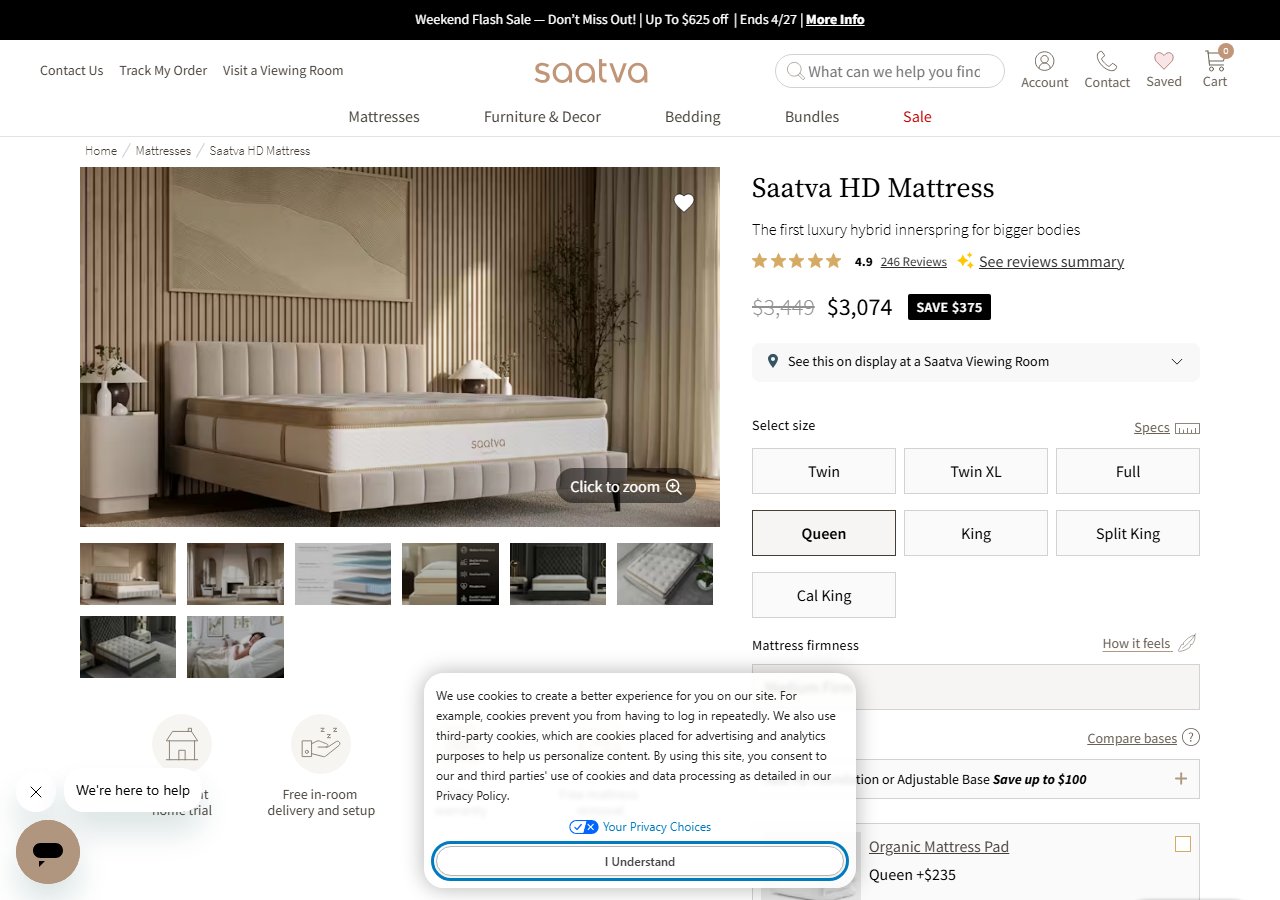
Saatva HD Mattress (Heavy-Duty)
$2,395-$3,995
See Price at Saatva →
Purple Hybrid Premier Mattress
$2,499-$4,799
See Price at Purple →Building a Strategy, Not Just Buying a Mattress
The federal data is clear on the problem: back pain is the dominant occupational injury in the United States, CMS drug spending data identifies opioid and non-opioid pain medication spending among the most expensive Medicare drug categories — a downstream reflection of how many Americans are managing chronic pain pharmacologically rather than mechanically — and SSA disability data shows that musculoskeletal disorders are ending careers at scale.
For a high-bodyweight individual in a physically demanding occupation, the path forward is not a single purchase — it is a hierarchy of interventions. Correct the lift mechanics first, using OSHA's ergonomics guidance. Optimize sleep position using NIH NIAMS recommendations. Add daily walking consistent with NIH NCCIH's evidence review. Replace a mattress that is visibly degraded, following CDC sleep hygiene thresholds. And when a new mattress is warranted, choose one engineered for the actual load — not one engineered for a 180-pound body-weight model.
The Saatva HD is the most specifically engineered for this population's primary mechanical need: resistance to progressive compression under sustained higher loads. The Loom & Leaf is the right call for sleepers prioritizing high-density memory foam with long-term body-impression resistance. The Purple Hybrid Premier addresses the pressure-distribution problem at the material level for sleepers whose pain is driven by hip and shoulder loading. All three represent genuine engineering differences from mass-market alternatives, not just premium price points.
Back pain at scale is a federal data story. The sleep surface you spend 7–8 hours on every night is a small but measurable variable in that story — particularly when your body weight amplifies every mechanical failure the mattress makes.