The Federal Numbers That Should Reframe How You Think About Your Mattress
According to the BLS Musculoskeletal Disorders by Occupation tracking, the back is the most common body part injured across all U.S. occupations that result in days away from work. That is not a close race. It is not second place for certain industries and first for others. It is the single most injury-prone structure in the American workforce, full stop. And for workers who carry more than 250 pounds of bodyweight into physically demanding jobs every morning—warehouse associates, construction laborers, home health aides, long-haul drivers—the spinal load accumulated during a shift does not disappear when the shift ends. It follows them to bed.
The CDC's NCHS Data Brief 390 places approximately 20% of U.S. adults in the chronic pain category, with the lower back named as the most common pain location. That is roughly 66 million people. The AHRQ's Healthcare Cost and Utilization Project (HCUP) identifies back pain as one of the most expensive conditions in U.S. healthcare when measured by total inpatient and outpatient costs. The AHRQ Medical Expenditure Panel Survey (MEPS) further documents that adults with chronic back conditions spend substantially more on personal healthcare annually than those without—a gap that compounds every year the underlying condition goes unmanaged. Meanwhile, SSA Disability Insurance annual reports identify musculoskeletal disorders as the single largest category of new disability claims filed each year in the United States.
None of that data is designed to sell mattresses. It is designed to measure suffering and economic loss. But it has a direct implication for sleep surface engineering that the mattress industry rarely discusses plainly: if your back is your most vulnerable occupational asset, and if you weigh 250 pounds or more, the standard consumer mattress—typically engineered for a 130–180 pound load profile—is almost certainly accelerating your injury trajectory during the one daily block of time when recovery should be happening.
Why Higher Bodyweight Changes the Physics of Sleep
The mechanism here is not complicated, but it is worth explaining precisely because understanding it determines which product characteristics actually matter versus which are marketing language.
All mattresses, regardless of material, respond to compressive load. The relationship between bodyweight and compression depth is not linear—it is pressure-dependent and surface-area-dependent. A person weighing 180 pounds distributes that load across their hip and shoulder contact points at a pressure that most medium-firmness mattresses are engineered to resist with proportional pushback, keeping the spine roughly horizontal. A person weighing 275 pounds places significantly higher pressure per square inch at those same contact points. If the mattress is not engineered with a higher-durometer core or additional support layers, the heavier sleeper sinks further into the comfort layer—past the designed support zone—and the lumbar spine drops into hyperextension or lateral torque depending on sleep position.
In a side-sleeping position, inadequate support causes the hip to plunge and the shoulder to collapse inward, creating a lateral curve in the thoracolumbar spine that persists for hours. In a back-sleeping position, insufficient lumbar zone support allows the natural lordotic curve to flatten or invert against a soft surface, placing the posterior spinal musculature in continuous eccentric stretch. Neither scenario is catastrophic in a single night. But NIOSH's Lifting Equation research documents that cumulative spinal loading—not single-event trauma—is the dominant mechanism behind most chronic back disorders in physically demanding occupations. The same principle applies to sleep surfaces: cumulative hours of poor spinal alignment across months and years degrade the intervertebral disc integrity and paraspinal muscle function in ways that compound occupational injury risk.
For high-bodyweight workers who already exceed NIOSH-recommended spinal loading limits during their work shifts, the sleep surface is not a peripheral wellness variable. It is a primary recovery tool that either buffers or amplifies the cumulative load exposure.
The BLS Employer Costs for Employee Compensation data shows that industries with high musculoskeletal disorder incidence carry workers' compensation insurance rates 3–5 times higher than low-MSD industries. That cost differential reflects real bodies with real injuries that required real treatment. CMS Drug Spending Dashboard data identifies opioid and non-opioid pain medications among the most expensive Medicare drug categories—a reflection of how frequently chronic back pain drives pharmaceutical intervention when structural contributors go unaddressed. And approximately 25% of U.S. adults report doctor-diagnosed arthritis, with prevalence concentrated in exactly the physically demanding occupations that also carry the highest MSD rates.
This is the context in which a mattress decision should be made. Not "which one feels comfortable in a showroom" but "which one is structurally engineered to maintain spinal alignment under the load profile and cumulative tissue stress of my specific body and occupation."
The Sleep Deprivation Multiplier
There is a second mechanism that receives even less attention: sleep deprivation's role in pain amplification. CDC Sleep and Sleep Disorders data shows that approximately 35% of U.S. adults sleep fewer than 7 hours per night—the threshold the CDC identifies as associated with elevated chronic disease risk. For workers already managing back pain, pain itself is one of the primary drivers of sleep disruption. The relationship is bidirectional and reinforcing: pain interrupts sleep architecture; sleep deprivation lowers pain thresholds; lower pain thresholds make the next night's sleep worse. A mattress that eliminates pressure-point pain and maintains spinal neutrality can interrupt that cycle at the input stage—not by treating the underlying pathology, but by removing the mechanical sleep disruptor.
The free interventions below address the behavioral and postural levers that should be adjusted before spending $2,000–$4,000 on a mattress. These are not perfunctory disclaimers—they are documented first-line interventions from NIH, CDC, and OSHA that change outcomes. The cheapest intervention is the one that does not require buying anything.
If you have already worked through the sleep-position adjustments, replaced a visibly sagging mattress, added consistent walking to your routine, and corrected your lift mechanics at work—and you are still waking up stiffer than you went to bed—then the sleep surface itself is a legitimate variable to address. The remainder of this article is written for that reader: someone who has done the behavioral work and needs a structural tool that matches their actual body and occupational load profile.
When the Problem Requires a Clinician, Not a Mattress
Before any product discussion, this section needs to be read carefully. Not all back pain is mechanical, and not all mechanical back pain responds to mattress changes. NIH's National Institute of Neurological Disorders and Stroke provides specific criteria for when back pain requires prompt clinical evaluation rather than conservative management.
For high-bodyweight workers—who are at elevated risk for both mechanical and systemic back pathology due to cumulative load exposure—the threshold for clinical evaluation should be lower, not higher, than the general population. If your back pain radiates below the knee, intensifies with rest rather than activity, follows a traumatic event, or is accompanied by leg weakness, numbness, bowel or bladder changes, or unexplained fever, a new mattress is not the correct intervention. These are signs of nerve compression, fracture, infection, or malignancy that require imaging and clinical care. AHRQ back pain research consistently finds that delayed diagnosis of serious spinal pathology leads to substantially worse outcomes and higher total treatment costs.
For high-bodyweight individuals specifically: central sleep apnea, which has a higher prevalence in this population, can also drive the fatigue and morning pain that feels like a mattress problem. A sleep study may be more clinically valuable than a mattress upgrade if fatigue rather than localized spinal pain is the primary complaint.
The Reinforced Construction Variables That Actually Matter
Assuming clinical red flags have been ruled out, here is what the construction literature and load-engineering logic tell us to look for in a mattress designed for 250+ lb sleepers.
Coil gauge and zone count. In hybrid mattresses, the pocketed coil system carries the structural load. Standard mattresses use 14–15 gauge coils. Purpose-built heavy-duty mattresses step down to 13 or even 12.5 gauge—a meaningful stiffness increase. Zoned coil systems with higher spring counts in the lumbar and hip zones (typically zones 3 and 4 in a 5-zone layout) provide differential support that prevents the hip-drop failure mode described earlier.
Foam density and ILD. Comfort layers matter as much as the support core. Foam is rated by density (pounds per cubic foot) and Indentation Load Deflection (ILD, a firmness measure). For 250+ lb sleepers, look for comfort layer foam at 4–5 lb/ft³ density minimum; lower-density foams compress and degrade faster under elevated bodyweight. A medium-firm ILD in the 28–35 range provides initial contouring without allowing the full-sink-through that misaligns the spine.
Edge support construction. This is underrated in reviews but critical for high-bodyweight sleepers. A reinforced perimeter (high-density foam encasement or border-rod system) prevents edge compression that would otherwise limit usable sleep surface and cause lateral roll-out instability—particularly relevant for larger individuals who may sleep closer to mattress edges.
Height and foundation compatibility. Heavy-duty mattresses often run 13–16 inches in profile height. Foundation and frame weight ratings must match. A mattress rated for 600 lb placed on a frame rated for 450 lb creates a structural failure point that matters more than any foam specification.
With those engineering criteria established, here is how three specific mattresses perform against them.
The Saatva HD Mattress is the most explicitly engineered-for-this-problem option in the premium segment. Saatva designed the HD specifically for sleepers up to 500 pounds, with a dual-coil system—an individually wrapped comfort coil layer above a tempered steel Bonnell coil base—that provides both contour response and structural load capacity that standard hybrid constructions simply do not offer. The lumbar zone is reinforced with additional coil density, directly addressing the hip-drop failure mode. For warehouse workers, construction laborers, or any high-bodyweight sleeper who has burned through standard mattresses in under five years, the HD's construction logic maps directly onto the problem federal data describes.
For sleepers who prioritize foam conformity alongside structural support, the Saatva Loom & Leaf Memory Foam Mattress represents a different engineering approach to the same problem. Loom & Leaf uses a high-density 5 lb/ft³ memory foam comfort layer—above the 4 lb/ft³ minimum that load engineering recommends for this weight class—with a 4 lb/ft³ transitive foam layer and a high-density support base. The result is a mattress that contours to individual spinal geometry without the accelerated compression degradation that plagues lower-density foam at elevated bodyweight. It is the premium memory foam pick for back-pain sufferers who have previously found traditional coil mattresses too firm at pressure points but want durability that matches their body weight.
For sleepers whose primary complaint is pressure-point pain—hips, shoulders, or the sacroiliac region—the Purple Hybrid Premier Mattress introduces a genuinely different material science approach. Purple's proprietary GelFlex Grid is a hyper-elastic polymer grid structure that behaves differently from both foam and coil: it collapses fully at low-pressure points (allowing bony prominences to sink through without resistance) while maintaining firm resistance at high-pressure zones (preventing the full-sink-through that misaligns the lumbar spine). For high-bodyweight sleepers who run warm and find memory foam's pressure-relief benefits offset by heat retention, the Grid's open-structure airflow is a meaningful functional difference, not a marketing claim.
Reinforced Mattresses Built for 250+ lb Sleepers With Back Pain
Each mattress below was selected for demonstrated construction engineering—coil gauge, foam density, lumbar zone reinforcement—that addresses the spinal alignment failure modes documented in high-bodyweight, physically demanding occupational profiles.

Saatva Loom & Leaf Memory Foam Mattress
$1,695-$3,295
See Price at Saatva →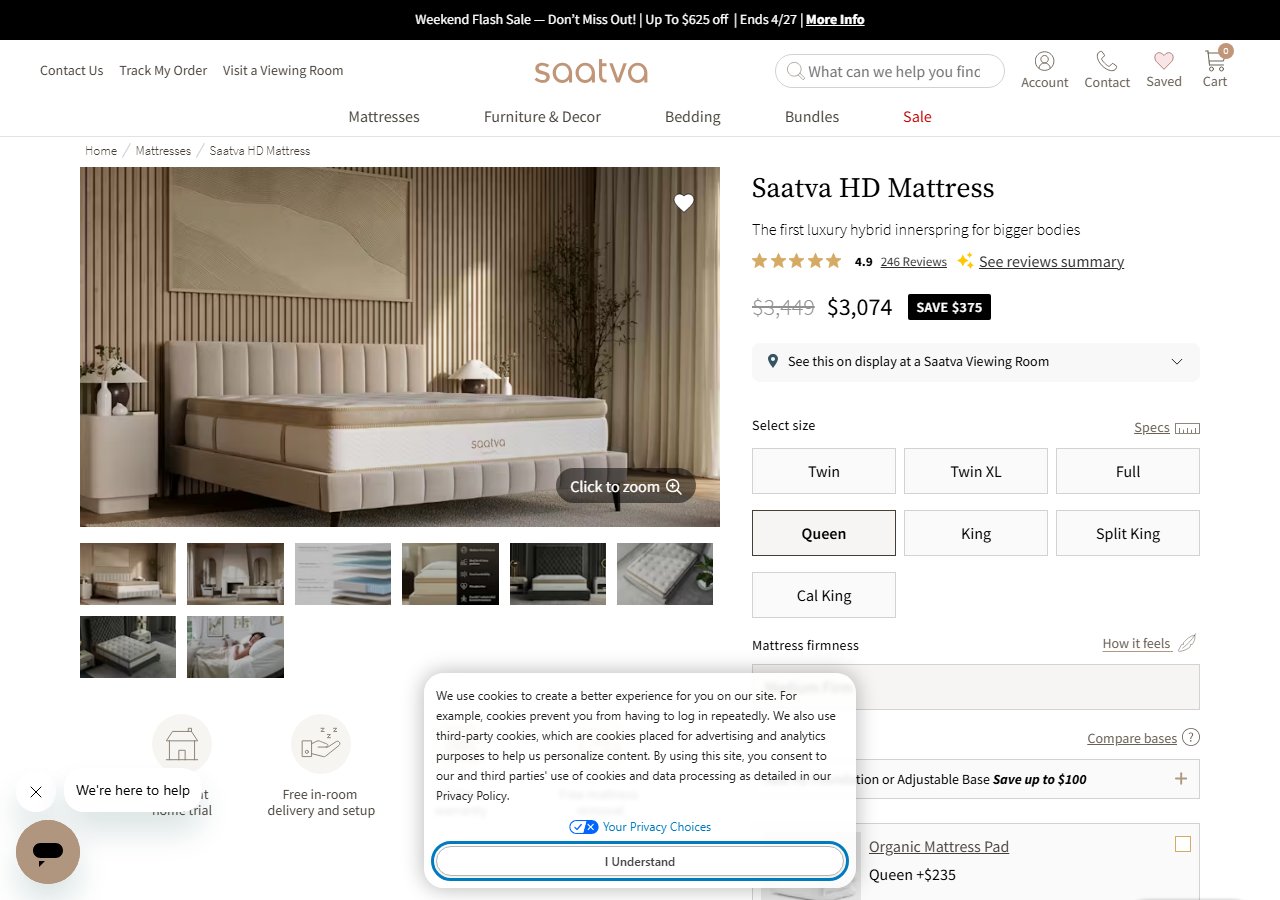
Saatva HD Mattress (Heavy-Duty)
$2,395-$3,995
See Price at Saatva →
Purple Hybrid Premier Mattress
$2,499-$4,799
See Price at Purple →Making the Decision: A Data-to-Construction Framework
The federal data assembled above tells a consistent story: back pain is the dominant occupational injury, musculoskeletal disorders are the leading driver of disability claims, sleep deprivation amplifies chronic pain, and the healthcare system absorbs enormous costs from undertreated back conditions. None of that data was generated to sell mattresses. But it does define the performance requirements a mattress must meet for a high-bodyweight worker whose back is already under cumulative occupational stress.
The decision framework that follows from the evidence is straightforward:
Start with the free variables. Sleep position adjustment, consistent daily walking (documented by NIH NCCIH as matching most non-drug treatments for chronic low back pain), corrected lift mechanics per OSHA guidance, and honest assessment of your current mattress age and condition cost nothing. If your mattress has visible sag or is older than 7–10 years, replacement is warranted regardless of brand or construction—as CDC sleep hygiene guidance notes, even the best mattress cannot compensate for degraded infrastructure.
Apply the clinical filter. Red-flag symptoms described above require clinical evaluation before any equipment investment. Do not attempt to manage nerve-compression or fracture symptoms with a premium mattress.
Match construction to body and occupational profile. High-bodyweight workers in physically demanding occupations should prioritize dual-coil or reinforced-coil hybrid construction (Saatva HD for the highest load ratings), high-density memory foam with verified density specifications (Saatva Loom & Leaf for foam-preferring sleepers), or polymer grid technology for pressure-point-dominant complaints (Purple Hybrid Premier for sleepers who run hot or have pronounced hip or shoulder pain).
Verify weight ratings and foundation compatibility. A mattress spec sheet should list a maximum weight rating. A foundation and frame should be rated to at least that same capacity. Mismatched ratings are the most common cause of premature mattress failure in this population—and they void most warranties.
The CDC reports that approximately 35% of U.S. adults are already sleep-deprived below the 7-hour chronic-disease-risk threshold. For a 260-pound warehouse associate who lifted beyond NIOSH-recommended spinal load limits four times today and is sleeping on a 9-year-old mattress with visible hip-zone sag, the sleep surface is not a luxury variable. It is a structural component of a recovery system that federal data clearly shows is already failing for tens of millions of American workers. Addressing it with the same rigor applied to the occupational problem—mechanism first, interventions ranked by evidence, products selected by engineering fit rather than aesthetics—is the correct approach.