The federal data on lifting injuries starts with your spine — and it doesn't clock out when you do
According to the Bureau of Labor Statistics' Musculoskeletal Disorders by Occupation tracking, the back is the single most commonly injured body part across all U.S. occupations that involve days away from work. That's not surprising to anyone who has spent a decade in a warehouse, a hospital supply chain, a construction site, or a delivery route. What is surprising — and what most occupational health guidance underemphasizes — is that spinal loading doesn't stop when the shift ends. For workers at 250 pounds or more, the forces acting on lumbar discs, facet joints, and paraspinal musculature continue through the night, shaped entirely by what surface they sleep on and what position they hold for seven or eight hours.
The NIOSH Lifting Equation is the federal government's primary tool for quantifying spinal compression risk in occupational lifting tasks. It documents that manual material-handling work across warehousing, construction, and healthcare routinely pushes spinal loading beyond the 3,400 Newton action limit — the threshold at which disc injury risk becomes clinically significant. What NIOSH does not explicitly model is the cumulative overnight component: eight hours of inadequate spinal support on a mattress that has lost structural integrity, or that was never designed for body weights above 200 pounds, adds a passive mechanical insult on top of the active one workers absorb all day.
This is the core problem this article addresses. Not back pain in the abstract. Not a generic mattress guide. The specific biomechanical situation of a high-bodyweight manual worker whose spine is absorbing occupational load during the day and failing to decompress at night — and what federal data, free interventions, and (only then) reinforced sleep surfaces can do about it.
Why body weight changes the math on spinal recovery during sleep
CDC NCHS Data Brief 390 documents that approximately 20% of U.S. adults experience chronic pain, with lower back pain as the most prevalent single location. What the CDC brief doesn't parse — but what biomechanical research does — is how body weight interacts with sleep surface compliance to determine whether the lumbar spine is actually decompressing overnight or being held in a mechanically stressed position for hours.
The problem works like this. A standard consumer mattress is engineered around a median adult weight of roughly 150 to 180 pounds. At that weight, the foam layers compress enough to allow the shoulders and hips to sink slightly while supporting the lumbar curve — a position that approximates neutral spine alignment. At 250 pounds and above, the same foam compresses further and faster. The hips sink deeper than the shoulders and lumbar region, placing the spine in a sustained flexion posture that increases intradiscal pressure in the lumbar segments — exactly the segments that absorb the highest compressive loads from lifting tasks during the workday. Over seven or eight hours, this isn't a minor inconvenience. It is a mechanical stressor that accumulates on already-loaded tissue.
The consequence shows up in federal disability data. SSA Disability Insurance Reports identify musculoskeletal disorders as the largest single category of new disability claims annually — outpacing cardiovascular, respiratory, and neurological conditions. A worker who cannot recover spinal loading overnight is a worker whose musculoskeletal reserve erodes faster. And AHRQ HCUP data places back pain among the most expensive conditions in U.S. healthcare by total inpatient and outpatient cost — costs that fall on workers, employers, and public insurance programs alike.
The BLS Employer Costs for Employee Compensation data reinforces the systemic dimension: industries with high musculoskeletal disorder incidence carry workers' compensation insurance rates 3 to 5 times higher than low-MSD industries. That's not abstract arithmetic. That's a measurable wage suppression effect on every worker in those sectors, because elevated insurance costs reduce the compensation budget available for wages and benefits.
Layer on the sleep-deprivation data and the picture sharpens further. The CDC Sleep and Sleep Disorders tracking shows that approximately 35% of U.S. adults sleep fewer than 7 hours per night — the threshold the CDC associates with elevated chronic disease risk including cardiovascular disease, obesity, and impaired immune function. Workers who wake in pain, who shift positions repeatedly overnight, or who sleep on surfaces that create pressure points at the hips and shoulders are contributing to that 35% figure. Poor sleep and chronic musculoskeletal pain are bidirectional: each worsens the other.
The CMS Drug Spending Dashboard identifies opioid and non-opioid pain medication spending among the most expensive Medicare drug categories — a downstream marker of how inadequately managed chronic back pain cascades into pharmaceutical dependency and system-wide cost. Arthritis compounds the picture: CDC Arthritis data shows approximately 25% of U.S. adults report doctor-diagnosed arthritis, with prevalence concentrated in physically demanding occupations. A 250-pound worker with occupational back exposure and arthritis is absorbing mechanical load from multiple directions simultaneously.
The biomechanics of overnight spinal loading at higher body weights
To understand why sleep surface matters differently at 250-plus pounds, it helps to walk through what the lumbar spine is actually doing during sleep. In a neutral side-lying position, the lumbar spine should maintain a slight lordotic curve — not excessive, not flattened. Maintaining that curve during sleep requires the sleep surface to support the hips and shoulders proportionally so neither sinks disproportionately.
At high body weights, two structural failures commonly occur in standard mattresses. First, foam density becomes the limiting variable. Standard memory foam and polyfoam are typically engineered at 3 to 4 pounds per cubic foot of density. That density is adequate for weights under 200 pounds but compresses to the underlying support core too quickly at higher weights, eliminating the contouring effect. The result is bottom-out — the foam has exhausted its range of motion and the body is essentially resting on a hard substrate with minimal pressure distribution.
Second, coil gauge and count determine whether the support core can resist the load. In hybrid mattresses, the coil system underneath the comfort layers carries the structural burden. Standard consumer hybrids often use 14- to 16-gauge coils at counts of 800 to 1,000 for a queen. At 250-plus pounds, those coils deflect excessively and do not recover their shape over multi-year use cycles at the rate the manufacturer's stated durability implies. Reinforced coil systems — heavier gauge, higher count, or zoned construction — are what distinguish a mattress actually engineered for higher body weights from a standard mattress being marketed at higher body weights.
This distinction matters for the products discussed later in this article. But before we get there, the most important point in this entire piece is the section that follows.
The cheapest intervention is the one that doesn't require buying anything
Every federal occupational health agency that publishes guidance on chronic back pain — NIOSH, OSHA, NIH, NCCIH — places behavioral and movement-based interventions ahead of any equipment purchase. This is not a caveat. It is the core finding of the evidence base. A reinforced mattress on top of poor sleep position, sedentary daytime behavior, or incorrect lifting mechanics will underperform a standard mattress combined with correct positioning and daily walking.
Five interventions the federal evidence base supports — all free or low-cost — are described below. These come before any product recommendation in this article because that is what the data supports.
For some readers, the interventions above will be sufficient. Side-sleeping with a pillow between the knees, correcting lifting mechanics at work, and walking thirty minutes on most days addresses the majority of mechanical low-back pain presentations in otherwise healthy adults. If your mattress is less than seven years old, shows no visible sag, and you wake without stiffness, a new mattress is unlikely to move the needle significantly compared to these behavioral changes.
For other readers — particularly those at 250 pounds or more whose mattress is visibly sagging, older than seven to ten years, or who have tried the behavioral interventions consistently for several months without relief — the sleep surface itself may be the constraint. The following sections address that scenario.
When to see a clinician before spending anything on a mattress
Before we discuss products, a direct note on clinical red flags. The NIH National Institute of Neurological Disorders and Stroke back pain guidance is unambiguous: certain back pain presentations are not sleep-surface problems and are not solved by any mattress, reinforced or otherwise. These presentations require evaluation by a physician, and purchasing a new sleep surface before getting that evaluation delays care.
See a clinician promptly — before buying anything — if your back pain includes any of the following: pain that radiates continuously below the knee (suggesting nerve root compression, not mechanical back pain); pain that followed a fall, motor vehicle accident, or direct trauma; leg weakness, numbness, or tingling that is worsening; new changes in bowel or bladder function; or back pain accompanied by unexplained fever, weight loss, or night sweats. AHRQ clinical guidance documents that average annual healthcare expenditures for adults with chronic back conditions substantially exceed those for adults without — a gap that widens when initial presentations are mismanaged or delayed. Getting the right diagnosis first is the single highest-return action available.
Where a reinforced sleep surface enters the picture
For the reader who has ruled out clinical red flags, has tried behavioral interventions, and is sleeping on a mattress that is failing structurally — either through age, visible sag, or design limitations at higher body weights — a purpose-built sleep surface is a legitimate adjunct. Not a cure. Not a replacement for the interventions above. An adjunct that removes a mechanical stressor from the overnight recovery window.
Three products in this category are worth evaluating for high-bodyweight workers with occupational back exposure. Each is positioned differently in the market, and each has a specific engineering rationale tied to the biomechanical problem described above.
The Saatva HD Mattress is the most specifically engineered product on this list for the reader this article is written for. Saatva built it explicitly for body weights up to 500 pounds, with a support system that uses a dual coil configuration — a micro-coil layer over a base coil layer — rather than the single coil system in standard hybrids. The coils are individually wrapped for motion isolation, and the lumbar zone is reinforced with additional support to maintain the lordotic curve under higher loads. For a warehouse worker or construction laborer at 275 pounds who wakes every morning with lumbar stiffness and whose current mattress shows visible sag at the hip zone, this is the product that most directly addresses the structural failure the biomechanics section described.
For workers whose primary complaint is pressure-point pain at the hips and shoulders — common in side-sleepers at higher body weights — the Saatva Loom & Leaf Memory Foam Mattress offers a different engineering approach. It uses high-density memory foam (5-pound density in the comfort layer, which is meaningfully higher than the standard 3- to 4-pound density discussed above) over a high-density support base. The higher foam density means slower compression under load and better pressure redistribution across the hip and shoulder contact zones. It is available in Relaxed Firm and Firm, and for high-bodyweight sleepers the Firm configuration is typically the appropriate choice — enough give to contour without bottoming out.
The Purple Hybrid Premier Mattress takes a different approach to pressure relief through its proprietary GelFlex Grid — a polymer grid structure that collapses under pressure points while remaining rigid under areas of lighter contact. The result is pressure relief without the sinking sensation that standard memory foam produces. For a back-pain sufferer who has tried memory foam and found it traps them in one position, the Purple Hybrid Premier's grid structure allows easier repositioning overnight — which matters for pain patients who need to shift position multiple times during sleep without waking fully. The coil system underneath the grid is a steel coil hybrid with reinforced edge support.
Reinforced Sleep Surfaces for High-Bodyweight Workers with Occupational Back Exposure
These three mattresses were selected because each addresses a specific structural failure mode documented in the biomechanics of high-bodyweight sleeping — not because they are the most marketed options in the category.

Saatva Loom & Leaf Memory Foam Mattress
$1,695-$3,295
See Price at Saatva →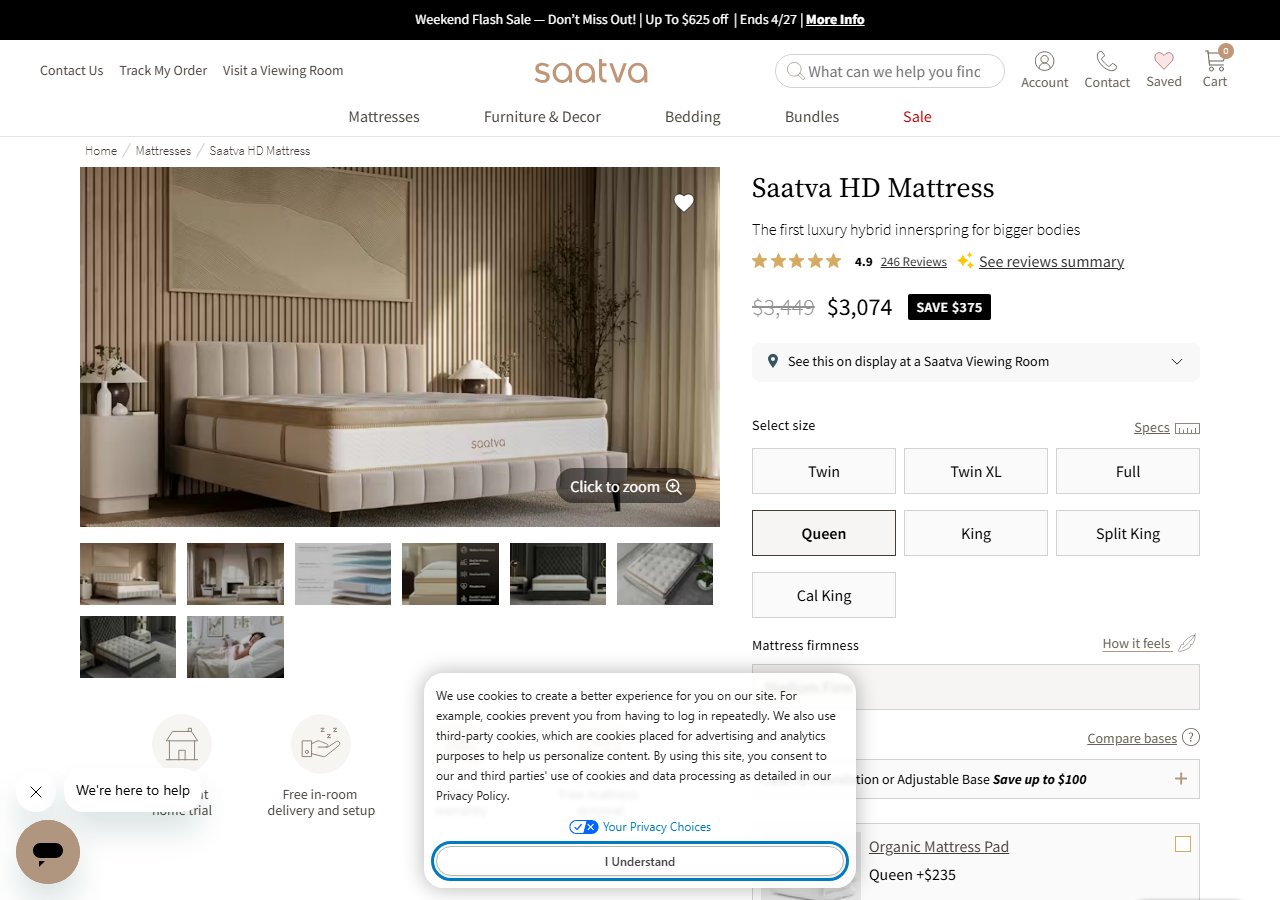
Saatva HD Mattress (Heavy-Duty)
$2,395-$3,995
See Price at Saatva →
Purple Hybrid Premier Mattress
$2,499-$4,799
See Price at Purple →How to evaluate your current mattress before purchasing anything new
One of the clearest findings in the CDC Sleep Hygiene guidance is that the trigger for mattress replacement should be observable and functional, not marketing-driven. Before spending $2,000 to $4,000 on a new sleep surface, apply this four-point evaluation to your current mattress.
First: Stand the mattress on its side and look for visible sag or body impressions deeper than about three-quarters of an inch in the sleep zone. If you see them, the support core has failed and no topper or adjustment will restore adequate support.
Second: Assess how you feel in the first thirty minutes after waking versus after you've been upright for an hour. If morning stiffness resolves within thirty minutes of movement, it is likely positional rather than sleep-surface related. If the stiffness persists beyond thirty to sixty minutes most mornings, the overnight mechanical environment may be a contributing factor.
Third: Check the mattress age. Most manufacturers engineer durability to seven to ten years of use at median body weights. At 250 pounds and above, that service life compresses — expect meaningful performance degradation at five to seven years in standard consumer mattresses not specifically designed for higher weights.
Fourth: Assess whether you've actually implemented the sleep-position interventions consistently. A pillow between the knees in side-lying, or under the knees in back-lying, changes spinal alignment measurably — the NIH National Institute of Arthritis and Musculoskeletal and Skin Diseases back pain guidance specifically identifies sleep position as a primary modifiable variable. If you haven't tried this consistently, try it for two weeks before replacing the mattress.
The downstream economics of inadequate spinal recovery
The federal data on back pain costs is worth sitting with for a moment. AHRQ MEPS data shows that adults with chronic back conditions carry substantially higher average annual personal healthcare expenditures than adults without. The SSA Disability Insurance data shows musculoskeletal disorders as the top driver of new disability claims. The CMS Drug Spending Dashboard shows pain management pharmaceuticals among the most expensive Medicare drug categories.
None of this cost is abstract. For a 52-year-old warehouse worker at 265 pounds who has been managing chronic lumbar pain with over-the-counter NSAIDs, occasional cortisone injections, and periodic physical therapy visits, the cumulative annual cost of managing inadequately recovered back pain — in out-of-pocket expenditure, lost productivity, and long-term disability risk — likely exceeds the cost of a purpose-built sleep surface within two to three years. That arithmetic doesn't make a $3,500 mattress a casual purchase. But it does reframe the economics of the decision.
CDC Arthritis data adds the arthritis complication: with 25% of U.S. adults reporting doctor-diagnosed arthritis and incidence concentrated in physically demanding occupations, many high-bodyweight manual workers are managing both mechanical back pain and inflammatory joint disease simultaneously — a combination that amplifies the importance of overnight recovery conditions.
The summary: mechanism, intervention, then product
The federal data tells a coherent story. The back is the most injured body part in U.S. workplaces. NIOSH documents that manual handling tasks routinely exceed safe spinal loading limits. At body weights of 250 pounds and above, standard consumer mattresses fail structurally in ways that prevent adequate overnight spinal decompression — converting the sleep environment from a recovery window into an additional mechanical stressor.
The evidence-based response to that problem moves in a specific order. First, behavioral interventions: sleep position correction, daily walking, proper lifting mechanics at work — all free, all supported by federal clinical guidance, all more powerful than any product purchase for the majority of cases. Second, clinical evaluation if red flags are present — because no mattress addresses nerve root compression, fracture, or malignancy. Third, and only third, a purpose-built sleep surface when the current one has demonstrably failed and behavioral interventions have been tried consistently.
For that third step, the Saatva HD is the most structurally appropriate option for heavy-duty occupational users. The Loom & Leaf addresses the pressure-point failure mode in high-density memory foam. The Purple Hybrid Premier solves the repositioning problem for pain patients who move frequently overnight. All three are adjuncts to the interventions above — not replacements for them.