The federal data on back injuries is worse than most workers realize
If you work a physically demanding job and you're over 250 lbs, you're operating at the intersection of two compounding risk vectors — and the federal data makes that collision hard to ignore. According to BLS Musculoskeletal Disorders by Occupation tracking, the back is the single most commonly injured body part across all U.S. occupations that result in days away from work. This isn't a warehouse-only problem. It's nurses, construction laborers, long-haul drivers, package handlers, and agricultural workers. The back takes the load when the job demands it, and at higher body weights, it takes more load per repetition, more compression per step, and more sustained spinal stress per hour of standing than conventional ergonomic standards are designed to address.
CDC NCHS Data Brief 390 adds the chronic layer: approximately 20% of U.S. adults live with chronic pain, and the lower back is the most commonly cited location. That 20% is not evenly distributed across the population — it concentrates in physically demanding occupations and in adults who carry more bodyweight, because both factors amplify cumulative spinal load over a working lifetime.
The financial stakes are not abstract. AHRQ HCUP data places back pain among the most expensive conditions in U.S. healthcare by total inpatient and outpatient cost. AHRQ MEPS data shows that adults with chronic back conditions spend substantially more on personal healthcare annually than those without. And SSA Disability Insurance reporting identifies musculoskeletal disorders as the single largest category of new disability claims filed each year in the United States. These are not edge-case outcomes. They are actuarial patterns with predictable inputs — and elevated bodyweight combined with high-demand manual labor is among the clearest of those inputs.
Why back injuries accumulate differently at higher body weights
Understanding the mechanism is not optional if you want to make good decisions about recovery. The NIOSH Lifting Equation establishes that manual material-handling tasks in warehousing, construction, and healthcare routinely exceed safe spinal loading limits even for average-weight workers. The equation defines an Action Limit — the compressive load on the L4-L5 lumbar disc beyond which injury risk rises sharply. At higher body weights, that threshold is reached faster and exceeded more often, because body weight itself contributes to the compressive load equation. A 275-lb construction worker bending to pick up a 40-lb concrete block is generating meaningfully more lumbar disc compression than a 175-lb worker performing the identical lift — the difference is physics, not effort or technique.
This matters for sleep because the night shift is when your spine tries to undo the day's compressive damage. Intervertebral discs are avascular — they receive nutrients through diffusion, a process that depends on the unloading that happens during recumbency. When you lie down, the compressive load on your spine drops dramatically, discs rehydrate, and tissue repair begins. But this process has a prerequisite: your spine needs to actually be in a neutral or near-neutral alignment while you sleep. If your mattress sags under your body weight, your lumbar spine stays in a flexed or laterally bent position for six to eight hours. The rehydration still happens, but it happens in a deformed geometry — and you wake up feeling worse than when you went to bed, because you've effectively spent the night reinforcing the very deformations that built up during work.
CDC sleep data shows that approximately 35% of U.S. adults already sleep less than 7 hours per night — the threshold below which chronic disease risk measurably increases. For high-bodyweight workers in physically demanding jobs, inadequate sleep duration compounds the mechanical injury risk: less sleep means less disc rehydration time, less muscle repair, and less cortisol regulation, all of which increase injury susceptibility the following workday. It is a physiological feedback loop with a clear entry point, and the sleep surface is one of the few variables in that loop that can be modified without a clinical intervention.
CDC Arthritis Data shows that approximately 25% of U.S. adults have doctor-diagnosed arthritis, with prevalence concentrated in physically demanding occupations. For workers already managing arthritic joint load, a sleep surface that fails to distribute pressure appropriately across the hips, shoulders, and lumbar region creates additional inflammatory pressure points that extend morning stiffness well into the first hours of a shift — reducing reaction time, mobility, and lifting mechanics at precisely the moment they need to be sharpest.
The cheapest intervention is the one that doesn't require buying anything
Before any product enters this conversation, the non-product interventions deserve serious attention. Federal data and clinical evidence consistently show that movement, mechanics, and sleep hygiene outperform passive solutions — including the best mattress on the market — when they are applied consistently. The following interventions are drawn directly from federal and NIH sources, and each one addresses a mechanism that affects high-bodyweight workers specifically.
Lifting and bending mechanics are the first line of defense, not a checkbox. OSHA's ergonomics guidance is specific: hinge at the hips, not the lumbar spine. Keep the load close to your body's center of mass. Avoid twisting under load, which generates shear forces the lumbar spine handles poorly at any weight. Most acute back episodes in physically demanding jobs are mechanical — meaning they result from a specific movement pattern, not from structural damage that requires surgery. Mechanical injuries are, by definition, teachable and preventable. The NIOSH Lifting Equation exists precisely to give employers and workers a quantitative framework for identifying dangerous lifts before they cause injury. Workers over 250 lbs should apply that framework more conservatively than the published limits suggest, because the limits were derived from population averages that underrepresent higher bodyweight distributions.
Daily walking is one of the most evidence-supported interventions for chronic low back pain that most workers underutilize during recovery. NIH NCCIH's evidence review on low-back pain finds that 30 minutes of walking on most days reduces chronic low back pain as effectively as most non-drug clinical treatments. Walking loads the spine in a controlled, rhythmic way that promotes disc nutrition, activates the stabilizing musculature of the lumbar region, and reduces the inflammatory markers associated with sedentary recovery. For workers who spend shifts on their feet doing heavy lifting, this recommendation may feel counterintuitive — but the movement quality of walking is structurally different from load-bearing occupational movement, and the benefit is well-documented.
Sleep position is a zero-cost intervention that most chronic back pain patients have never been explicitly taught. NIH guidance on back pain is direct: side-sleeping with a pillow between the knees, or back-sleeping with a pillow under the knees, maintains a more neutral lumbar curve than any other common position. Stomach-sleeping hyperextends the lumbar spine and rotates the cervical spine, generating sustained low-grade stress through the entire posterior chain over a full night's sleep. For high-bodyweight individuals, stomach-sleeping is even more problematic because the abdomen creates a more pronounced lumbar hyperextension curve. This is a correctable variable that costs nothing.
Mattress replacement timing matters more than most consumers realize. CDC sleep hygiene guidance points to the sleep environment as a modifiable determinant of sleep quality. A mattress with visible sag, one that produces morning stiffness worse than what you felt when you lay down, or one that's older than 7 to 10 years is no longer functioning as a spinal support system — it's a hammock. Even the most expensive replacement mattress cannot undo the effects of poor sleep hygiene, inadequate exercise, or daily cumulative spinal overload. But a mattress that has structurally failed is an active obstacle to recovery, not a neutral factor.
For some readers, the interventions above will be sufficient. Improved mechanics, consistent walking, corrected sleep position, and a replaced-if-failed mattress will shift the trajectory of chronic back pain without a significant capital investment. But a meaningful subset of high-bodyweight workers — particularly those over 250 lbs sleeping on standard consumer mattresses built for a 180-lb average — will find that even a relatively new mattress is insufficient. Standard mattresses are typically engineered and tested at weight loads that don't reflect the compressive and sag dynamics at 250, 275, or 300+ lbs. The coil gauge, foam density, and edge-support systems that perform well at average body weights can deflect significantly at higher loads, producing exactly the hammock geometry described above — even in a mattress that is technically not worn out.
When to see a clinician — red flags that no mattress addresses
Not all back pain is mechanical, and not all mechanical back pain is manageable with lifestyle and sleep surface changes. NIH NINDS back pain guidance identifies specific presentations that require prompt clinical evaluation, not a new mattress. Understanding these red flags is particularly important for high-bodyweight workers in physically demanding jobs, because the same occupational exposure that causes mechanical back pain also creates the conditions for more serious pathology — herniated discs with nerve compression, spinal stenosis, and vertebral fractures under sustained compressive load.
The CMS drug spending dashboard identifies opioid and non-opioid pain medication as among the most expensive Medicare drug categories — a reflection of how often chronic back pain escalates into a long-term pharmacological management problem when structural pathology is not identified and addressed early. The workers who end up on that cost curve are disproportionately those who attributed early warning signs to occupational soreness and delayed evaluation. See the clinical red flags section below for the specific presentations that require immediate referral.
Where sleep surface engineering actually matters for 250+ lb workers
For readers who have addressed the free interventions, confirmed there are no clinical red flags requiring imaging, and identified that their current mattress is either structurally failed or inadequate for their body weight, the sleep surface becomes a legitimate tool in the recovery stack — not a cure, but a material factor.
The engineering requirements for a mattress that actually performs at 250+ lbs are different from what most consumer mattress reviews address. You need higher coil gauge or coil count (meaning stiffer, more resilient springs that don't deflect into progressive sag under sustained load), higher-density foam layers (typically 4+ lbs/cubic foot for memory foam, versus the 2-3 lbs that characterizes most standard foam), and robust edge support that maintains consistent spinal alignment whether you're sleeping at the center or the edge of the bed. Without all three, the mattress will perform adequately in a showroom test and progressively fail over the first 18 months of actual use at higher body weights.
The Saatva HD Mattress is the most directly engineered product on this list for the specific reader this article addresses. Saatva built the HD explicitly for higher-bodyweight sleepers — it features a dual-coil system (a tempered steel coil-on-coil architecture) with individually wrapped support coils designed to handle sustained loads above the consumer average without the progressive center deflection that undermines standard innerspring performance. The lumbar zone reinforcement in the HD is a deliberate engineering response to the spinal loading pattern that physically demanding jobs create over a career. For warehouse workers, construction laborers, and heavy-industry workers over 250 lbs, this isn't a luxury tier — it's an appropriately specified tool. Priced at $2,395–$3,995 depending on size, it is a significant capital purchase, which is why it belongs after the free interventions, not before them.
For high-bodyweight workers whose primary complaint is pressure-point pain — the hip, shoulder, and lumbar aching that comes from a surface that can't conform to their body's actual geometry — the Saatva Loom & Leaf Memory Foam Mattress deserves serious consideration. Loom & Leaf uses a high-density, gel-infused memory foam construction with a base layer designed to resist the deep compression that causes standard memory foam to bottom out under higher loads. For workers with arthritic joints or significant hip and shoulder pressure sensitivity — a common presentation in physically demanding occupations, as the CDC arthritis data confirms for 25% of adults in high-demand jobs — the conforming pressure relief of a high-density memory foam surface can reduce morning inflammatory stiffness more effectively than a firmer spring system. Priced at $1,695–$3,295, it's the premium memory foam pick on this list.
The Purple Hybrid Premier Mattress takes a materially different engineering approach that is worth understanding. Purple's GelFlex Grid is a polymer grid architecture — not foam, not spring — that is designed to collapse under pressure points (hips and shoulders) while remaining supportive under areas that don't need contouring (lumbar). The Hybrid Premier version adds a pocketed coil base beneath the grid, providing the support base that higher-bodyweight sleepers require. The grid's pressure-relief performance is particularly relevant for side sleepers over 250 lbs, where hip and shoulder pressure accumulation through a standard surface can cause enough discomfort to disrupt sleep continuity — and sleep continuity, as the CDC sleep data makes clear, is already compromised for 35% of U.S. adults. Priced at $2,499–$4,799, the Hybrid Premier is the premium pressure-relief pick.
Sleep Surfaces Built for High-Load, High-Bodyweight Spinal Recovery
These three mattresses were curated specifically for adults over 250 lbs in physically demanding occupations — each engineered with coil gauges, foam densities, or grid architectures that maintain neutral spinal alignment under sustained higher loads, where standard consumer mattresses progressively fail.

Saatva Loom & Leaf Memory Foam Mattress
$1,695-$3,295
See Price at Saatva →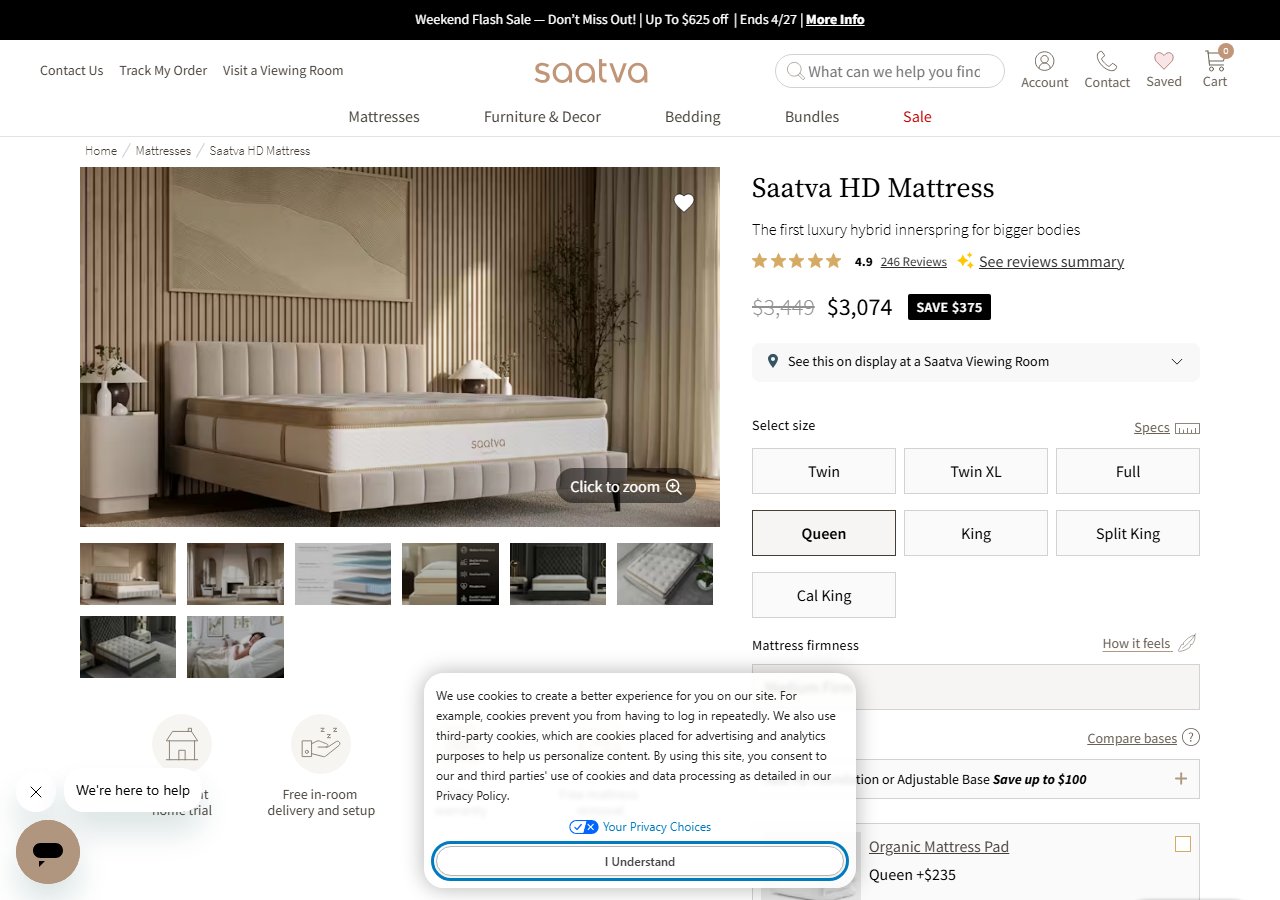
Saatva HD Mattress (Heavy-Duty)
$2,395-$3,995
See Price at Saatva →
Purple Hybrid Premier Mattress
$2,499-$4,799
See Price at Purple →The data-to-intervention-to-product hierarchy in practice
The pattern the federal data describes is consistent and well-documented: physically demanding jobs generate cumulative spinal load that exceeds safe thresholds (NIOSH), the back is the most frequently injured body part at work (BLS), chronic back pain affects 20% of U.S. adults (CDC) and drives some of the highest healthcare expenditures in the system (AHRQ), and musculoskeletal disorders are the leading cause of new disability claims (SSA). For workers over 250 lbs, each of these risks is amplified by the physics of higher body weight interacting with occupational spinal load.
The correct response to that data — in order — is: fix your lifting mechanics, add daily walking, correct your sleep position, replace a structurally failed mattress, see a clinician if red flags are present, and then, if you've done all of that and your sleep surface is still inadequate for your body weight, invest in one of the reinforced surfaces described above. That sequence is not arbitrary. It reflects where the marginal return on effort is highest at each step. Movement and mechanics are the highest-return interventions because they address the primary injury mechanism directly. Sleep position is free and evidence-supported. A mattress replacement is a capital decision that only makes sense once the free variables have been addressed.
If you're a 275-lb warehouse worker who sleeps on a 9-year-old standard mattress with visible sag, walks fewer than 3,000 steps on rest days, and sleeps on your stomach, the mattress is probably the third problem, not the first. Start with the walk. Fix the sleep position. Then reassess the surface. The federal data on what actually moves the needle on chronic back pain points consistently toward movement and mechanics first — products are one tool in the stack, not the foundation of it.
BLS Employer Costs data shows that industries with high MSD incidence carry workers' compensation insurance rates 3-5x higher than low-MSD industries — a cost that ultimately depresses wages and benefits for the workers who bear the highest physical risk. The individual-level decisions described in this article — better mechanics, more movement, appropriate sleep surface — are modest levers against a structural problem. But they are the levers that are within reach tonight, and the evidence says they work.