The Quiet Epidemic Disrupting Sleep After 60
CDC Arthritis Data puts the prevalence of doctor-diagnosed arthritis at approximately 25% of all U.S. adults — and that number does not distribute evenly across age groups. The concentration in adults over 60 is striking. Osteoarthritis, the most common form, affects the cartilage-lined surfaces of weight-bearing joints: knees, hips, lumbar facet joints, and the small joints of the hands and feet. These are precisely the structures that bear the most mechanical stress during a lifetime of work — and they are the same structures that make horizontal rest painful rather than restorative.
Now layer on another federal data point. CDC Sleep and Sleep Disorders Data shows that roughly 35% of U.S. adults sleep fewer than 7 hours per night — the threshold the CDC and the American Academy of Sleep Medicine associate with elevated chronic disease risk. Chronic pain is one of the most reliable drivers of that deficit. When hips ache on a too-firm surface, when lumbar facet joints compress on a sagging mattress, when shoulder joints protest being pressed into a pillow for eight hours, sleep fragments. Light sleep replaces deep slow-wave sleep. Morning stiffness worsens. And the pain-sleep feedback loop tightens: poor sleep lowers pain thresholds, which makes the next night worse.
This article is structured to give you the full picture — mechanism first, free interventions second, clinical red flags third, and products last. That ordering is intentional. As AHRQ MEPS data makes clear, average annual healthcare expenditures for adults with chronic back conditions substantially exceed those for adults without such conditions. A new mattress is a reasonable tool. But it is one tool in a much larger toolkit, and it works best when the other tools are already in place.
Why Aging Joints Make Every Surface Feel Wrong
Understanding why joint pain disrupts sleep requires a brief tour of age-related changes in musculoskeletal tissue. This is not academic — it directly explains why the interventions and product features discussed later actually work.
Cartilage and synovial fluid changes. Articular cartilage loses water content with age, becoming stiffer and more brittle. Synovial fluid — the lubricant that allows low-friction joint movement — decreases in volume and changes in viscosity. The result is that joints that were mechanically quiet during a lifetime of daily activity become loud and painful when they are asked to maintain a single pressure-loaded position for six to eight hours. A hip joint pressed into a firm mattress surface for four hours straight experiences sustained compressive loading without the redistribution that walking provides.
Lumbar facet joint degeneration. The lumbar spine contains paired facet joints at each vertebral level. These joints guide spinal movement and prevent excessive rotation. With age and cumulative loading — BLS Musculoskeletal Disorders by Occupation tracking identifies the back as the most common body part injured across all U.S. occupations with days away from work — these facet joints develop osteophytes (bone spurs) and cartilage erosion. Sleeping on a surface that allows the lumbar spine to sag into flexion (too soft) or that forces it into sustained extension (too firm) directly loads these degenerated surfaces. The waking-up-stiff phenomenon is largely a facet joint and spinal disc hydration story.
Peripheral joint sensitivity. Osteoarthritis creates peripheral sensitization — the nervous system lowers its threshold for pain signaling from affected joints. This means that pressure that would be unremarkable to a 30-year-old causes genuine pain in a 65-year-old with hip or shoulder OA. A mattress that does not adequately relieve pressure at the greater trochanter (the widest point of the hip) and the shoulder creates sustained, low-grade nociceptive input that fragments sleep without the sleeper always being fully aware of why they are waking.
The medication burden. CMS Drug Spending Dashboard data identifies opioid and non-opioid pain medication spending among the most expensive Medicare drug categories, reflecting how heavily chronic pain drives pharmaceutical utilization in older adults. Many of these medications — NSAIDs, muscle relaxants, opioids, gabapentinoids — alter sleep architecture independently of pain. They suppress REM sleep, cause next-day sedation, and create their own feedback loops. Improving sleep surface mechanics is not a replacement for medication management, but it can reduce the nightly pain stimulus that drives medication use in the first place.
Cumulative occupational load. Many adults over 60 spent decades in physically demanding jobs. NIOSH Lifting Equation documentation shows that manual material-handling tasks in warehousing, construction, and healthcare routinely exceed safe spinal loading limits. The cumulative disc compression, facet joint loading, and soft tissue strain from a 30-year career in a physical trade does not disappear at retirement. It presents as accelerated lumbar degeneration, hip arthritis, and chronic pain that peaks — and disrupts sleep — in the sixth and seventh decades.
SSA Disability Insurance data identifies musculoskeletal disorders as the largest single category of new disability claims annually, which underscores how consequential this population's pain burden is at a systemic level. And AHRQ HCUP data confirms that back pain is among the most expensive conditions in U.S. healthcare by total inpatient and outpatient cost. The financial case for prevention and early management is as strong as the clinical case.
Try These First — The Cheapest Intervention Is the One That Requires No Purchase
Before we talk about specific mattresses, federal evidence supports several interventions that cost nothing or very little. The principle here is straightforward: the cheapest intervention is the one that does not require buying anything. Many older adults who report poor sleep on their current mattress have not yet optimized sleep position, daily movement, or basic sleep hygiene — all of which have stronger evidence bases than surface firmness alone.
NIH NCCIH evidence makes a striking point that is worth quoting directly: walking 30 minutes most days reduces chronic low back pain as effectively as most non-drug clinical treatments. Not stretching, not massage, not a new mattress — walking. The mechanism is well understood: rhythmic axial loading and unloading of spinal discs during gait pumps nutrients into disc tissue, maintains facet joint mobility, and triggers endogenous pain-modulating pathways. For older adults whose back and joint pain peaks at night and on waking, a daily 30-minute walk — even split into two 15-minute segments — is the highest-yield intervention available.
NIH National Institute of Arthritis and Musculoskeletal and Skin Diseases guidance on sleep position is equally actionable. Side-sleeping with a pillow between the knees keeps the pelvis level and reduces rotational torque on the lumbar spine and hip joints. Back-sleeping with a pillow or folded blanket under the knees flattens the lumbar lordosis and reduces facet joint compression. Stomach-sleeping — which approximately 7% of adults prefer — places the lumbar spine in sustained hyperextension and torques the cervical spine for the full sleep period. For adults with lumbar facet OA or hip arthritis, sleep position change is a zero-cost, immediate intervention.
CDC Sleep Hygiene guidance also sets a practical threshold for mattress replacement: replace a mattress if it has visible sag, if you wake stiffer than you went to bed, or if it is older than 7 to 10 years. This is important framing for older adults who may be sleeping on a mattress purchased in a previous decade. A mattress that has lost its structural integrity cannot provide spinal alignment regardless of its original specification.
For readers who have already tried these free interventions — who walk daily, sleep with correct pillow positioning, maintain consistent sleep hygiene, and are still waking with joint pain or stiffness — surface mechanics become the relevant variable. The research literature on mattress firmness and chronic pain, while not as robust as the walking literature, does support a few consistent findings: medium-firm surfaces outperform both very firm and very soft surfaces for lumbar pain; pressure-relieving materials (memory foam, latex, hybrid gel layers) reduce trochanteric and shoulder pressure points for side sleepers; and zoned support systems that provide more resistance under the lumbar region and less under the shoulders and hips address the conflicting needs of different body regions. With those mechanisms in mind, here are the products we recommend for adults over 60 managing arthritis and chronic back pain.
When to See a Clinician — Red Flags That a Mattress Cannot Fix
A new sleep surface is appropriate for mechanical, position-related pain. It is not appropriate — and potentially dangerous to pursue instead of medical care — when back or joint pain carries features that suggest serious underlying pathology.
NIH National Institute of Neurological Disorders and Stroke Back Pain guidance is explicit about the red flags that require prompt clinical evaluation: back pain that radiates below the knee (suggesting nerve root compression), pain that follows trauma, pain accompanied by leg weakness (possible cauda equina involvement), bowel or bladder changes (a surgical emergency if caused by spinal cord or cauda equina compression), or pain accompanied by fever (possible infectious etiology). For adults over 60, add unexplained weight loss and pain that is worse at night and does not respond to position change — these patterns suggest systemic disease including malignancy.
CDC NCHS Data Brief 390 establishes that approximately 20% of U.S. adults experience chronic pain, with lower back as the most common pain location. Not all of that pain is benign mechanical pain. For older adults who have not had a clinical assessment of their back or joint pain in several years, a physician or physical therapist evaluation before investing in a new sleep surface is time well spent. A physical therapist can identify whether specific structural issues — spinal stenosis, hip labral tears, inflammatory arthritis — require targeted intervention that surface firmness alone cannot address.
Where Surface Mechanics Actually Help
For the majority of adults over 60 with mechanical back pain, hip OA, or shoulder OA whose pain does not carry red flags, the sleep surface matters — but the specific mechanism matters too. Here is what the evidence supports:
Pressure relief at bony prominences. The hip (greater trochanter), shoulder (acromion), and knee (medial femoral condyle) are the three primary pressure points for side sleepers. For adults with arthritis at any of these sites, a surface that does not adequately conform to body contours creates sustained pressure that fragments sleep. This is the core argument for adaptive materials — memory foam, latex, and gel-infused hybrid layers — over traditional innerspring systems.
Zoned support for lumbar alignment. A surface that conforms everywhere equally will allow the lumbar spine to sag into flexion in a side-sleeping position if the hips sink too deeply. Zoned support systems — firmer coil or foam zones under the lumbar region, softer zones under the shoulders and hips — address this biomechanical conflict. For back-sleeping older adults with lumbar facet OA, maintaining the natural lordotic curve rather than flattening it is the priority.
Motion isolation. Older adults are more likely than younger adults to share a sleep surface with a partner, and more likely to have their sleep disrupted by partner movement given the light-sleep predominance that comes with age. High-density foam and individually pocketed coil systems substantially reduce motion transfer compared to traditional interconnected innerspring systems.
With those mechanics established, three products stand out for this reader profile. The Saatva Loom & Leaf Memory Foam Mattress is the premium memory foam pick for adults whose primary complaint is joint pain and pressure sensitivity. Saatva builds the Loom & Leaf with a dual-layer organic memory foam system — a 5-pound-density comfort layer over a convoluted support foam — that provides the deep pressure relief at hip and shoulder that arthritis patients need, while the firm base prevents the catastrophic sinking that exacerbates lumbar pain. The Relaxed Firm option ($1,695–$3,295) is the specification most consistently recommended by occupational therapists for adults with hip or shoulder OA who are side sleepers.
For older adults who are larger-framed, who spent careers in physically demanding trades, or whose lumbar degeneration is more advanced, the Saatva HD Mattress addresses a specific biomechanical problem: standard mattresses lose their zoned support properties faster under higher body weights, allowing the lumbar spine to sag regardless of initial firmness specification. The Saatva HD ($2,395–$3,995) is engineered with a dual tempered steel coil system — 884 individually wrapped 13-gauge coils over a base layer of 476 Bonnell coils — that maintains its support profile under sustained high load. For a retired construction worker or warehouse supervisor with lumbar disc disease and 30 years of axial loading, this is the more appropriate specification than a standard mattress.
For side-sleeping older adults whose primary complaint is hip and shoulder pressure pain rather than lumbar instability, the Purple Hybrid Premier Mattress approaches pressure relief through a different material science. Purple's proprietary GelFlex Grid — a hyper-elastic polymer grid structure — redistributes pressure horizontally rather than simply conforming to the body's contours. The result is that bony prominences like the greater trochanter and acromion experience materially lower interface pressure than on conventional foam surfaces, while the grid's column-buckling behavior provides firm support to the lumbar region. The Hybrid Premier ($2,499–$4,799) adds individually pocketed coils beneath the grid layer, improving edge support and reducing motion transfer — relevant for older adults with mobility limitations who use the edge of the mattress to assist with getting up.
Mattresses Engineered for Arthritis Relief and Spinal Support After 60
These three mattresses were selected specifically for adults over 60 managing arthritis, lumbar degeneration, or chronic joint pain — with each pick targeting a distinct biomechanical need: deep pressure relief, heavy-load spinal stability, or grid-based trochanteric and shoulder pressure redistribution.

Saatva Loom & Leaf Memory Foam Mattress
$1,695-$3,295
See Price at Saatva →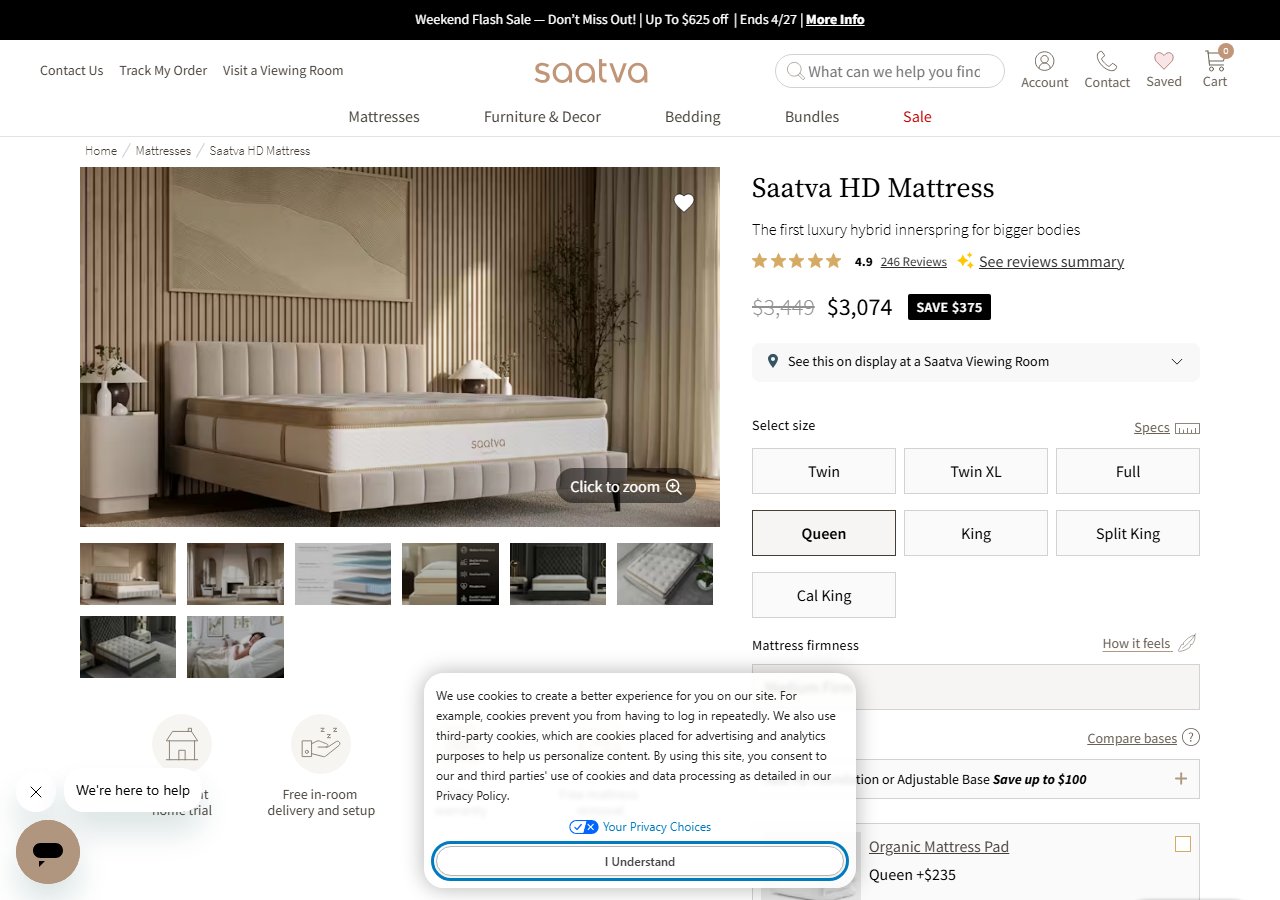
Saatva HD Mattress (Heavy-Duty)
$2,395-$3,995
See Price at Saatva →
Purple Hybrid Premier Mattress
$2,499-$4,799
See Price at Purple →The Data-to-Intervention Hierarchy in Practice
The federal data reviewed in this article tells a coherent story. CDC Arthritis Data and CDC Sleep Data establish that joint pain and sleep deficiency co-occur at high rates in older adults. The biomechanical mechanisms — cartilage degeneration, facet joint loading, peripheral sensitization — explain why horizontal rest is uniquely stressful on arthritic joints. The BLS MSD tracking data and NIOSH Lifting Equation documentation explain the occupational loading history that accelerates that degeneration. And the AHRQ MEPS and AHRQ HCUP cost data establish why getting this right has financial consequences at both the individual and system level.
The intervention hierarchy that follows from that data is: daily walking first, sleep position optimization second, mattress replacement when the current surface has demonstrably failed, and clinical evaluation whenever red flags are present. Products are a legitimate tool in that hierarchy — but they are the fourth step, not the first. For older adults who have worked through steps one through three, the Saatva Loom & Leaf, Saatva HD, and Purple Hybrid Premier represent evidence-aligned choices for the specific biomechanical problems that arthritis and chronic back pain create at night. Choose based on your body weight, primary pain location, and whether pressure relief or lumbar support stability is your primary need.