The Federal Data Picture for Adults Over 60
Start with the numbers that don't require interpretation. CDC arthritis surveillance reports that approximately 25% of U.S. adults carry a doctor-diagnosed arthritis diagnosis — a figure that climbs steeply with age and concentrates in populations with histories of sustained physical demand: construction trades, agriculture, manufacturing, nursing. For adults over 60 who spent decades on their feet, on ladders, or bending into confined spaces, that 25% is a floor, not a ceiling. Meanwhile, CDC WONDER mortality data documents that cardiovascular disease accounts for approximately 1 in 3 U.S. deaths annually — the single largest cause of mortality in a country that increasingly skews older. These two chronic condition burdens — joint degradation and cardiovascular risk — are not separate problems. They share inflammatory pathways, they compound each other's functional limitations, and they are both significantly influenced by the same upstream variable: circulatory health.
Layer in a third federal data point and the picture sharpens further. CDC's Behavioral Risk Factor Surveillance System (BRFSS) documents that approximately 76% of U.S. adults do not meet the 150-minute-per-week moderate aerobic activity guideline — and that failure rate worsens with age and musculoskeletal pain. When joint pain makes walking uncomfortable and cardiovascular conditioning has declined after decades of occupational rather than recreational exertion, the standard intervention prescription — just exercise more — runs into a practical wall. This is precisely the niche that passive thermal therapy occupies in serious cardiovascular and occupational health research: it produces measurable circulatory and hemodynamic responses without requiring the musculoskeletal load of active exercise.
NIOSH's published research literature — the same federal body that sets workplace heat exposure limits and thermal physiology standards — documents that passive heat therapy interventions, including sauna use, are associated with measurable cardiovascular and circulatory adaptation in regular users. This is not fringe wellness marketing. It is federally-acknowledged physiology, studied in occupational health contexts precisely because thermal regulation is a core NIOSH research domain. The NIOSH Total Worker Health framework explicitly integrates workplace recovery interventions, including thermal therapy, as components of comprehensive occupational health — not separate wellness programming. For the 60-year-old retired ironworker or active-duty postal carrier, that framing matters: this is recovery infrastructure, not luxury.
Why Cardiovascular and Joint Decline Accelerates After 60 — The Mechanism
To understand why infrared sauna shows up in serious literature as an intervention for this demographic, you need to understand what actually happens to the cardiovascular and musculoskeletal systems after six decades of use.
Arterial compliance — the ability of blood vessel walls to expand and contract with each heartbeat — declines progressively with age. This stiffening increases systolic blood pressure, elevates the workload on the left ventricle, and reduces perfusion efficiency to peripheral tissues including joint cartilage. Cartilage is avascular: it receives its nutrients entirely through the compression-and-release mechanics of movement and through synovial fluid circulation. When blood supply to periarticular tissues declines and synovial fluid viscosity increases with inactivity and aging, joint stiffness becomes a self-reinforcing cycle. Less movement produces less synovial fluid turnover, which produces more stiffness, which produces less movement.
Infrared sauna interrupts this cycle through a specific thermal mechanism distinct from traditional steam sauna. Near-infrared and far-infrared wavelengths penetrate tissue at depths of 1.5 to nearly 4 centimeters — reaching periarticular tissue, muscle belly, and subcutaneous fat layers directly rather than relying solely on convective surface heating. The thermal stimulus triggers vasodilation of peripheral blood vessels, increases cardiac output (studies consistently document heart rate elevation to 100–150 BPM during moderate sauna sessions, mimicking moderate-intensity aerobic work), and elevates skin and core temperature in ways that drive systemic hemodynamic responses. For someone whose joint capsules are receiving suboptimal perfusion and whose arterial compliance has declined, this represents a genuine physiological stimulus.
CDC's PLACES data system tracks cardiovascular disease, hypertension, and stroke rates at the county level — the exact conditions most studied in sauna intervention research. The geographic concentration of these conditions in post-industrial regions with high proportions of former manual-labor workers is not coincidental. These are populations whose occupational history has compounded their cardiovascular aging trajectory. AHRQ's Medical Expenditure Panel Survey documents a substantial healthcare cost differential between adults with and without chronic cardiovascular conditions — a federal-level accounting of what unmanaged circulatory decline costs. Preventive interventions that slow that trajectory have economic as well as clinical justification.
NOAA's tracking of outdoor heat exposure — built around agricultural, construction, and roadwork occupational risk — has contributed substantially to federal understanding of thermal physiology. The same physiological data that documents how heat stress affects workers informs the positive adaptation research: controlled, sub-threshold thermal exposure produces cardiovascular conditioning responses. The distinction between harmful occupational heat stress and beneficial therapeutic heat exposure is dose and control — exactly what a home sauna provides.
Try These First: Free Interventions That Compound Sauna's Benefit
The most important sentence in this article is this one: the cheapest intervention is the one that doesn't require buying anything. Before a dollar is spent on a sauna unit, four behavioral and clinical interventions will determine whether any thermal therapy you add to your routine actually produces the benefits the research documents. These are not disclaimers. They are the actual evidence-based practice.
The cardiovascular cohorts in sauna research who showed the strongest measurable benefit — reduced all-cause mortality risk, improved endothelial function, lower hypertension burden — were not sedentary people sitting in a box. They were people who also met or approached CDC adult physical activity guidelines of 150 minutes of moderate aerobic activity per week. Sauna appears to function as a cardiovascular complement and recovery accelerant, not as a standalone substitute for movement. For the active adult over 60 who swims three days a week, cycles, or walks daily, infrared sauna layers onto an existing aerobic foundation. For the adult who is currently sedentary, building that movement base first — even 20-minute daily walks — is the higher-leverage intervention.
Hydration protocol is the second non-negotiable. A 20-minute infrared session at therapeutic temperatures can produce 0.5 to 1 liter of fluid loss through sweat. CDC NIOSH heat-stress guidance translates directly: pre-hydrate with 16 ounces of water before entering, and replace fluid plus electrolytes within an hour of exit. For adults over 60, whose thirst sensation is physiologically blunted relative to younger adults and whose kidney function may be operating at reduced reserve, this protocol is not optional. Electrolyte replacement — sodium, potassium, magnesium — matters as much as fluid volume when sessions exceed 20 minutes.
The third intervention addresses session timing. NIH sleep guidance is explicit: core body temperature must drop to initiate sleep onset, and sauna sessions immediately before bed can delay that drop by 60–90 minutes. The practical protocol: finish heat exposure at least 90 minutes before your intended sleep time. For older adults managing circadian rhythm changes and sleep architecture shifts, getting this timing right means the difference between sauna improving sleep quality — which is documented in the research — and disrupting it.
Finally, and most critically for this demographic: clear heat therapy with your clinician before beginning. NIH NCCIH guidance on sauna use is specific — sauna can drop blood pressure rapidly, and it is contraindicated in uncontrolled hypertension, recent cardiac events, certain arrhythmias, and in individuals taking medications that affect thermoregulation (beta-blockers, diuretics, some antidepressants, and antihistamines are all in this category). For the 62-year-old managing hypertension on two medications, this is not a theoretical concern. It is the first clinical conversation.
For readers who have addressed these four behavioral foundations and have had the clinical conversation — and whose physicians have cleared them for thermal therapy — the question becomes which product form factor makes sense for their living situation, budget, and use frequency. This is where equipment enters the hierarchy, as an adjunct to intervention, not a replacement for it.
When to See a Clinician Before Starting Heat Therapy
This section is not boilerplate. For the 60-plus demographic, the clinical screening step has specific, evidence-backed urgency.
FDA's Adverse Event Reporting System (FAERS) maintains federal-level safety data on adverse events associated with thermal therapy devices. The adverse event profile is not dominated by equipment malfunction — it is dominated by user-level contraindication: hypertensive episodes, syncopal events (fainting), and cardiac arrhythmia in individuals who did not screen their cardiovascular status before beginning heat therapy. The FDA's 510(k) clearance database indexes infrared therapy devices as Class II medical devices, which means manufacturers have made specific safety and efficacy claims that received federal review — but that review does not substitute for individual clinical screening.
Cardiovascular disease kills approximately 1 in 3 Americans per CDC WONDER, and the prevalence of subclinical cardiovascular disease — arterial disease that has not yet produced a diagnosed event — in adults over 60 is substantially higher than diagnosed prevalence suggests. An adult who has not had a cardiovascular workup in several years, who carries two or more risk factors (hypertension, dyslipidemia, type 2 diabetes, tobacco history, obesity, family history), or who is managing active joint inflammation from an autoimmune condition (rheumatoid arthritis rather than osteoarthritis) warrants a physician conversation before adding any thermal therapy protocol. The clinical conversation is the intervention.
Where Products Fit: Form Factor First, Brand Second
For adults over 60 who have cleared the clinical threshold and established the behavioral foundation, the product decision is primarily a form-factor decision. The two dominant options are a full-footprint barrel or cabin sauna installed outdoors or in a dedicated space, and a portable infrared blanket that stores under a bed and deploys on any flat surface. These are not equivalent products competing on the same dimension — they serve different use cases, different budgets, and different living situations.
The full-installation option is best for households with outdoor space, a dedicated room, or a finished garage — and for adults who intend to use the sauna as a serious, multi-session-per-week recovery protocol. The Almost Heaven Pinnacle 4-Person Barrel Sauna represents the highest-quality domestic option in the barrel sauna category at $5,499. The barrel geometry is not aesthetic preference — the curved interior promotes natural convection, reducing hot and cold spots and allowing the thermal environment to stabilize more evenly than a rectangular cabin design. For an older adult who may be sharing sessions with a spouse or using the space for extended low-temperature sessions targeting joint mobility rather than cardiovascular peak response, the four-person footprint provides practical flexibility. Almost Heaven builds in North American white cedar, which is the gold standard for thermal sauna construction: dimensionally stable, naturally antimicrobial, low-resin, and fragrant without chemical treatment. At $5,499, this is a capital investment comparable to a piece of fitness equipment — and one that depreciates considerably more slowly than most.
The portable option is best for apartments, renters, traveling adults who split time between residences, or anyone who wants to trial infrared therapy before committing to a full installation. The HigherDOSE Infrared Sauna Blanket V4 at $599 delivers far-infrared wavelength exposure through a full-body blanket design that produces comparable core temperature elevation and sweat response to a low-temperature cabin session. The V4 generation uses amethyst and tourmaline layers — materials that emit far-infrared wavelengths when heated — and a non-toxic polyurethane interior that has been independently tested for off-gassing. For the 68-year-old who travels between a primary residence and a winter rental, or who lives in a condo without outdoor space, the HigherDOSE blanket represents access to the same underlying thermal physiology at a fraction of the installation cost and zero permanent footprint. The tradeoff is the experience: a blanket session is functionally different from sitting upright in a cedar cabin, and users with claustrophobia or significant mobility limitations should note that entry and exit from a blanket design requires a different range of motion than a bench-access cabin.
Both products sit at opposite ends of the commitment and cost spectrum — and that is intentional in this curation. Most readers over 60 fall into one of two categories: those who are ready to make thermal therapy a serious household infrastructure investment (the Almost Heaven), and those who want a practical, reversible entry point (the HigherDOSE blanket). There is no meaningful product in this category at the $1,500–$4,000 mid-range that we can recommend without reservation; the barrel and blanket options represent clearer value propositions.
Infrared Saunas for Active Adults Over 60: Two Form Factors, One Evidence Base
These two products were selected specifically for adults over 60 managing cardiovascular and joint health — one for serious home installation, one for portability and budget flexibility — both with a clinical safety profile supported by FDA device oversight.
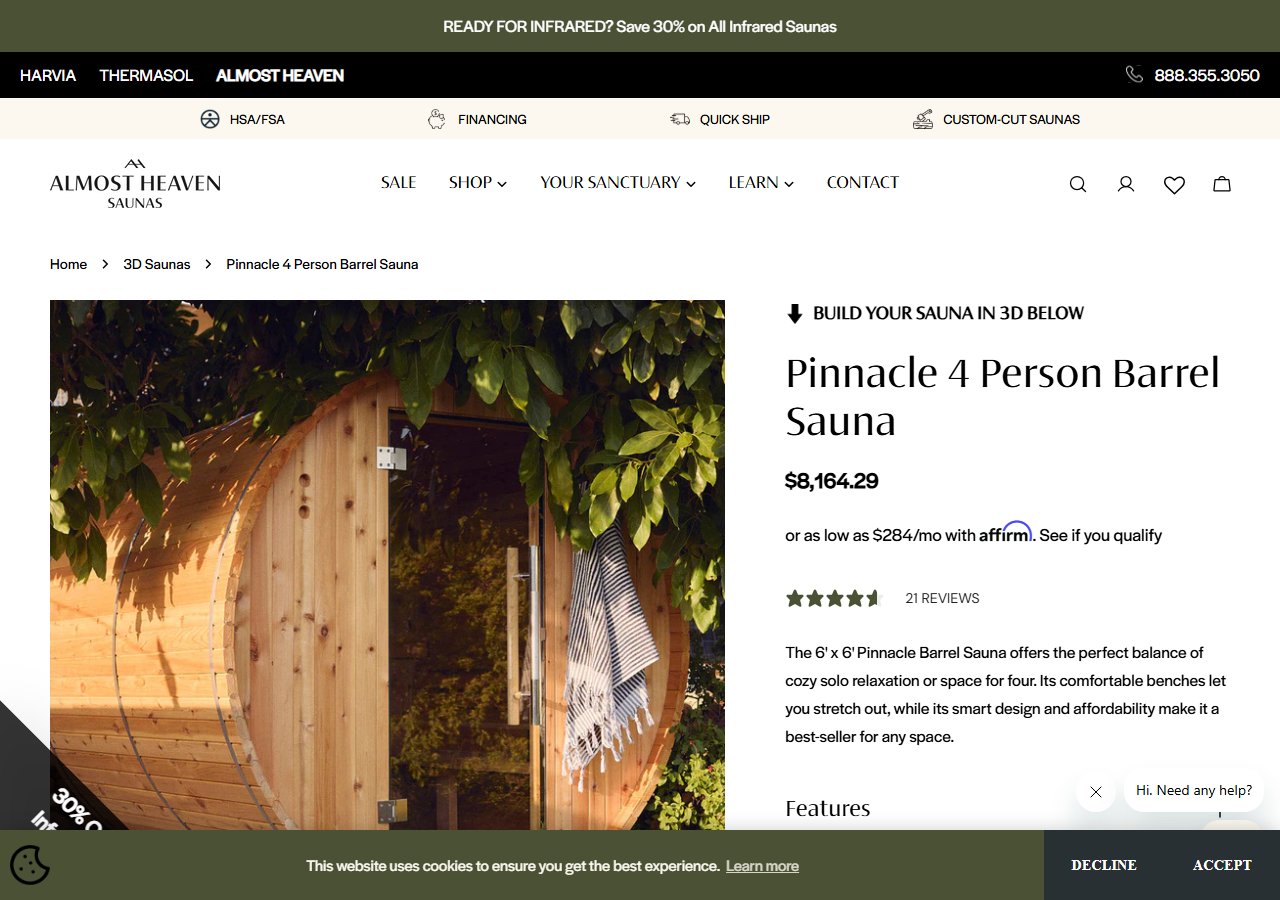
Almost Heaven Pinnacle 4-Person Barrel Sauna
$5,499
See Price at Almost Heaven →
HigherDOSE Infrared Sauna Blanket V4
$599
See Price at HigherDOSE →The Investment Case: Federal Data, Not Marketing Copy
Return to the federal data for the closing argument. AHRQ MEPS documents that the healthcare cost differential between adults with and without chronic cardiovascular conditions is substantial — a gap that compounds year over year as managed conditions progress. CDC PLACES county-level data shows the geographic concentration of hypertension, cardiovascular disease, and stroke in exactly the post-industrial communities where older manual-labor workers are most concentrated. The NIOSH Total Worker Health framework frames thermal therapy not as wellness programming but as legitimate occupational recovery infrastructure.
For the active adult over 60 — the retired pipefitter who still skis, the 64-year-old nurse who walks five miles a day, the former construction foreman who is now managing bilateral knee arthritis — the investment case is not "this feels good." It is: passive thermal therapy produces documented cardiovascular adaptation, supports joint perfusion and synovial fluid dynamics, has a federal-level safety and efficacy review pathway through FDA 510(k) clearance, and compounds in benefit when layered onto an existing aerobic foundation.
The sequencing matters. Pair sauna with light cardio per CDC physical activity guidelines. Hydrate aggressively per NIOSH heat-stress protocols. Time sessions for sleep optimization per NIH NCCIH guidance. Clear contraindications with your clinician per NIH NCCIH sauna guidance. Then, if the clinical picture supports it and the form factor fits your living situation, the Almost Heaven Pinnacle or the HigherDOSE Infrared Sauna Blanket V4 provide the hardware to execute a protocol with genuine federal-data backing.
This is not a luxury purchase dressed in wellness language. For the right candidate — active, medically cleared, already meeting or approaching aerobic activity guidelines — it is a recovery investment with a credible evidence base and a federal-research foundation that the marketing industry has not yet caught up to accurately representing.