The Federal Data Picture: Two Epidemics Colliding After 60
Start with two numbers. CDC sleep surveillance data shows that approximately 35% of U.S. adults report sleeping fewer than 7 hours per night — the threshold the CDC associates with elevated risk for heart disease, diabetes, obesity, and cognitive decline. Separately, CDC arthritis data shows that roughly 25% of U.S. adults have received a doctor's diagnosis of arthritis, with prevalence climbing steeply after age 60 and concentrated in adults who spent careers in physically demanding occupations.
For adults over 60, these are not two separate statistics. They are one compounding problem. Joint pain disrupts sleep. Sleep deprivation amplifies pain sensitivity. The cycle feeds itself every night, and federal healthcare cost data shows exactly what it costs when the cycle goes unbroken for years.
AHRQ HCUP data identifies back pain as one of the most expensive conditions in U.S. healthcare by total inpatient and outpatient cost. The AHRQ Medical Expenditure Panel Survey documents that adults with chronic back conditions carry personal healthcare expenditures that substantially exceed those of adults without such conditions. And the CMS Drug Spending Dashboard shows that opioid and non-opioid pain medications rank among the most expensive Medicare drug categories — a direct reflection of the chronic-pain burden falling hardest on older Americans.
The SSA Disability Insurance reports add a final, sobering data point: musculoskeletal disorders are the single largest category of new disability claims filed in the United States every year. For adults approaching or navigating retirement, this is not an abstract statistic. It is a preview of what untreated, poorly managed musculoskeletal pain looks like over a decade.
This article is for adults 60 and older who are waking up stiff, lying awake with aching hips or a burning lower back, and wondering whether the problem is their body or their bed. The honest answer, rooted in federal data, is: usually both — and the interventions are almost always in that order.
Why This Happens: The Biomechanics of Nighttime Joint Pain in Older Adults
Understanding why joint pain disrupts sleep requires understanding what the body does — and stops doing — after 60.
Cartilage thinning and synovial changes. Osteoarthritis, the most common form of arthritis in older adults, involves the progressive degradation of articular cartilage. As cartilage thins, the gap between bones narrows. This matters at night because when you lie still for extended periods, synovial fluid — the joint's natural lubricant — circulates less effectively. Joints that are minimally loaded during the day can stiffen significantly after two or three hours of the same position. This is why many adults over 60 report their worst pain not at the start of the night but at 2 or 3 a.m., when they've been in one position long enough for inflammation to pool.
Spinal changes and disc compression. The intervertebral discs that cushion the vertebrae lose hydration and height with age. This disc desiccation reduces the spine's ability to absorb compressive forces and changes how the lumbar curve behaves in a lying position. A mattress that does not contour to the spine's natural curvature forces the lumbar region into either hyperextension (on a too-firm surface) or flexion-loaded sag (on a too-soft surface). Both patterns generate sustained muscular tension through the night, producing the classic morning stiffness that improves within 20–30 minutes of moving.
Pressure points and circulatory changes. Older adults have less subcutaneous fat padding over bony prominences — hips, shoulders, sacrum, heels. A surface that provides inadequate pressure relief concentrates load on these landmarks, triggering localized ischemia (reduced blood flow), which the nervous system registers as pain and converts into frequent position changes. Those position changes fragment sleep architecture, reducing time in slow-wave and REM sleep — exactly the stages where the body clears inflammatory cytokines and consolidates physical recovery.
The pain-sleep feedback loop. CDC NCHS Data Brief 390 documents that approximately 20% of U.S. adults experience chronic pain, with the lower back as the most common pain location. Chronic pain is not just a physical signal — it activates the hypothalamic-pituitary-adrenal axis, elevating cortisol and keeping the nervous system in a low-grade arousal state. This is why back pain and sleep problems are so rarely separate diagnoses in older adults; they share neurological infrastructure.
Occupational loading history. The BLS Musculoskeletal Disorders by Occupation data confirms that the back is the most commonly injured body part across all U.S. occupations with days away from work. Adults now in their 60s and 70s who worked in healthcare, construction, warehousing, manufacturing, or agriculture spent decades loading their spines in ways that accumulated microtrauma long before arthritis was diagnosed. The NIOSH Lifting Equation documents that manual material-handling tasks in those industries routinely exceed safe spinal loading limits. The pain those workers experience at night is not a coincidence — it is the cumulative balance sheet of a career.
Try These First: Free and Low-Cost Interventions Backed by Federal Evidence
The cheapest intervention is the one that does not require buying anything. Before evaluating any mattress — regardless of price or construction — every adult with nighttime joint pain should work through the following interventions. Several of them have stronger evidence bases than any single product on the market.
Sleep position is the biggest free variable. NIH guidance on back pain from NIAMS identifies sleep position as a modifiable factor with direct impact on spinal loading. Side-sleeping with a pillow between the knees keeps the pelvis level and reduces rotational stress on the lumbar spine. Back-sleeping with a pillow under the knees reduces lumbar hyperextension. Stomach-sleeping, by contrast, torques the lumbar spine into rotation and extension simultaneously — the worst mechanical configuration for adults with degenerative disc disease or facet arthritis. A pillow repositioned tonight costs nothing.
Daily walking is a primary intervention. The NIH National Center for Complementary and Integrative Health's evidence review on low back pain finds that walking 30 minutes most days reduces chronic low back pain as effectively as most non-drug clinical treatments. For older adults, walking also promotes synovial fluid circulation in the hip and knee joints, reduces inflammatory cytokine levels, and improves sleep quality directly through circadian entrainment. This is not a lifestyle nicety — it is a clinical-grade intervention that no mattress can replicate.
Evaluate your current mattress honestly. CDC sleep hygiene guidance and broad clinical consensus support replacing a mattress if it shows visible sag, if you consistently wake stiffer than you went to bed, or if it is older than 7 to 10 years. The last point matters: a 12-year-old mattress with internal coil collapse or foam compression is not a pressure-relief surface — it is a source of active harm. But a new mattress will not undo poor sleep hygiene, sedentary days, or sleep apnea. Fix the obvious variables first.
Mechanical lifting habits, even off the job. OSHA's ergonomics guidance emphasizes hinging at the hips rather than rounding the lumbar spine for any load-bearing movement — including getting in and out of bed, picking up grandchildren, or carrying groceries. Most acute back episodes in older adults are mechanical in origin and are triggered by familiar, repeatable movements done carelessly. Rehearsing proper mechanics is free and evidence-backed.
For readers who have already worked through those interventions — who walk daily, sleep in a neutral position, and have a mattress that is less than 7 years old and shows no visible sag — the remaining question is whether surface firmness, foam type, and pressure-relief architecture are still a limiting factor in sleep quality. For a meaningful subset of older adults with arthritis, the answer is yes, and that is where targeted product selection becomes a legitimate tool.
When to See a Clinician Before Buying Anything
A new mattress is appropriate for mechanical, positional sleep disruption. It is not appropriate — and may delay necessary care — when pain has features that signal underlying pathology requiring imaging or clinical evaluation. NIH neurological disorder guidance from NINDS is specific about which symptoms warrant prompt evaluation: back pain that radiates below the knee (possible nerve root compromise), pain following trauma, pain accompanied by leg weakness or numbness, any change in bowel or bladder function, unexplained weight loss, or pain accompanied by fever. These are not situations where a firmer mattress is the answer.
For older adults specifically, the differential diagnosis for nighttime back and joint pain extends beyond mechanical musculoskeletal causes. Compression fractures from osteoporosis, spinal stenosis, peripheral vascular disease, and inflammatory arthritis (rheumatoid, psoriatic, ankylosing spondylitis) all present with nighttime symptoms that can mimic the positional discomfort that mattress selection addresses. If your pain is worst in the early morning and improves with movement, that pattern — while consistent with osteoarthritis — also matches inflammatory arthritis, which requires rheumatologic evaluation and disease-modifying treatment. A sleep surface is not part of that treatment plan.
The guidance is simple: if you have any of the red flags listed below, see your physician or a musculoskeletal specialist before purchasing any sleep equipment. Federal data from AHRQ confirms that untreated or misattributed back conditions generate substantially higher downstream healthcare costs than those caught and properly categorized early.
Where Surface Science Meets Sleep Quality: Picking the Right Mattress for Aging Joints
For older adults who have cleared the clinical threshold — mechanical pain, no red flags, interventions tried — mattress selection comes down to three variables: pressure relief at bony prominences, lumbar support without excessive firmness, and edge support and ease of repositioning. The last one matters more after 60 than almost any marketing language acknowledges: a mattress that swallows you is a mattress you'll struggle to get out of at 3 a.m., which matters both for comfort and for fall risk.
Memory foam for serious arthritis pain. For adults whose primary complaint is pressure-point pain — hips and shoulders aching after a few hours on their side — a high-quality memory foam surface provides the most conforming pressure distribution available in consumer sleep products. The Saatva Loom & Leaf Memory Foam Mattress is the premium memory foam pick in this lineup. Built with an American-made, gel-infused memory foam comfort layer over a high-density support foam base, the Loom & Leaf comes in two firmness options (Relaxed Firm and Firm) — a design decision that directly serves older adults who need pressure relief without the excessive sink that leaves the lumbar spine unsupported. At $1,695–$3,295 depending on size, it is priced as a serious long-term investment in sleep quality for someone dealing with real joint pain, not as a commodity purchase. Saatva ships with white-glove delivery and old mattress removal, which matters for adults managing mobility limitations.
For heavier frames and durability demands. One of the most underserved groups in mattress marketing is adults over 60 who are larger-framed or who simply want a surface that will not compress and degrade within three years. The Saatva HD Mattress was engineered specifically for heavier loads, with a reinforced coil-on-coil construction, extra-wide base coils for edge support, and a foam encasement that prevents roll-off at the perimeter. For older adults who need to sit up on the edge of the mattress to put on shoes, use a bed rail, or transition to a mobility aid, that edge support is not a luxury feature — it is a functional requirement. Priced at $2,395–$3,995, the HD's construction is designed to remain supportive for a longer service life than standard mattresses, making it a cost-effective choice for someone who does not want to replace their sleep surface again in five years.
For pressure relief as the primary engineering goal. The Purple Hybrid Premier Mattress takes a mechanically different approach to the pressure-relief problem. Purple's proprietary GelFlex Grid — a hyper-elastic polymer grid rather than foam — collapses under pressure at bony prominences while maintaining support at the surrounding areas. The clinical analogy is a surface that simultaneously offloads and supports, rather than simply softening. For older adults with both hip or shoulder pressure-point pain and lumbar support needs — the combination that makes mattress selection genuinely difficult — the grid construction offers a geometry that standard foam cannot replicate. The Hybrid Premier's pocketed coil base also provides responsive support and airflow, addressing the temperature regulation issues that older adults disproportionately report. At $2,499–$4,799, it is the most expensive option in this lineup and appropriate for readers for whom pressure relief is the primary documented complaint.
Mattresses Engineered for Arthritis Pain and Aging Joints
These three mattresses were selected specifically for older adults with chronic joint pain, arthritis, or back pain — evaluated on pressure-relief architecture, lumbar support, edge stability, and durability under sustained use.

Saatva Loom & Leaf Memory Foam Mattress
$1,695-$3,295
See Price at Saatva →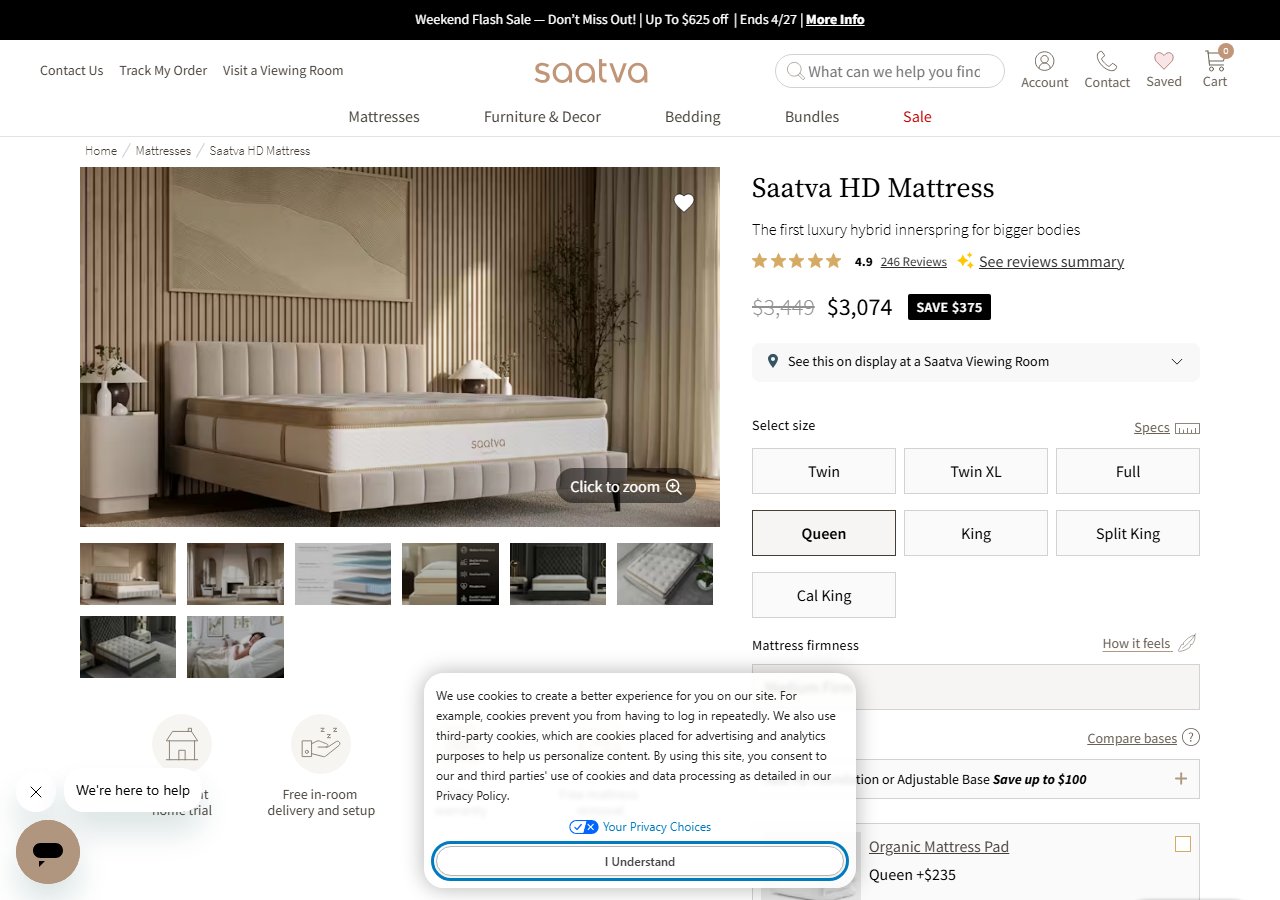
Saatva HD Mattress (Heavy-Duty)
$2,395-$3,995
See Price at Saatva →
Purple Hybrid Premier Mattress
$2,499-$4,799
See Price at Purple →Putting the Data Hierarchy in Order
Federal data from the CDC, AHRQ, CMS, and SSA collectively describe an older American population in which joint pain, poor sleep, and escalating healthcare costs are tightly linked — and in which the medical system's primary response has been pharmacological, as the CMS drug spending data on Medicare pain medication costs makes clear. That is not the whole toolkit.
The evidence hierarchy for older adults with nighttime joint pain runs: sleep position correction → daily walking → honest mattress assessment (age, visible sag, hygiene) → clinical evaluation if red flags are present → targeted surface selection for confirmed mechanical, pressure-related sleep disruption.
Products occupy the last rung of that ladder — not because they are ineffective, but because they are most effective when the rungs above them have already been addressed. An older adult who sleeps on their stomach on a 12-year-old mattress and walks fewer than 2,000 steps a day will not solve their pain problem with a $3,000 memory foam mattress. An older adult who walks daily, sleeps in a neutral position, has no red flags, and is still waking at 2 a.m. with hip pressure pain is the person for whom the Purple Hybrid Premier or Saatva Loom & Leaf was actually designed.
The federal data is consistent: musculoskeletal disorders are the largest driver of disability claims, back pain is among the most expensive conditions in the healthcare system, and the Medicare population is already spending heavily on pain management pharmacology. A well-chosen sleep surface is a modest intervention in that context — but modest does not mean meaningless. For the right reader, at the right stage of that hierarchy, it is the remaining variable worth addressing.