When Your Joints Won't Let You Sleep: What the Federal Numbers Actually Show
If you are over 60 and waking at 2 a.m. because your hip hurts, your shoulder aches, or your lower back has locked into a dull, insistent throb, you are not alone — and the problem is not imaginary or simply age. CDC Arthritis Data shows that approximately 25% of U.S. adults carry a doctor-diagnosed arthritis diagnosis, and that prevalence climbs sharply with age. Meanwhile, CDC Sleep and Sleep Disorders Data shows 35% of U.S. adults already sleep fewer than seven hours per night — the threshold below which chronic disease risk measurably increases. The overlap between those two populations is not random. Joint inflammation, pain sensitization, and reduced cartilage cushioning make the horizontal, load-bearing position of sleep actively uncomfortable in ways it simply was not at 35.
This article is not a mattress review dressed up in science. It is a structured look at what federal health data tells us about why joints disrupt sleep after 60, what interventions the evidence actually supports, when the surface you sleep on becomes a clinically relevant variable, and how to evaluate that surface if you reach that threshold.
Why Joint Pain Gets Worse Overnight: The Biomechanics Nobody Explains
The mechanism behind nighttime joint pain is specific and worth understanding, because understanding it changes what interventions you prioritize. During the day, synovial fluid — the viscous lubricant inside your joints — is continuously redistributed by movement. Walking, standing, and even seated weight shifts keep cartilage surfaces bathed and pressure cycling across the joint surface rather than pooling in one spot.
At night, that dynamic redistribution stops. You hold a single posture for six, seven, or eight hours. Wherever a bony prominence contacts the mattress surface — the greater trochanter of the hip, the lateral knee, the acromioclavicular joint in the shoulder, the sacral base — the pressure is static. For a joint with healthy cartilage and low systemic inflammation, this is not a problem. For a joint with osteoarthritis, rheumatoid disease, or age-related cartilage thinning, static pressure on an already irritated surface triggers local inflammatory cascades that peak in the early morning hours. This is not incidental to the well-documented phenomenon of morning stiffness in arthritis — it is the direct cause.
That biomechanical reality interacts with what CDC NCHS Data Brief 390 documents: approximately 20% of U.S. adults experience chronic pain, with the lower back the single most common location. For adults over 60, years of accumulated occupational load — lifting, sustained standing, repetitive bending — have frequently degraded lumbar disc height and facet joint integrity. BLS MSD by Occupation data identifies the back as the most commonly injured body part across all occupations with days away from work, and many adults over 60 have spent decades in exactly those occupations. The structural legacy shows up in how they sleep.
The economic consequence is enormous. AHRQ HCUP data identifies back pain as one of the most expensive conditions in U.S. healthcare by total inpatient and outpatient cost. AHRQ Medical Expenditure Panel Survey data confirms that adults living with chronic back conditions carry substantially higher average annual personal healthcare expenditures than those without. And CMS Drug Spending Dashboard data shows that opioid and non-opioid pain medications are among the most expensive Medicare drug categories — a direct reflection of how many older Americans are managing musculoskeletal pain pharmacologically rather than structurally.
The takeaway from that data cluster is uncomfortable but important: the U.S. healthcare system is spending enormous sums treating the downstream effects of chronic joint and back pain in older adults, while comparatively little attention goes to the upstream mechanical factors — including the eight hours per night spent on a surface that either supports or stresses the joint structures causing that pain.
The Compound Effect: Sleep Loss Accelerates Joint Decline
Sleep deprivation and joint pain operate in a bidirectional loop that the federal data illuminates starkly. CDC sleep data establishes the seven-hour floor as a population-level threshold for chronic disease risk elevation. What that means biologically for older adults with arthritis is that every night of fragmented sleep — the kind joint pain reliably produces — suppresses systemic anti-inflammatory signaling, elevates cortisol, and reduces the anabolic repair processes that maintain connective tissue. You wake more inflamed, more pain-sensitive, and structurally less repaired than you went to bed.
This is why the intervention hierarchy matters so much. The goal is not simply to reduce pain at 3 a.m. — it is to stop the compounding cycle where poor sleep worsens inflammation, which worsens pain, which fragments sleep further. Each intervention discussed below targets a specific link in that chain.
Try These First: Free and Low-Cost Interventions the Evidence Supports
The cheapest intervention is the one that requires buying nothing. Before evaluating any sleep surface, federal guidance points to several behavioral and positional changes that have direct, documented effects on overnight joint pain and sleep quality. These are not placeholders — they are first-line treatments with more evidence behind them than most products carry.
Sleep position is the most powerful free variable you have. NIH guidance on back pain is specific: side-sleeping with a pillow between the knees keeps the lumbar spine in a neutral position by preventing hip drop and pelvis rotation. Back-sleeping with a pillow under the knees reduces lumbar lordosis and takes facet joints partially out of compression. Stomach-sleeping, by contrast, forces the cervical spine into sustained rotation and torques the lumbar spine — it is the worst position for both neck arthritis and lower back pain and should be systematically eliminated for anyone with chronic joint complaints.
Daily walking outperforms most passive interventions — including mattress upgrades — in the evidence base for chronic low back pain. NIH NCCIH's evidence review on low back pain documents that 30 minutes of walking most days reduces chronic low back pain as effectively as most non-drug clinical treatments. Walking also keeps synovial fluid circulating, maintains lumbar extensor muscle tone that stabilizes the spine during sleep, and reduces systemic inflammatory markers that worsen overnight pain sensitization. A new mattress cannot do any of those things.
Lifting and bending mechanics deserve attention even for adults who have retired from physical occupations. OSHA's ergonomics guidance is explicit: hinge at the hips, not the lumbar spine; keep loads close to the body; never twist under load. Most acute back episodes in older adults are mechanical — triggered by a specific movement that exceeds the spine's current tolerance — and are therefore preventable by rehearsing and ingraining better movement patterns. An acute episode that flares during the night, waking you from sleep, is often traceable to a mechanical insult earlier in the day.
When the mattress itself is the problem, the diagnosis is straightforward. CDC Sleep Hygiene guidance provides practical criteria: visible sagging or body impressions, waking stiffer than you went to bed consistently, or a mattress older than seven to ten years are all legitimate signals that the sleep surface is a contributing variable, not a coincidental one. Even the most expensive mattress on the market does not undo poor sleep hygiene or sedentary days — but a surface with a three-inch body impression is a biomechanical problem that no amount of walking will fix.
For readers who have already corrected their sleep position, walk daily, and are sleeping on a relatively recent mattress that passes the sag and stiffness tests — and still wake in pain — the surface itself may genuinely be the limiting factor. That is the population for whom product selection becomes a clinically relevant decision rather than a consumer preference. The rest of this article addresses that population specifically.
When to See a Clinician Before You Buy Anything
Some overnight pain patterns are not solved by any mattress. NIH guidance on back pain is unambiguous about the signals that require clinical evaluation rather than consumer product research: pain that radiates below the knee (possible nerve root compression), pain that follows a fall or acute trauma, pain accompanied by leg weakness, any change in bowel or bladder function, or back pain with fever. These are not surface-sensitivity problems — they are structural or systemic problems that imaging or referral can identify and that a new sleep surface will not address.
For adults over 60 specifically, unexplained new-onset back or hip pain that is severe, progressive, or present at rest without a mechanical trigger warrants evaluation before attributing it to sleep surface issues. The SSA Disability Insurance data showing musculoskeletal disorders as the largest single category of new disability claims annually reflects how frequently undertreated joint and back conditions progress to disability — often because early warning signs were attributed to aging or poor sleep hygiene rather than addressed clinically. If you have not had a recent evaluation of your joint pain, that conversation should happen before you invest in a sleep surface.
Where Surface Selection Becomes a Real Variable
Assuming behavioral interventions are in place and clinical red flags have been ruled out, the sleep surface is a legitimate mechanical variable for older adults with arthritis and chronic back pain. The mechanism is pressure distribution: a surface that allows bony prominences to sink into a conforming layer while supporting the lumbar spine and pelvis reduces peak interface pressure at pain-sensitive joints, reduces the frequency of micro-arousals driven by discomfort, and allows sleep architecture to deepen toward the restorative stages that drive tissue repair.
For older adults, the key surface variables are: conforming layer depth and material (how much the top layer deforms to match body contour), support core firmness (whether the base of the mattress prevents excessive sink that misaligns the spine), and edge support (critical for older adults who need a stable surface to push up from when getting in and out of bed, reducing the torsional stress on the hip and lumbar spine during that transition).
The Saatva Loom & Leaf: Memory Foam Contouring for Pressure-Sensitive Joints
For older adults whose primary complaint is pressure sensitivity at the hip, shoulder, or lumbar spine — the classic arthritis presentation — the Saatva Loom & Leaf Memory Foam Mattress addresses the mechanism directly. Loom & Leaf uses multiple layers of high-density memory foam — including a gel-infused top layer that manages the heat retention that memory foam traditionally produces — over a supportive base. The key distinction from budget foam options is density: higher-density foam resists the body impression formation that creates the three-inch sag that CDC sleep hygiene guidance identifies as a legitimate surface problem. For older adults who have burned through lower-density foam mattresses in three to four years, the material quality difference here is real. The Relaxed Firm option in the Loom & Leaf lineup is the configuration most directly aligned with the clinical literature on lumbar support — conforming enough to relieve hip and shoulder pressure, firm enough to prevent the excessive lumbar flexion that a too-soft surface produces.
The Saatva HD: When Body Weight Is a Compounding Factor
Some older adults carry higher body weight — often a consequence of the same reduced mobility that arthritis produces — and standard mattresses are engineered for a load profile that does not match their reality. A 250-pound adult sinks differently into a foam support core than a 170-pound adult, and a support core not designed for that load will bottom out faster, producing the very surface degradation that worsens back pain. The Saatva HD Mattress is specifically engineered for body weights up to 500 pounds, with a reinforced coil system and higher-density foam layers that maintain their mechanical properties under sustained higher loads. For older adults in this category, the HD is not a luxury upgrade — it is the configuration that will actually deliver the support claims that standard mattresses make. The edge support in the HD is also notably reinforced, which matters for the getting-in and getting-out-of-bed transition that many arthritis patients find as painful as lying in bed.
The Purple Hybrid Premier: Grid Technology for Heat and Pressure
A distinct surface option for older adults who run warm, who find memory foam uncomfortably enveloping, or whose primary complaint is pressure at the hip and shoulder rather than lumbar support, is the Purple Hybrid Premier Mattress. Purple's GelFlex Grid is a hyper-elastic polymer structure that collapses under direct pressure points (hip, shoulder) while remaining rigid under distributed load (torso, lumbar spine). This is mechanically different from foam contouring: the grid does not envelop the joint so much as allow it to fall into a pressure-neutral zone while supporting adjacent structures. The airflow through the grid also substantially reduces the heat buildup that is a known contributor to sleep disruption — relevant for older adults, who frequently report night sweats and thermoregulation difficulty that compound joint-pain-driven arousals. The Hybrid Premier layers the grid over pocketed coils, which provides the edge support and motion isolation that older adults sharing a bed require.
Mattresses Engineered for Arthritis Pressure Relief and Joint Support After 60
These three mattresses were selected specifically for older adults whose joint pain disrupts sleep — evaluated for pressure distribution at the hip and shoulder, lumbar support under sustained load, edge support for safer bed transitions, and construction durability that maintains those properties beyond the five-year mark.

Saatva Loom & Leaf Memory Foam Mattress
$1,695-$3,295
See Price at Saatva →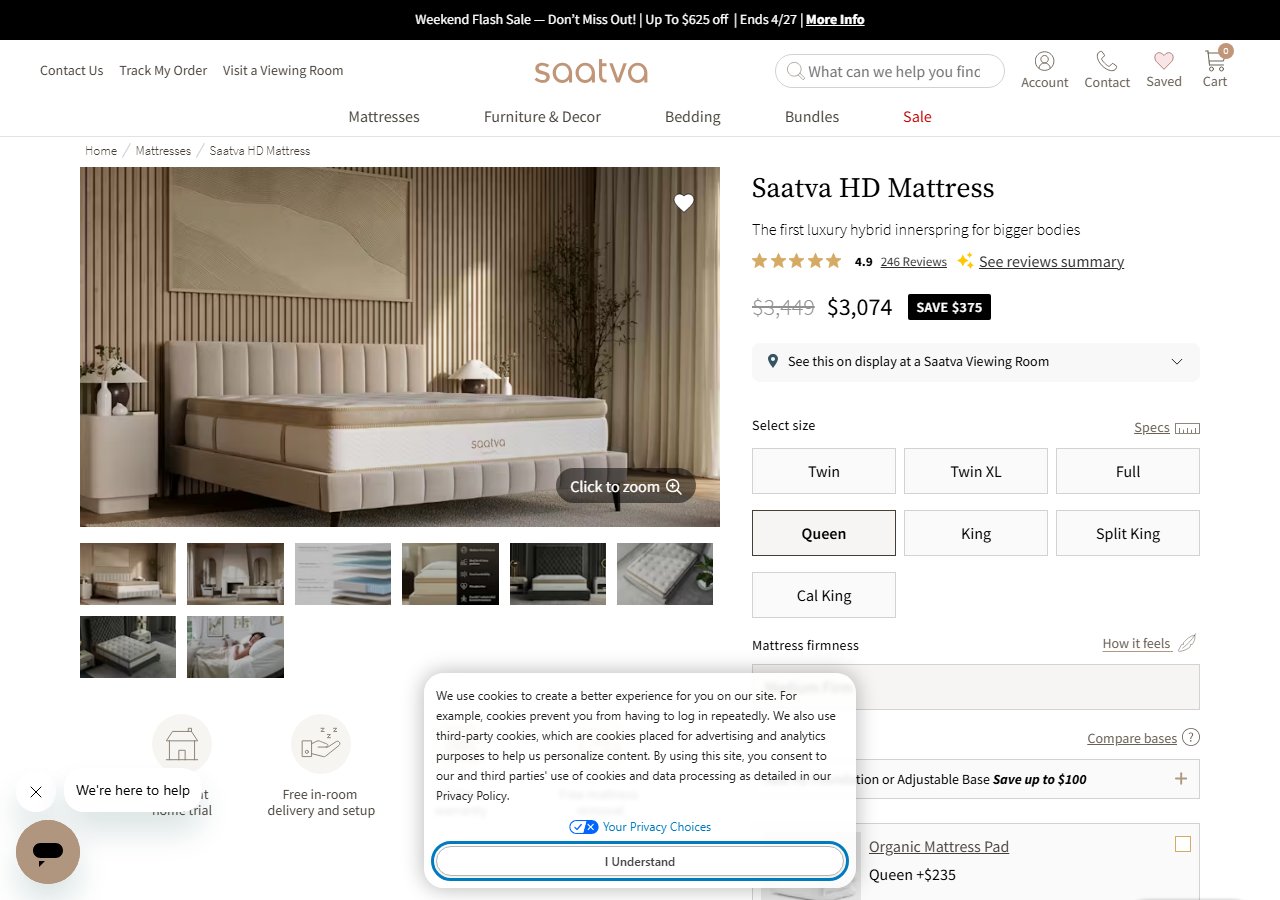
Saatva HD Mattress (Heavy-Duty)
$2,395-$3,995
See Price at Saatva →
Purple Hybrid Premier Mattress
$2,499-$4,799
See Price at Purple →Matching Surface to Symptom Pattern: A Decision Framework
The three products above are not interchangeable, and the right choice depends on the specific joint complaint pattern rather than general price-tier preference. A useful framework:
Pressure sensitivity at hip or shoulder, normal body weight, heat not a primary complaint: Loom & Leaf Relaxed Firm is the most direct match. High-density memory foam addresses pressure distribution without the motion instability that softer foams produce.
Same pressure pattern but body weight above 230–250 pounds: The Saatva HD's reinforced construction is not optional at this weight — it is what keeps the surface performing as designed over a five-to-seven-year period rather than developing body impressions in year two.
Primary complaint is hip or shoulder pressure AND heat retention OR preference for a less enveloping feel: The Purple Hybrid Premier's grid technology addresses both simultaneously. It costs more, but it solves two distinct sleep disruption mechanisms rather than one.
Lumbar pain as the dominant complaint, no significant pressure-point sensitivity: A medium-firm innerspring or hybrid at a lower price point may be adequate. None of these three products is wrong for lumbar pain, but none is specifically optimized for it the way they are optimized for pressure relief.
The Data-to-Decision Summary
The federal data tells a coherent story. CDC arthritis data and CDC sleep data document a large and growing older adult population caught between joint pain and sleep deprivation, with each condition worsening the other. AHRQ HCUP and AHRQ MEPS document the enormous cost burden of managing those conditions downstream — in emergency visits, specialist referrals, and pharmaceutical spending captured by CMS drug spending data. The SSA disability data shows how frequently these conditions progress when not structurally addressed.
The intervention hierarchy that evidence supports is: correct sleep position first, add daily walking, evaluate and correct any mechanical loading habits, see a clinician if red flags are present, and then — if behavioral interventions are in place and the surface itself is contributing — invest in a surface with documented pressure-distribution advantages. The Saatva Loom & Leaf, Saatva HD, and Purple Hybrid Premier represent three distinct engineering approaches to the same mechanical problem, each with a specific use case within the older adult arthritis population.
The goal is not a product purchase. The goal is sleeping through the night without pain waking you. The data tells you that the cheapest path to that goal runs through movement and position before it runs through any commerce.