The Federal Data Behind a Very Common 3 a.m. Problem
If you are over 60 and waking up at 3 a.m. with aching hips, a stiff lower back, or throbbing knees, you are not alone — and the federal data explains exactly why this is happening. CDC arthritis surveillance data shows that approximately 25% of U.S. adults carry a doctor-diagnosed arthritis diagnosis, and prevalence climbs steeply with age. Among adults 65 and older, the CDC estimates that more than half report some form of arthritis. Simultaneously, CDC sleep data documents that roughly 35% of U.S. adults sleep fewer than 7 hours per night — the threshold the CDC associates with elevated risk for obesity, heart disease, diabetes, and mental health disorders. These two datasets are not independent. Adults with arthritis and chronic joint pain are systematically overrepresented in that sleep-deprived 35%, and the mechanism is not mysterious once you understand what happens to aging joints during the night.
The economic signal reinforces the clinical one. AHRQ HCUP data ranks back pain among the most expensive conditions in U.S. healthcare by combined inpatient and outpatient cost. AHRQ's Medical Expenditure Panel Survey finds that adults with chronic back conditions spend substantially more per year on personal healthcare than adults without those conditions — a gap that widens as conservative management fails and patients escalate to injections, imaging, and surgery. CMS drug spending data identifies opioid and non-opioid pain medications among the most expensive Medicare drug categories, a proxy for how inadequately the healthcare system is managing chronic musculoskeletal pain in older adults. And SSA Disability Insurance reports consistently identify musculoskeletal disorders as the single largest category of new disability claims filed annually — not cardiovascular disease, not cancer, but bones, joints, and backs.
For older adults reading this at 6 a.m. after a rough night, that federal picture maps directly onto your body. The question is what actually moves the needle.
Why Joint Pain Disrupts Sleep After 60: The Biomechanical Mechanism
Understanding why joint pain worsens at night is not optional background — it is the foundation for choosing the right intervention. Several mechanisms converge in older adults.
Synovial fluid viscosity drops during inactivity. Joints are lubricated by synovial fluid, which is distributed across cartilage surfaces by movement. When you lie still for hours, fluid redistribution slows, cartilage surfaces become less cushioned, and inflammatory mediators that accumulate in arthritic joints are not flushed by the mechanical pumping that walking provides. This is why osteoarthritis and rheumatoid arthritis patients frequently report their worst pain in the first 30 to 60 minutes after waking — stiffness correlates directly with the duration of inactivity. It is also why the sleep surface matters: a surface that forces awkward joint angles or fails to offload pressure on bony prominences (hips, shoulders, knees) compounds the inflammatory load on already-compromised cartilage.
Cortisol follows a diurnal curve that bottoms out overnight. Cortisol, the body's primary endogenous anti-inflammatory, reaches its lowest circadian levels between midnight and 4 a.m. For adults with rheumatoid arthritis or inflammatory arthritis, this trough corresponds precisely with the window of worst pain and most fragmented sleep. This is not placebo effect — it is predictable endocrinology, and it means that even a well-managed arthritis patient will experience more pain during the cortisol nadir than during daylight hours.
Aging changes soft-tissue pressure tolerance. Skin and subcutaneous fat thin with age. Bony prominences — the greater trochanter at the hip, the lateral knee, the acromion at the shoulder — have less natural padding than they did at 40. A sleep surface that was adequate at 45 may generate genuine pressure-point pain at 65, particularly for side-sleepers. CDC NCHS Data Brief 390 documents that approximately 20% of U.S. adults experience chronic pain, with the lower back as the most frequent site — but hip and knee pain from inadequate pressure relief is the specific complaint that escalates for older side-sleepers on worn or overly firm mattresses.
Decades of occupational loading have a cumulative effect. The BLS Musculoskeletal Disorders by Occupation data identifies the back as the most commonly injured body part across all occupations with days away from work. For adults now 60 and older who spent careers in healthcare, construction, manufacturing, or agriculture, the spinal discs, facet joints, and hip joints entering their seventh decade carry 30 to 40 years of compressive and shear loading. The NIOSH Lifting Equation documents that manual material-handling tasks across these industries routinely exceed safe spinal loading limits. The structural consequence is accelerated degenerative disc disease and facet arthropathy — conditions that make nighttime positioning and surface firmness genuinely consequential, not merely a luxury preference.
The intersection of these four mechanisms — synovial stiffness from inactivity, cortisol trough pain amplification, reduced soft-tissue padding, and cumulative occupational joint load — explains why adults over 60 experience sleep disruption from joint pain at rates that dramatically exceed younger cohorts. It also clarifies which interventions are actually load-bearing.
Try These First: Free and Low-Cost Interventions That Federal Data Supports
The cheapest intervention is the one that does not require buying anything. Before evaluating any sleep surface, every older adult with joint-related sleep disruption should run through the following evidence-based behavioral and positional strategies. These are not filler advice — they are backed by NIH and OSHA guidance, and for a meaningful fraction of readers, they will resolve or substantially reduce the problem without a dollar spent on equipment.
Sleep position is the highest-leverage free variable. NIH guidance on back pain is explicit: side-sleeping with a pillow between the knees keeps the lumbar spine and hips in a neutral alignment, reducing rotational stress on inflamed facet joints and the sacroiliac joint. Back-sleeping with a pillow or rolled towel under the knees reduces lumbar lordosis and the posterior disc pressure that makes degenerative disc disease worse. Stomach-sleeping torques the lumbar spine and cervical spine simultaneously — it is the worst position for almost every arthritic condition and should be actively discouraged. If you have been a lifelong stomach-sleeper, transitioning takes time, but a body pillow placed along your side creates a physical barrier that prevents rolling onto your stomach during sleep.
Daily walking is a clinical-grade intervention. The NIH NCCIH evidence review on low-back pain finds that walking 30 minutes on most days reduces chronic low-back pain as effectively as most non-drug clinical treatments. For arthritic joints specifically, walking promotes the synovial fluid circulation described above, maintains the muscle mass that offloads joint surfaces, and — critically — reduces the systemic inflammation that drives nighttime pain amplification. A new mattress helps at night. Walking helps at night because it changes what happens all day.
Lifting and bending mechanics remain relevant after 60. Many older adults are still active caregivers, gardeners, or recreational athletes. OSHA's ergonomics guidance specifies hinging at the hips rather than flexing the lumbar spine, keeping loads close to the body's center of gravity, and avoiding twisting under any load. Most acute back episodes in older adults are mechanical in origin — the same rehearsable movement patterns that protect warehouse workers protect grandparents lifting grandchildren.
Replace a mattress when the evidence says to, not on a schedule. CDC sleep hygiene guidance frames sleep surface as one variable in a broader sleep environment. The clinical indicators for replacement are specific: visible sag or body impressions, waking stiffer than you went to bed consistently, or a mattress older than 7 to 10 years. A mattress that meets none of these criteria is probably not your primary problem. Even the most sophisticated pressure-mapping mattress on the market will not compensate for poor sleep hygiene, inconsistent sleep schedules, or the sedentary days that let inflammatory mediators build.
For readers who have already addressed sleep position, are walking regularly, and are sleeping on a mattress less than 8 years old with no visible sag — and are still waking with joint pain — the evidence does support evaluating your sleep surface more critically. Firmness matching, pressure-relief architecture, and motion isolation all have legitimate biomechanical rationales for arthritic older adults. Here is how to think through the clinical threshold before moving to equipment.
When to See a Clinician: Red Flags That Override Any Equipment Decision
Sleep disruption from joint pain is common. But some presentations of back or joint pain at night are not mechanical — they are signals of something that requires imaging, blood work, or urgent referral. NIH National Institute of Neurological Disorders and Stroke guidance on back pain is clear that certain symptoms should prompt immediate clinical evaluation rather than a mattress trial.
For older adults specifically, the threshold for clinical evaluation should be lower than in younger populations. Osteoporosis-related vertebral compression fractures can occur with minimal trauma in adults over 70 and may present primarily as nighttime back pain. Spinal stenosis — the narrowing of the spinal canal most common in adults over 60 — produces a characteristic pattern of leg pain and weakness with walking that worsens over months and does not respond to positional changes or surface adjustments. Inflammatory arthropathies like ankylosing spondylitis or psoriatic arthritis cause nighttime stiffness that is paradoxically worst after rest and better with movement — the opposite of mechanical back pain, and a pattern that should trigger rheumatological evaluation rather than mattress shopping.
Do not buy a mattress for any of the following symptoms. See a clinician first.
- Back or joint pain that radiates below the knee, particularly with numbness or tingling (NIH NINDS)
- Pain that followed a fall, even a minor one, in an adult over 65 (compression fracture risk)
- Back pain accompanied by unexplained weight loss, fever, or night sweats (red flags for malignancy or infection)
- New bowel or bladder changes concurrent with back pain (cauda equina syndrome — requires emergency evaluation)
- Leg weakness or instability when walking that has developed over weeks to months (spinal stenosis)
Where Your Sleep Surface Actually Fits In
If you have cleared the clinical red flags, addressed sleep position and daily movement, and still have a surface that is objectively compromised — sag, age, or a firmness level that was chosen before your joints changed — then your sleep surface is a legitimate intervention point. Here is what the biomechanical evidence supports for older adults with arthritis and chronic back pain, and how three specific mattresses address those needs.
Firmness Is Not One-Size-Fits-All After 60
The popular advice to "buy a firm mattress for back pain" is outdated and partially wrong. A mattress that is too firm creates pressure points at the hip and shoulder — the exact bony prominences that have lost padding with age — and forces the lumbar spine into an exaggerated curve for side-sleepers. The evidence-supported target for most older adults with arthritis is medium to medium-firm: firm enough to maintain spinal alignment and prevent sinkage that torques the lumbar spine, but with sufficient surface conformability to offload hip and shoulder pressure.
For back-sleepers, a slightly firmer surface is appropriate because body weight is distributed across a larger surface area, reducing peak pressure at any single point. For side-sleepers — the position NIH recommends for most back and joint pain — a surface that allows the shoulder and hip to sink 1 to 3 inches while keeping the lumbar spine level is the mechanical target. Weight matters here: lighter adults (under 130 lbs) need less resistance to achieve that sinkage; heavier adults (over 230 lbs) need more support underneath the conforming top layers to prevent bottoming out.
Memory Foam and Pressure Relief for Inflamed Joints
Memory foam — specifically high-density, slow-recovery formulations — was originally engineered for exactly this application: distributing pressure across a contoured surface to reduce peak loading at bony prominences. For older adults with hip or shoulder arthritis who are side-sleeping, the pressure-relief advantage of quality memory foam over coil-only or latex surfaces is real and measurable in pressure-mapping studies.
The Saatva Loom & Leaf Memory Foam Mattress is the premium memory foam pick in this category for a specific reason: it uses a dual-layer memory foam system with a cooling layer at the surface (addressing the thermoregulation issues that compound sleep disruption in older adults) and a high-density support base that prevents the "hammock" sinkage that cheaper all-foam mattresses develop over time. It is available in Relaxed Firm (5.5 out of 10 firmness) and Firm (8 out of 10) — the Relaxed Firm is the correct specification for most older side-sleepers with hip or shoulder arthritis; the Firm for back-sleepers who are heavier than 200 lbs. At $1,695 to $3,295, it sits at the premium tier, but the construction density justifies the durability claim: high-density foam resists the body impression formation that medium-density foam develops within 3 to 5 years.
For Heavier Adults: Support Architecture That Doesn't Compress Out
For adults over 230 lbs — a cohort that is disproportionately represented among older adults with joint pain, because excess weight accelerates cartilage degradation — standard mattresses present a specific failure mode: the comfort layers compress through under sustained load, delivering the support layer's firmness directly to the sleeper. The result is progressive pressure-point pain at the hip and shoulder that worsens over months as the mattress softens unevenly.
The Saatva HD Mattress was engineered to address that specific failure mode. Its coil-on-coil architecture — individually wrapped comfort coils over a heavy-gauge foundational coil system — maintains zoned support across the weight range up to 500 lbs per side. The lumbar zone uses higher-gauge coils to resist sinkage at the heaviest load point on the body, while the shoulder zone uses softer coils to allow the conformability that side-sleeping arthritis patients need. For an older adult who spent decades in physically demanding work — consistent with the populations documented in BLS MSD data as carrying the highest cumulative spinal load — this zoned support architecture addresses the mechanical reality that a single-firmness surface cannot.
Pressure Mapping for Complex Pain Presentations
For older adults with multi-site pain — hip arthritis plus shoulder arthritis plus chronic lower back pain simultaneously — the clinical challenge is that a surface optimized for one complaint may worsen another. This is where grid-based pressure-relief architecture, rather than traditional foam or coil design, offers a different biomechanical approach.
The Purple Hybrid Premier Mattress uses Purple's GelFlex Grid, a hyperelastic polymer grid that buckling-collapses under concentrated pressure (at bony prominences) while remaining firm under distributed load (at the lumbar spine and core). The practical effect is that hip and shoulder pressure is offloaded simultaneously with lumbar support — a combination that traditional foam-firmness selections struggle to achieve because the same material property that makes foam pressure-relieving also makes it insufficiently supportive. The grid architecture is also temperature-neutral, which matters for older adults whose thermoregulation is less efficient and for women managing menopausal hot flashes that are themselves a major driver of the sleep disruption documented in CDC sleep data. The Purple Hybrid Premier ranges from $2,499 to $4,799 — it is the premium pressure-relief pick for complex, multi-site pain presentations.
Sleep Surfaces Matched to Older Adult Joint Pain — By Architecture, Not Guesswork
These three mattresses were selected specifically for the pressure-relief, support-zone, and durability requirements of adults over 60 managing arthritis, chronic back pain, or cumulative joint load from decades of physical work.

Saatva Loom & Leaf Memory Foam Mattress
$1,695-$3,295
See Price at Saatva →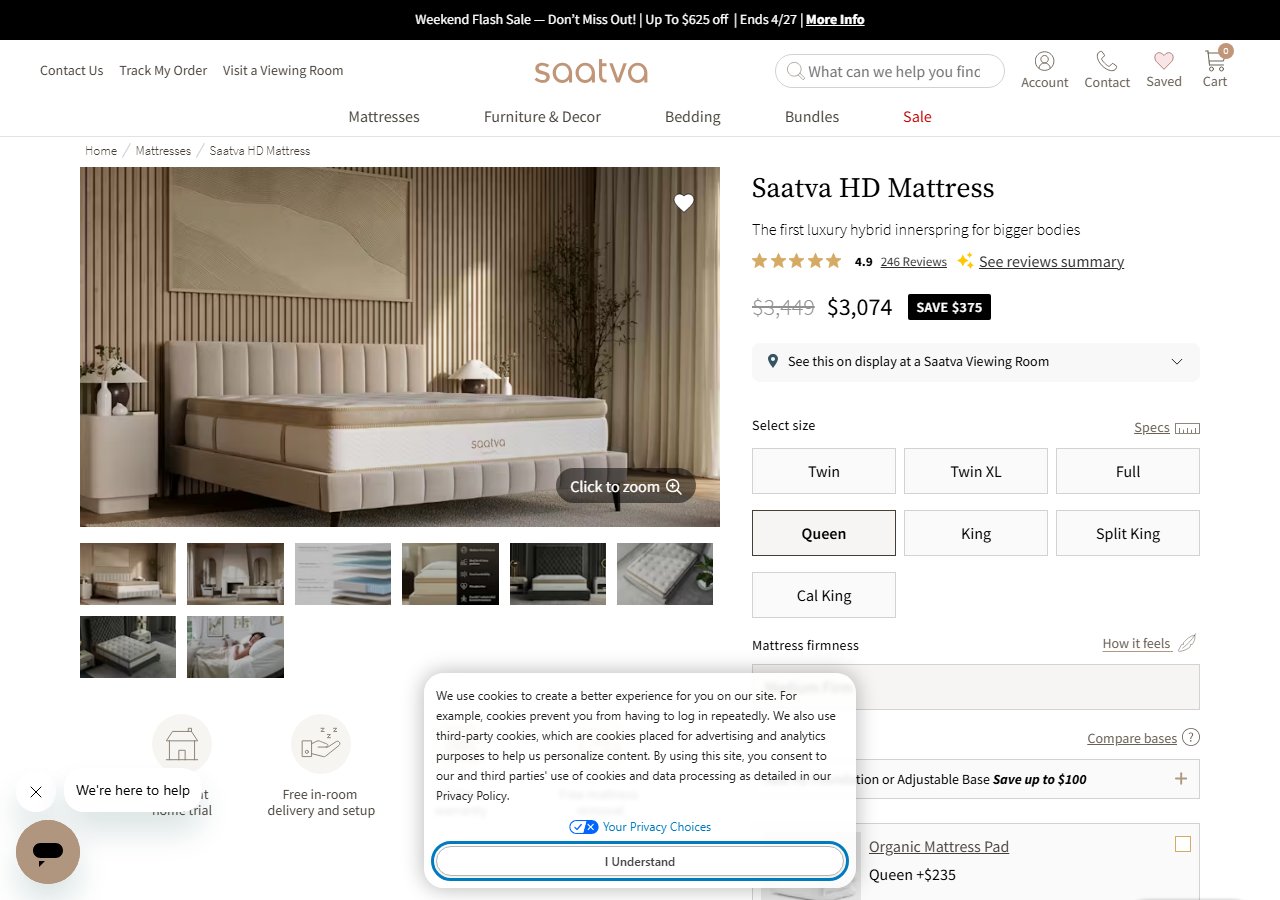
Saatva HD Mattress (Heavy-Duty)
$2,395-$3,995
See Price at Saatva →
Purple Hybrid Premier Mattress
$2,499-$4,799
See Price at Purple →Making the Evidence Work in Your Bedroom
The federal data tells a clear story: older adults bear a disproportionate share of the musculoskeletal pain burden documented by CDC, AHRQ, BLS, and SSA. The biomechanical mechanisms are well understood. And the hierarchy of intervention is unambiguous: sleep position, daily movement, and mechanical body mechanics come first because they are free, have strong federal evidence behind them, and address root causes rather than symptoms. Clinical evaluation comes before any equipment purchase when red flags are present.
When a sleep surface does belong in the picture, the decision is not "firm vs. soft" — it is matching surface architecture to your specific body weight, sleep position, and pain distribution. Memory foam for pressure-dominant hip and shoulder pain in side-sleepers. Zoned coil-on-coil for heavier adults whose weight would compress through standard comfort layers. Grid-based architecture for complex multi-site presentations where simultaneous pressure relief and lumbar support are both required.
The CMS drug spending data and AHRQ MEPS expenditure data make the stakes concrete: Americans over 60 are spending more on pain management than any other age cohort, and much of that spending is downstream of conditions that earlier intervention — movement, position, surface — could have modified. A sleep surface is not a medical device, and this article is not medical advice. But within the range of lifestyle and environmental decisions that older adults control, nighttime joint loading is among the most modifiable. The federal data supports taking it seriously.