The Federal Data Picture: What Happens to Sleep After 60
Here is the number that should anchor this conversation: approximately 25% of U.S. adults have doctor-diagnosed arthritis, according to CDC tracking data. That prevalence does not distribute evenly across the lifespan. It concentrates heavily after age 60, when decades of mechanical loading, cartilage wear, and cumulative inflammation converge into a condition that millions of older Americans simply call "my joints." Pair that with CDC sleep data showing that 35% of all U.S. adults already sleep under the recommended 7 hours per night — the threshold below which chronic disease risk climbs measurably — and you start to see the compounding problem clearly. Arthritis disrupts sleep. Disrupted sleep worsens pain perception. Worsened pain perception makes it harder to stay mobile. Reduced mobility accelerates joint degeneration. The cycle is well-documented and punishing.
The economic signal is equally stark. AHRQ HCUP data identifies back pain as one of the most expensive conditions in U.S. healthcare by combined inpatient and outpatient cost. AHRQ's Medical Expenditure Panel Survey confirms that adults with chronic back conditions carry substantially higher annual personal healthcare costs than adults without them. And at the population level, CMS drug spending data shows that opioid and non-opioid pain medications rank among the most expensive Medicare drug categories — a direct measure of how many older Americans are managing chronic joint and back pain through pharmacology because other interventions have been under-utilized or under-communicated. This is the downstream cost of a problem that often starts, or is significantly worsened, in the bedroom between the hours of 11 p.m. and 6 a.m.
Why Joint Pain Disrupts Sleep: The Biomechanical and Physiological Mechanism
Understanding why arthritis and chronic back pain wreck sleep after 60 is not just academic — it determines which interventions actually work. There are three overlapping mechanisms.
First: inflammatory cytokine activity peaks at night. Arthritis is an inflammatory condition. The cytokines that drive joint inflammation — including tumor necrosis factor and interleukin-6 — follow circadian rhythms, with activity peaking in the early morning hours. This is why many arthritis patients report that stiffness and pain are worst upon waking, not at the end of an active day. The very hours when the body is supposed to be in restorative sleep are also the hours when inflammatory signaling is most active.
Second: the aging musculoskeletal system loses the ability to find a comfortable position and stay there. Younger adults shift position dozens of times per night without fully waking. As the intervertebral discs lose hydration and the hip and shoulder joints lose cartilage cushion, minor positional pressure that would be imperceptible at 35 becomes a waking stimulus at 65. CDC's chronic pain data shows that approximately 20% of U.S. adults experience chronic pain, with the lower back as the most common site — and for adults over 60, that figure climbs further, reflecting decades of spinal loading accumulation.
Third: the compounding effect of prior occupational loading. Many adults now in their 60s and 70s spent decades in physically demanding work. The BLS MSD by Occupation data identifies the back as the most commonly injured body part across all occupations with days away from work. The NIOSH Lifting Equation documents that manual material-handling tasks in warehousing, construction, and healthcare routinely exceed safe spinal loading limits. Adults who spent careers in these sectors are now sleeping in bodies that carry the accumulated structural consequences of those loads — compressed discs, arthritic facet joints, and reduced lumbar lordosis. Their sleep surfaces must work significantly harder to provide the pressure relief and spinal alignment that a less-loaded spine would need.
SSA Disability Insurance data confirms that musculoskeletal disorders are the single largest category of new disability claims annually — a downstream measure of how badly the U.S. has managed cumulative joint and back health for working-age adults who are now the older adults this article addresses.
What the Research Hierarchy Actually Looks Like
Before any discussion of sleep surfaces, it is worth establishing what the evidence base actually prioritizes. Federal health agencies — NIH, NIOSH, NCCIH — are consistent on this point: the cheapest intervention is the one that does not require buying anything. Sleep position, movement habits, and clinical evaluation of red-flag symptoms are all higher-leverage starting points than purchasing a new mattress. A new mattress on top of unaddressed sleep hygiene problems, a sedentary lifestyle, or an undiagnosed spinal condition will not solve the problem. That is not a caveat buried at the bottom of this article. It is the central organizing principle of evidence-based back pain management.
For older adults specifically, NIH NCCIH evidence reviews show that daily walking for 30 minutes reduces chronic low back pain as effectively as most non-drug clinical treatments. That is a striking finding, and it is underutilized. NIH back pain guidance from NIAMS identifies sleep position as the largest free variable for overnight spinal loading: side-sleeping with a pillow between the knees, or back-sleeping with a pillow under the knees, keeps the lumbar spine in neutral alignment without any equipment purchase. Stomach-sleeping, by contrast, forces the lumbar spine into hyperextension and torques the cervical spine — a pattern that worsens both low back and neck pain regardless of how good the mattress is.
On the question of whether the mattress itself is the problem: CDC sleep hygiene guidance supports replacing a mattress if it shows visible sag, if you consistently wake stiffer than you went to bed, or if it is older than 7 to 10 years. A mattress in good condition is not the primary lever. An aged, sagging mattress that fails to maintain spinal alignment absolutely is.
For readers who have already addressed sleep position, walking habits, and mattress age — and who are still waking with joint pain and disrupted sleep — sleep surface selection becomes a legitimate and evidence-adjacent intervention. The research on mattress firmness and back pain is not perfectly controlled at the federal level, but the biomechanical logic is sound: a surface that distributes pressure across the hips and shoulders while maintaining lumbar support reduces the positional micro-awakenings that fragment sleep for arthritic joints. That is what the products below are engineered to do.
When to See a Clinician: Red Flags for Older Adults
This section matters more for adults over 60 than for any other age group, because the differential diagnosis for back and joint pain expands significantly with age. A 35-year-old with low back pain is almost always dealing with a mechanical issue. A 68-year-old with new or worsening back pain may be dealing with spinal stenosis, compression fracture from osteoporosis, referred pain from vascular disease, or — rarely but importantly — malignancy. Buying a new mattress for any of these conditions is not only ineffective, it delays appropriate care.
NIH's National Institute of Neurological Disorders and Stroke back pain guidance identifies the following as red flags requiring prompt clinical evaluation: pain that radiates below the knee, pain following any trauma (including minor falls, which are more consequential in older adults with reduced bone density), leg weakness or numbness, bowel or bladder dysfunction, and pain accompanied by fever. For older adults specifically, new-onset severe back pain without clear mechanical cause should also prompt evaluation, as osteoporotic compression fractures can present this way.
The AHRQ HCUP data showing back pain as one of the most costly conditions in U.S. healthcare reflects, in part, the cost of delayed diagnosis. Early clinical evaluation — particularly for older adults — reduces downstream imaging costs, procedure costs, and medication costs. Do not manage red-flag symptoms with a new mattress.
Where Sleep Surface Selection Fits In: The Product Evidence
For older adults who have addressed the free interventions, ruled out clinical red flags, and are working with a genuine mattress-quality problem — or who have tried everything and need incremental gains from a better sleep surface — the evidence points toward two specific engineering properties: conforming pressure relief (to reduce positional awakenings at arthritic hips and shoulders) and zoned or targeted lumbar support (to maintain spinal alignment without the firmness that compresses arthritic joints).
Memory foam at controlled density is the most studied material for pressure distribution in clinical contexts. The Saatva Loom & Leaf Memory Foam Mattress is the premium memory foam pick for older adults managing serious back pain. It uses an organic cotton cover with a cooling layer beneath — critical for older adults whose thermoregulation is less efficient — over a 5-inch support core with an enhanced lumbar zone built into the foam geometry. The Relaxed Firm firmness option (one of two available) places this in the medium-firm range that most back pain research favors: enough support to maintain spinal alignment, enough conforming to reduce hip and shoulder pressure. At $1,695 to $3,295 depending on size, this is a deliberate investment in a surface engineered for exactly the load pattern described above.
For older adults who spent careers in physically demanding work — the warehouse workers, the construction tradespeople, the nurses who are now in their 60s and 70s carrying the structural consequences of decades of high-load occupational exposure — the Saatva HD Mattress addresses a different biomechanical reality. Heavier body frames and bodies that have experienced years of spinal compression require a support system engineered for higher load distribution. The HD uses a dual-coil system with a 3-inch Euro pillow top and a reinforced center-third support zone, preventing the premature sag that causes standard mattresses to fail as pressure-relief devices within a few years. At $2,395 to $3,995, it is priced for longevity and load — not a casual purchase, but one with a specific engineering rationale for this population.
For joint-focused pressure relief — particularly for older adults with hip or shoulder arthritis where lateral sleeping creates significant point-pressure pain — the Purple Hybrid Premier Mattress uses a proprietary GelFlex Grid that functions differently from both foam and coil systems. The grid collapses under pressure points (hips, shoulders) while remaining rigid where the spine needs support (lumbar zone). This adaptive geometry is particularly relevant for arthritis patients because it reduces the peak pressure that triggers positional awakenings without sacrificing the underlying support that prevents lumbar sagging. The Hybrid Premier is available in 3-inch and 4-inch grid depths; the 4-inch is the relevant choice for older adults with significant joint sensitivity. Pricing runs $2,499 to $4,799.
Mattresses Engineered for Arthritis and Joint Pain After 60
Each of these surfaces was selected for a specific biomechanical need common in adults over 60: pressure relief at arthritic joints, zoned lumbar support, and long-term durability under the load patterns left by decades of physical work or age-related structural change.

Saatva Loom & Leaf Memory Foam Mattress
$1,695-$3,295
See Price at Saatva →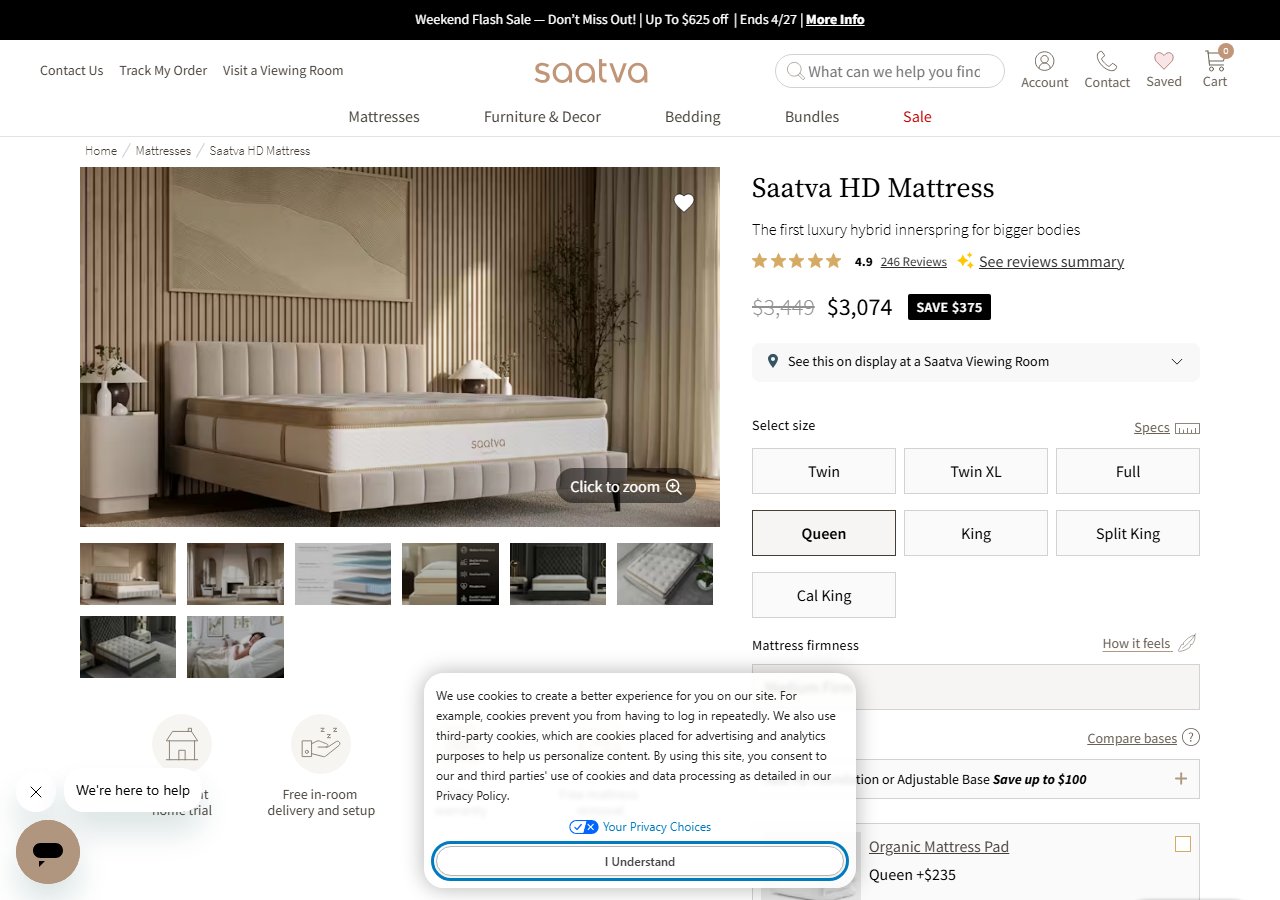
Saatva HD Mattress (Heavy-Duty)
$2,395-$3,995
See Price at Saatva →
Purple Hybrid Premier Mattress
$2,499-$4,799
See Price at Purple →Putting the Data Hierarchy Together
The federal data on joint pain, sleep disruption, and musculoskeletal disease in older adults points in a consistent direction: this is a serious, expensive, and undertreated problem — and the intervention hierarchy matters. CDC's finding that 35% of adults sleep under 7 hours, combined with CDC arthritis prevalence data showing 25% of adults have diagnosed arthritis, means that for millions of Americans over 60, inadequate sleep and chronic joint pain are not separate problems. They are the same problem, feeding each other.
The most cost-effective first step is free: adjust your sleep position. Use a pillow between or under your knees as recommended by NIH NIAMS. Walk 30 minutes daily, which NIH NCCIH evidence shows reduces chronic low back pain as effectively as most clinical interventions. Evaluate your current mattress honestly — visible sag or consistent morning stiffness in a mattress older than a decade is a legitimate clinical problem, per CDC sleep hygiene guidance. See a clinician if any red flags appear, per NIH NINDS criteria.
If you have done those things and still need a better sleep surface, the products above — the Loom & Leaf for foam-based pressure relief, the Saatva HD for high-load-history bodies, and the Purple Hybrid Premier for adaptive joint pressure management — represent the current engineering state of the art for this specific population and these specific biomechanical needs. They are not magic. They are precision tools that work best when the surrounding intervention ecosystem is also in place.
The AHRQ MEPS data showing elevated lifetime healthcare costs for chronic back pain patients is a reminder that the cost of ignoring this problem compounds over time. A well-chosen sleep surface, as part of a complete intervention strategy, is not an indulgence. For an older adult managing arthritis and chronic back pain, it is infrastructure.