The Night Shift Nobody Talks About: Arthritis, Age, and the Federal Data on Why Sleep Breaks Down After 60
The body does not stop hurting at bedtime. For the roughly 25% of U.S. adults who carry a doctor-diagnosed arthritis diagnosis — a share that climbs sharply with each decade of age — nighttime is when joint inflammation often feels most acute. Inactivity removes the gentle compression of movement that pumps synovial fluid through cartilage; lying still for hours allows inflammatory cytokines to pool. The result is that the people who most need restorative sleep are often the least able to get it.
CDC arthritis surveillance data documents this overlap without ambiguity: arthritis prevalence rises steeply after 60, tracking almost perfectly with the age cohort that also reports the highest rates of sleep disruption. At the same time, CDC sleep data shows approximately 35% of all U.S. adults report sleeping fewer than seven hours per night — the threshold the CDC and major sleep medicine bodies associate with elevated risk for cardiovascular disease, metabolic disorders, and accelerated musculoskeletal deterioration. For adults over 60, these two trends compound each other in a feedback loop: pain interrupts sleep, and insufficient sleep amplifies pain sensitivity.
This article is built on that federal data, not on mattress marketing. The goal is to help adults navigating joint pain after 60 understand why their sleep is breaking down, what the evidence says to try first, when to see a clinician, and — only after all of that — how a sleep surface fits into the picture.
Why This Happens: The Biomechanics of Arthritis-Driven Sleep Disruption
Understanding the mechanism matters because it tells you which interventions will actually work — and which are noise.
Osteoarthritis and inflammatory arthritis behave differently at night, but both cause sleep disruption. Osteoarthritis (OA), the most common form in adults over 60, is a degradation of cartilage — the cushioning tissue between bones at the hip, knee, and lumbar facet joints. When you lie still, the joint loses the mild pumping action that circulates synovial fluid, and the already-thinned cartilage bears static load from body weight against the sleep surface. If the surface is too firm, bony prominences at the hip and shoulder create pressure points that activate nociceptors (pain receptors) even during sleep, fragmenting sleep architecture without the sleeper fully waking. If the surface is too soft, the spine loses neutral alignment: the lumbar curve collapses, facet joints compress asymmetrically, and the sleeper wakes with stiffness that takes hours to resolve.
Rheumatoid arthritis and other inflammatory forms compound this with cytokine activity that peaks in early morning hours — a well-documented phenomenon that explains why RA patients often describe 4–6 a.m. as their most painful window. No mattress eliminates cytokine activity, but a surface that maintains spinal neutrality and reduces pressure-point loading can reduce the mechanical stress that amplifies that inflammatory pain.
The lumbar spine is the epicenter. CDC NHANES survey data identifies lower back pain as the most common chronic pain location among U.S. adults — approximately 20% of adults live with it. The BLS Musculoskeletal Disorders tracking confirms that the back is the most commonly injured body part across all occupations with lost workdays. For adults over 60 who spent decades in physically demanding work — manufacturing, construction, healthcare, agriculture — those occupational loading histories have deposited mechanical wear into lumbar discs and facet joints that now make nighttime positioning a critical variable.
Why the surface matters more as bodies age. Younger adults with intact cartilage and flexible soft tissue can adapt to a wider range of sleeping surfaces. After 60, several changes narrow that tolerance: reduced hip and shoulder muscle mass means bony prominences sit closer to the surface; decreased lumbar flexibility makes it harder for the spine to adjust to surface irregularities; and slower recovery from tissue compression means pressure from an ill-fitted surface lingers longer into the morning. A mattress that a 35-year-old could sleep on without consequence may cause a 65-year-old to wake with hip bursitis flares or lumbar stiffness lasting until noon.
The cost of getting this wrong is not just discomfort. AHRQ HCUP data identifies back pain as one of the most expensive conditions in U.S. healthcare by total inpatient and outpatient cost. AHRQ MEPS data shows that annual personal healthcare spending for adults with chronic back conditions substantially exceeds that of adults without — a gap that widens with age as the conditions become more complex. CMS drug spending data shows pain medication — opioid and non-opioid — among the costliest Medicare drug categories, reflecting a treatment burden that often traces back to under-managed chronic musculoskeletal conditions. Sleep disruption accelerates the deterioration that drives those costs. That is the public health case for taking nighttime joint management seriously.
The Cheapest Interventions Come Before Any Product Purchase
The evidence hierarchy here is unambiguous: behavioral and positional interventions for chronic back pain and arthritis-related sleep disruption have as strong or stronger a body of evidence as any passive product. Before evaluating any sleep surface, older adults dealing with joint-pain-driven sleep disruption should work through the following steps — all of them free or near-free, all cited to federal health sources.
Sleep position is the single biggest free variable. NIH guidance on back pain is explicit: side-sleeping with a pillow between the knees maintains hip alignment and prevents the top hip from rotating the lumbar spine into flexion. Back-sleeping with a pillow under the knees reduces lumbar hyperextension by allowing the curve to relax toward neutral. Stomach-sleeping — still extremely common among older adults who developed the habit decades ago — torques the lumbar spine and compresses cervical vertebrae, and the NIH National Institute of Neurological Disorders and Stroke identifies it as a contributor to worsened chronic pain. Changing sleep position is a behavioral intervention with zero cost and measurable benefit. It deserves serious effort before spending $2,000 on a mattress.
Daily walking is the most evidence-supported active intervention. An NIH NCCIH evidence review on low back pain finds that 30 minutes of walking on most days reduces chronic low back pain as effectively as most non-drug clinical treatments. For adults with arthritis, movement maintains synovial fluid circulation and reduces the inflammatory pooling that worsens nighttime pain. The point here is not that a new mattress is useless — it is that a sedentary 60-year-old who begins a daily walking routine will likely see more sleep improvement from that single change than from any sleep-surface upgrade.
Evaluate the existing mattress honestly. CDC sleep hygiene guidance recommends replacing a mattress that shows visible sag, one that causes you to wake stiffer than you went to bed, or one that is older than 7 to 10 years. Most adults underestimate mattress age. If your mattress is 12 years old and you wake stiff every morning, the surface is a legitimate variable — but a new mattress does not undo poor sleep hygiene or a sedentary lifestyle.
Lifting and bending mechanics apply during waking hours but affect nighttime recovery. OSHA ergonomics guidance recommends hinging at the hips rather than the lumbar spine, keeping loads close to the body, and avoiding twisting under load. For older adults still managing household tasks, grandchildren, or part-time work, daily mechanical insults to the lumbar spine during waking hours show up as nighttime pain. Correcting movement mechanics is a direct upstream intervention on nighttime symptoms.
For readers who have genuinely worked through the positional adjustments, the walking routine, and an honest assessment of their existing sleep surface — and are still waking with pain — a thoughtfully chosen sleep surface becomes a legitimate next variable. The evidence supports the idea that surface firmness, pressure relief, and spinal alignment support are real, measurable properties that affect pain outcomes. What the evidence does not support is skipping the behavioral work and leading with a product purchase.
When to See a Clinician Before Changing Anything
Not all joint pain that disrupts sleep is musculoskeletal maintenance. Some symptom patterns indicate conditions that require clinical evaluation before any positional or surface intervention, and older adults in particular should be alert to these flags.
NIH NINDS back pain guidance identifies several patterns that warrant prompt referral: pain that radiates below the knee (suggesting nerve root compression or spinal stenosis — more common after 60 due to disc height loss and facet joint hypertrophy); pain following even minor trauma (vertebral compression fractures are disproportionately common in older adults with osteoporosis); any back pain accompanied by bowel or bladder changes (possible cauda equina involvement); and systemic symptoms like unexplained weight loss or fever alongside back pain (can indicate infection or malignancy). None of these presentations should be managed with a mattress change. They need imaging and clinical evaluation.
For adults over 60, the SSA Disability Insurance data context is worth internalizing: musculoskeletal disorders are the largest single category of new disability claims annually. A meaningful portion of those claims reflect conditions that were allowed to progress without adequate clinical management. Early evaluation of red-flag symptoms is both medically appropriate and economically protective.
Where a Sleep Surface Fits In: The Product Evidence
With mechanism, behavioral interventions, and clinical red flags addressed, the sleep surface becomes the right conversation to have. For adults over 60 managing arthritis, lumbar pain, or combined joint pathology, the relevant surface properties are: zoned pressure relief (softer zones under the shoulder and hip, firmer support under the lumbar and lower body), motion isolation (reduces partner disturbance, which fragments sleep architecture independently of pain), and temperature regulation (inflammatory conditions are often worsened by sleeping hot, and older adults thermoregulate less efficiently).
Three products fit this reader cohort with the specificity the data demands.
For serious arthritis-related back pain: The Saatva Loom & Leaf
The Saatva Loom & Leaf Memory Foam Mattress is the strongest match for older adults whose primary complaint is pressure-point pain at the hip and shoulder alongside lumbar stiffness. It uses multi-layer American-made memory foam with a cooling gel layer at the surface — relevant for older adults who sleep warm and find that heat worsens joint inflammation overnight. The Loom & Leaf comes in two firmness options: Relaxed Firm (5.5 on a 10-point scale) and Firm (8). For most adults over 60 with OA at the hip and lumbar spine, the Relaxed Firm provides enough give to reduce bony-prominence loading without sacrificing the lumbar support that prevents morning stiffness. The full foam construction also provides exceptional motion isolation — a feature that matters to the significant share of older couples where one partner's pain-related repositioning disturbs the other's sleep. The Saatva white-glove delivery and old-mattress removal service is a practical consideration for adults who cannot manage heavy furniture independently.
For adults who are larger-framed or carried physically demanding occupational histories: The Saatva HD
The Saatva HD Mattress was engineered for a specific load profile: sleepers over 300 pounds, or those whose decades of manual labor have created the kind of compressed disc and joint pathology that requires a more robust support core to prevent the sleep surface from bottoming out under sustained weight. For this reader — the former warehouse worker, construction tradesperson, or agricultural worker now in their 60s — a standard foam or coil system often underperforms because the support core compresses too far under the load, losing the zoned architecture that keeps the lumbar spine from sagging into flexion. The Saatva HD uses a triple-tempered steel coil system with a higher coil count and reinforced perimeter, topped with a Euro pillow top that provides pressure relief without sacrificing the structural depth needed for heavier frames. The NIOSH Lifting Equation documentation confirms that workers in high-demand occupations routinely exceed safe spinal loading limits across careers — the cumulative effect of that loading history is exactly what the Saatva HD's support architecture is designed to accommodate at night.
For dominant pressure-relief needs and hip or shoulder arthritis: The Purple Hybrid Premier
The Purple Hybrid Premier Mattress takes a structurally different approach to pressure relief. Rather than conforming foam, it uses Purple's proprietary GelFlex Grid — a hyper-elastic polymer grid that collapses under pressure points (hip, shoulder) while maintaining rigid support under lighter zones (waist, lower legs). For older adults whose primary complaint is hip or shoulder joint pain rather than lumbar instability, this design produces less sustained lateral pressure against inflamed joint tissue than foam-based systems. The hybrid construction pairs the Grid with pocketed coils, which adds airflow (relevant for temperature management) and reduces motion transfer. The Purple Hybrid Premier is available in 2", 3", and 4" Grid heights — for adults with significant hip OA, the 3" or 4" Grid options provide greater pressure relief depth. It is the most unconventional material choice of the three, and some older adults accustomed to traditional foam or innerspring feel find the initial texture unfamiliar; Purple's trial period provides the necessary runway for adaptation.
Sleep Surfaces for Arthritis and Joint Pain After 60: Three Evidence-Aligned Picks
These three mattresses were selected for their specific pressure-relief, spinal support, and motion-isolation properties — the variables most relevant to older adults managing arthritis, lumbar pathology, or combined joint pain that disrupts sleep.

Saatva Loom & Leaf Memory Foam Mattress
$1,695-$3,295
See Price at Saatva →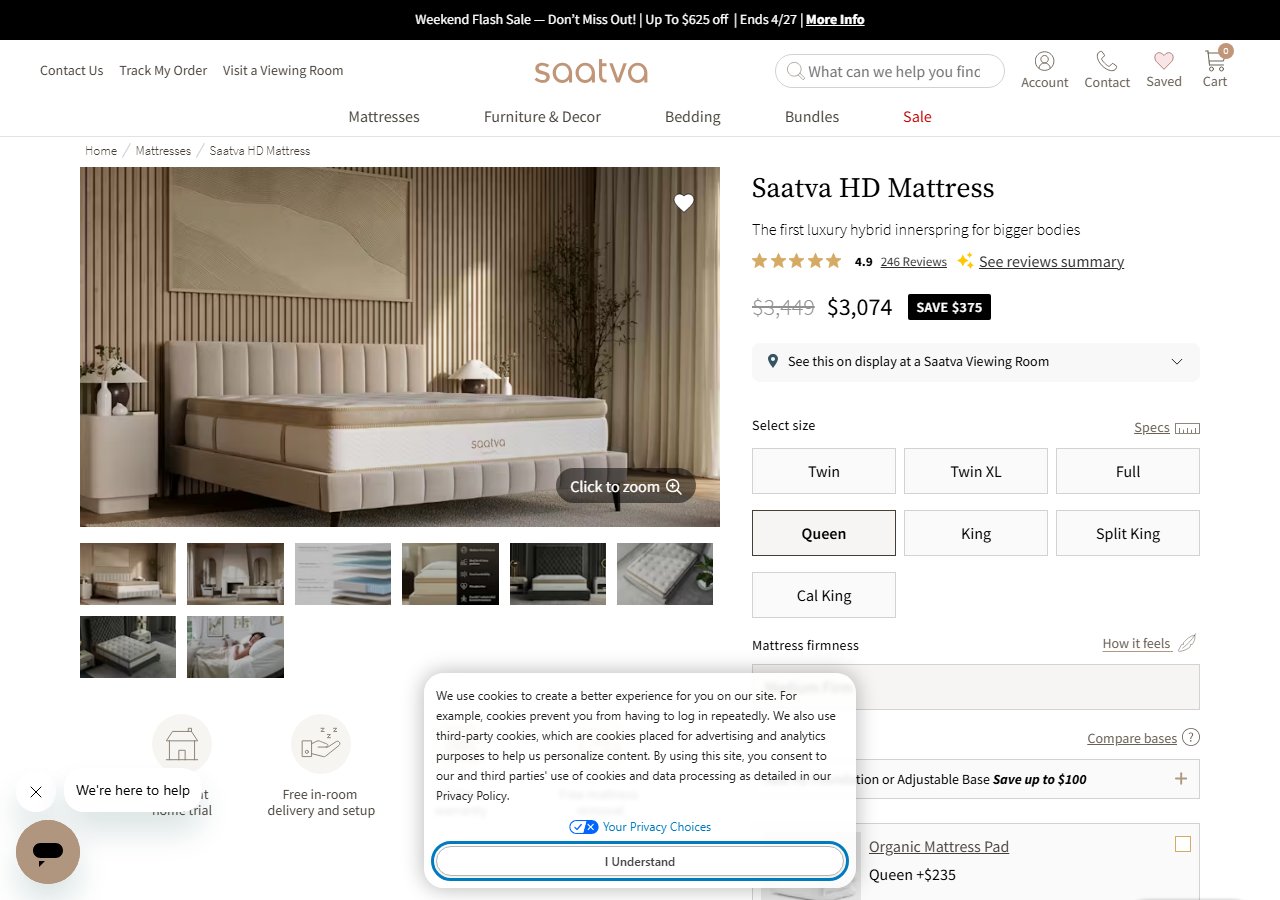
Saatva HD Mattress (Heavy-Duty)
$2,395-$3,995
See Price at Saatva →
Purple Hybrid Premier Mattress
$2,499-$4,799
See Price at Purple →A Note on Firmness Mythology
One of the most persistent pieces of sleep advice — 'firm mattress, healthy back' — has weak evidence support and is particularly poorly matched to adults over 60. The research on back pain and sleep surface firmness, summarized across several NIH-adjacent reviews, generally finds that medium-firm surfaces outperform both very firm and very soft options for chronic low back pain. 'Medium-firm' in mattress marketing language varies considerably by manufacturer, which is why understanding the underlying property — zoned pressure relief with lumbar support — matters more than chasing a firmness label. For arthritis patients specifically, a surface that is too firm increases tissue loading at bony prominences, which directly worsens joint pain. The federal health data does not endorse any specific product, but the biomechanical evidence is clear: 'hard mattress' is not a treatment for arthritis-related sleep disruption.
The Summary the Data Supports
For adults over 60 navigating joint pain that disrupts sleep, the evidence-based path is sequential and hierarchical. The CDC's arthritis data and sleep surveillance tell the etiological story: these conditions overlap, compound, and worsen without deliberate management. The AHRQ cost data and CMS drug spending figures quantify what happens when musculoskeletal conditions go unmanaged. The intervention sequence — position, movement, surface evaluation, clinical referral if red flags are present, then surface selection — is not a product funnel. It is what the federal evidence actually recommends.
A well-chosen sleep surface for an older adult with arthritis is not a luxury purchase. For the cohort that spent decades loading their spines in physically demanding work, it is a recovery tool for a body that has been working for 40 years and deserves a sleep environment that matches its current mechanical reality. The Saatva Loom & Leaf, Saatva HD, and Purple Hybrid Premier each address specific aspects of that reality. None of them replace the behavioral and clinical work that comes first.