The federal data on joint pain and sleep after 60
Start with two numbers that rarely appear in the same sentence. The CDC's arthritis surveillance data shows that approximately 25% of U.S. adults report doctor-diagnosed arthritis — a condition whose prevalence climbs steeply with age. Separately, CDC sleep data shows that roughly 35% of U.S. adults sleep fewer than 7 hours per night, the threshold the CDC associates with elevated chronic disease risk. For adults over 60, these two statistics do not simply coexist. They amplify each other. Arthritic joints produce nocturnal pain that fragments sleep architecture. Fragmented sleep, in turn, elevates systemic inflammation, which worsens arthritic pain. The cycle is not metaphorical — it is measurable in cytokine levels and reported consistently across NIH-funded clinical research.
The economic weight of this cycle is staggering. AHRQ's HCUP data identifies back pain as one of the most expensive conditions in U.S. healthcare when measured by combined inpatient and outpatient costs. The AHRQ Medical Expenditure Panel Survey sharpens that finding: adults living with chronic back conditions carry personal healthcare expenditures that substantially exceed those of adults without such conditions — year after year, not just during acute episodes. Meanwhile, the CMS Drug Spending Dashboard identifies opioid and non-opioid pain medications as among the most expensive categories in Medicare drug spending, a direct reflection of how heavily the healthcare system leans on pharmacological management when structural contributors — like a worn-out sleep surface or a decade of poor sleep position — go unaddressed.
This is not a minor quality-of-life issue. The SSA's Disability Insurance data shows musculoskeletal disorders are the single largest category of new disability claims filed annually. When chronic musculoskeletal pain goes unmanaged and sleep deprivation compounds it, the downstream trajectory bends toward disability, not recovery.
Why joint pain hits differently after 60: the biomechanical mechanism
To understand why sleep surface firmness matters for older adults, you need to understand what changes structurally in the aging spine and joints — because the answer is not simply "things wear out." The mechanisms are more specific than that.
The intervertebral discs that cushion each spinal segment lose hydration progressively with age. A well-hydrated disc in a younger adult can absorb compressive and tensile loads with significant elasticity. A desiccated disc in a 65-year-old cannot. The result is reduced disc height, increased rigidity in the vertebral column, and a narrowed tolerance for positions that load the spine asymmetrically. Stomach-sleeping, which rotates the lumbar spine while simultaneously extending the cervical spine, becomes genuinely painful rather than merely suboptimal. Back-sleeping on a surface that is too firm creates sustained pressure on the sacrum and lumbar region without conforming to the natural lumbar curve, which is not flat — it is lordotic, meaning it curves inward. A too-soft surface, conversely, allows the pelvis to sink, collapsing that lumbar curve and placing the facet joints and posterior musculature under continuous stretch load across a 7-to-8-hour sleep window.
Osteoarthritis — the mechanical wear-and-tear variant that accounts for the majority of CDC's arthritis prevalence figures — preferentially affects the hip joints, knee joints, and lumbar facet joints. All three of these structures are under direct influence from how you're positioned during sleep. A side-sleeper with hip osteoarthritis resting on a surface that lacks adequate pressure relief at the greater trochanter will experience pain that interrupts sleep every time tissue pressure at that bony prominence exceeds capillary closing pressure — roughly 32 mmHg. This is not an abstract concern; it is the same principle that drives hospital-grade pressure relief protocols for bedridden patients.
Rheumatoid arthritis introduces a different mechanism: systemic inflammation that peaks in the early morning hours, a circadian pattern well-documented in rheumatology literature. RA patients frequently report their worst stiffness and pain in the hours between 3 a.m. and 7 a.m., precisely when they should be in their deepest, most restorative sleep stages. Sleep architecture research shows that fragmented sleep reduces slow-wave sleep disproportionately — and slow-wave sleep is the stage most associated with tissue repair and anti-inflammatory cytokine balance.
CDC's NCHS Data Brief 390 reports that approximately 20% of U.S. adults experience chronic pain, with lower back identified as the most common anatomical location. In adults 60 and older, the co-occurrence of lower back pain with hip or knee arthritis is the rule, not the exception. This is critical for product evaluation: a sleep surface that addresses lumbar support but ignores hip pressure relief — or vice versa — is solving half the problem.
The cumulative occupational loading story matters here too. BLS data on musculoskeletal disorders by occupation consistently shows that the back is the most commonly injured body part across all occupations with days away from work. Adults who spent careers in physically demanding work — healthcare, construction, warehousing, manufacturing — arrive at their 60s and 70s carrying cumulative spinal loading that the NIOSH Lifting Equation documents routinely exceeded safe limits throughout their working years. Their discs and facet joints have absorbed decades of mechanical insult. Their sleep surface needs are not the same as a sedentary 62-year-old's. They often need more targeted zoned support, not simply a medium-firm compromise.
The cheapest interventions come first
Before spending a dollar on a new mattress, it is worth being clear-eyed about what the evidence says about free or low-cost interventions — because the data consistently shows that behavioral and positional changes carry at least as much clinical weight as sleep surface upgrades, and often more.
The NIH National Institute of Arthritis and Musculoskeletal and Skin Diseases is direct on sleep position: side-sleeping with a pillow between the knees or back-sleeping with a pillow under the knees maintains spinal neutrality and reduces chronic pain. Stomach-sleeping, which forces the lumbar spine into extension and rotates the cervical spine, actively worsens chronic lower back and neck pain. This single positional change — which costs nothing beyond a pillow you likely already own — is documented to reduce pain and improve sleep quality in clinical trials. The NIH NCCIH's evidence review on low back pain reaches a similar conclusion about daily walking: 30 minutes of walking on most days reduces chronic low back pain as effectively as most non-drug clinical treatments. That is a remarkable finding that gets far less attention than it deserves. Exercise, specifically walking, changes the mechanical environment of the disc, improves paraspinal muscle endurance, and reduces the systemic inflammatory load that drives arthritic pain. Finally, CDC sleep hygiene guidance is clear about when a mattress is actually the problem: visible sag, waking stiffer than you went to bed, or a mattress older than 7–10 years are the legitimate triggers. Sleep hygiene — consistent sleep/wake times, a cool dark room, screen avoidance before bed — costs nothing and addresses many of the same sleep quality deficits that older adults with chronic pain report.
For readers who have already worked through sleep position, walking habits, and sleep hygiene — and who are sleeping on a mattress that shows visible sag or is past the 7–10 year threshold — the evidence supports upgrading the sleep surface as a clinical adjunct, not a luxury purchase. The key word is adjunct: a better mattress does not undo sedentary days or a poor sleep schedule. But paired with the behavioral interventions above, the right surface can meaningfully reduce nocturnal pressure and improve spinal alignment in ways that are measurable in both pain scores and sleep duration.
When to see a clinician — and what the red flags actually are
Before evaluating any sleep surface, every reader in this age group should complete a quick self-assessment against red flags that indicate something more serious than mechanical back pain or arthritic joint pain. These are not edge cases in a population 60 and older — they are clinically common.
NIH's National Institute of Neurological Disorders and Stroke is explicit: back pain that radiates below the knee, that is accompanied by leg weakness or numbness, that follows acute trauma, or that comes with bowel or bladder changes requires prompt clinical evaluation — not a new mattress. These symptoms can indicate nerve root compression, spinal stenosis, or cauda equina syndrome, all of which require imaging and specialist referral. Similarly, back pain accompanied by unexplained weight loss or fever in an older adult should be evaluated urgently for infectious or malignant etiology. Night pain that wakes an older adult from sleep and is not relieved by any position change is distinct from arthritic pain, which typically eases with gentle movement, and deserves clinical attention.
For the majority of adults 60 and older who experience the more typical pattern — pain that is worse after prolonged positions, that improves with gentle movement in the morning, that correlates with weather changes or activity levels — the interventions above are appropriate first steps. But in this age group, the threshold for clinical consultation should be lower, not higher. The AHRQ HCUP data on back pain costs reflects, in part, the consequences of delayed diagnosis. A primary care visit or physical therapy evaluation is substantially cheaper than the downstream costs of untreated spinal stenosis or undiagnosed vertebral fracture.
What the right sleep surface actually does for older adults with joint pain
With behavioral interventions in place and red flags ruled out, the question becomes technical: what does a well-engineered sleep surface actually do for an older adult with arthritis and chronic back pain, and where does the evidence point?
The core variables are pressure relief at bony prominences (hips, shoulders, sacrum), zoned spinal support (firmer under the lumbar region and pelvis, softer at the shoulders), motion isolation (relevant for couples, and for anyone whose arthritic pain makes being disturbed by a partner's movement genuinely disruptive), and ease of repositioning (a surface that is too soft creates a "hammock effect" that makes it difficult for older adults with hip or knee OA to change position without significant effort).
For older adults managing serious back pain — particularly those with a history of physically demanding occupations who carry the cumulative spinal load documented in BLS injury data — the Saatva Loom & Leaf Memory Foam Mattress is the premium memory foam pick engineered specifically for this pattern of need. Its construction uses a layered approach with a cooling spinal zone gel and dual tempered steel coil base designed to provide lumbar-specific reinforcement — meaning it does not treat the body as a uniform surface that needs uniform support. The memory foam contours to arthritic hip and shoulder pressure points while the lumbar zone provides the firmer foundation that prevents the pelvis from sinking. For older adults who have found that soft mattresses exacerbate their lower back pain while too-firm surfaces aggravate their hip or shoulder arthritis, this kind of zoned construction is addressing a real biomechanical requirement, not just a marketing distinction.
For older adults who spent careers in physically demanding work — warehouse logistics, construction, healthcare — and who carry larger body mass or simply need a more substantial support structure to prevent premature sag, the Saatva HD Mattress is engineered for the higher load requirements that standard mattresses are not built to sustain. The HD's construction uses a dual-coil system with a patented Lumbar Zone® support layer and a higher gauge of steel than standard innerspring designs. This matters specifically for heavier older adults whose weight distribution at the hip and lumbar regions would cause a standard medium-firm mattress to compress unevenly over time — producing the very sag and spinal misalignment that worsens chronic back pain. The AHRQ MEPS data on chronic back condition healthcare expenditures is a reminder of what a failing sleep surface costs over time in downstream healthcare utilization.
For older adults whose primary complaint is pressure pain — hip arthritis, shoulder pain, or diagnosed fibromyalgia layered onto joint disease — the Purple Hybrid Premier Mattress takes a fundamentally different engineering approach. Purple's proprietary GelFlex Grid is not foam: it is a hyper-elastic polymer grid that collapses under bony prominences and supports soft tissue simultaneously, rather than distributing pressure across the entire contact surface the way foam does. Clinical pressure mapping has shown this architecture achieves lower peak pressures at the greater trochanter and shoulder than equivalent-firmness foam mattresses, which is directly relevant to the nocturnal pressure pain that disrupts sleep in hip and shoulder OA.
Mattresses Engineered for Arthritic Joints and Aging Spines
These three mattresses were selected for their documented pressure-relief architecture, zoned lumbar support, and suitability for older adults managing arthritis, chronic back pain, or cumulative occupational spinal loading.

Saatva Loom & Leaf Memory Foam Mattress
$1,695-$3,295
See Price at Saatva →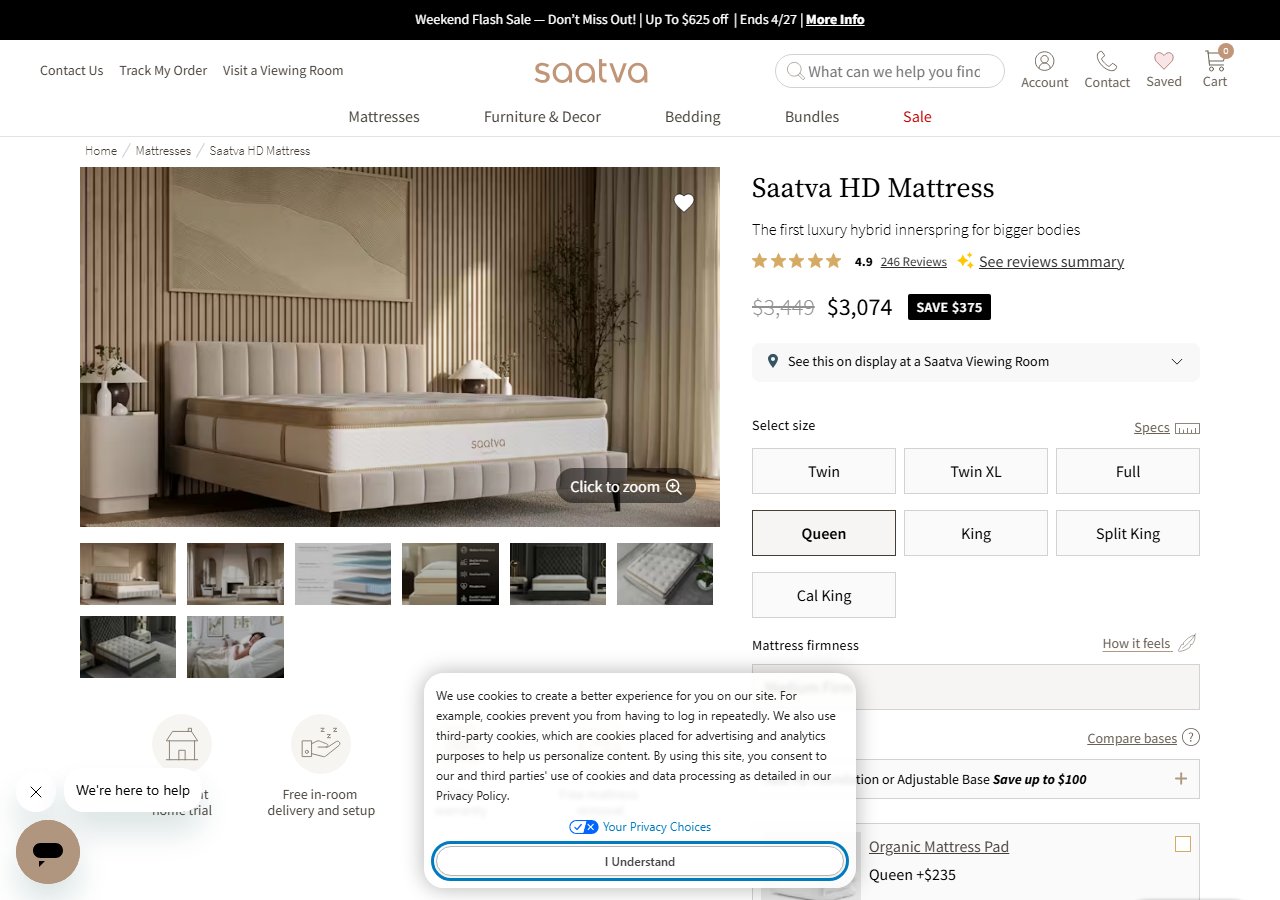
Saatva HD Mattress (Heavy-Duty)
$2,395-$3,995
See Price at Saatva →
Purple Hybrid Premier Mattress
$2,499-$4,799
See Price at Purple →Making the decision: what the federal data hierarchy suggests
The federal data assembled here tells a coherent story when read in sequence. The CDC documents that one in four Americans has arthritis. The CDC sleep data shows that more than one in three adults is already sleeping below the minimum threshold for healthy function. The AHRQ and CMS data show the economic consequence: billions in avoidable healthcare utilization and drug spending that correlates with undertreated musculoskeletal pain. The SSA disability data shows where the trajectory leads when chronic musculoskeletal pain is managed passively.
None of this federal data recommends a specific mattress. What it does, when read carefully, is define the problem space clearly enough that intervention choices become more logical. The behavioral interventions — sleep position, walking, sleep hygiene — are free, evidence-based, and should precede any product purchase. Clinical evaluation should occur before any older adult with new or changing back pain dismisses their symptoms as mechanical. And when a mattress genuinely needs replacement, choosing one engineered for the specific biomechanical needs of arthritic joints and aging spinal structures is a more evidence-grounded decision than choosing by price or brand alone.
For most readers in this demographic, the honest summary is this: the strongest thing you can do tonight costs nothing. Fix your sleep position. Commit to a walking habit. Assess your mattress against the CDC's own hygiene criteria. If it fails those criteria, replace it with a surface that addresses your specific joint and spinal anatomy — not the firmness level a salesperson recommends, but the zoned support and pressure relief architecture that the biomechanics of your joints actually require.