The Epidemiology Is Personal: Why Older Adults Lose Sleep to Joint Pain
You already know what the data confirms. You go to bed tired, you lie down, and within 20 minutes your hips are aching, your lower back is stiff, or your knees are throbbing. You shift positions. The shoulder takes over. You shift again. By 3 a.m. you've clocked two positions, one trip to the bathroom, and maybe four hours of actual sleep. The morning feels like a punishment.
This is not a willpower problem. It is a documented physiological cascade — and federal health agencies have been tracking the upstream causes for decades.
CDC Arthritis Data shows that approximately 25% of U.S. adults carry a doctor-diagnosed arthritis diagnosis, with that prevalence sharply elevated in adults who spent careers in physically demanding work — construction, warehousing, nursing, agriculture, manufacturing. For adults over 60, the cumulative toll of those occupational loads compounds with natural cartilage thinning, reduced synovial fluid production, and the biomechanical changes that arrive with age. The result is a body that hurts more at rest than in motion, because compression from a hard surface replaces the dynamic support that movement provides.
Simultaneously, CDC sleep and sleep disorders data shows that approximately 35% of U.S. adults report sleeping fewer than 7 hours per night, the threshold the CDC associates with elevated risk for chronic disease, obesity, diabetes, and cardiovascular events. That national average almost certainly underrepresents the situation for adults over 60 with musculoskeletal conditions, who face the additional sleep-architecture disruption that chronic pain creates: more time in light sleep, less time in the deep slow-wave sleep where tissue repair occurs, and more frequent micro-arousals that the sleeper may not even consciously remember but that accumulate as next-day fatigue and mood impairment.
The economic data tells the same story from a different angle. AHRQ HCUP data identifies back pain as one of the most expensive conditions in U.S. healthcare by total inpatient and outpatient cost — a figure driven in part by the compounding of untreated musculoskeletal conditions into surgeries, imaging, and long-term medication dependence. CMS drug spending data identifies opioid and non-opioid pain medication spending among the most expensive Medicare drug categories, which is a particularly stark signal given that Medicare is disproportionately covering adults over 65. The same population that is sleeping poorly on inadequate surfaces is generating enormous downstream treatment costs.
Why This Happens: The Biomechanics of Nighttime Joint Pain After 60
Understanding why older joints hurt more at night requires understanding what a mattress is actually doing — and what it fails to do when it is wrong for your body.
During the day, your musculature is engaged. Your hip abductors, your paraspinal muscles, your gluteus medius — these active stabilizers hold your skeleton in alignment and buffer the mechanical stress that would otherwise land directly on your joints. When you lie down, that active muscular support largely switches off. Whatever surface you're lying on becomes the sole external support for your skeletal structure. If that surface is too firm, it creates pressure concentrations at bony prominences — hips, shoulders, sacrum — that compress the underlying soft tissue and trigger pain signals. If it's too soft, the pelvis sinks, the lumbar spine falls into flexion or lateral deviation, and the facet joints and intervertebral discs absorb the misalignment throughout the night.
For adults over 60, the margin for error on this spectrum narrows considerably. Arthritic joints are not just painful — they are inflamed. Inflamed tissue is hyperalgesic: it has a lower pain threshold than healthy tissue. A pressure concentration that a 35-year-old with healthy cartilage might sleep through without waking will trigger an arousal in a 65-year-old with hip osteoarthritis. This is not weakness or low pain tolerance. It is a measurable physiological change in nociceptor sensitivity that occurs with chronic inflammation.
Add to this the postural changes that accumulate with age. Many adults over 60 have developed kyphosis — a forward rounding of the thoracic spine — from decades of desk work or forward-leaning labor. Others have lost lumbar lordosis, the natural inward curve of the lower back, from years of hip flexor tightening. These structural shifts mean the body's neutral sleeping position is no longer a straight line from crown to sacrum. A surface that was adequate at 45 may be genuinely inadequate at 65 for purely anatomical reasons.
CDC NCHS Data Brief 390 documents that approximately 20% of U.S. adults experience chronic pain, with lower back as the single most common pain location. For older adults, that chronic pain is frequently the compounded result of career-long occupational loading — the warehouse worker's repetitive bending, the nurse's prolonged standing and patient transfers, the construction worker's overhead reaching. BLS Musculoskeletal Disorder tracking confirms that the back is the most common body part injured across all U.S. occupations with days away from work — which means the majority of adults over 60 who worked physical jobs are carrying some degree of accumulated lumbar stress into their retirement years.
AHRQ MEPS data shows that annual personal healthcare expenditures for adults with chronic back conditions substantially exceed those without — a gap that grows with age as the conditions become more complex and treatment-resistant. The SSA Disability Insurance data identifies musculoskeletal disorders as the largest single category of new disability claims annually, underscoring that for a meaningful fraction of the population, the trajectory from untreated nighttime pain to functional disability is not hypothetical.
None of this is deterministic. The evidence also shows that the right interventions — behavioral, clinical, and where appropriate, equipment-based — can interrupt the cycle. But the order matters.
Try These First: Free and Low-Cost Interventions That Federal Research Supports
The cheapest intervention is the one that does not require buying anything. Before evaluating any product, older adults with joint-related sleep disruption should exhaust the behavioral and positional interventions that federal health agencies have specifically validated. These are not filler advice. They are, in many cases, as effective as clinical treatments and far more effective than any single product change.
Sleep position is probably the most impactful zero-cost variable. NIH guidance from the National Institute of Arthritis and Musculoskeletal and Skin Diseases is explicit: side-sleeping with a pillow between the knees keeps the pelvis level and the lumbar spine in neutral, reducing the lateral shear forces that aggravate facet joints and hip bursae. Back-sleeping with a pillow under the knees flattens the lumbar curve into a supported neutral position and reduces compressive load on the posterior disc. Stomach-sleeping torques the lumbar spine into extension and lateral rotation simultaneously — it is, for adults with arthritis or disc degeneration, almost universally the worst choice.
Daily walking is a more powerful intervention than most people expect. NIH NCCIH's evidence review on low-back pain concludes that walking 30 minutes most days reduces chronic low-back pain as effectively as most non-drug clinical treatments. The mechanism is both mechanical — walking restores disc hydration and lubricates facet joints through cyclical loading — and systemic, through anti-inflammatory effects of aerobic exercise. A new mattress helps. Movement helps more, and it costs nothing.
Knowing when the mattress itself is the problem is a legitimate diagnostic step. CDC Sleep Hygiene guidance provides practical criteria: if your mattress has visible sag, if you consistently wake stiffer than when you went to bed, or if it is older than 7 to 10 years, surface replacement is a rational intervention. But even the most expensive mattress does not compensate for poor sleep hygiene — late screens, inconsistent wake times, alcohol before bed — or for a sedentary lifestyle that leaves the muscular stabilizers too weakened to protect joints during sleep.
For older adults who have already addressed position, movement, and sleep hygiene — and who are sleeping on a mattress that is sagging, overly firm, or simply no longer matched to a body that has changed significantly since they last replaced it — surface selection does matter. The evidence on pressure relief and spinal alignment during sleep is real, even if the marketing around it is often inflated. The key is knowing what criteria to apply, rather than price-anchoring or brand-following.
When to See a Clinician: Red Flags That Require Medical Attention First
Before any product decision, older adults need to screen for pain patterns that indicate a condition requiring clinical evaluation — not sleep surface optimization. This is especially critical for the 60-plus population, in whom serious spinal pathology, inflammatory arthritis, and systemic conditions are more prevalent than in younger cohorts.
NIH guidance from the National Institute of Neurological Disorders and Stroke is unambiguous: pain that radiates below the knee, pain that follows a traumatic event, pain accompanied by leg weakness, numbness, or tingling, and pain associated with bowel or bladder changes are all red flags that require prompt clinical evaluation. Similarly, back pain accompanied by unexplained weight loss or fever should be evaluated emergently. Do not buy a new mattress for these symptoms. See a physician.
For older adults specifically, new-onset severe back pain that appears suddenly and without obvious mechanical cause warrants imaging, because vertebral compression fractures — common in post-menopausal women and older men with low bone density — can present as mechanical back pain and are frequently underdiagnosed. The appropriate intervention for a compression fracture is orthopedic or neurosurgical consultation, not surface firmness optimization.
If your pain is instead the familiar, longstanding stiffness and aching of osteoarthritis, managed and known, and you are waking at night from pressure discomfort rather than acute radiating pain, then surface evaluation is appropriate — and the evidence supports it.
Where Mattress Design Intersects With Arthritis Physiology
For older adults whose joint pain is clinically stable and whose sleep disruption is driven by inadequate pressure relief and spinal support, mattress construction variables have measurable implications. The relevant criteria are not price or brand. They are: zonal pressure distribution (does the surface offload bony prominences at the hip and shoulder while supporting the lumbar curve?), motion isolation (does partner movement transfer into pain-inducing micro-arousals?), edge support (can you get in and out of bed without the edge collapsing, which is a safety and independence issue for older adults?), and temperature neutrality (does the surface trap heat, which disrupts sleep architecture and is more problematic with age-related thermoregulatory changes?).
For the premium memory foam category, the Saatva Loom & Leaf Memory Foam Mattress is the most clinically relevant pick for older adults with serious, documented back pain and arthritis. Its gel-infused spinal zone memory foam is specifically engineered to provide targeted lumbar support while the surrounding foam conforms to the hip and shoulder pressure points that are most commonly implicated in arthritis-related sleep disruption. Loom & Leaf is available in two firmness options — Relaxed Firm and Firm — which allows adults with different sleep positions and body types to select the appropriate support gradient rather than guessing. The organic cotton cover and reduced off-gassing profile are relevant for older adults with respiratory sensitivities. White-glove in-home delivery and old mattress removal is included, which matters practically for adults who cannot handle heavy mattress installation alone.
For older adults who are larger-framed — or who spent careers in physically demanding work that has left them with a higher BMI and significant lumbar loading history — standard mattress construction often fails at the edge and at the center, creating the sag that mechanically destabilizes sleep position throughout the night. The Saatva HD Mattress is purpose-engineered for bodies in the 250-to-500-pound range, with a 2-inch lumbar crown, a proprietary foam-encased coil system, and a reinforced perimeter that maintains support geometry at the edge rather than collapsing under loading. For an older adult of larger frame who is waking with hip or low back pain and finds that their current mattress has developed body impressions, the HD addresses the engineering root cause rather than providing a comfort-layer workaround.
For older adults whose primary complaint is pressure-point pain — concentrated hip or shoulder aching that wakes them specifically when the joint contacts the mattress — the Purple Hybrid Premier Mattress takes a fundamentally different approach to the pressure-relief problem. Purple's GelFlex Grid is a non-foam polymer structure that collapses under direct point pressure (offloading the bony prominence) while providing firm support to areas of the body that are not applying concentrated load. This means the hip sinks into the grid while the lumbar region is supported, approximating the zonal differentiation that orthopedic sleep recommendations describe. The coil base provides the motion isolation and edge support that memory foam alone sometimes lacks. For an older adult who has tried medium-firm memory foam and still wakes from hip pain, the grid architecture represents a genuinely different mechanical approach rather than just a different firmness grade.
Mattresses Evaluated for Arthritis Pressure Relief and Joint Support After 60
Each of these mattresses was selected against clinical criteria specific to older adults with joint pain: zonal pressure relief at bony prominences, lumbar support geometry, edge stability for safe in-and-out-of-bed transfers, and construction appropriate for age-related body composition changes.

Saatva Loom & Leaf Memory Foam Mattress
$1,695-$3,295
See Price at Saatva →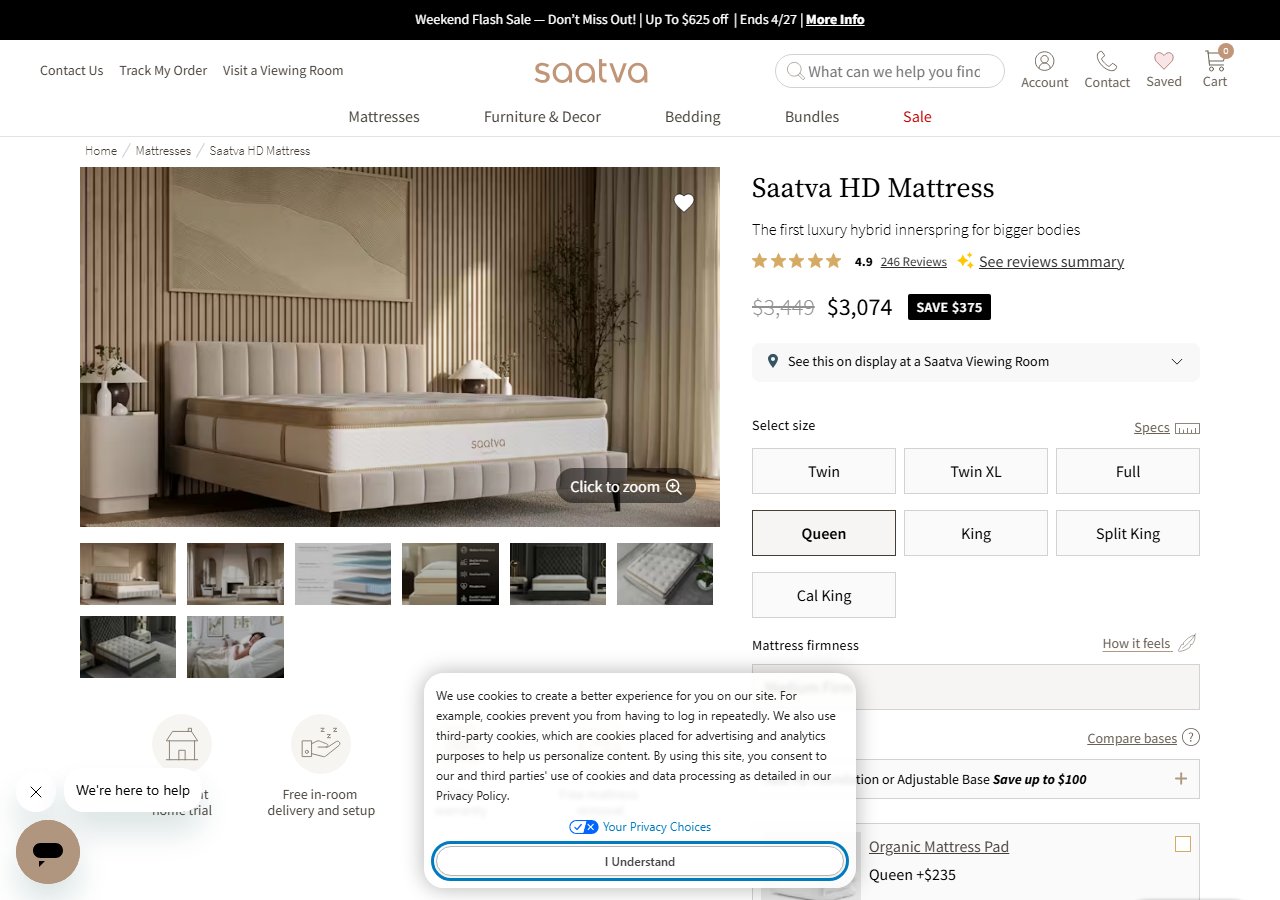
Saatva HD Mattress (Heavy-Duty)
$2,395-$3,995
See Price at Saatva →
Purple Hybrid Premier Mattress
$2,499-$4,799
See Price at Purple →Making the Decision: A Federal-Data-to-Product Framework for Older Adults
The federal data creates a clear decision hierarchy. Start with the interventions that cost nothing: correct your sleep position using NIH-validated guidance, add a daily walking habit that NCCIH evidence supports as equivalent to most non-drug clinical treatments, and audit your sleep hygiene against CDC criteria. If you have red-flag symptoms per NINDS guidance, see a clinician before evaluating any product. If you are on Medicare and your drug costs for pain management are climbing — a pattern the CMS drug spending dashboard documents nationally — speak with your physician about whether non-pharmacological approaches to sleep quality might reduce that burden.
If you have done all of that and you are sleeping on a mattress that is visibly sagged, more than a decade old, or simply wrong for a body that has changed significantly with age and occupational history, then surface selection is a legitimate next step. Use the clinical criteria — pressure relief at bony prominences, lumbar support, edge stability, temperature regulation — not price or marketing language.
The AHRQ MEPS data is a useful lens: adults with chronic back conditions already spend substantially more on healthcare than those without. A mattress that demonstrably reduces nighttime pain and improves sleep architecture is not a luxury purchase for this population — it is a rational investment in a body that federal data shows is already under significant medical and financial stress.
The SSA disability data is the starkest framing: musculoskeletal disorders are the largest single category of new disability claims annually. Not all of those trajectories are preventable. But the evidence strongly supports that sleep quality, pain management, and functional mobility are interdependent — and that adults who sleep better recover better, move more, and maintain functional independence longer. The surface you sleep on is one variable in that system. A real one. Just not the only one.