The Federal Data Picture: Joint Pain, Age, and Lost Sleep
Start with a number that should alarm anyone who works in healthcare, elder care, or public health: approximately 25% of U.S. adults report doctor-diagnosed arthritis, per CDC surveillance data. Now layer on a second number: approximately 35% of U.S. adults report sleeping fewer than 7 hours per night, the threshold the CDC associates with elevated risk for obesity, diabetes, cardiovascular disease, and mental health disorders. These two statistics do not sit in separate silos. For adults over 60, they are almost always the same people — and the interaction between them is not random. It is biological, biomechanical, and, to a meaningful degree, addressable.
The CDC's arthritis surveillance also documents that arthritis prevalence rises sharply with age, with adults 65 and older carrying the highest burden. For this population, nighttime is not a reprieve from joint pain — it is frequently when pain intensifies. Inflammatory cytokines follow a circadian rhythm, peaking in the early morning hours. Joints that were manageable during a carefully paced afternoon can become acutely painful between 2 and 5 a.m., fragmenting sleep into shallow, non-restorative intervals. The result is a vicious cycle: poor sleep elevates systemic inflammation markers (C-reactive protein, interleukin-6), which in turn worsen joint pain the following night.
The economic footprint of this intersection is substantial. AHRQ HCUP data identifies back pain as one of the most expensive conditions in U.S. healthcare by total inpatient and outpatient cost. AHRQ's Medical Expenditure Panel Survey confirms that adults with chronic back conditions carry annual personal healthcare expenditures that substantially exceed those of adults without such conditions. And at the federal payer level, CMS drug spending data shows opioid and non-opioid pain medications among the most expensive Medicare drug categories — a direct reflection of how undertreated and persistent this pain burden is among older Americans. Meanwhile, SSA Disability Insurance data consistently identifies musculoskeletal disorders as the single largest category of new disability claims each year. The public health math is unambiguous: joint and back pain is not a lifestyle inconvenience. It is a systemically expensive, functionally disabling condition that worsens with age and is deeply entangled with sleep quality.
Why Joint Pain Gets Worse at Night After 60: The Biomechanics
Understanding why older adults lose sleep to joint pain requires understanding what actually changes in the musculoskeletal system across the sixth decade of life and beyond. The changes are structural, hormonal, and neurological — and they interact in ways that make the 60+ sleep experience categorically different from sleep at 40.
Cartilage thinning and contact stress. Articular cartilage — the shock-absorbing tissue at joint surfaces — degrades progressively with age. In the spine, intervertebral disc height decreases, reducing the cushioning between vertebrae. When an older adult lies on a surface that does not distribute bodyweight evenly, bony prominences (hips, shoulders, sacrum) bear concentrated pressure that healthy cartilage at 35 would buffer. The result is pressure-point pain that wakes people up — typically after 60 to 90 minutes of sleep, corresponding to the first full sleep cycle.
Reduced overnight muscle tone. During non-REM sleep, paraspinal and hip-girdle muscles relax more completely in older adults than in younger ones. This is partly adaptive (muscles need recovery), but it means the passive support burden shifts entirely to the sleeping surface. On a mattress that has lost its structural integrity — visible sag, coil fatigue, foam compression — the spine drops into flexion or lateral deviation, loading facet joints and sacroiliac joints in positions they cannot tolerate for six to eight hours. BLS injury data confirms the back as the most frequently injured body part across U.S. occupations, and for older adults who spent careers in physically demanding work, spinal structures often arrive at retirement with cumulative microtrauma already present.
Inflammatory timing. Rheumatoid and osteoarthritic processes are not static. Synovial inflammation follows circadian rhythms. Pro-inflammatory cytokines peak in early morning, which is why many arthritis patients report their worst pain and stiffness between 3 and 6 a.m. No sleep surface eliminates inflammation, but a surface that reduces mechanical loading on affected joints — hips, knees, lumbar facets, shoulders — reduces the additive mechanical trigger that compounds inflammatory pain.
Thermoregulation changes. Older adults have reduced vascular flexibility and thermoregulatory reserve. Sleeping surfaces that trap heat (dense foam without conductive layers, fully enclosed mattress constructions) can trigger night sweats and micro-arousals. Combined with inflammatory pain, these thermal arousals further fragment the restorative deep sleep that the body uses to regulate inflammatory cytokine production. It is a feedback loop, and the sleeping surface sits at the center of it.
Approximately 20% of U.S. adults experience chronic pain with the lower back as the most common site, per CDC NHANES data — and among adults over 60, that figure climbs substantially. This is not an abstract statistic. It represents millions of people lying awake at 4 a.m., caught between an aching hip and a mattress that cannot hold their spine level.
Try These First: Free and Low-Cost Interventions Supported by Federal Evidence
The cheapest intervention is the one that does not require buying anything. Before evaluating a new mattress — a purchase that ranges from $1,695 to nearly $5,000 in the options we examine below — it is worth rigorously applying the interventions that federal health agencies document as effective for chronic back and joint pain in older adults. Some of these will solve the problem without a mattress change. Some will make any mattress work better. All of them are backed by evidence that a new mattress alone cannot match.
Sleep position is the single largest free variable available to you. NIH guidance from the National Institute of Arthritis and Musculoskeletal and Skin Diseases is direct on this: side-sleeping with a pillow between the knees keeps the lumbar spine and hip joints neutral, preventing the femur from internally rotating and torquing the sacroiliac joint. Back-sleeping with a pillow under the knees flattens the lumbar curve and reduces facet joint loading. Stomach-sleeping places the lumbar spine in sustained extension and rotation simultaneously — a posture that compresses posterior vertebral structures and reliably worsens chronic back and hip pain. If you are currently stomach-sleeping on a firm mattress and wondering why you wake with hip and lower back pain, the surface is not your primary problem. Position is. This costs nothing to change.
Daily walking is the most evidence-supported active intervention. NIH's National Center for Complementary and Integrative Health review of low-back pain treatments documents that 30 minutes of walking most days reduces chronic low-back pain as effectively as most non-drug clinical treatments. For older adults specifically, walking also reduces joint stiffness, maintains cartilage hydration through synovial fluid circulation, and preserves paraspinal muscle tone — all mechanisms that directly reduce nighttime pain loading. No mattress replaces this. If the limiting factor is joint pain that makes walking difficult, water walking (aquatic exercise) carries the same evidence base with lower joint loading.
Assess your current mattress honestly before replacing it. CDC sleep hygiene guidance provides clear replacement criteria: visible surface sag, waking consistently stiffer than you went to bed, or a mattress older than 7 to 10 years. If your mattress fails any of these criteria, replacement is appropriate. If it does not, the sleep disruption may have other causes — sleep apnea, medication effects, anxiety, pain from sources other than the sleeping surface — that a new mattress will not address. This distinction matters: the average American over 65 is managing 4+ chronic conditions, and attributing fragmented sleep entirely to the mattress is a diagnostic shortcut that can delay addressing the real driver.
Lifting and bending mechanics reduce cumulative spinal loading. For older adults who are still active, doing housework, gardening, or light physical labor, OSHA's ergonomics guidance on hip-hinge mechanics — loading the hips rather than the lumbar spine, keeping objects close to the body, avoiding simultaneous loading and twisting — reduces the acute mechanical episodes that make nighttime pain worse. Most acute back flares in older adults are mechanical and have a trigger that can be identified and modified.
For readers who have already applied these interventions consistently — who walk daily, sleep in a neutral position, have replaced a sagging mattress within the last decade, and still wake with hip or shoulder pain that fragments sleep — the evidence does support evaluating the surface characteristics of your current mattress. Some pain patterns in older adults are driven not by behavior but by structural changes in joint anatomy that require genuine pressure relief and spinal support that a worn or inappropriate mattress cannot provide. That is where surface selection becomes a clinical-grade decision, not just a comfort preference.
When to See a Clinician: Red Flags for Older Adults
A mattress is not a medical device, and some pain presentations in adults over 60 require clinical evaluation before any equipment decision. NIH's National Institute of Neurological Disorders and Stroke identifies specific red-flag symptoms that require prompt evaluation rather than self-management. For older adults, the threshold for seeking evaluation should be lower than for younger populations because serious spinal pathology — vertebral fracture, spinal stenosis with cord compression, malignancy — is more prevalent in this age group and can present initially as back pain that mimics mechanical pain.
If your sleep disruption is accompanied by any of the red flags listed below, contact a clinician before purchasing a new sleep surface. A mattress will not address these presentations and may delay appropriate treatment.
Surface Firmness, Pressure Relief, and Why the Right Mattress Matters After 60
For older adults who have cleared the clinical threshold — mechanical joint pain, arthritis, age-related pressure sensitivity without red-flag symptoms — mattress selection is a genuine intervention with biomechanical logic behind it. The relevant variables are firmness, pressure relief at bony prominences, spinal alignment support, and thermal management. Each of these maps directly to the physiological changes described earlier.
Firmness is not a simple scale. The relevant question is not "firm or soft" but "does this surface hold my spine in neutral alignment without creating pressure points at my hips, shoulders, and sacrum?" For most adults over 60, a mattress in the medium to medium-firm range (roughly 5 to 7 on a 10-point firmness scale) achieves both goals. Too soft and the heavier torso sinks into spinal flexion; too firm and bony prominences bear concentrated load that interrupts sleep. Body weight matters significantly here: lighter adults (under 130 lbs) may need a softer surface to achieve the same spine-neutral geometry that a medium-firm provides for someone at 160 to 200 lbs.
Pressure relief is measurable and matters. Pressure mapping research — conducted in clinical settings for mattress and hospital bed evaluation — consistently shows that materials with higher conforming capacity (memory foam, gel-infused foam, latex, and the newer grid polymer systems) reduce peak interface pressure at bony prominences compared to traditional innerspring coils alone. For an older adult with hip or shoulder arthritis, the difference between 30 mmHg and 80 mmHg of interface pressure at the greater trochanter over eight hours is not trivial. The former allows normal tissue perfusion; the latter creates the micro-arousals and pain signals that fragment sleep.
The Saatva Loom & Leaf Memory Foam Mattress is the strongest performing option in this category for older adults with arthritis and serious back pain. Saatva builds the Loom & Leaf with a 3.5-inch layer of gel-spun memory foam over a high-density foam base — a construction designed to contour to the irregular pressure map of an older adult's body while maintaining the structural rigidity needed to prevent spinal sag. The gel component addresses the thermal regulation problem specific to older adults. At a price point of $1,695 to $3,295 depending on size, it sits in the premium tier, but AHRQ MEPS data on the annual healthcare cost differential for adults with chronic back conditions puts that figure in clinical-economic context: if better sleep reduces pain medication use, specialist visits, or physical therapy frequency, the mattress cost can represent genuine savings over a 7 to 10 year replacement cycle.
For older adults who spent careers in physically demanding occupations — the warehouse workers, construction laborers, and healthcare professionals whose cumulative spinal loading the NIOSH Lifting Equation documents as routinely exceeding safe limits — and who arrive at their 60s and 70s with structurally compromised spinal anatomy, a heavy-duty construction may be the appropriate specification. The Saatva HD Mattress is engineered specifically for higher body weights and sustained load demands, with a lumbar zone support system and coil gauge designed to maintain spinal alignment geometry across a broader range of body types and weights than standard mattress constructions. At $2,395 to $3,995, it is the highest-priced option in this review, but for the reader whose career put decades of mechanical stress on spinal structures, it is also the most biomechanically justified specification.
The third option in this analysis addresses a specific gap that memory foam and standard hybrid constructions leave for older adults with hip and shoulder arthritis: dynamic pressure redistribution. The Purple Hybrid Premier Mattress uses a hyper-elastic polymer grid rather than foam as its primary comfort layer. The grid architecture functions differently from foam: it collapses under bony prominences (providing pressure relief) while maintaining support under the broader, less bony areas of the body (preserving spinal alignment). For older adults with bilateral hip arthritis who cannot find a side-sleeping position that relieves pressure on both hips simultaneously, this mechanical differentiation is not marketing language — it reflects a genuinely different pressure redistribution mechanism. The Purple Hybrid Premier runs $2,499 to $4,799 and carries the premium price that typically accompanies proprietary material technology, but for the reader with refractory pressure-point pain that memory foam has not resolved, it represents a mechanistically distinct alternative rather than a lateral substitution.
It is worth being direct about what these mattresses do not do. They do not reduce synovial inflammation. They do not rebuild cartilage. They do not address the sleep apnea that is present in a significant proportion of older adults with fragmented sleep. They do not substitute for the daily walking that NIH NCCIH evidence identifies as the most consistently effective chronic-back-pain intervention. What they do — when selected correctly for the reader's body weight, primary pain location, and joint pathology — is reduce the mechanical loading and pressure-point stimulation that compounds inflammatory pain during the night. That is a meaningful contribution to sleep quality for a population that, per CDC data, is already sleeping significantly below recommended thresholds.
Mattresses Curated for Arthritis Relief and Joint Support After 60
These three mattresses were selected specifically for older adults managing arthritis, chronic back pain, or career-related spinal degeneration — evaluated on pressure relief at bony prominences, spinal alignment support, and thermal management.

Saatva Loom & Leaf Memory Foam Mattress
$1,695-$3,295
See Price at Saatva →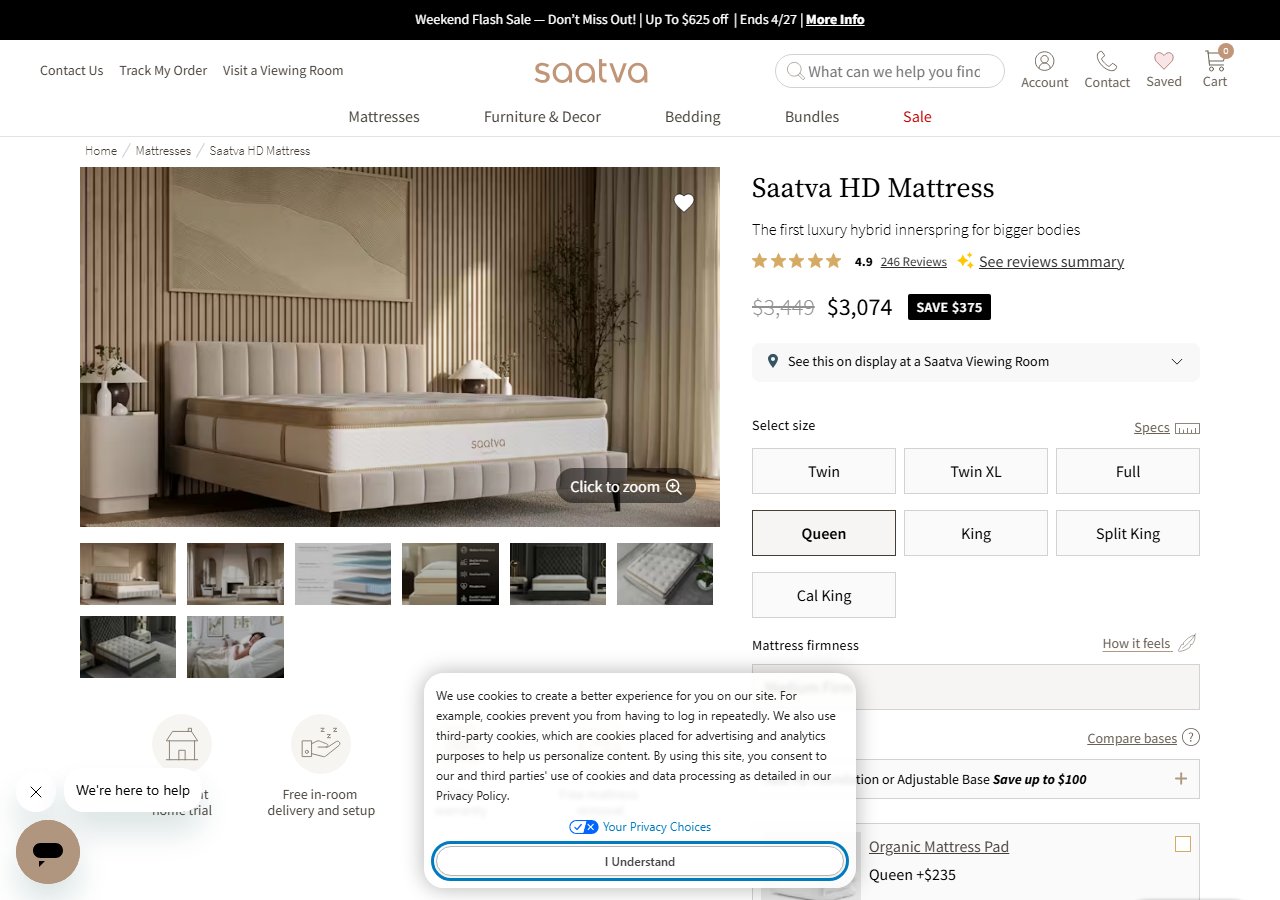
Saatva HD Mattress (Heavy-Duty)
$2,395-$3,995
See Price at Saatva →
Purple Hybrid Premier Mattress
$2,499-$4,799
See Price at Purple →The Data-Driven Bottom Line for Adults Over 60
The federal data tells a coherent story: arthritis affects one in four U.S. adults, chronic pain affects one in five, and more than a third of all Americans sleep below the CDC's recommended 7-hour threshold. For adults over 60, these statistics cluster — the same person managing hip arthritis, lumbar degeneration, and fragmented sleep is also the person facing the highest Medicare drug spending for pain management, the highest healthcare utilization for musculoskeletal conditions, and the greatest risk of disability from a condition that, in many cases, responds meaningfully to non-surgical, non-pharmacological interventions.
The hierarchy of interventions that evidence supports is not controversial: position first, movement second, surface quality third, clinical evaluation when red flags are present. A mattress is a legitimate tool in that hierarchy — not the first one to reach for, but not a trivial one either. For an older adult who has optimized sleep position, maintained daily walking, and is sleeping on a surface with visible sag or more than a decade of compression fatigue, evaluating a pressure-relieving, spine-neutral sleep surface is a clinically grounded decision with real cost-benefit logic behind it.
The options reviewed here — the Saatva Loom & Leaf for premium memory foam pressure relief, the Saatva HD for older adults with high body weight or career-related spinal loading history, and the Purple Hybrid Premier for refractory pressure-point pain at hip and shoulder — each address specific biomechanical profiles within the 60+ population. None of them is the right answer for every reader. All of them are better answers than a mattress selected on price alone for a population whose sleep quality has outsized consequences for inflammatory disease progression, fall risk, cognitive function, and healthcare cost.