The Sleep Problem Hiding Inside the Arthritis Numbers
Here is the stat that should reframe how you think about sleep after 60: approximately 25% of U.S. adults report doctor-diagnosed arthritis, and that prevalence climbs steeply with age. By the time most Americans reach their mid-sixties, arthritis is not a distant risk — it is a daily physical reality. What the CDC arthritis data does not fully surface is the sleep consequence that follows. Pain and sleep deprivation run a closed loop: inflamed joints interrupt sleep architecture, and fragmented sleep measurably lowers the body's pain tolerance threshold the next morning, meaning you wake up hurting more than you went to bed. Repeat that cycle for months or years and you have the lived experience that millions of older Americans describe to their physicians every week.
At the same time, CDC sleep data shows roughly 35% of all U.S. adults already sleep fewer than 7 hours per night — the threshold at which chronic disease risk begins to climb. For adults over 60, the underlying cause is frequently not a matter of willpower or screen time. It is pain. Hip pain from osteoarthritis wakes people when they roll onto one side. Lumbar stenosis flares when the spine is unloaded in a soft mattress that sags into a hammock shape. Shoulder impingement makes it impossible to maintain lateral sleep positions for more than 20 minutes. These are mechanical problems, and they demand mechanical solutions — but the right sequence matters enormously.
Why Joint Pain and Back Pain Get Worse at Night After 60
The biomechanical story of nighttime pain in older adults is more specific than most consumer health content acknowledges. During the day, your muscles — even fatigued ones — provide dynamic stabilization to arthritic joints. You are upright, moving, adjusting. The moment you lie down for 7 or 8 hours, that muscular support largely disappears. Your body weight now exerts sustained, static pressure on your hips, shoulders, lumbar spine, and SI joints. If the surface beneath you does not distribute that load evenly, the result is localized ischemia in soft tissue (pressure points), coupled with spinal misalignment that aggravates already-compromised facet joints and intervertebral discs.
Age compounds this in several specific ways. Cartilage in arthritic joints is thinner and less shock-absorbing than it was at 40. The intervertebral discs, which hydrate through a pumping mechanism driven by movement, lose fluid content faster in a completely static position. Reduced muscle mass — sarcopenia affects roughly 10-30% of adults over 60, according to NIH estimates — means there is less protective tissue cushioning bony prominences at the hip and shoulder. And the restorative slow-wave sleep that the body uses for tissue repair becomes harder to reach and maintain as we age, making any pain-driven arousal more disruptive than it would have been decades earlier.
AHRQ HCUP data confirms that back pain is one of the most expensive conditions in U.S. healthcare by total inpatient and outpatient cost — a figure that reflects how many older Americans eventually exhaust conservative options and reach for higher-cost interventions. AHRQ MEPS data reinforces this: adults with chronic back conditions carry substantially higher average annual personal healthcare expenditures than adults without such conditions. Meanwhile, CMS drug spending data identifies opioid and non-opioid pain medication spending among the most expensive Medicare drug categories — a direct reflection of how many older Americans are managing chronic musculoskeletal pain with pharmacology because the underlying biomechanical contributors have not been addressed.
This is not a story about mattresses yet. It is a story about what happens to joints and spinal structures over a lifetime of load, and what the body needs during its primary recovery window — sleep — to slow that deterioration.
The Occupational History You Carry Into Retirement
For adults now in their 60s and 70s, many of whom worked in physically demanding occupations for decades, the cumulative spinal load is substantial. The back is the most common body part injured across all U.S. occupations with days away from work, per BLS Musculoskeletal Disorders by Occupation tracking. The NIOSH Lifting Equation documents that manual material-handling tasks across warehousing, construction, and healthcare routinely exceed safe spinal loading limits — limits that were exceeded shift after shift, year after year, by workers who are now retired and wondering why their lower back hurts every morning.
SSA Disability Insurance data identifies musculoskeletal disorders as the largest single category of new disability claims annually, which tells you something important: for a meaningful share of the population, chronic musculoskeletal pain is not just uncomfortable — it is functionally disabling. For older adults who have not yet reached that threshold but feel themselves trending in that direction, the nightly recovery environment is one of the few remaining modifiable variables.
CDC NCHS Data Brief 390 reports that approximately 20% of U.S. adults experience chronic pain, with lower back as the most common pain location. For adults over 60 with a history of physical work, that number is almost certainly higher. The question is what to do about it — and in what order.
Try These First — Free and Low-Cost Interventions Before You Spend a Dollar on Equipment
The cheapest intervention is the one that does not require buying anything. The federal evidence base for non-product interventions in chronic back pain and arthritis-related sleep disruption is strong, and these approaches should be the first line of action for every reader — not because products do not help, but because the mechanism of your pain determines whether a product addresses it or merely masks it.
Sleep position is the biggest free variable you control every night. NIH guidance on back pain from the National Institute of Arthritis and Musculoskeletal and Skin Diseases recommends side-sleeping with a pillow between the knees or back-sleeping with a pillow under the knees to maintain spinal neutrality. Stomach-sleeping torques the lumbar spine and cervical spine simultaneously — it is the worst mechanical position for almost every chronic pain condition in older adults, full stop. If you currently sleep on your stomach, changing that habit alone may reduce morning stiffness more than upgrading your mattress.
Daily walking is one of the most federally-supported interventions for chronic low back pain. NIH NCCIH's in-depth evidence review on low-back pain finds that walking 30 minutes most days reduces chronic low back pain as effectively as most non-drug clinical treatments. The mechanism is real: walking pumps intervertebral discs, maintains hip extensor strength that supports lumbar posture during sleep, and keeps the synovial fluid in arthritic joints circulating. A new mattress is a passive tool. Walking is an active one, and the evidence for it is robust.
Reassess your current mattress before you replace it. CDC sleep hygiene guidance supports replacing a mattress when it shows visible sag, when you wake stiffer than you went to bed, or when it is older than 7 to 10 years. If your mattress meets one of those criteria, replacement is rational. If it does not, focus on position, movement, and clinical evaluation before adding cost.
Lifting and bending mechanics matter even in retirement. OSHA's ergonomics guidance recommends hinging at the hips rather than the lumbar spine, keeping loads close to the body, and avoiding twisting under load. Older adults doing yard work, carrying groceries, or loading a car trunk are performing manual material-handling tasks every day. Acute flares triggered by poor mechanics will overwhelm whatever support your mattress provides.
Some readers will have already tried the free interventions — changed sleep positions, started walking, replaced an obviously worn mattress — and are still waking in pain. For that group, the surface they sleep on is a legitimate variable worth addressing with precision. The question shifts from whether to upgrade equipment to which engineering characteristics match the specific joint and spinal demands of an older adult body. That is where the products below enter the picture.
When to See a Clinician Before You Buy Anything
Not every nighttime pain is a mattress problem, and this point cannot be stated clearly enough. NIH National Institute of Neurological Disorders and Stroke guidance on back pain identifies several presentations that require prompt clinical evaluation, not equipment purchases. These include back pain that radiates below the knee (possible nerve root compression or spinal stenosis requiring imaging), pain following trauma, pain accompanied by leg weakness, any bowel or bladder changes, and pain with fever. These are red flags that indicate structural or systemic pathology, not surface firmness issues.
For older adults specifically, new or escalating back or joint pain without a clear mechanical cause also warrants evaluation, because osteoporotic fractures can present as back pain that worsens at night, and systemic inflammatory conditions like rheumatoid arthritis have different management pathways than mechanical osteoarthritis. If your pain is worsening despite conservative measures, or if it wakes you from deep sleep in the second half of the night without being position-dependent, see your physician before investing in sleep equipment. The right mattress for spinal stenosis is a different product than the right mattress for hip osteoarthritis, and a clinician can help you identify which mechanism is dominant.
Where Surface Engineering Makes a Measurable Difference
For older adults who have addressed the free variables and confirmed with a clinician that their pain is mechanical in nature — arthritis-driven pressure point discomfort, mild-to-moderate lumbar pain from disc degeneration, hip pain from bursitis or osteoarthritis — the sleep surface becomes a genuinely meaningful variable. The relevant engineering characteristics are pressure redistribution (how well the surface off-loads bony prominences at the hip and shoulder), zoned support (whether the mattress provides differential firmness that supports the lumbar region more firmly while cushioning the shoulder and hip), thermal neutrality (memory foam traps heat, which disrupts sleep in older adults who already experience thermoregulatory changes), and edge support (relevant for adults with mobility limitations who need stable ingress and egress).
The Saatva Loom & Leaf Memory Foam Mattress is the first product worth examining for this population. Priced between $1,695 and $3,295 depending on size and firmness, it is built around gel-infused memory foam with a 5-pound density that provides the deep-contour pressure relief arthritic hips and shoulders need, while its organic cotton cover and phase-change material address the heat-retention problem that makes traditional memory foam problematic for older adults. Saatva offers it in two firmness options — Relaxed Firm and Firm — and for most adults over 60 with arthritis and moderate back pain, Relaxed Firm will deliver the pressure relief without the spinal instability of an excessively soft surface. The spinal zone technology built into the Loom & Leaf places firmer support specifically under the lumbar region, which matters for adults with disc degeneration.
For older adults who are larger-framed or who spent careers in physically demanding occupations and carry higher body weight as a result, the Saatva HD Mattress ($2,395–$3,995) deserves specific attention. Engineered for bodies up to 500 pounds, the Saatva HD uses a dual coil system — a micro-coil comfort layer over a heavy-gauge tempered steel innerspring — that provides the progressive resistance larger bodies need to prevent the hammocking that standard mattresses develop over 12–18 months. For adults over 60 with significant joint load history and higher BMI, this is not a luxury consideration; it is a structural one. A mattress that sags under body weight creates the exact spinal misalignment that worsens both lumbar and hip pain regardless of foam quality.
The third product in this evaluation takes a fundamentally different engineering approach. The Purple Hybrid Premier Mattress ($2,499–$4,799) uses Purple's GelFlex Grid — a hyper-elastic polymer grid that neither compresses uniformly like foam nor pushes back uniformly like a coil. The grid collapses under pressure points (hips and shoulders) while remaining supportive under lower-pressure zones (lumbar, thighs), creating a pressure map that is genuinely different from foam-based surfaces. For older adults with hip osteoarthritis who find that every foam mattress creates morning hip soreness regardless of density, the grid architecture is worth understanding. It also runs significantly cooler than any memory foam product, which matters for sleep maintenance in older adults.
Mattresses Engineered for Joint Pain and Back Pain in Adults Over 60
These three mattresses were selected for their pressure-redistribution engineering, zoned lumbar support, and thermal properties — characteristics that directly address the joint and spinal demands documented in federal arthritis and sleep data for older adults.

Saatva Loom & Leaf Memory Foam Mattress
$1,695-$3,295
See Price at Saatva →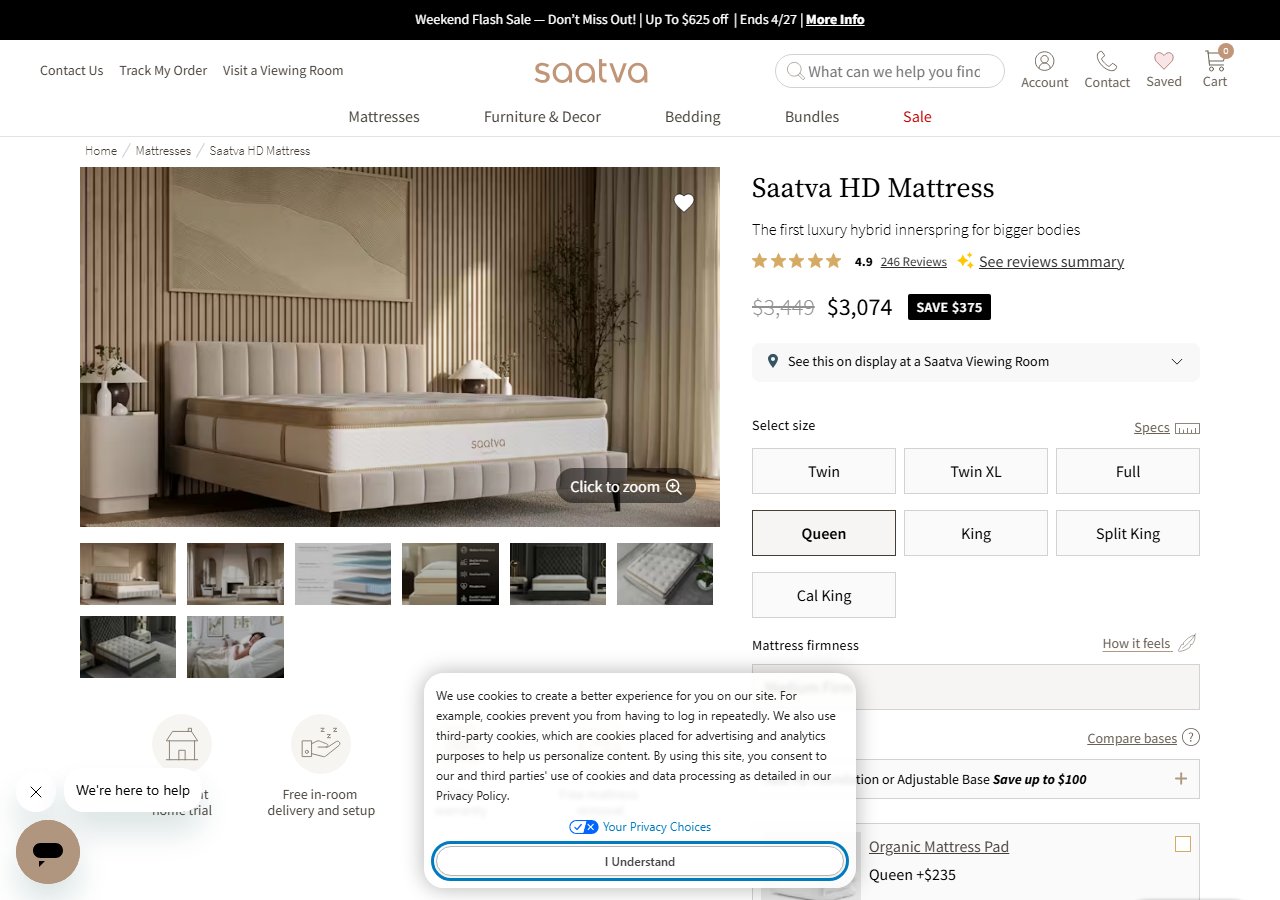
Saatva HD Mattress (Heavy-Duty)
$2,395-$3,995
See Price at Saatva →
Purple Hybrid Premier Mattress
$2,499-$4,799
See Price at Purple →Putting the Evidence Hierarchy Back Together
The federal data tells a consistent story: chronic pain and arthritis are prevalent conditions in the older adult population, they carry enormous personal healthcare costs, and their consequences for sleep are severe and self-reinforcing. BLS workers' compensation data shows industries with high MSD incidence carry insurance rates 3–5x higher than low-MSD industries — a proxy measure of just how physically costly musculoskeletal disease becomes over a working lifetime. By the time that lifetime ends and retirement begins, many adults over 60 are carrying a structural load that their sleep environment was not designed for.
The right response to that data is not to immediately purchase an expensive mattress. It is to work through the evidence hierarchy: adjust sleep position, increase daily walking, evaluate whether your current mattress has visible wear or age-related failure, confirm with a clinician that your pain does not have a red-flag etiology, and then — if all of those steps have been taken — match the engineering of your sleep surface to the specific mechanical demands of your joints and spine.
For older adults with arthritis and back pain, the Saatva Loom & Leaf addresses the pressure-relief and spinal-zone support combination most effectively in the foam category. The Saatva HD addresses the structural demands of larger-framed bodies that standard mattresses were not built to accommodate. The Purple Hybrid Premier offers a grid-based alternative for adults who have found foam universally unsatisfying for hip pressure relief. None of these products is a substitute for movement, position optimization, or clinical care — but for the older adult who has done the work and is still waking in pain, the surface they sleep on for seven or eight hours a night is one of the most mechanically consequential variables left to address.